Michael Scherer has narrated 6 audiobooks on Listento.it by 8 authors, with an average listener rating of 4★ across 3 ratings. The most-rated is Prabhupada: Your Ever Well-Wisher.

Prabhupada: Your Ever Well-Wisher
Summary
Prabhupada: Your Ever Well-Wisher tells the inspiring story of a remarkable man and his remarkable achievement. A. C. Bhaktivedanta Swami Prabhupada - philosopher, scholar, religious leader, author - founded the Hare Krishna movement in 1966, effectively transplanting India's spiritual culture of bhakti yoga from India to America. In his seventies and with almost superhuman drive, Prabhupada took his Hare Krishna movement and its iconic chant around the world and then back to India, establishing centers and ashrams wherever he went and writing over sixty books. Drawing on Prabhupada's own words and on numerous interviews with those who knew him both in India and the West, Prabhupada emerges as a vital and earnest ambassador of spiritual India whose teachings continue to influence spiritual culture today.
©1983, 2003 The Bhaktivedanta Book Trust International, Inc. (P)2014 The Bhaktivedanta Book Trust International, Inc.

A Contest for Supremacy
Summary
Despite its impressive size and population, economic vitality, and drive to upgrade its military, China remains a vulnerable nation surrounded by powerful rivals and potential foes. Understanding China's foreign policy means fully appreciating these geostrategic challenges, which persist even as the country gains increasing influence over its neighbors. Andrew J. Nathan and Andrew Scobell analyze China's security concerns on four fronts: at home, with its immediate neighbors, in surrounding regional systems, and in the world beyond Asia. By illuminating the issues driving Chinese policy, they offer a new perspective on the country's rise and a strategy for balancing Chinese and American interests in Asia. Though rooted in the present, Nathan and Scobell's study makes ample use of the past, reaching back into history to illuminate the people and institutions shaping Chinese strategy today. They also examine Chinese views of the United States; explain why China is so concerned about Japan; and uncover China's interests in such problematic countries as North Korea, Iran, and the Sudan. The authors probe recent troubles in Tibet and Xinjiang and explore their links to forces beyond China's borders. They consider the tactics deployed by mainland China and Taiwan, as Taiwan seeks to maintain autonomy in the face of Chinese advances toward unification. They evaluate the strengths and weaknesses of China's three main power resources - economic power, military power, and soft power. The authors conclude with recommendations for the United States as it seeks to manage China's rise. Chinese policymakers understand that their nation's prosperity, stability, and security depend on cooperation with the United States. If handled wisely, the authors believe, relations between the two countries can produce mutually beneficial outcomes for both Asia and the world.
©2011 Aaron L. Friedberg (P)2013 Audible, Inc.

Year of Meteors
Summary
In early 1860, pundits across America confidently predicted the election of Illinois senator Stephen A. Douglas in the coming presidential race. Douglas, after all, led the only party that bridged North and South. But the Democrats would split over the issue of slavery, leading Southerners in the party to run their own presidential slate. This opened the door for the upstart Republicans, exclusively Northern, to steal the Oval Office. Dark horse Abraham Lincoln, not the first choice even of his own party, won the presidency with a record-low 39.8 percent of the popular vote. Acclaimed scholar Douglas R. Egerton chronicles the contest with a historian's keen insight and a veteran political reporter's eye for detail. Vividly, Egerton re-creates the cascade of unforeseen events that confounded political bosses, set North and South on the road to disunion, and put not Stephen Douglas, but his greatest rival, in the White House. We see Lincoln and his team outmaneuvering more prominent Republicans, like New York's grandiose William Seward, while Democratic conventions collapse in confusion. And we see the gifted, flawed Douglas marking his finest hour in defeat, as he strives, and fails, to save the Union. Year of Meteors delivers a teeming cast of characters, minor and major, and a breakneck narrative of this most momentous year in American history.
©2010 Douglas R. Ederton (P)2013 Audible, Inc.

A Brief History of the Soul
Summary
The concept of the soul is accepted in many religious traditions and widely used in fictional worlds, and yet the idea that we are anything more than physio-chemical organisms seems out of step with contemporary secular thinking. Scratch the surface of western philosophy, however, and you find a history filled with arguments in favour of the idea that we are embodied souls. This book provides a clear and concise history of the soul, from Plato to cutting-edge contemporary work in philosophy of mind. Taking in the arguments of influential thinkers, such as Aristotle, Aquinas, Descartes, and Hume, Goetz and Taliaferro tackle keys issues, such as the problem of mind-body interaction, the causal closure of the physical world, and the philosophical implications of the brain sciences for the soul's existence. A Brief History of the Soul brings together historical and contemporary scholarship to examine one of the essential questions of our existence. Stewart Goetz is Ross Frederick Wicks Distinguished Professor in Philosophy and Religion at Ursinus College. He has written extensively on the philosophy of mind and action theory and his books include Freedom, Teleology, and Evil (2008), Naturalism (with Charles Taliaferro, 2008), and The Soul Hypothesis (edited with Mark Baker, 2011). Charles Taliaferro is Professor of Philosophy at St. Olaf College. He is on the editorial board of the American Philosophical Quarterly, Religious Studies, Sophia, and Philosophy Compass. His books include Consciousness and the Mind of God (1994, 2004), Naturalism (with Stewart Goetz, 2008), A Companion to Philosophy of Religion, 2nd edition (edited with Paul Draper, Wiley-Blackwell, 2010), and The Image in Mind (with Jil Evans, 2010).
©2013 Stewart Goetz, Charles Taliaferro (P)2013 Audible Ltd

Nagarjuna's Tree of Wisdom
Summary
The Tree of Wisdom is about the love you find and how you share it with others. It's about how you're going to spend your time, about the give-and-take, and how we treat each other. It's all about the friends you make. It's all about the choices you make. It's on the importance of forgiving and being forgiven. To live a life that is pure in faith and heart. To strive to stay on the path. To find the way of the masters that have gone before us. To recognize the path that they forge for us and the wisdom to see it. All of our lives we have pretended and hidden our feelings from others. We have tried hard to believe that there is this distance between us. In this misperception, we thought we could find comfort in isolation. But this comfort is fleeting when the soul speaks up in a longing for something more meaningful. It's about how to stop pretending and start being true to yourself. It's about stopping to make excuses and taking responsibility for your actions. All of our life has been a struggle in trying to be free but the reality is the life you have created has been all about you. This is because you have allowed your ego to rule over you. In this realization comes a sense of freedom, a release from your self-imposed prison. When you have the key, you can unlock the doors of this dungeon and step into the light of the divine love of the way. Once in the light, you'll see that we all are brothers and sisters, all part of something bigger than we can imagine. In this oneness, there is a liberation of knowing that life and death are only illusions. Yes, the Tree of Wisdom contains this timeless knowledge for those who quest for it, that have a thirst for the cool waters of the fountain of life. The Tree of Wisdom by Nagarjuna is a treatise on morals and ethics written over 2,000 years ago. This commentary on moral living is very similar to other text such as the Tao Te Ching by Lao Tzu, the Hsin Hsin Ming by Seng Ts'an, the Enchiridion by Epictetus, and Meditations by Marcus Aurelius. It's remarkable that this is only the second English translation of this ancient text from this incredible Indian philosopher. The first translation into English was done by W.L. Campbell in 1918. At the time of Campbell's translation, there was so already much lost to history in the allegories that the meaning couldn't be extrapolated for all the verses. This version has been interpreted into a more modern new age style yet it still possess the essence of the message that Nagarjuna implied. I prefer to use the word interpretation over the word translation as this is more of a rendering constructed to clarify the meaning in such a way that it is easy to grasp the concepts. However, there are a few verses that have been left in the original Campbell translation as their relevance hasn't changed. The primary difference between the Tree of Wisdom and the Tao Te Ching is the Tree of Wisdom takes a more "matter of fact" practical approach to life where the Tao Te Ching is more spiritual and esoteric. Both texts have the same basic underlying principles, they are just different paths to the same goal. The text itself consists of 260 verses containing just over 8,000 words. In the tradition of Buddhism, there are a few verses that will leave you confused. This is natural as in the contemplation of the verse, the understanding will become clear. One major difference in this translation and Campbell's is the use of the word "way". Where the word "way" is used, it is to imply the way of the Tao Te Ching. This is to serve in helping give a clearer understanding the principles that the text is conveying. I encourage those who are not familiar with the Tao Te Ching to read it as the two texts complement each other.
©2012 Dennis Waller (P)2013 Dennis Waller
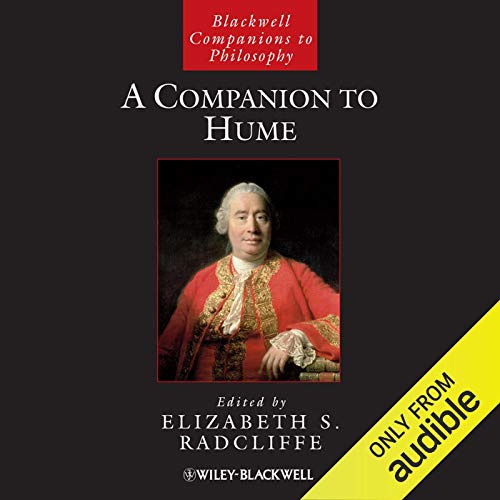
A Companion to Hume
Summary
David Hume’s revolutionary philosophies took an empirical approach to the study of human nature. Controversial in his time, he was accused of everything from atheism to moral corruption; he has since been recognized as one of the foremost thinkers of the late modern period, influencing the thought of nearly every philosopher in his wake. The arguments presented in his writings have survived three centuries of varying perspectives, and have had a lasting influence on the philosophy of mind, knowledge, religion, action, morality, economics, and politics. A Companion to Hume is the ideal resource for the study of one of history’s most remarkable thinkers, demonstrating the range of Hume’s work and illuminating the ongoing debates that they have generated. Comprised of 29 expertly commissioned essays addressing such expansive topics of knowledge, passion, morality, religion, economics, and politics, this collection examines the paradoxes of Hume’s thought and his legacy, covering the methods, themes, and consequences of his contributions to philosophy. Elizabeth S. Radcliffe is Professor of Philosophy at The College of William and Mary. She has published on the British Moralists and on Hume’s metaethics and motivational psychology. She was co–editor of the journal Hume Studies , with Kenneth Winkler, from 2000 until 2005. She is currently working on issues surrounding the contemporary Humean theory of motivation and its connection to Hume.
©2013 Elizabeth S. Radcliffe (P)2013 Audible Ltd