Christina Croft has 6 audiobooks on Listento.it, narrated by 3 narrators. The most-rated is Queen Victoria's Granddaughters: 1860-1918.

Shattered Crowns: The Scapegoats
Summary
On 28th June 1914, Archduke Franz Ferdinand and his morganatic wife, Sophie Chotek, were shot dead in broad daylight on a crowded street in Sarajevo. The murder of a relatively unknown archduke in a remote Bosnian city might well have been quickly forgotten were it not for the fact that this seemingly minor event ignited a spark that would explode into one of the bloodiest conflicts in history. Within four years, over sixteen million people from one hundred countries would lie dead on the battlefields of the First World War.
©2011 Christina Croft (P)2017 Christina Croft

Shattered Crowns: The Sacrifice
Summary
In the summer of 1914, the capitals of Europe erupt in a patriotic frenzy as peoples on all sides, roused by the press, rejoice at the outbreak of the "war to end wars". The rejoicing soon turns to disillusionment as the full horrors of the bloodiest conflict the world has ever seen become apparent. For the Emperors of Germany, Austria-Hungary and Russia comes the growing awareness that this war, which they sought desperately to avoid, is not being fought for territory or honor, but rather to destroy the old world order and to replace their autocracies with secular ideologies and international economic control. Amid the intrigue and deception, Kaiser Wilhelm, Tsar Nicholas, Emperor Franz Josef, Archduke Karl, and Queen Marie of Roumania not only face the horrific sacrifice of their people, but are also confronted by their own personal and family tragedies. The Sacrifice is the second novel in the Shattered Crowns trilogy, following the royalties of Europe from 1913 to the Treaty of Versailles. The Sacrifice covers the period from the outbreak of war to the Russian revolution (1914-1917) and is based on actual events.
©2012 Christina Croft (P)2017 Christina Croft

Shattered Crowns: The Betrayal
Summary
Spring 1917 - the war has been raging for over two and a half years, and neither the Central Powers (Germany, Austria-Hungary, and Turkey) nor the Entente (Britain, France, Russia, and Italy) are any closer to a decisive victory. In Russia, the Revolution and enforced abdication of the Tsar has left the country in the shaky hands of the Provisional Government, but as the Bolsheviks begin to seize power, it is clear that behind the scenes, something rather sinister is occurring. Both Kaiser Wilhelm of Germany, and Karl, the new Emperor of Austria-Hungary, are eager to pursue peace, but the United States’ entry into the war thwarts their efforts and leaves them convinced that the true aim of the conflict is the destruction of their monarchies. Based on actual events, The Betrayal is the third book of the Shattered Crowns trilogy which follows the tragic story of the royalties who sought peace throughout the bloodiest conflict of the 20th century.
©2013 Christina Croft (P)2018 Christina Croft

The Innocence of Kaiser Wilhelm II
Summary
Almost a century after the signing of the Treaty of Versailles, Kaiser Wilhelm II is still viewed as either a warmonger or a madman, as the hundred-year-old propaganda posters remain fixed in the general consciousness. Was he, though, truly responsible for the catastrophe of the First World War, or was he in fact a convenient scapegoat, blamed for a conflict which he desperately tried to avoid?
©2015 Christina Croft (P)2017 Christina Croft

Queen Victoria's Cousins
Summary
Throughout her lonely and isolated childhood, with only her dogs and dolls for company, Queen Victoria relished the visits of her cousins, many of whom she came to regard as surrogate brothers and sisters. From the newly created Empire of Mexico, to the largely undiscovered African Congo, their influence crossed continents; and their lives, spanning more than a century, were interwoven with some of the most significant events of the age. They experienced wars, revolutions, personal tragedies, and national disasters, and, as in any extended family, their characters were as varied as their experiences. Among them were princes, potentates and dukes; dutiful wives and desperate daughters; an empress; three kings; the consorts of queens; and the spouses of theater performers and a circus artiste. With several, Queen Victoria maintained a lifelong correspondence, while others were gradually distanced from her. All, however, contributed something to her life’s experience, and many repaid her devotion with love.
©2016 Christina Croft (P)2021 Christina Croft
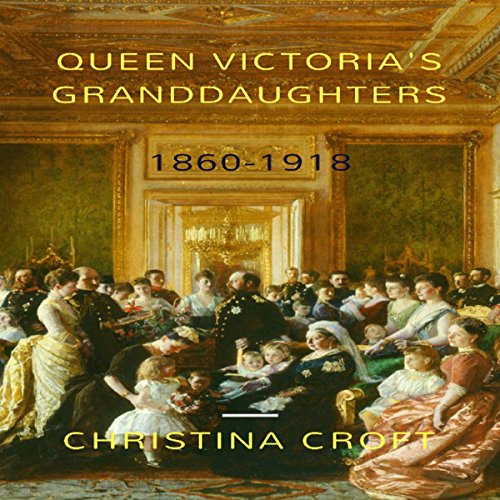
Queen Victoria's Granddaughters: 1860-1918
Summary
On 6 July 1868, when told of the birth of her seventh granddaughter, Queen Victoria remarked that the news was "a very uninteresting thing for it seems to me to go on like the rabbits in Windsor Park". Her apathy was understandable - this was her 14th grandchild, and, though she had given birth to nine children, she had never been fond of babies, viewing them as "frog-like and rather disgusting...particularly when undressed". The early years of her marriage had, she claimed, been ruined by frequent pregnancies, and large families were unnecessary for wealthy people since the children would grow up with nothing worthwhile to do. Nevertheless, her initial reaction to the birth of Princess Victoria of Wales belied the genuine concern that Queen Victoria felt for each of her 22 granddaughters. "As a rule," she wrote, "I like girls best," and she devoted a great deal of time to their well-being and happiness, showering them with affection she had seldom shown her own children. By 1914, through a series of dynastic marriages, the queen's granddaughters included the empress of Russia; the queens of Spain, Greece, and Norway' and the crown princesses of Rumania and Sweden. As their brothers and cousins occupied the thrones of Germany, Britain, and Denmark, Prince Albert's dream of a peaceful Europe created through bonds of kinship seemed a real possibility. Yet in little more than a decade after Queen Victoria's death, the prince consort's dream would lie shattered in the carnage of the First World War. Royal cousins and even siblings would find themselves on opposing sides; two of them would die horrifically at the hands of revolutionaries, and several others would be ousted from their thrones. They had lived through the halcyon days of the European monarchies, but their lives, like the lives of millions of their people, would be changed forever by the catastrophe.
©2013 Christina Croft (P)2017 Christina Croft