David Cannadine has 4 audiobooks on Listento.it, narrated by 3 narrators, with an average listener rating of 3.5★ across 2 ratings. The most-rated is Victorious Century.

Victorious Century
Summary
To live in 19th-century Britain was to experience an astonishing series of changes, of a kind for which there was simply no precedent in the human experience. There were revolutions in transport, communication and work; cities grew vast; and scientific ideas made the intellectual landscape unrecognisable. This was an exhilarating time but also a horrifying one. In his dazzling new book, David Cannadine has created a bold, fascinating new interpretation of the British 19th century in all its energy and dynamism, darkness and vice. This was a country which saw itself at the summit of the world. And yet it was a society also convulsed by doubt, fear and introspection. Repeatedly, politicians and writers felt themselves to be staring into the abyss - and what is seen sometimes seen as an era of irritating self-belief was in practice obsessed by a sense of its own fragility, whether as a great power or as a moral force. Victorious Century is an extraordinarily enjoyable book - its author catches the relish, humour and theatricality of the age but also the dilemmas of a kind with which we remain familiar today. It reframes a time at once strangely familiar and yet wholly unlike our own.
©2017 David Cannadine (P)2017 Audible, Ltd

Mellon
Summary
A landmark work from one of the preeminent historians of our time: the first published biography of Andrew W. Mellon, the American colossus who bestrode the worlds of industry, government, and philanthropy, leaving his transformative stamp on each. Following a boyhood in 19th-century Pittsburgh, during which he learned from his Scotch-Irish immigrant father the lessons of self-sufficiency and wealth accumulation, Andrew Mellon overcame painful shyness to become one of America's greatest financiers. Across an unusually diverse range of enterprises, from banking to oil to aluminum manufacture, he built a legendary personal fortune, tracking America's course to global economic supremacy. The Mellon way was to hold companies closely, including such iconic enterprises as Alcoa and Gulf Oil. Personal happiness eluded Mellon, however: his loveless marriage at 45 to a British girl less than half his age ended in a scandalous divorce, and for all his best efforts, he would remain a stranger to his children. He had been bred to do one thing, and that he did with brilliant and innovative entrepreneurship. Collecting art, a pursuit inspired by his close friend Henry Clay Frick, would become his only nonprofessional gratification. And by the end of his life, Mellon's "pictures" would constitute one of the world's foremost private collections. The issues Andrew W. Mellon confronted, concerning government, business, influence, the individual and the public good, remain at the center of our national discourse to this day. Indeed, the positions he steadfastly held reemerged relatively intact with the Reagan revolution, having lain dormant since the New Deal. David Cannadine's magisterial biography brings to life a towering, controversial figure, casting new light on our history and the evolution of our public values.
©2006 David Cannadine (P)2006 Books on Tape
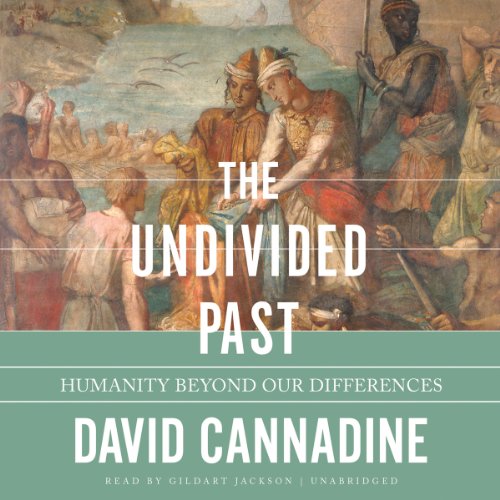
The Undivided Past
Summary
From one of our most acclaimed historians comes an account of human solidarity throughout the ages, provocatively arguing against the received wisdom that history is best understood as a chronicle of groups in conflict. Investigating the six most pervasive categories of human difference - religion, nation, class, gender, race, and civilization - Cannadine asks how determinative each of them has really been over the course of history. Without denying their power to motivate populations dramatically at particular moments, he reveals that in the long term none has proven remotely as divisive as the occasional absolutist cries of "us versus them" would suggest, whether Christian versus Muslim during the Crusades (and now), landed gentry versus peasantry during the Bolshevik Revolution, or Jews versus "Aryan race" in Nazi Germany. For most of recorded time, these same "unbridgeable" differences were experienced as just one identity among others; whatever most chroniclers, self-serving mythmakers, and demagogues would have us believe, history needs to be reimagined to include the countless fruitful interactions across these lines, which are usually left out of the picture.
©2013 David Cannadine (P)2013 Blackstone Audio, Inc.

Mellon
Summary
Here is a landmark work from one of the preeminent historians of our time: the first published biography of Andrew W. Mellon, the American colossus who bestrode the worlds of industry, government, and philanthropy, leaving his transformative stamp on each. Following a boyhood in 19th-century Pittsburgh, during which he learned from his Scotch-Irish immigrant father the lessons of self-sufficiency and wealth accumulation, Andrew Mellon overcame painful shyness to become one of America's greatest financiers. Across an unusually diverse range of enterprises, from banking to oil to aluminum manufacture, he built a legendary personal fortune, tracking America's course to global economic supremacy. The Mellon way was to hold companies closely, including such iconic enterprises as Alcoa and Gulf Oil. Personal happiness eluded Mellon, however: his loveless marriage at 45 to a British girl less than half his age ended in a scandalous divorce, and for all his best efforts, he would remain a stranger to his children. He had been bred to do one thing, and that he did with brilliant and innovative entrepreneurship. Collecting art, a pursuit inspired by his close friend Henry Clay Frick, would become his only nonprofessional gratification. And by the end of his life, Mellon's "pictures" would constitute one of the world's foremost private collections. The issues Andrew W. Mellon confronted, concerning government, business, influence, the individual and the public good, remain at the center of our national discourse to this day. Indeed, the positions he steadfastly held reemerged relatively intact with the Reagan revolution, having lain dormant since the New Deal. David Cannadine's magisterial biography brings to life a towering, controversial figure, casting new light on our history and the evolution of our public values.
©2006 David Cannadine (P)2006 Random House, Inc.