Edward O. Wilson has 9 audiobooks on Listento.it, narrated by 2 narrators, with an average listener rating of 4.2★ across 37 ratings. The most-rated is Letters to a Young Scientist.
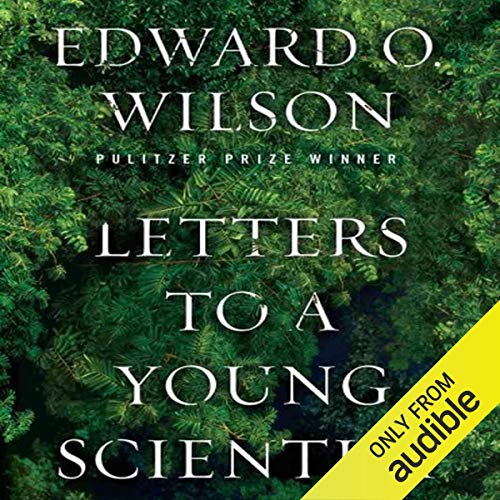
Letters to a Young Scientist
Summary
Pulitzer Prize–winning biologist Edward O. Wilson imparts the wisdom of his storied career to the next generation. Edward O. Wilson has distilled sixty years of teaching into a book for students, young and old. Reflecting on his coming-of-age in the South as a Boy Scout and a lover of ants and butterflies, Wilson threads these twenty-one letters, each richly illustrated, with autobiographical anecdotes that illuminate his career - both his successes and his failures - and his motivations for becoming a biologist. At a time in human history when our survival is more than ever linked to our understanding of science, Wilson insists that success in the sciences does not depend on mathematical skill, but rather a passion for finding a problem and solving it. From the collapse of stars to the exploration of rain forests and the oceans’ depths, Wilson instills a love of the innate creativity of science and a respect for the human being’s modest place in the planet’s ecosystem in his readers.
©2013 Edward O. Wilson (P)2013 Audible, Inc.

On Human Nature: Revised Edition
Summary
This revised edition of Human Nature begins a new phase in the most important intellectual controversy of this generation: Is human behavior controlled by the species' biological heritage? Does this heritage limit human destiny? With characteristic pungency and simplicity of style, the author of Sociobiology challenges old prejudices and current misconceptions about the nature-nurture debate. He shows how evolution has left its traces on the most distinctively human activities, how patterns of generosity, self-sacrifice, and worship, as well as sexuality and aggression, reveal their deep roots in the life histories of primate bands that hunted big game in the last Ice Age. His goal is nothing less than the completion of the Darwinian revolution by bringing biological thought into the center of the social sciences and the humanities. Wilson presents a philosophy that cuts across the usual categories of conservative, liberal, or radical thought. In systematically applying the modern theory of natural selection to human society, he arrives at conclusions far removed from the social Darwinist legacy of the last century. Sociobiological theory, he explains, is compatible with a broadly humane and egalitarian outlook. Human diversity is to be treasured, not merely tolerated, he argues. Discrimination against ethnic groups, homosexuals, and women is based on a complete misunderstanding of biological fact. But biological facts can never take the place of ethical choices. Once we understand our human nature, we must choose how "human" in the fullest, biological sense, we wish to remain. We cannot make this choice with the aid of external guides or absolute ethical principles, because our very concept of right and wrong is wholly rooted in our own biological past. This paradox is fundamental to the evolution of consciousness in any species; there is no formula for escaping it. The book is published by Harvard University Press.
©2004 President and Fellows of Harvard College (P)2010 Redwood Audiobooks

Consilience
Summary
One of our greatest living scientists - and the winner of two Pulitzer Prizes for On Human Nature and The Ants - gives us a work of visionary importance that may be the crowning achievement of his career. In Consilience (a word that originally meant "jumping together"), Edward O. Wilson renews the Enlightenment's search for a unified theory of knowledge in disciplines that range from physics to biology, the social sciences and the humanities. Using the natural sciences as his model, Wilson forges dramatic links between fields. He explores the chemistry of the mind and the genetic bases of culture. He postulates the biological principles underlying works of art from cave-drawings to Lolita. Presenting the latest findings in prose of wonderful clarity and oratorical eloquence, and synthesizing it into a dazzling whole, Consilience is science in the path-clearing traditions of Newton, Einstein, and Richard Feynman.
©1999 Edward O. Wilson (P)2018 Random House Audio

The Social Conquest of Earth
Summary
Edward O. Wilson is one of the world’s preeminent biologists, a Pulitzer Prize winner, and the author of more than 25 books. The defining work in a remarkable career, The Social Conquest of Earth boldly addresses age-old questions (Where did we come from? What are we? Where are we going?) while delving into the biological sources of morality, religion, and the creative arts.
©2012 Edward O. Wilson (P)2012 Recorded Books. LLC

Tales from the Ant World
Summary
Edward O. Wilson recalls his lifetime with ants - from his first boyhood encounters in the woods of Alabama to perilous journeys into the Brazilian rainforest. "Ants are the most warlike of all animals, with colony pitted against colony.... Their clashes dwarf Waterloo and Gettysburg", writes Edward O. Wilson in his most finely observed work in decades. In a myrmecological tour to such far-flung destinations as Mozambique and New Guinea, the Gulf of Mexico's Dauphin Island and even his parents' overgrown yard back in Alabama, Wilson thrillingly evokes his nine-decade-long scientific obsession with more than 15,000 ant species. Wryly observing that "males are little more than flying sperm missiles" or that ants send their "little old ladies into battle", Wilson eloquently relays his brushes with fire, army, and leafcutter ants, as well as more exotic species: the Matabele, Africa's fiercest warrior ants; Costa Rica's Basiceros, the slowest ants in the world; and New Caledonia's Myrmecia apicalis, the most endangered of them all. A personal account by one of our greatest scientists, Tales from the Ant World is an indispensable volume for any lover of the natural world.
©2020 Edward O. WIlson (P)2020 Recorded Books

Half-Earth
Summary
Refusing to accept the mass extinction of species as an inevitability, "the world's greatest naturalist" (Jeffrey Sachs) proposes a plan to save Earth's imperiled biosphere. Half-Earth resoundingly concludes the best-selling trilogy begun by The Social Conquest of Earth and The Meaning of Human Existence, a National Book Award finalist. History is not a prerogative of the human species, Edward O. Wilson declares in Half-Earth, a brave work that becomes a radical redefinition of human history. Demonstrating that we blindly ignore the histories of millions of other species, Wilson warns of a point of no return that is imminent. Angrily challenging the fashionable theories of anthropocenes, who contend that humans can survive alone in an Edenic bubble engineered for their own survival, Wilson documents that the biosphere does not belong to us. Yet, refusing to believe that our extinction is, as so many fear, predetermined, Wilson has written Half-Earth as a cri de coeur, proposing that the only solution to our impending "sixth extinction" is to increase the area of natural reserves to half the surface of the Earth. Suffused with a profound Darwinian understanding of our planet's fragility, Half-Earth is a transformative work that reverberates with an urgency like few other books.
©2016 Edward O.Wilson (P)2016 Recorded Books

The Meaning of Human Existence
Summary
Searching for meaning in what Nietzsche once called “the rainbow colors” around the outer edges of knowledge and imagination, Edward O. Wilson bridges science and philosophy to create a 21st century treatise on human existence. Once criticized for his over-reliance on genetics, Wilson unfurls here his most expansive and advanced theories on human behavior, recognizing that, even though the human and spider evolved similarly, the poet’s sonnet is wholly different than the spider’s web. Whether attempting to explicate "the Riddle of the Human Species", warning of "the Collapse of Biodiversity", or even creating a plausible "Portrait of E.T.", Wilson does indeed believe that humanity holds a special position in the known universe. Alarmed, however, that we are about to abandon natural selection by redesigning biology and human nature as we wish them, Wilson concludes that advances in science and technology bring us our greatest moral dilemma since God stayed the hand of Abraham. Edward O. Wilson is widely recognized as one of the world’s leading scientists. He is the winner of the Pulitzer Prize and the author of the best-selling The Social Conquest of Earth and Letters to a Young Scientist.
©2014 Edward O. Wilson (P)2014 Recorded Books

Genesis
Summary
Asserting that religious creeds and philosophical questions can be reduced to purely genetic and evolutionary components, and that the human body and mind have a physical base obedient to the laws of physics and chemistry, Genesis demonstrates that the only way for us to fully understand human behavior is to study the evolutionary histories of nonhuman species. Of these, Wilson demonstrates that at least 17 - among them the African naked mole rat and the sponge-dwelling shrimp - have been found to have advanced societies based on altruism and cooperation. Whether writing about midges who "dance about like acrobats" or schools of anchovies who protectively huddle "to appear like a gigantic fish", or proposing that human society owes a debt of gratitude to "postmenopausal grandmothers" and "childless homosexuals", Genesis is a pithy yet path-breaking work of evolutionary theory, braiding 21st-century scientific theory with the lyrical biological and humanistic observations for which Wilson is known.
©2019 Edward O. Wilson (P)2019 Recorded Books

The Origins of Creativity
Summary
"Creativity is the unique and defining trait of our species, and its ultimate goal, self-understanding", begins Edward O. Wilson's sweeping examination of the humanities and its relationship to the sciences. By studying fields as diverse as paleontology, evolutionary biology, and neuroscience, Wilson demonstrates that human creativity began not 10,000 years ago, as we have long assumed, but over 100,000 years ago in the Paleolithic Age. Chronicling the evolution of creativity from primates to humans, Wilson shows how the humanities, in large part, spurred on by the invention of language, have played a previously unexamined role in defining our species. Exploring a surprising range of creative endeavors - the instinct to create gardens, the use of metaphors and irony in speech, the power of music and song- Wilson proposes a transformational "Third Enlightenment" in which the blending of science and humanities will enable a deeper understanding of the human condition and how it ultimately originated.
©2017 Edward O. Wilson (P)2017 Recorded Books