Frans de Waal has 7 audiobooks on Listento.it, narrated by 5 narrators, with an average listener rating of 4.6★ across 132 ratings. The most-rated is Are We Smart Enough to Know How Smart Animals Are?.

Are We Smart Enough to Know How Smart Animals Are?
Summary
From world-renowned biologist and primatologist Frans de Waal comes this groundbreaking work on animal intelligence destined to become a classic. What separates your mind from an animal's? Maybe you think it's your ability to design tools, your sense of self, or your grasp of past and future - all traits that have helped us define ourselves as the planet's preeminent species. But in recent decades, these claims have been eroded - or even disproved outright - by a revolution in the study of animal cognition. Take the way octopuses use coconut shells as tools; elephants that classify humans by age, gender, and language; or Ayumu, the young male chimpanzee at Kyoto University whose flash memory puts that of humans to shame. Based on research involving crows, dolphins, parrots, sheep, wasps, bats, whales, and of course chimpanzees and bonobos, Frans de Waal explores both the scope and the depth of animal intelligence. He offers a firsthand account of how science has stood traditional behaviorism on its head by revealing how smart animals really are - and how we've underestimated their abilities for too long. People often assume a cognitive ladder from lower to higher forms, with our own intelligence at the top. But what if it is more like a bush, with cognition taking different, often incomparable forms? Would you presume yourself dumber than a squirrel because you're less adept at recalling the locations of hundreds of buried acorns? Or would you judge your perception of your surroundings as more sophisticated than that of an echolocating bat? De Waal reviews the rise and fall of the mechanistic view of animals and opens our minds to the idea that animal minds are far more intricate and complex than we have assumed. De Waal's landmark work will convince you to rethink everything you thought you knew about animal - and human - intelligence.
©2016 Frans de Waal (P)2016 Blackstone Audio, Inc.

Mama's Last Hug
Summary
New York Times best-selling author and primatologist Frans de Waal explores the fascinating world of animal and human emotions. Mama's Last Hug opens with the dramatic farewell between Mama, a dying 59-year-old chimpanzee matriarch, and biologist Jan Van Hooff. This heartfelt final meeting of two longtime friends, widely shared as a video, offers a window into how deep and instantly recognizable these bonds can be. So begins Frans de Waal's whirlwind tour of new ideas and findings about animal emotions, based on his renowned studies of the social and emotional lives of chimpanzees, bonobos, and other primates. De Waal discusses facial expressions, animal sentience and consciousness, Mama's life and death, the emotional side of human politics, and the illusion of free will. He distinguishes between emotions and feelings, all the while emphasizing the continuity between our species and other species. And he makes the radical proposal that emotions are like organs: We don't have a single organ that other animals don't have, and the same is true for our emotions.
©2019 Frans de Waal (P)2019 Recorded Books

Hearthglen
Summary
Having accepted the love of both Myna Mooncaller and Fiona Mithrilsoul, Sean discovered happiness he hadn’t ever thought he would know, and began to acknowledge how different this society was from his old world. Everywhere they went, they ran into trouble. First had been bandits, which actually proved to be fortuitous, with Ryann Cullin entering Sean’s service after that attack. The sudden harsh blizzard had been the worst trial they had to endure. Cold that even Sean couldn’t withstand had nearly stopped them in their tracks, but they managed to reach Flento. Once the storm had passed, they were finally on their way to Hearthglen. Sean was hoping to use the city to settle down and learn more about what he could do. However, that would require finding a way to make a living, which meant Sean would have to make a name for himself. That was always something he hadn’t wanted to do; it might earn him some friends, but the enemies he would certainly make might very well be his undoing. (This work contains adult situations that some might find offensive, the least of which is graphic sex. This book is about an Overpowered MC, and contains a harem. You’ve been warned.)
©2019 Daniel James Schinhofen (P)2019 Daniel James Schinhofen

The Bonobo and the Atheist
Summary
In this lively and illuminating discussion of his landmark research, esteemed primatologist Frans de Waal argues that human morality is not imposed from above but instead comes from within. Moral behavior does not begin and end with religion but is in fact a product of evolution. For many years, de Waal has observed chimpanzees soothe distressed neighbors and bonobos share their food. Now he delivers fascinating fresh evidence for the seeds of ethical behavior in primate societies that further cements the case for the biological origins of human fairness. Interweaving vivid tales from the animal kingdom with thoughtful philosophical analysis, de Waal seeks a bottom-up explanation of morality that emphasizes our connection with animals. In doing so, de Waal explores for the first time the implications of his work for our understanding of modern religion. Whatever the role of religious moral imperatives, he sees it as a "Johnny-come-lately" role that emerged only as an addition to our natural instincts for cooperation and empathy. But unlike the dogmatic neo-atheist of his book’s title, de Waal does not scorn religion per se. Instead, he draws on the long tradition of humanism exemplified by the painter Hieronymus Bosch and asks reflective readers to consider these issues from a positive perspective: What role, if any, does religion play for a well-functioning society today? And where can believers and nonbelievers alike find the inspiration to lead a good life? Rich with cultural references and anecdotes of primate behavior, The Bonobo and the Atheist engagingly builds a unique argument grounded in evolutionary biology and moral philosophy. Ever a pioneering thinker, de Waal delivers a heartening and inclusive new perspective on human nature and our struggle to find purpose in our lives.
©2013 Frans de Waal (P)2013 Audible, Inc.
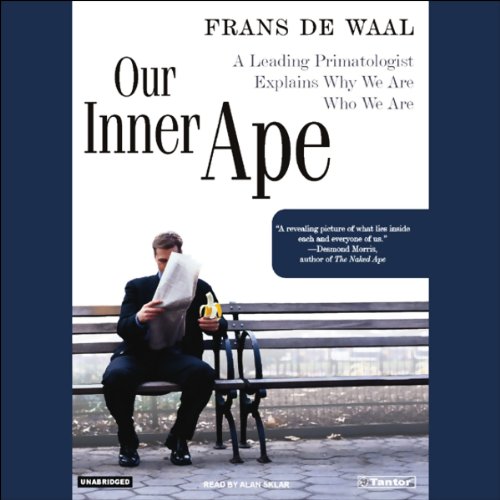
Our Inner Ape
Summary
We have long attributed man's violent, aggressive, competitive nature to his animal ancestry. But what if we are just as given to cooperation, empathy, and morality by virtue of our genes? What if our behavior actually makes us apes? What kind of apes are we? From a scientist and writer E.O. Wilson has called "the world authority on primate social behavior" comes a fascinating look at the most provocative aspects of human nature: power, sex, violence, kindness, and morality, through our two closest cousins in the ape family. For nearly 20 years, Frans de Waal has worked with both the famously aggressive chimpanzee and the lesser-known, egalitarian, erotic, matriarchal bonobo, two species whose DNA is nearly identical to that of humans. De Waal shows the range of human behavior through his study of chimpanzees and bonobos, drawing from their personalities, relationships, power struggles, and hijinx important insights about our human behavior. The result is an engrossing and surprising narrative that reveals what their behavior can teach us about our own nature.
©2005 Frans de Waal (P)2005 Tantor Media, Inc.
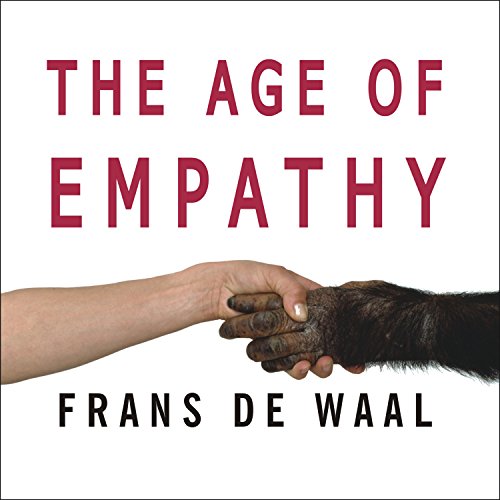
The Age of Empathy
Summary
Is it really human nature to stab one another in the back in our climb up the corporate ladder? Competitive, selfish behavior is often explained away as instinctive, thanks to evolution and "survival of the fittest", but in fact, humans are equally hard-wired for empathy. Using research from the fields of anthropology, psychology, animal behavior, and neuroscience, Frans de Waal brilliantly argues that humans are group animals - highly cooperative, sensitive to injustice, and mostly peace-loving - just like other primates, elephants, and dolphins. This revelation has profound implications for everything from politics to office culture.
©2009 Frans de Waal (P)2009 Tantor

Primates and Philosophers
Summary
"It's the animal in us," we often hear when we've been bad. But why not when we're good? Primates and Philosophers tackles this question by exploring the biological foundations of one of humanity's most valued traits: morality. In this provocative book, primatologist Frans de Waal argues that modern-day evolutionary biology takes far too dim a view of the natural world, emphasizing our "selfish" genes. Science has thus exacerbated our reciprocal habits of blaming nature when we act badly and labeling the good things we do as "humane". Seeking the origin of human morality not in evolution but in human culture, science insists that we are moral by choice, not by nature. Citing remarkable evidence based on his extensive research of primate behavior, de Waal attacks "Veneer Theory", which posits morality as a thin overlay on an otherwise nasty nature. He explains how we evolved from a long line of animals that care for the weak and build cooperation with reciprocal transactions. Drawing on both Darwin and recent scientific advances, de Waal demonstrates a strong continuity between human and animal behavior. In the process, he also probes issues such as anthropomorphism and human responsibilities toward animals. Based on the Tanner Lectures de Waal delivered at Princeton University's Center for Human Values in 2004, Primates and Philosophers includes responses by the philosophers Peter Singer, Christine M. Korsgaard, and Phillip Kitcher, and the science writer Robert Wright. They press de Waal to clarify the differences between humans and other animals, yielding a lively debate that will fascinate all those who wonder about the origins and reach of human goodness. The book is published by Princeton University Press.
©2006 Princeton University Press (P)2010 Redwood Audiobooks