Michael Klein has 5 audiobooks on Listento.it, narrated by 5 narrators, with an average listener rating of 4★ across 1 ratings. The most-rated is Julius Caesar and Cleopatra VII.

Julius Caesar and Cleopatra VII
Summary
Although there are fictionalized accounts of the rise of Julius Caesar, his relationships with Cleopatra, Mark Antony, and Octavian Caesar Augustus, there are few accounts that follow them through the last days of the Roman Republic through the development of the Roman Empire. This audiobook, drawing from sources such as Plutarch, Suetonius, and more contemporary accounts, does exactly that. Listeners become acquainted with young Julius as he takes up the burden of being the head of his household at the age of 16. We meet Mark Antony as a wild youth who was more interested in a good party than in politics, hear about the exotic young beauty born into the ruling house of Egypt, and finally, the cold machinations of Octavian Caesar Augustus as he establishes himself as emperor. It is a story of adventure, of travel, and of intrigue. It is also a tale of wedding and betrayal, of jealousy and political maneuvering. For not only are the lives of the four main players in this drama of interest, so are the lives of the many people surrounding them. There are even pirates and great engineering feats. Small wonder that this story has spawned so many fictionalized stories, branching off the main thread of a dying republic becoming an empire.
©2017 Michael Klein (P)2017 Michael Klein

The Rise and Fall of the Roman Empire
Summary
On the horizons of many warring tribes, Roman warriors, knights from chivalric orders, and the devoted penniless appeared on a divine mission ready to conquer with an appetite for destruction, salvation, and a higher purpose. Pax Romana. Had the world ever seen the magnitude of empires as it did in the Roman Empires that would unhinge themselves from their very foundation in their attempt to dominate over kings, lords, and tribes? What caused the Romans to proclaim themselves worthy of answering a seemingly providential call to spread the Roman way? This is the story of their shifting identity over the course of a mind-boggling history in their steep ascents and defiant schisms transfixed with glory and virtue that lasted for thousands of years. It is the story of Rome's lingering origin and Rome's spirit of conquest as their enemies encircled them. The perilous protection they would offer to a papacy, besieged by perpetual land grabs of powerful nobles and distant tribes, was often compromised by their own faults, negligence and the nature of where their empire stopped and their Romanness began. They fought their own with just as much fervor as those who appeared at their fronts. Did their very spirit and ascent imperil that which united them, dividing them, as the world around them embraced or rejected their very foundation?
©2016 Michael Klein (P)2016 Michael Klein

The Warrior King Charlemagne
Summary
In the middle of the eighth century, Europe was in a state of upheaval. The Islamic armies were still waging wars from Spain while Vikings began raiding from the north. Heathen tribes in the west still fought constant skirmishes with one another over land and power, while the Catholic Church remained the only hope of stability in the realm. The French kingdoms were recently united, and with their unification, one of the greatest rulers of all time took the throne. The great barbarian king Charlemagne lived a prosperous life, conquering his enemies and setting Europe onto the path of reform. Over the course of his 72-year life, Charlemagne waged wars with his enemies and conquered their territory. He subjugated the conquered people, bringing them under the rule of the Franks while giving them the access to the things they haven't had since the fall of the Roman Empire. Though his motivation was to spread Catholicism to those who did not worship his God, Charlemagne's reforms made it possible for them to remain in his kingdom and live a prosperous life. Through the alterations in education, currency, art, music, and leadership, Charlemagne brought stability back to Europe, setting it on the path to thrive for years to come.
©2016 Michael Klein (P)2016 Michael Klein

Fear Thy Name
Summary
Genghis Khan was arguably one of the most decisive figures in medieval history. He is responsible for the creation and management of one of history's largest empires. He did things during this rise to power, and the subsequent conquests that followed it, that will be remembered in history for their brutality and bloodshed, giving him a mixed reputation across the world. This biography explores the life of Genghis Khan, breaking down the benevolent unifier and leader, and the horrifically violent warlord that he was. The book traces the entirety of Genghis Khan's life, beginning with his humble beginnings as Temujin. The harrowing political instability which Temujin found himself born in gave way to his conquests across Mongolia, unifying the country with unprecedented sincerity. Upon taking power, Temujin became Genghis Khan, and set out to conquer what he was likely hoping would be the entire world. We follow the life of Genghis Khan and his Mongol army through their bloody campaigns on all borders of the rapidly expanding Mongolian Empire, and also what came of the empire after Genghis Khan's death. It is a truly magnificent story marked by ambition and violence. In a relatively short time, one man's willpower was able to change the world in sweepingly dramatic ways, and this biography paints the exciting picture of one of medieval history's most epic sagas.
©2016 Michael Klein (P)2016 Michael Klein
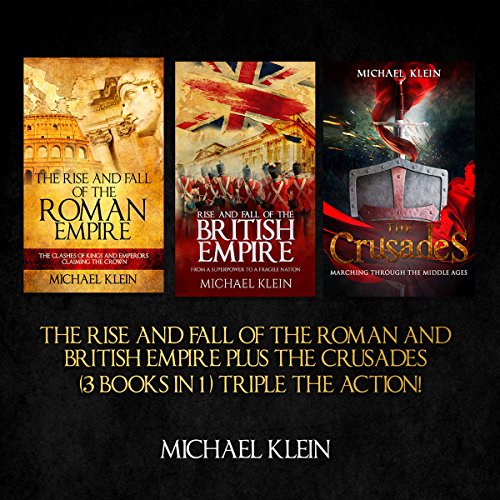
The Rise and Fall of the Roman and British Empire plus the Crusades
Summary
How did we get here, to this time and place in history? Are we repeating history's mistakes because we did not learn about the pivotal events that shaped the modern world? This three-book history course helps you quickly understand the nuances and the impact of three crucial periods portrayed in countless films: the Crusades and of the rise and fall of two great empires, the Roman and British. The culture, technology, law, and military organization of the Roman Empire shaped western civilization. Determined to spread their rule, the Romans succeeded magnificently until human nature and other factors led to the empire's collapse. Were current relationships between Christians and Muslims determined when the knights of the Crusades rode off on their grand quest? By the beginning of the 20th century, the British Empire and its superior navy claimed territory larger than that of any other empire in history, but its overreach foretold its downfall. This insightful and critically acclaimed history of the British Empire spans from the 17th century to contemporary time and combines comprehensive scholarship with popular history.
©2016 Michael Klein (P)2016 Michael Klein