Tian Dayton has 5 audiobooks on Listento.it, narrated by 4 narrators, with an average listener rating of 4.8★ across 5 ratings. The most-rated is ACOA Trauma Syndrome.

ACOA Trauma Syndrome
Summary
Growing up in a home where there is addiction or relationship trauma puts a child at great risk for long-term, post-traumatic stress effects that adversely compromise adult relationships. Best-selling author, psychologist, and psychodramatist Tian Dayton examines this trauma through an exploration of the way the brain and body process frightening or painful emotions and experiences in childhood. She shows how these traumas can become catalysts for unhealthy, self-medicating behaviors including drug and alcohol abuse, food issues, and sex, gambling, and shopping addictions.
©2012 Tian Dayton (P)2013 Audible, Inc.

Emotional Sobriety
Summary
Do you use substances or engage in compulsive activities to regulate your mood? Do you reach for something sweet, a couple of drinks, or a pack of cigarettes after a difficult day because you can't unwind without them? Do you race to the stores to spend away the day's frustrations or run around in circles taking more time to get less done? If these self-defeating habits sound familiar, Emotional Sobriety will shed light on why and how these coping mechanisms threaten your health and impact resilience. When we manage the stresses of the day by turning to outside 'mood managers' such as food, sex, work, shopping, gambling, drugs, and alcohol rather than healthier forms of 'self-soothing,' it is because we lack emotional sobriety - the state of processing our thoughts efficiently to bring our emotions into balance, says best-selling author and renowned addictions psychologist Tian Dayton, Ph.D. In her latest book, Emotional Sobriety, Dr. Dayton shares compelling, honest tales of her life experiences and case studies of those she has counseled. Illustrating that emotional sobriety is a mind/body phenomenon, Dr. Dayton includes ideas on how to attain emotional literacy - the skill of translating feelings into words so that we can use our thought processes to understand and bring our emotions into balance - and how to calm the limbic system so that we can actually experience what we're feeling. The limbic system processes our emotions and governs our mood, appetite, and sleep cycles. Repeated painful experiences, in childhood or adulthood, over which we have no ability or sense of control or escape can over sensitize us to stress and deregulate our limbic system. Dr. Dayton shows you through concrete examples how to bring your emotions and thoughts into balance and learn healthy ways of 'self-soothing' to relieve symptoms of depression, anxiety, rage, and the desire to self-medicate.
©2007 Tian Dayton (P)2012 Audible, Inc.

The Soulful Journey of Recovery
Summary
More than just a book full of the latest information, this is a dynamic, interactive, and personalized journey of recovery for those impacted by adverse childhood experiences (ACES). Finally, they can put their past behind them where it belongs! For those who have grown up in a family with addiction, mental illness, or other adverse childhood experiences (ACES), the heartache and pain doesn't end when they grow up and leave home. The legacy can last a lifetime and spread to generations unseen, as author Janet Wotitiz first showed listeners in the groundbreaking Adult Children of Alcoholics. In The ACoA Trauma Syndrome Dr. Tian Dayton picked up where Dr. Woititz left off, filling in the decades of research that tell us why pain from yesterday recreates itself over and over again in our today. In The Soulful Journey of Recovery, Dr. Dayton gives us the how. There is a journey of recovery that you can start today. Simple, elegantly written and researched, poignant, penetrating, and on point, Dr. Dayton will move with you through the confusion, pain, and anger you may carry in secrecy and silence. Through engaging and enlightening exercises, you will give voice to hidden wounds and space to your innermost emotions and thoughts. Online links will also offer guided meditations, film clips and other tools to enhance the work you do in the book. You will learn what happened to you growing up with dysfunction and you will learn how to deal with it in the present. You will discover that recovery is a self-affirming life adventure, and the kindest and best thing you can do for yourself and future generations. Some books can change your life. This is one of them.
©2019 Tian Dayton, PhD (P)2019 Recorded Books
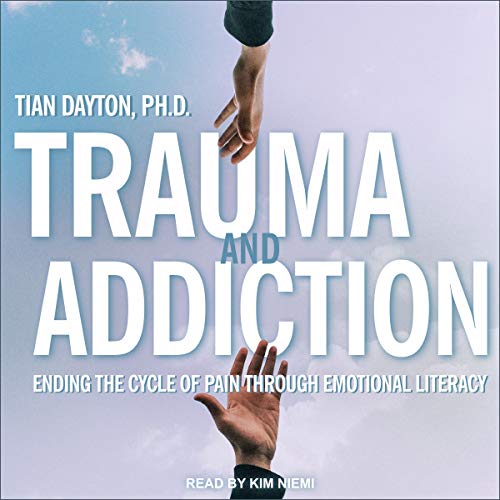
Trauma and Addiction
Summary
For the past decade, author Tian Dayton has been researching trauma and addiction, and how psychodrama (or sociometry group psychotherapy) can be used in their treatment. Since trauma responses are stored in the body, a method of therapy that engages the body through role play can be more effective in accessing the full complement of trauma-related memories. This latest book identifies the interconnection of trauma and addictive behavior, and shows why they can become an unending cycle. Emotional and psychological pain so often lead to self-medicating, which leads to more pain, and inevitably more self-medicating, and so on-ad infinitum. This groundbreaking audiobook offers listeners effective ways to work through their traumas in order to heal their addictions and their predilection toward what clinicians call self-medicating - the abuse of substances (alcohol, drugs, food), activities (work, sex, gambling), and/or possessions (money, material things). Therapists treating patients for whom no other avenue of therapy has proved effective will find that this audiobook offers practical, lasting solutions. Case studies and examples of this behavioral phenomenon will illustrate the connection, helping listeners understand its dynamics, recognize their own situations and realize that they are not alone in experiencing this syndrome.
©2000 Tian Dayton (P)2020 Tantor

Neuro-Psychodrama in the Treatment of Relational Trauma
Summary
There is a growing awareness that the body, as well as the mind, needs to be involved in therapy. Neuroscience and attachment theories have clearly demonstrated that emotion is a physiological as well as a mental phenomenon. Dr. Dayton's approach to experiential work has been in the forefront of what is now so commonly in use in treatment centers that it has become mainstream. Used in treating relational trauma and PTSD, neuropsychodrama is designed to be easily incorporated into existing programs regardless of length of stay and can be used in outpatient settings, group, and one-to-one practices. Additionally, she has created a model of treatment called relational trauma repair, RTR, which is a multisensory model used in the treatment of relational trauma issues. Neuro-Psychodrama in the Treatment of Relational Trauma provides education woven into a healing, interactive experience. It will mobilize, engage, bond, and motivate groups through a process that is interactional and relational and progressively imparts skills of emotional literacy and emotional regulation.
©2015 Tian Dayton (P)2015 Audible, Inc.