Elizabeth Hanley has narrated 4 audiobooks on Listento.it by 3 authors, with an average listener rating of 4.6★ across 8 ratings. The most-rated is ACOA Trauma Syndrome.

ACOA Trauma Syndrome
Summary
Growing up in a home where there is addiction or relationship trauma puts a child at great risk for long-term, post-traumatic stress effects that adversely compromise adult relationships. Best-selling author, psychologist, and psychodramatist Tian Dayton examines this trauma through an exploration of the way the brain and body process frightening or painful emotions and experiences in childhood. She shows how these traumas can become catalysts for unhealthy, self-medicating behaviors including drug and alcohol abuse, food issues, and sex, gambling, and shopping addictions.
©2012 Tian Dayton (P)2013 Audible, Inc.

Emotional Sobriety
Summary
Do you use substances or engage in compulsive activities to regulate your mood? Do you reach for something sweet, a couple of drinks, or a pack of cigarettes after a difficult day because you can't unwind without them? Do you race to the stores to spend away the day's frustrations or run around in circles taking more time to get less done? If these self-defeating habits sound familiar, Emotional Sobriety will shed light on why and how these coping mechanisms threaten your health and impact resilience. When we manage the stresses of the day by turning to outside 'mood managers' such as food, sex, work, shopping, gambling, drugs, and alcohol rather than healthier forms of 'self-soothing,' it is because we lack emotional sobriety - the state of processing our thoughts efficiently to bring our emotions into balance, says best-selling author and renowned addictions psychologist Tian Dayton, Ph.D. In her latest book, Emotional Sobriety, Dr. Dayton shares compelling, honest tales of her life experiences and case studies of those she has counseled. Illustrating that emotional sobriety is a mind/body phenomenon, Dr. Dayton includes ideas on how to attain emotional literacy - the skill of translating feelings into words so that we can use our thought processes to understand and bring our emotions into balance - and how to calm the limbic system so that we can actually experience what we're feeling. The limbic system processes our emotions and governs our mood, appetite, and sleep cycles. Repeated painful experiences, in childhood or adulthood, over which we have no ability or sense of control or escape can over sensitize us to stress and deregulate our limbic system. Dr. Dayton shows you through concrete examples how to bring your emotions and thoughts into balance and learn healthy ways of 'self-soothing' to relieve symptoms of depression, anxiety, rage, and the desire to self-medicate.
©2007 Tian Dayton (P)2012 Audible, Inc.
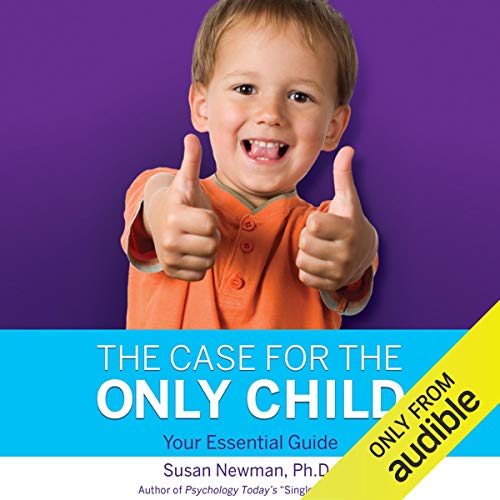
The Case for the Only Child
Summary
Although parenting approaches change, attitudes about only children remain stuck in the past. The negative stereotypes - lonely, selfish, bossy, spoiled, socially maladjusted - make parents think their child will be at a disadvantage when compared to those who grow up with siblings. The Case for the Only Child debunks the myths, taking into account the many changes the nuclear family has experienced in the face of two-family incomes, women who have children later, and the economic reality of raising children in our modern world. Combining often-surprising findings with real-life stories, compassionate insight, and thought-provoking questions, Dr. Susan Newman provides a guide to help you decide for yourself how to best plan your family and raise a single child.Provides fascinating facts and statistics to show the reasons for the rapid risein the number of singletonsExplores pressure from friends, relatives, and strangers to have a second child...and how to deal with itDemystifies the realities of raising and being an only child with personal stories and current researchExplores the highly debated question: Does a child need a sibling?
©2011 Susan Newman (P)2013 Audible, Inc.

The United Nations
Summary
The United Nations has been called everything from "the best hope of mankind" to "irrelevant" and "obsolete". With this much-needed introduction to the UN, Jussi Hanhimäki engages the current debate over the organizations effectiveness as he provides a clear understanding of how it was originally conceived, how it has come to its present form, and how it must confront new challenges in a rapidly changing world. After a brief history of the United Nations and its predecessor, the League of Nations, the author examines the UN's successes and failures as a guardian of international peace and security, as a promoter of human rights, as a protector of international law, and as an engineer of socio-economic development. Hanhimäki stresses that the UN's greatest problem has been the impossibly wide gap between its ambitions and capabilities. In the area of international security, for instance, the UN has to settle conflicts - be they between or within states - without offending the national sovereignty of its member states, and without being sidelined by strong countries, as happened in the 2003 intervention of Iraq. Hanhimäki also provides a clear accounting of the UN and its various arms and organizations (such as UNESCO and UNICEF), and he offers a critical overview of how effective it has been in the recent crises in Rwanda and the former Yugoslavia, for example - and how likely it is to meet its overall goals in the future. The United Nations, Hanhimäki concludes, is an indispensable organization that has made the world a better place. But it is also a deeply flawed institution, in need of constant reform.
©2008 Jussi M. Hanhimaki (P)2013 Audible, Inc.