William Craig has 3 audiobooks on Listento.it, narrated by 3 narrators, with an average listener rating of 4.8★ across 44 ratings. The most-rated is Enemy at the Gates.
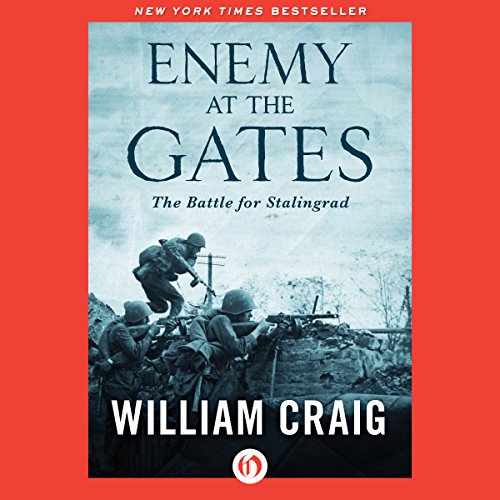
Enemy at the Gates
Summary
A classic work of World War II history that brings to vivid, dramatic life one of the bloodiest battles ever fought - and the beginning of the end for the Third Reich. On August 5, 1942, giant pillars of dust rose over the Russian steppe, marking the advance of the 6th Army, an elite German combat unit dispatched by Hitler to capture the industrial city of Stalingrad and press on to the oil fields of Azerbaijan. The Germans were supremely confident; in three years, they had not suffered a single defeat. The Luftwaffe had already bombed the city into ruins. German soldiers hoped to complete their mission and be home in time for Christmas. The siege of Stalingrad lasted five months, one week, and three days. Nearly two million men and women died, and the 6th Army was completely destroyed. Considered by many historians to be the turning point of World War II in Europe, the Soviet Army's victory foreshadowed Hitler's downfall and the rise of a communist superpower. Best-selling author William Craig spent five years researching this epic clash of military titans, traveling to three continents in order to review documents and interview hundreds of survivors. Enemy at the Gates is the enthralling result: the definitive account of one of the most important battles in world history. The book was the inspiration for the 2001 film of the same name, starring Joseph Fiennes and Jude Law.
©1973 William Craig; This edition published in 2015 by Open Road Integrated Media, Inc. (P)2015 Audible, Inc.

The Fall of Japan
Summary
Told from both Japanese and American perspectives, this thrilling account of the final weeks of World War II in the Pacific has been heralded by the New York Times Book Review as "virtually faultless". By midsummer 1945, Japan had long since lost the war in the Pacific. The people were not told the truth, and neither was the emperor. Japanese generals, admirals, and statesmen knew, but only a handful of leaders were willing to accept defeat. Most were bent on fighting the Allies until the last Japanese soldier died and the last city burned to the ground. Exhaustively researched and vividly told, The Fall of Japan masterfully chronicles the dramatic events that brought an end to the Pacific War and forced a once-mighty military nation to surrender unconditionally. From the ferocious fighting on Okinawa to the all-but-impossible mission to drop the second atom bomb, and from Franklin D. Roosevelt's White House to the Tokyo bunker where tearful Japanese leaders first told the emperor the truth, William Craig captures the pivotal events of the war with spellbinding authority. The Fall of Japan brings to life both celebrated and lesser-known historical figures, including Admiral Takijiro Onishi, the brash commander who drew up the Yamamoto plan for the attack on Pearl Harbor and inspired the death cult of kamikaze pilots. This astonishing account ranks alongside Cornelius Ryan's The Longest Day and John Toland's The Rising Sun as a masterpiece of World War II history.
©1967 William Craig; This edition published in 2015 by Open Road Integrated Media, Inc. (P)2015 Audible, Inc.

Yankee Come Home
Summary
Yankee Come Home explores one family's history in Cuba, and through it, the intense, complex, smoldering relationship between the island nation and its leviathan neighbor. In Cuba's most entrancing, storied landscape, William Craig is searching for a history that his family has lost - and now needs to recover. He's looking for the truth about his mysterious great-grandfather, Thomas O'Brien, a self-proclaimed hero of the "splendid little war" who left a legacy of glorious, painful lies. Living a dream that haunts American hearts-the dream of escaping the past, of becoming who we say we are - "Papa" died leaving his own children wondering who he'd really been. Along the way, Craig searches for the place where Gilded Age America abandoned republican ideals in favor of imperial ambition - and where his own generation of Americans now preside over arbitrary imprisonment and systematized torture. "I needed to see Guantnamo the way some Americans needed to drive through the night to kneel at JFK's coffin, and others are drawn to Ground Zero," he writes. "Sometimes, we don't know what we've lost until we trace the scars." Traveling with Craig, listeners will join in present-day adventures: spirit-possession rituals, black market odysseys, roots-music epiphanies, and discovering the continuing impact of the war in 1898 on both Cuba and America. The story of the United States in Cuba is fascinating, but none too flattering. Like the reality of "Papa" O'Brien's identity, it reflects more hubris than heroism, more avarice than sacrifice. In the end, however, Craig's journey in Yankee Come Home is a transformation from disillusionment to redemption.
©2012 William Craig (P)2012 Audible, Inc.