The Europe category has 561 audiobooks on Listento.it, with an average listener rating of 4.3★ across 1,762 ratings. The most-rated is Clanlands.

La Gran Aventura del Reino de Asturias [The Great Adventure of the Kingdom of Asturias]
Summary
El nacimiento del reino de Asturias bajo la España musulmana fue una empresa titánica de resistencia y supervivencia. Una de las aventuras más fascinantes no sólo de la Historia de España, sino de la historia universal. Aunque resulta inconcebible que un puñado de rebeldes cristianos consiguiera formar, en el norte de la Península, un reino independiente frente al mayor poder de su tiempo y, después, extenderlo hacia el sur en una tenaz labor de repoblación, eso es lo que ocurrió en torno a Covadonga, entre Asturias y Cantabria, a partir del año 722. ¿Cómo fue posible semejante proeza? ¿Quiénes fueron sus autores? ¿Cómo se llamaban los heroicos pioneros que empezaron a ganar tierras hacia el sur, gracias a sus azadas más que a sus espadas? José Javier Esparza - director del programa La estrella polar, de la COPE - nos sumerge en aquel tiempo extraordinario, donde todos los días se jugaba la supervivencia de una civilización. Año tras año, paso a paso, el relato de los orígenes del reino de Asturias nos va descubriendo nombres y figuras hoy olvidados: desde los pioneros Lebato y Muniadona hasta Beato de Liébana, pasando por los condes guerreros y los monjes colonos. Doscientos años de historia que culminan en la llegada al Duero y en la metamorfosis de la corona de Oviedo en el reino de León. Pero ¿cómo empezó todo? Please note: This audiobook is in Spanish.
©2009 Sant Yago, S. L. (P)2017 Audible, Inc.

Imprudent King
Summary
Philip II is not only the most famous king in Spanish history, but one of the most famous monarchs in English history: the man who married Mary Tudor and later launched the Spanish Armada against her sister Elizabeth I. This compelling biography of the most powerful European monarch of his day begins with his conception (1526) and ends with his ascent to Paradise (1603), two occurrences surprisingly well documented by contemporaries. Eminent historian Geoffrey Parker draws on four decades of research on Philip as well as a recent, extraordinary archival discovery - a trove of 3,000 documents in the vaults of the Hispanic Society of America in New York City, unread since crossing Philip's own desk more than four centuries ago. Many of them change significantly what we know about the king. The book examines Philip's long apprenticeship; his three principal interests (work, play, and religion); and the major political, military, and personal challenges he faced during his long reign. Parker offers fresh insights into the causes of Philip's leadership failures: was his empire simply too big to manage, or would a monarch with different talents and temperament have fared better?
©2014 Geoffrey Parker (P)2018 Tantor

Tudors
Summary
From Henry VIII's cataclysmic break with Rome to the epic rule of Elizabeth I, the age of the Tudors comes to vivid life in audio.
Peter Ackroyd, one of Britain's most acclaimed writers, brings the age of the Tudors to vivid life in this monumental audiobook in his History of England series, charting the course of English history from Henry VIII's cataclysmic break with Rome to the epic rule of Elizabeth I.
Rich in detail and atmosphere, Tudors is the story of Henry VIII's relentless pursuit of both the perfect wife and the perfect heir; of how the brief royal reign of the teenage king, Edward VI, gave way to the violent reimposition of Catholicism and the stench of bonfires under "Bloody Mary". It tells, too, of the long reign of Elizabeth I, which, though marked by civil strife, plots against her, and even an invasion force, finally brought stability.
Above all it is the story of the English Reformation and the making of the Anglican Church. At the beginning of the sixteenth century, England was still largely feudal and looked to Rome for direction; at its end it was a country where good governance was the duty of the state, not the church, and where men and women began to look to themselves for answers rather than to those who ruled them.
©2012 Peter Ackroyd (P)2015 Blackstone Audio, Inc.

A Year in Provence
Summary
Peter Mayle and his wife had been to Provence as tourists. They had dreamed of one day trading the long, grey winters and damp summers of England for the blue skies and sunshine of the coast of southern France. And then they made it happen. They moved into an old farmhouse at the foot of the Luberon mountains and embarked on a wonderful, if at times bewildering, new life. Among their experiences that first year: being inundated with builders and visitors, grappling with the native accent, taking part in goat races and supervising the planting of a new vineyard. Now, Peter Mayle personally recounts the pleasures and frustrations of Provençal life - sharing in a way no one else can, the unique and endearing culture that is Provence.
©1989 Peter Mayle (P)1991 Macmillan Audio

Emperor
Summary
The life of Emperor Charles V (1500-1558), ruler of Spain, Germany, the Netherlands, and much of Italy and Central and South America, has long intrigued biographers. But the elusive nature of the man (despite an abundance of documentation), his relentless travel and the control of his own image, together with the complexity of governing the world's first transatlantic empire, complicate the task. Geoffrey Parker, one of the world's leading historians of early modern Europe, has examined the surviving written sources in Dutch, French, German, Italian, Latin, and Spanish, as well as visual and material evidence. He explores the crucial decisions that created and preserved this vast empire, analyzes Charles' achievements within the context of both personal and structural factors, and scrutinizes the intimate details of the ruler's life for clues to his character and inclinations. The result is a unique biography that interrogates every dimension of Charles' reign and views the world through the emperor's own eyes.
©2019 Geoffrey Parker (P)2019 Tantor

Walk Quietly: 58 Tips to Help You Prepare to Walk the Camino de Santiago in Spain
Summary
Planning to walk a Camino de Santiago pilgrimage in Spain? This is the book for you. This audiobook is a collection of tips to help you plan, prepare, train, shop for, and walk the famous Camino de Santiago, written by someone who spent seven weeks walking the Via de La Plata route of the Camino de Santiago. You’ll learn what gear you’ll need, how to choose the right boots, and how to break them in properly. You’ll discover the best ways to condition yourself to walk the Camino de Santiago. You’ll discover what to wear on the plane and what to have in your pockets when you arrive in Spain. You’ll be ready for a “typical” day on the Camino and you’ll also be prepared for some of the changes that are coming your way, too.
©2018 Gregory A. Kompes (P)2018 Gregory A. Kompes

A History of Britain, Volume 1
Summary
To look back at the past is to understand the present. In this vivid account of over 4,000 years of British history, Simon Schama takes us on an epic journey which encompasses the very beginnings of the nation's identity, when the first settlers landed on Orkney.
From the successes and failures of the monarchy to the daily life of a Roman soldier stationed on Hadrian's Wall, Schama gives a vivid, fascinating account of the many different stories and struggles that lie behind the growth of our island nation.
Simon Schama's hugely successful BBC2 series has shown him to be one of the most original and exciting historians. Timothy West's abridged reading of the book bears further testimony to Schama's extraordinary gift for story-telling.
©2014 Audible, Inc. (P)2014 Audible, Inc.

1666
Summary
1666 was a watershed year for England. The outbreak of the Great Plague, the eruption of the second Dutch War and the Great Fire of London all struck the country in rapid succession and with devastating repercussions. Shedding light on these dramatic events, historian Rebecca Rideal reveals an unprecedented period of terror and triumph. Based on original archival research and drawing on little-known sources, 1666: Plague, War and Hellfire takes listeners on a thrilling journey through a crucial turning point in English history, as seen through the eyes of an extraordinary cast of historical characters. While the central events of this significant year were ones of devastation and defeat, 1666 also offers a glimpse of the incredible scientific and artistic progress being made at that time, from Isaac Newton's discovery of gravity to Robert Hooke's microscopic wonders. It was in this year that John Milton completed Paradise Lost, Frances Stewart posed for the now-iconic image of Britannia, and a young architect named Christopher Wren proposed a plan for a new London - a stone phoenix to rise from the charred ashes of the old city. With flair and style, 1666 shows a city and a country on the cusp of modernity, and a series of events that forever altered the course of history. Cover image: The Great Fire of 1666, detail of a coloured woodcut by Matthaus Merian the Younger, courtesy of Swiss Re Company Archives, SRCA 10.122.727.01.
©2016 Rebecca Rideal (P)2017 Audible, Ltd

Her Little Majesty
Summary
Her Little Majesty is a fresh and fascinating portrait of the diminutive monarch who ruled the vast British empire for over 60 years. Award-winning biographer and historian, Carolly Erickson, transports you behind the walls of Buckingham Palace to introduce you to the quirky, loveable Queen Victoria—revealed only to her closest associates. Emotionally deprived, inadequately educated, and socially isolated for much of her life, young Victoria felt ill-prepared to ascend the throne. But the 19-year-old queen met her coronation day with outward dignity and confidence—then went home to bathe her pet dog. Even though her frequent temper tantrums and neurotic obsessions would have critics repeatedly fearing for her sanity, she became a powerful ruler, relentlessly leading her country through devastating wars and sweeping political reform. Carolly Erickson draws on diaries, letters, and historical documents to pen this dramatic account of England’s popular matriarch and the turbulent era that carries her name. Narrator Nelson Runger will hold you enthralled as the glory and the adversities of the Victorian age unfold.
©1997 Carolly Erickson (P)1997 Recorded Books, LLC

A Concise History of Spain
Summary
This audiobook traces Spain's development from prehistoric times to the present, focusing particularly on culture, society, politics, and personalities. It introduces listeners to key themes that have shaped Spain's history and culture, including its varied landscapes and climates; the impact of waves of diverse human migrations; the importance of its location as a bridge between the Atlantic and the Mediterranean and Europe and Africa; and religion, particularly militant Catholic Christianity and its centuries of conflict with Islam and Protestantism, as well as debates over the place of the Church in modern Spain. PLEASE NOTE: When you purchase this title, the accompanying PDF will be available in your Audible Library along with the audio.
©2010, 2016 William Phillips Jr. and Carla Rahn Phillips (P)2018 Naxos Audiobooks

Amsterdam
Summary
An endlessly entertaining portrait of the city of Amsterdam and the ideas that make it unique, by the author of the acclaimed Island at the Center of the World Tourists know Amsterdam as a picturesque city of low-slung brick houses lining tidy canals; student travelers know it for its legal brothels and hash bars; art lovers know it for Rembrandt's glorious portraits. But the deeper history of Amsterdam, what makes it one of the most fascinating places on Earth, is bound up in its unique geography - the constant battle of its citizens to keep the sea at bay and the democratic philosophy that this enduring struggle fostered. Amsterdam is the font of liberalism, in both its senses. Tolerance for free thinking and free love make it a place where, in the words of one of its mayors, "craziness is a value". But the city also fostered the deeper meaning of liberalism, one that profoundly influenced America: political and economic freedom. Amsterdam was home not only to religious dissidents and radical thinkers but to the world's first great global corporation. In this effortlessly erudite account, Russell Shorto traces the idiosyncratic evolution of Amsterdam, showing how such disparate elements as herring anatomy, naked Anabaptists parading through the streets, and an intimate gathering in a 16th-century wine-tasting room had a profound effect on Dutch - and world - history. Weaving in his own experiences of his adopted home, Shorto provides an ever-surprising, intellectually engaging story of Amsterdam from the building of its first canals in the 1300s, through its brutal struggle for independence, its golden age as a vast empire, to its complex present in which its cherished ideals of liberalism are under siege.
©2013 Russell Shorto (P)2013 Random House Audio

Bloody Sunday
Summary
Bloody Sunday was the worst massacre of British citizens by British troops since Peterloo in 1819 - a potent distillation of the rage and anguish of a bitter conflict that spanned decades and claimed three and a half thousand lives. In 2002, when the Saville Inquiry transferred from Derry to London, author Douglas Murray began attending daily to hear at firsthand the testimony of the soldiers and members of the IRA who had been there that dreadful day. What he discovered was a devastating story of ordinary people thrown into the most terrible of situations, a story not only more straightforward than the British army would like to admit, but more complex than the IRA has always claimed. This book is not solely about a shocking event or a process of justice; it is about the efforts of a group of people to arrive at truth and a country’s attempt - three decades on - at painful and perhaps incomplete reconciliation. Douglas Murray is a best-selling author and award-winning political journalist based in London. From 2007 to 2011 he was the director of the Centre for Social Cohesion in London. He is now a Senior Fellow at the Henry Jackson Society. Read by Michael Fenton Stevens (Last Trains, MI9, Whisper Wings, The Science of the Discworld, Long Earth, Long War, David Jason: Autobiography, Spitting Image, KYTV) WARNING - this audiobook contains some strong language and descriptions of violence & injuries.
©2011 Biteback Publishing (P)2014 Spokenworld Audio & Ladbroke Audio Ltd

The Lost Painting
Summary
Told with consummate skill by the writer of the best-selling, award-winning A Civil Action, The Lost Painting is a remarkable synthesis of history and detective story. An Italian village on a hilltop near the Adriatic coast, a decaying palazzo facing the sea, and in the basement, cobwebbed and dusty, lit by a single bulb, an archive unknown to scholars. Here, a young graduate student from Rome, Francesca Cappelletti, makes a discovery that inspires a search for a work of art of incalculable value, a painting lost for almost two centuries. The artist was Caravaggio, a master of the Italian Baroque. He was a genius, a revolutionary painter, and a man beset by personal demons. Four hundred years ago, he drank and brawled in the taverns and streets of Rome, moving from one rooming house to another, constantly in and out of jail, all the while painting works of transcendent emotional and visual power. He rose from obscurity to fame and wealth, but success didn’t alter his violent temperament. His rage finally led him to commit murder, forcing him to flee Rome a hunted man. He died young, alone, and under strange circumstances. Caravaggio scholars estimate that between 60 and 80 of his works are in existence today. Many others - no one knows the precise number - have been lost to time. Somewhere, surely, a masterpiece lies forgotten in a storeroom, or in a small parish church, or hanging above a fireplace, mistaken for a mere copy. Prizewinning author Jonathan Harr embarks on an spellbinding journey to discover the long-lost painting known as The Taking of Christ - its mysterious fate and the circumstances of its disappearance have captivated Caravaggio devotees for years. After Francesca Cappelletti stumbles across a clue in that dusty archive, she tracks the painting across a continent and hundreds of years of history. But it is not until she meets Sergio Benedetti, an art restorer working in Ireland, that she finally manages to assemble all the pieces of the puzzle. Praise for The Lost Painting “Jonathan Harr has gone to the trouble of writing what will probably be a bestseller...rich and wonderful...In truth, the book reads better than a thriller.... If you're a sucker for Rome, and for dusk... [you'll] enjoy Harr's more clearly reported details about life in the city.” (The New York Times Book Review) “Jonathan Harr has taken the story of the lost painting, and woven from it a deeply moving narrative about history, art and taste - and about the greed, envy, covetousness and professional jealousy of people who fall prey to obsession. It is as perfect a work of narrative nonfiction as you could ever hope to read.” (The Economist)
©2005 Jonathan Harr (P)2005 Random House, Inc.
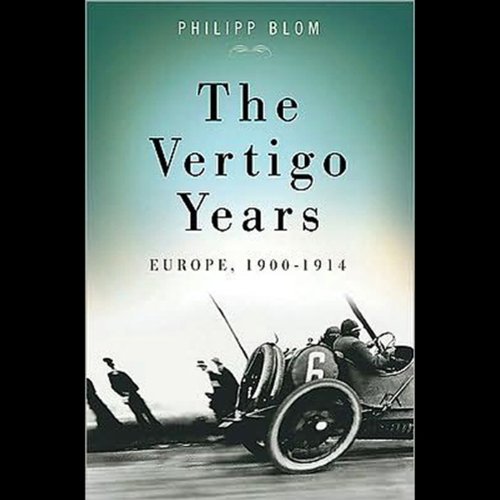
The Vertigo Years
Summary
Europe, 1900 - 1914: a world adrift, a pulsating era of creativity and contradictions. The major topics of the day: terrorism, globalization, immigration, consumerism, the collapse of moral values, and the rivalry of superpowers. The 20th century was not born in the trenches of the Somme or Passchendaelebut rather in the 15 vertiginous years preceding World War I. In this short span of time, a new world order was emerging in ultimately tragic contradiction to the old. These were the years in which the political and personal repercussions of the Industrial Revolution were felt worldwide: Cities grew like never before as people fled the countryside and their traditional identities; science created new possibilities as well as nightmares; education changed the outlook of millions of people; mass-produced items transformed daily life; industrial laborers demanded a share of political power; and women sought to change their place in society as well as the very fabric of sexual relations. From the tremendous hope for a new century embodied in the 1900 Worlds Fair in Paris to the shattering assassination of a Habsburg archduke in Sarajevo in 1914, historian Philipp Blom chronicles this extraordinary epoch year by year. Prime Ministers and peasants, anarchists and actresses, scientists and psychopaths intermingle on the stage of a new century in this portrait of an opulent, unstable age on the brink of disaster. Beautifully written and replete with deftly told anecdotes, The Vertigo Years brings the wonders, horrors, and fears of the early 20th century vividly to life.
©2008 Phillip Blom (P)2009 Audible, Inc.

The Partition of Ireland and the Troubles: The History of Northern Ireland from the Irish Civil War to the Good Friday Agreement
Summary
“The Honorable Member must remember that in the South they boasted of a Catholic State. They still boast of Southern Ireland being a Catholic State. All I boast of is that we are a Protestant Parliament and a Protestant State. It would be rather interesting for historians of the future to compare a Catholic State launched in the South with a Protestant State launched in the North and to see which gets on the better and prospers the more.” (Sir James Craig) One of the most bitter and divisive struggles in the history of the British Isles, and in the history of the British Empire, played out over the question of Home Rule and Irish independence, and then later still as the British province of Northern Ireland grappled within itself for the right to secede from the United Kingdom or the right to remain. What is it within this complicated relationship that has kept this strange duality of mutual love and hate at play? A rendition of “Danny Boy” has the power to reduce both Irishmen and Englishmen to tears, and yet they have torn at one another in a violent conflict that can be traced to the very dawn of their contact. This history of the British Isles themselves is in part responsible. The fraternal difficulties of two neighbors so closely aligned, but so unequally endowed, can be blamed for much of the trouble. The imperialist tendencies of the English themselves, tendencies that created an empire that embodied the best and worst of humanity, alienated them from not only the Irish, but the Scots and Welsh too. However, the British also extended that colonial duality to other great societies of the world, India not least among them, without the same enduring suspicion and hostility. There is certainly something much more than the sum of its parts in this curious combination of love and loathing that characterizes the Anglo-Irish relationship. The Partition of Ireland and the Troubles: The History of Northern Ireland from the Irish Civil War to the Good Friday Agreement analyzes the tumultuous events that marked the creation of Northern Ireland, and the conflicts fueled by the partition. Along with pictures of important people, places, and events, you will learn about Northern Ireland like never before.
©2018 Charles River Editors (P)2018 Charles River Editors

French Revolution: A History from Beginning to End
Summary
During the late years of the 18th century, the spirit of Enlightenment thinking and revolution were in the air. The world was changing, moving away from ingrained beliefs about religion, reason, society, and the rights of the individual and turning more toward the laws of nature as interpreted by the scientific method. Nowhere was the influence of this radical new way of thinking more apparent than in France, and the upheaval this caused would come to bloody fruition in the form of revolution. You will learn about: An environment of revolution Rise of the Third Estate The rights of man Vive la revolution! Reign of Terror The last revolutionaries And more! Explore the triumph and terror that existed in France during the French Revolution. Review the causes and the lasting effects brought about during this tumultuous time period when the common people of France struggled to remake their world upon the cornerstone of liberty.
©2016 Hourly History (P)2018 Hourly History

The Regency Years
Summary
The Victorians are often credited with ushering in our current era, yet the seeds of change were planted in the years before. The Regency (1811-1820) began when the profligate Prince of Wales - the future King George IV - replaced his insane father, George III, as Britain's ruler. Around the regent surged a society steeped in contrasts: evangelicalism and hedonism, elegance and brutality, exuberance and despair. The arts flourished at this time with a showcase of extraordinary writers and painters such as Jane Austen, Lord Byron, the Shelleys, John Constable, and J. M. W. Turner. Science burgeoned during this decade, too, giving us the steam locomotive and the blueprint for the modern computer. Yet the dark side of the era was visible in poverty, slavery, pornography, opium, and the gothic imaginings that birthed the novel Frankenstein. With the British military in foreign lands, fighting the Napoleonic Wars in Europe and the War of 1812 in the United States, the desire for empire and an expanding colonial enterprise gained unstoppable momentum. Exploring these crosscurrents, Robert Morrison illuminates the profound ways this period shaped and indelibly marked the modern world.
©2019 Robert Morrison (P)2019 HighBridge, a division of Recorded Books

Medieval Europe: Crisis and Renewal
Summary
The Middle Ages harshly tested every aspect of human perseverance, imagination, and survival. Living conditions were squalid for almost everyone except the ruling elite, and most of the riches of Western culture were preserved in monasteries and on other continents. And into this setting came widespread famines, prolonged wars, and plagues that marked Europe's late medieval period as one of the most harrowing in recorded history. But Europe was not broken by these crises. Instead, it renewed itself and spawned fundamental artistic, religious, romantic, and political ideas that continue to shape our world to this day. This series of 16 engrossing lectures transports you to 14th-century Europe to experience a hero's tale of cultural trial, suffering, and triumph. It guides you through 200 years of stunning transformations in how people viewed themselves, how they worshiped, and their relationship to land and country, addressing key concepts that include national boundaries, church-state separation, individuality, and sovereignty - all of which find root in the medieval world. The series is divided into three main sections that provide you a framework for understanding medieval society through detailed descriptions of what life was like for peasants, merchants, and monarchs; show you how this rigid but well-entrenched social structure was shaken to the core by crises like the Hundred Years War and the Black Death, and let you experience the glorious renewal that followed, including the spread of Renaissance ideas and styles; the creation of the modern nation in Castile, France, and England; the "rediscovery" of Plato, and the far-reaching voyages of discovery.
©1996 The Teaching Company, LLC (P)1996 The Great Courses

The Gondola Maker
Summary
From the author of Made in Italy comes a tale of artisanal tradition and family bonds set in one of the world's most magnificent settings: Renaissance Venice. Venetian gondola-maker Luca Vianello considers his whole life arranged. His father charted a course for his eldest son from the day he was born, and Luca is positioned to inherit one of the city's most esteemed boatyards. But when Luca experiences an unexpected tragedy in the boatyard, he believes that his destiny lies elsewhere. Soon, he finds himself drawn to restore an antique gondola with the dream of taking a girl for a ride. The Gondola Maker brings the centuries-old art of gondola making to life in the tale of a young man's complicated relationship with his master-craftsman father. Lovers of historical fiction will appreciate the authentic details of gondola craftsmanship, along with an intimate first-person narrative set against the richly textured backdrop of 16th-century Venice.
©2014 Laura Morelli (P)2016 Laura Morelli

Irish History for Dummies
Summary
Putting history into a perspective, Irish History for Dummies is an engaging, entertaining and educational trip through time, packing in equal parts fun and facts, providing listeners with a riveting history of this ancient land. The history of Ireland has shaped the world far beyond its borders. And few stories have a greater need for a balanced and light-hearted telling than the complex and often controversial saga of Ireland and her people. With more than 250 million books in print and more than 1,800 titles, For Dummies is the most widely recognized and highly regarded reference series in the world. Since 1991, For Dummies has helped millions make everything easier. For Dummies audiobooks offer listeners proven experts presenting even the most complex subjects in plain English.
©2011 John Wiley & Sons, Ltd. (P)2012 John Wiley & Sons, Ltd.