The Middle East category has 186 audiobooks on Listento.it, with an average listener rating of 4.3★ across 560 ratings. The most-rated is The Crusades.

The Persian Empire
Summary
Explore the Captivating History of the Persian Empire! One of the most shocking things about the Persians is how quickly they went from an obscure, powerless, and nomadic tribe to an immense empire that spanned across western Asia, Africa, and parts of Europe. The rise of Cyrus the great, considered the father of Persia, in the seventh century BCE, filled the power vacuum caused by the fall of the Assyrians, and it led to the formation of one of the most powerful empires of the ancient world. The Persians have made significant contributions to world culture, ranging from their ability to raise and train one of the ancient world’s most formidable fighting forces, the Persian Immortals, to their new and effective ways of organizing and administering government. And Persian art heavily influenced their Muslim invaders, helping to usher in the Islamic Golden age that helped spread Islam throughout the Middle East and Africa. In The Persian Empire: A Captivating Guide to the History of Persia, Starting from the Ancient Achaemenid, Parthian, and Sassanian Empires to the Safavid, Afsharid, and Qajar Dynasties, you will discover topics such as: Who are the Persians? The history of human population in Iran The birth of the Achaemenid Empire: the rise and reign of Cyrus the Great The glory of the Achaemenid Empire: Cambyses and Darius The beginning of the end: the Reign of Xerxes and the downfall of the Achaemenid Dynasty Life in ancient Persia The Persian military Zoroastrianism: Persia’s religion Later Persian dynasties: the Parthian Empire to the Qajar Dynasty Persian art: mixing East and West Persian contributions to science and technology And much, much more!
©2018 Captivating History (P)2019 Captivating History

Sumerians: A History from Beginning to End
Summary
The Sumerians A legendary civilization vanished under the Fertile Crescent and escaped a fate worse than death until Sumerologists questioned widely accepted truths. The Sumerians reemerged onto the extraordinary timeline of human history. Their tales of kings and gods, including the Epic of Gilgamesh, and their fearless trade in distant lands, during the remarkable Bronze Age, centered in the world’s first city-states that chronicled ancient rivalries and their enduring impact. From this audiobook you will learn about: How we know what we know about Sumerians The Bronze Age - Sumer and its contemporaries How did the Sumerians become civilized How long were they around Primer of impact of Sumerian ancient civilization on our world What did they look like What shaped their worldview And much more Our journey relies on excavated and historical evidence to explore their productive fascinations with order and man’s place in the universe. Their application of impressive knowledge helps us unfold their mysterious civilization.
©2016 Henry Freeman (P)2018 Henry Freeman

Greater than a Tourist - Jerusalem Israel: 50 Travel Tips from a Local
Summary
Are you excited about planning your next trip? Do you want to try something new? Would you like some guidance from a local? If you answered yes to any of these questions, then this Greater Than a Tourist audiobook is for you. Greater than a Tourist - Jerusalem Israel by Raquel Baccetto and Igor de Mattos offers the inside scoop on Jerusalem. Most travel books tell you how to travel like a tourist. Although there is nothing wrong with that, as part of the Greater Than a Tourist series, this book will give you travel tips from someone who has lived at your next travel destination. In these sections, you will discover advice that will help you throughout your stay. This audiobook will not tell you exact addresses or store hours but instead will give you excitement and knowledge from a local that you may not find in other smaller print travel books. Travel like a local. Slow down, stay in one place, and get to know the people and culture. By the time you finish this audiobook, you will be eager and prepared to travel to your next destination.
©2019 CZYK Publishing (P)2019 CZYK Publishing

The Ancient Canaanites: A Captivating Guide to the Canaanite Civilization That Dominated the Land of Canaan Before the Ancient Israelites
Summary
Did you know the ancient Canaanites invented the alphabet? The Bible references Canaan several times. For example, God commanded the Israelites to destroy the Canaanites following the Israeli flight from Egypt. However, the actual history of this civilization doesn’t quite match theological sources. For one thing, the Canaanite civilization consisted of a multitude of different peoples from the same ethnic group but different cultures. The region also had frequently redefined borders, and very few written records remain of Canaan, making it difficult for scholars to research. It can therefore be hard for people to find an easily understood and cohesive resource on this fascinating civilization. But that is about to change. In this new captivating history audiobook, you will discover the truth about the ancient Canaanites. The Ancient Canaanites: A Captivating Guide to the Canaanite Civilization That Dominated the Land of Canaan Before the Ancient Israelites includes: Revolutionary findings provided by modern archaeological detective techniques A simple explanation of what Caanan is and where it's located Fascinating discoveries of Canaanites artifacts Remarkable insights into their government and social structure Startling theories about the Bronze Age collapse What there is to know about the culture of the Canaanites The main conflict with Canaan that occurs early in the Bible and more shocking mentions in the Bible Religion and beliefs And much, much more! Get the audiobook now to learn more about the ancient Canaanites!
©2018 Captivating History (P)2018 Captivating History

Gamal Abdel Nasser: The Life and Legacy of Egypt's Second President
Summary
"Our path to Palestine will not be covered with a red carpet or with yellow sand. Our path to Palestine will be covered with blood.... In order that we may liberate Palestine, the Arab nation must unite, the Arab armies must unite, and a unified plan of action must be established." (Nasser) Gamal Abdel Nasser has been called many things. The father of modern-day Egypt. The founder of Arab nationalism. The leader of the Egyptian Revolution. The second president of the Egyptian Republic. The creator of his own brand of political and social governance - Nasserism. Anthony Eden, the former British prime minister, called him the "Mussolini of the Nile." Nasser was all of these things and much more. Indeed he led the revolution that overthrew the monarchy of Egypt and subsequently shaped and led the new Egyptian government. He became a prominent regional and world leader, playing a significant role in the Non-Alignment Movement that he cofounded, formed during the midst of the Cold War. He led his country toward modernization and industrialization, implementing social and economic reforms focused on strengthening the nation and improving the lives of the people. Yet Nasser's legacy goes beyond state governance and policies; his name, to this day, evokes great emotion among Egyptians and much of the Arab world. His funeral in 1970 drew millions of mourners and an outpouring of genuine grief across the Arab world. Nasser continues to remain an iconic figure in the region, symbolizing Arab dignity, pride, and unity. In addition to working to carve a path for a new Egypt, Nasser aimed to help the rest of the Arab nations of the Middle East by uniting the historically uncooperative Arab countries and encouraging them to act as a united front.
©2012 Charles River Editors (P)2015 Charles River Editors

The Afghan Wars: History in an Hour
Summary
Britain has invaded Afghanistan twice before in the nineteenth century. Both times tenacious Afghan fighters defended their country to humiliating British defeats. The Soviet Union also discovered what a tough enemy the Afghans are after nearly a decade of conflict from 1979 to 1989. When not fighting foreign invaders, Afghanistan was torn apart by Civil War from 1990 to 1996, resulting in victory for the Taliban. The Afghan Wars in an Hour is an excellent way to learn all about the complex wars that have been fought in Afghanistan for almost four decades. It explains who the Taliban and the Mujahedeen are, how their politics work, why Osama Bin Laden was so significant, and why it is so hard to achieve peace Afghanistan, all in just one hour. Love history? Know your stuff with History in an Hour…
©2012 Kat Smutz (P)2012 HarperCollins Publishers Limited

Midnight at the Pera Palace
Summary
At midnight, December 31, 1925, citizens of the newly proclaimed Turkish Republic celebrated the New Year. For the first time ever, they had agreed to use a nationally unified calendar and clock. Yet in Istanbul - an ancient crossroads and Turkey's largest city - people were looking toward an uncertain future. Never purely Turkish, Istanbul was home to generations of Greeks, Armenians, and Jews, as well as Muslims. It welcomed White Russian nobles ousted by the Russian Revolution, Bolshevik assassins on the trail of the exiled Leon Trotsky, German professors, British diplomats, and American entrepreneurs - a multicultural panoply of performers and poets, do-gooders and ne'er-do-wells. During the Second World War, thousands of Jews fleeing occupied Europe found passage through Istanbul, some with the help of the future Pope John XXIII. At the Pera Palace, Istanbul's most luxurious hotel, so many spies mingled in the lobby that the manager posted a sign asking them to relinquish their seats to paying guests. With beguiling prose and rich character portraits, Charles King brings to life a remarkable era when a storied city stumbled into the modern world and reshaped the meaning of cosmopolitanism.
©2014 Charles King (P)2014 Blackstone Audio, Inc.

The Murder of King Tut
Summary
Since 1922, when Howard Carter discovered Tut's 3,000-year-old tomb, most Egyptologists have presumed that the young king died of disease, or perhaps an accident, such as a chariot fall. But what if his fate was actually much more sinister? Now, in The Murder of Tut, James Patterson and Martin Dugard chronicle their epic quest to find out what happened to the boy-king. They comb through the evidence--X-rays, Carter's files, forensic clues--and scavenge for overlooked data to piece together the details of his life and death. The result is a true crime tale of intrigue, betrayal, and usurpation that presents a compelling case that King Tut's death was anything but natural.
©2009 James Patterson (P)2009 Hachette
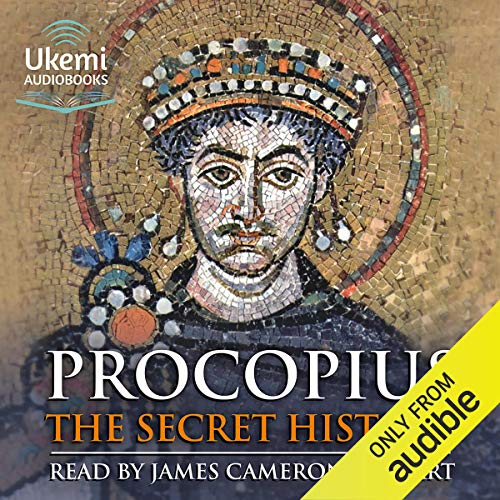
The Secret History
Summary
The Secret History, written by the sixth-century Byzantine historian Procopius, is one of the most extraordinary and scandalous documents to have survived from the early Byzantine period. Procopius, the leading official historian of his time, lived during the testing and indulgent time of Emperor Justinian the Great and wrote the official records of the successful wars and the grand building projects of his ruler. These were words of aggrandisement. But covertly, Procopius kept a very different record: The Secret History, a vivid, salacious and detailed account of the outrageous behaviour of Justinian and his wife, Theodora, and the equally corrupt, licentious and cruel members of the court and administration of the time. Secrecy was a necessary precaution for Procopius to prevent a painful and untimely death, for Justinian emerges as a grasping, ruthless and unprincipled ruler who would do anything to increase his wealth and power and who would not brook opposition on any level. No-one was safe around him - he was on a par with the worst Emperors of Rome such as Caligula. Theodora was no better - Procopius portrays her as a vulgar woman of insatiable sexual appetite given to scandalous displays and equally ready to kill to satisfy her desires. Not even Belisarius, the outstanding general of the time, was free from criticism: he is shown to be in thrall to his wife, Antonina, also a woman of wild habits, keen to pursue any person or object which appealed to her without let or hindrance. This was a time, Procopius shows, when no-one in the great capital of Constantinople was safe, a time when the rule of law could be subsumed at any time according to the whim of those in power. James Cameron Stewart reads the unabridged anonymous translation published in 1896 by The Athenian Society.
Public Domain (P)2018 Ukemi Productions Ltd

Lagash
Summary
In southern Iraq, a crushing silence hangs over the dunes. For nearly 5,000 years, the sands of the Iraqi desert have held the remains of the oldest known civilization: the Sumerians. When American archaeologists discovered a collection of cuneiform tablets in Iraq in the late 19th century, they were confronted with a language and a people who were at the time only scarcely known to even the most knowledgeable scholars of ancient Mesopotamia. The exploits and achievements of other Mesopotamian peoples, such as the Assyrians and Babylonians, were already known to a large segment of the population through the Old Testament and the nascent field of Near Eastern studies had unraveled the enigma of the Akkadian language that was widely used throughout the region in ancient times, but the discovery of the Sumerian tablets brought to light the existence of the Sumerian culture, which was the oldest of all the Mesopotamian cultures. For a people so great it is unfortunate that their accomplishments and contributions, not only to Mesopotamian civilization but to civilization in general, largely go unnoticed by the majority of the public. Perhaps the Sumerians were victims of their own success; they gradually entered the historical record, established a fine civilization, and then slowly submerged into the cultural patchwork of their surroundings. They also never suffered a great and sudden collapse like other peoples of the ancient Near East, such as the Hittites, Assyrians and Neo-Babylonians did. A close examination of Sumerian culture and chronology reveals that the Sumerians set the cultural tone in Mesopotamia for several centuries in the realms of politics/governments, arts, literature, and religion. The Sumerians were truly a great people whose legacy continued long after they were gone.
©2017 Charles River Editors (P)2017 Charles River Editors

Uruk
Summary
In southern Iraq, a crushing silence hangs over the dunes. For nearly 5,000 years, the sands of the Iraqi desert have held the remains of the oldest known civilization: the Sumerians. When American archaeologists discovered a collection of cuneiform tablets in Iraq in the late 19th century, they were confronted with a language and a people who were at the time only scarcely known to even the most knowledgeable scholars. The exploits and achievements of other Mesopotamian peoples, such as the Assyrians and Babylonians, were already known to a large segment of the population through the Old Testament and the nascent field of Near Eastern studies had unraveled the enigma of the Akkadian language that was widely used throughout the region in ancient times, but the discovery of the Sumerian tablets brought to light the existence of the Sumerian culture, which was the oldest of all the Mesopotamian cultures. Although the Sumerians continue to get second or even third billing compared to the Babylonians and Assyrians, perhaps because they never built an empire as great as the Assyrians or established a city as enduring and great as Babylon, they were the people who provided the template of civilization that all later Mesopotamians built upon. The Sumerians are credited with being the first people to invent writing, libraries, cities, and schools in Mesopotamia, and many would argue that they were the first people to create and do those things anywhere in world. For a people so great it is unfortunate that their accomplishments and contributions, not only to Mesopotamian civilization but to civilization in general, largely go unnoticed by the majority of the public. Perhaps the Sumerians were victims of their own success; they gradually entered the historical record, established a fine civilization, and then slowly submerged into the cultural patchwork of their surroundings. They also never suffered a great and sudden collapse like other peoples of the ancient Near East, such as the Hittites, Assyrians and Neo-Babylonians did. A close examination of Sumerian culture and chronology reveals that the Sumerians set the cultural tone in Mesopotamia for several centuries in the realms of politics/governments, arts, literature, and religion. The Sumerians were truly a great people whose legacy continued long after they were gone. No site better represents the importance of the Sumerians than the city of Uruk. Between the fourth and the third millennium BCE, Uruk was one of several city-states in the land of Sumer, located in the southern end of the Fertile Crescent, between the two great rivers of the Tigris and the Euphrates. Discovered in the late 19th century by the British archaeologist William Loftus, it is this site that has revealed much of what is now known of the Sumerian, Akkadian, and Neo-Sumerian people. Although Uruk was not the only city that the Sumerians built during the Uruk period, it was by far the greatest and also the source of most of the archeological and written evidence concerning early Sumerian culture. Uruk went from being the world’s first city to the most important political and cultural center in the ancient Near East in relatively quick fashion. Around 3200 BCE, the Sumerian Uruk culture began to expand beyond the borders of Sumer, which coincided with the emergence of writing. The form of writing that the Sumerians developed became known by its Greek name, cuneiform for the wedge style characters that it employed. Writing, like many other inventions throughout world history, appears to have been created because of necessity as the Uruk culture grew.
©2016 Charles River Editors (P)2016 Charles River Editors

Couchsurfing im Iran
Summary
Iran: Urlaub auf der "Achse des Bösen" Es ist offiziell verboten. Trotzdem reist Stephan Orth als Couchsurfer kreuz und quer durch den Iran, schläft auf Dutzenden von Perserteppichen, erlebt irrwitzige Abenteuer - und lernt dabei ein Land kennen, das so gar nicht zum Bild des Schurkenstaates passt. Denn die Iraner sind nicht nur Weltmeister in Sachen Gastfreundschaft, sondern auch darin, den Mullahs ein Schnippchen zu schlagen. Ob beim Rotwein-Besäufnis mit einem persischen Prinzen oder bei einem Wohnzimmer-Date mit versammelter Großfamilie, im stinkenden Schmugglerbus oder im rasenden Kleinwagen: Jede neue Begegnung fügt sich als Puzzleteil ein in das Gesamtbild eines Landes, dessen Realität komplett anders ist, als die Klischees vermuten lassen. Ein mitreißend erzählter Reisebericht über die kleinen Freiheiten und großen Sehnsüchte der Iraner. Bei der Bezeichnung "COUCHSURFING" handelt es sich um eine eingetragene Marke der Couchsurfing International, Inc. Der Titel dieses Buches und der Verlag stehen in keiner Beziehung zur Marke. Weiterhin besteht keine Partnerschaft, Zugehörigkeit, Lizenz oder sonstige Beziehung zu Couchsurfing International, Inc.
©2015 Piper (P)2016 der Hörverlag

The Hyksos
Summary
From approximately 3100 BCE until around 1075 BCE, ancient Egypt was ruled by 20 different dynasties. The length of the dynasties varied: some, such as those during the First and Second Intermediate periods could be quite short, while the 13th and 18th Dynasties each contained more a one dozen kings and ruled over the Nile Valley for around 200 years each. Although the first 20 Egyptian dynasties varied in number of rulers and length, most shared one important attribute: they were all native Egyptian dynasties. The one important exception came during Egypt's Second Intermediate Period when a mysterious foreign group of people, known as the Hyksos, conquered Egypt and established the 15th and 16th Dynasties some time shortly after 1700 BCE. For centuries, the Hyksos rule over Egypt was an enigma shrouded in half-truths and myth. The Hyksos were sometimes mistakenly associated with the biblical Israelites, but were for the most part forgotten in modern times due to the dearth of written texts that can be dated to their rule. It was only in the mid-20th century that Egyptologists, using newly discovered and translated texts, shed fresh light on the Hyksos to reveal details about their origins and rule in Egypt.
©2016 Charles River Editors (P)2016 Charles River Editors

Ancient Egyptian Myths & Legends
Summary
This book contains retold legends of the gods of ancient Egypt: legends, which were current in the "morning of the world", preserved to the present day engraved on stone and written on papyri. Retold, each in their own way, they strictly adhere to the story, but words and phrases have been rearranged according to the English method; retaining, as much as possible, the expressions and metaphors of the Egyptian. The book is intended entirely for the general public, who are increasingly interested in the religion and civilization of ancient Egypt, but whose only means of obtaining knowledge of that country is apparently through magazine stories in which a mummy is the principal character. It may be worth noting that in these legends of ancient Egypt mummies are not mentioned, except in the Duat, the home of the dead, where one naturally expects to find them. Some of the timeless legends within this book include "The Book of Thoth", "The Scorpions of Isis", "The Battles of Horus", "The Coming of the Great Queen", and more!
©2018 Game Winner LLC (P)2018 Game Winner LLC

The Start of the Russo-Turkish Wars
Summary
In terms of geopolitics, perhaps the most seminal event of the Middle Ages was the successful Ottoman siege of Constantinople in 1453. The city had been an imperial capital as far back as the fourth century, when Constantine the Great shifted the power center of the Roman Empire there, effectively establishing two almost equally powerful halves of antiquity’s greatest empire. Constantinople would continue to serve as the capital of the Byzantine Empire even after the Western half of the Roman Empire collapsed in the late fifth century. Naturally, the Ottoman Empire would also use Constantinople as the capital of its empire after their conquest effectively ended the Byzantine Empire, and thanks to its strategic location, it has been a trading center for years and remains one today under the Turkish name of Istanbul. The end of the Byzantine Empire had a profound effect not only on the Middle East but Europe as well. Constantinople had played a crucial part in the Crusades, and the fall of the Byzantines meant that the Ottomans now shared a border with Europe. The Islamic empire was viewed as a threat by the predominantly Christian continent to their west, and it took little time for different European nations to start clashing with the powerful Turks. In fact, the Ottomans would clash with Russians, Austrians, Venetians, Polish, and more before collapsing as a result of World War I, when they were part of the Central powers. In the wake of taking Constantinople, the Ottoman Empire would spend the next few centuries expanding its size, power, and influence, bumping up against Eastern Europe and becoming one of the world’s most important geopolitical players. It was a rise that would not truly start to wane until the 19th century, and in the centuries before the decline of the “sick man of Europe”, the Ottomans frequently tried to push further into Europe. Some of those forays were memorably countered by Western Europeans and the Holy League, but the Ottomans’ most frequent foe was the Russian Empire, which opposed them for both geopolitical and religious reasons. From negotiations to battles, the two sides jockeyed for position over the course of hundreds of years, and the start of the fighting may have represented the Ottomans’ best chance to conquer Moscow and change the course of history. For anyone trying to understand the origins of modern Russia and the start of the Russo-Turkish Wars, the search should begin with Tsar Peter I (1672-1725), who titled himself Peter the Great during his lifetime. The moniker is fitting, considering the manner in which Peter brought Russia out of the Middle Ages and into the 18th century. Through a series of campaigns, Peter turned Russia into a formidable empire that would subsequently become a major force on the European continent, while also emulating Western Europe and turning Russia into an international state that interacted with the other continental powers. By revolutionizing and modernizing Russian arms, including the creation of Russia’s first naval force, Peter was able to pursue an aggressive and expansionist foreign policy that set the stage for the way the European map would be redrawn again and again over the coming centuries. The Start of the Russo-Turkish Wars: The History of the Initial Conflicts Between the Russian Empire and Ottoman Empire looks at the various origins of the belligerence, how the first battles went, and how they influenced the course of both empires’ histories. You will learn about the the start of the Russo-Turkish Wars like never before.
©2020 Charles River Editors (P)2020 Charles River Editors

Osiris
Summary
To the ancient Egyptians, as was the case with any society made up of inquiring humans, the world was a confusing and often terrifying place of destruction, death, and unexplained phenomena. In order to make sense of such an existence, they resorted to teleological stories. Giving a phenomenon a story made it less horrifying, and it also helped them make sense of the world around them. Unsurprisingly, then, the ancient Egyptian gods permeated every aspect of existence. Given the abundance of funerary artifacts that have been found within the sands of Egypt, it sometimes seems as though the ancient Egyptians were more concerned with the matters of the afterlife than they were with matters of the life they experienced from day to day. This is underscored most prominently by the pyramids, which have captured the world’s imagination for centuries. Thus, it’s little surprise that Osiris was one of the most important gods in the Egyptian pantheon, and he could well be the most famous of the Egyptian gods today. Aside from the ubiquity of the sun-god Re in much of modern popular culture, it is Osiris who captivates the minds of modern readers most. His story is both familiar and strangely alien. He is the god of the dead, but he became so by the very fact of his mortality. All the gods of ancient Egypt were capable of dying, but Osiris was also a symbol of resurrection, not unlike Christ in Christian theology. Osiris was betrayed by somebody close to him (in this case, his brother Seth) and was murdered and reborn, but here is where Osiris and Christ part ways. Osiris’ death is brutal, and his resurrection is the product of his wife Isis’ love for him. Furthermore, Osiris was associated with the kings of Egypt because the Egyptians believed he was a king himself. The ancient Egyptians could trace their kings back, one by one, to a time when the gods were believed to have ruled the land in person. Osiris was the third or fourth successor to the Egyptian throne after creation, and the Egyptians believed that Osiris’ connection with kingship is what allowed their kings to be reborn in a way themselves. He was also said to be physically enormous – almost 15-and-a-half feet, according to some sources – which was said to have aided him in his military campaigns. Osiris: The History and Legacy of the Ancient Egyptian God of the Dead looks at the mythology surrounding one of antiquity’s most famous deities. You will learn about Osiris like never before.
©2018 Charles River Editors (P)2018 Charles River Editors

The Battle of Chaldiran
Summary
The town of Caldiran (Chaldiran) in Turkey is home to about 60,000 people. On a plain close to the Iranian border, it it backdropped by the Armenian Ranges and very close to a Faultline, which has ensured it’s suffered from seismic activity many times in the past. But in the early 16th century, it was the site of different kinds of faultlines, serving as a battleground between the region’s two greatest powers as they clashed over politics and religion. In the wake of taking Constantinople, the Ottoman Empire would spend the next few centuries expanding its size, power, and influence on the way to becoming one of the world’s most important geopolitical players. It was a rise that would not truly start to wane until the 19th century, and while its most memorable conflicts were fought against the Europeans, the course of Ottoman history was greatly impacted by events against the other major Muslim power in its region: the Safavid Empire. Naturally, the two powers quickly took up the geopolitical positions of the old Byzantine and Persian Empires in the time before Islam and fought over much of the same territory, including Mesopotamia, the Caucuses, today's eastern Turkey and the Persian Gulf. Their first battle was fought in 1514, their first real war was fought from 1532-1555, and they continued to spar regularly until the early 19th century, when European colonialism forced them both onto the defensive. Echoes of these conflicts can be seen in the recent sparring between Iran and Turkey through proxies in Iraq and Syria. On August 23, 1514 the two sides clashed at Chaldiran in a contest for hegemony over the Middle East, and the results have affected the Middle East ever since. Regrettably, few concrete details of the actual battle survive, a not uncommon obstacle when studying battles from the Middle Ages. However, the course of the conflict can be reconstructed from the politics of the time, knowledge of the characters involved, the contemporary records are available, and what followed the battle. There is no lasting monument to the battle in Chaldiran on site, but there is on the Iranian side of the border, nearly 20 miles to the east near the village of Gala Ashaki. It consists of a domed tomb for a Persian general, Sayyed Sharif-al-Din Ali Shirazi, who fell in the battle. He was the chief religious cleric of Shah Ismail I, the first of the Safavid rulers of Persia and a leader who brought a monumental religious shift to the Middle East. Believing himself the “Shadow of God” and his chosen vessel, he set about transforming Persia and the globe through his fanatical religious militia, the Qizilbash. He meant to lead not only Persia but the entire Islamic world, but this vision was vehemently opposed by Sultan Selim I of the Ottoman Empire. Selim the Grim had fought tenaciously for possession of his throne, and he too believed himself chosen by God to rule all Muslims. The battle is depicted in a magnificent painting in Sayyed Sharif-al-Din Ali Shirazi’s tomb. In the foreground of the representation, Shah Ismail I of Persia leads his Qizilbash in a charge against the Ottoman cavalry, riding over the corpses of the slain. In the middle, Sultan Selim (who did not actually participate in the battle, though he was present) leads an almost leisurely advance toward the Persian cavalry, preceded by two Janissaries armed with axes. In the background, the Ottoman artillery delivers a barrage into the Qizilbash, who are falling or fleeing. It seems to be a chronological depiction of the conflict, and though the figure Ismail is clearly the centerpiece, there is no attempt to mask the fact that the battle was a catastrophic defeat for the Persians.
©2019 Charles River Editors (P)2019 Charles River Editors

Egyptian Mythology
Summary
Fixate your focus on the great stories from the past, the legends from the desert lands that have been forgotten but still passed on. This mythology guide will take you back to ancient Egypt, a mysterious country with technology, knowledge, science, and superstitious beliefs about life, death, and the underworld. The book will show you what kinds of symbols they used back then. It will go over some cultural anecdotes and references that may surprise you, such as their temple worship and shabti dolls. Aside from that, the text takes you to a fantasy world of drama and tales about royalty, doom, wealth, and poverty, and the very creation of the world they believed in in that region. Discover more by getting started.
©2020 Xena Ronin (P)2020 Xena Ronin

All of Us, We All Are Arameans
Summary
Stuck with a plane ticket to Israel bought for her by a Polish Catholic ex-boyfriend, Eileen Pollack sets out on a hectic, solitary journey around the country, cataloging the region’s rich history, natural beauty, and troubled politics, while examining her own complicated relationship to her Jewish faith and heritage. In this darkly comic, incisive, and nuanced essay, Pollack upends the listener’s expectations as well as her own. A travel essay filled with bewilderment, outrage, humor, and faith, “All of Us, We All Are Arameans” takes us on a trip around Israel and the West Bank that few American tourists would have the chutzpah to attempt.Ploughshares, the literary magazine of Emerson College.
©2012 Emerson College (P)2014 Audible, Inc.

The Sumerians
Summary
When American archaeologists discovered a collection of cuneiform tablets in Iraq in the late 19th century, they were confronted with a language and a people who were at the time only scarcely known to even the most knowledgeable scholars of ancient Mesopotamia: the Sumerians. The exploits and achievements of other Mesopotamian peoples, such as the Assyrians and Babylonians, were already known to a large segment of the population through the Old Testament, and the nascent field of Near Eastern studies had unraveled the enigma of the Akkadian language that was widely used throughout the region in ancient times, but the discovery of the Sumerian tablets brought to light the existence of the Sumerian culture, which was the oldest of all the Mesopotamian cultures. Although the Sumerians continue to get second or even third billing compared to the Babylonians and Assyrians, perhaps because they never built an empire as great as the Assyrians or established a city as enduring and great as Babylon, they were the people who provided the template of civilization that all later Mesopotamians built upon. The Sumerians are credited with being the first people to invent writing, libraries, cities, and schools in Mesopotamia (Ziskind 1972, 34), and many would argue that they were the first people to create and do those things anywhere in world. For a people so great, it is unfortunate that their accomplishments and contributions, not only to Mesopotamian civilization but to civilization in general, largely go unnoticed by the majority of the public.
©2012 Charles River Editors (P)2015 Charles River Editors