The Military category has 1,612 audiobooks on Listento.it, with an average listener rating of 4.6★ across 5,283 ratings. The most-rated is The Rise and Fall of the Third Reich.

A Season of Slaughter
Summary
A gripping narrative of one of the Civil War’s most consequential engagements. In the spring of 1864, the newly installed Union commander Ulysses S. Grant did something none of his predecessors had done before: He threw his army against the wily, audacious Robert E. Lee and his Army of Northern Virginia over and over again. At Spotsylvania Court House, the two armies shifted from stalemate in the Wilderness to slugfest in the mud. Most commonly known for the horrific 22-hour hand-to-hand combat in the pouring rain at the Bloody Angle, the battle of Spotsylvania Court House actually stretched from May 8 to 21, 1864 - 14 long days of battle and maneuver. Grant, the irresistible force, hammering with his overwhelming numbers and unprecedented power, versus Lee, the immovable object, hunkered down behind the most formidable defensive works yet seen on the continent. Spotsylvania Court House represents a chess match of immeasurable stakes between two master opponents. This clash is detailed in A Season of Slaughter: The Battle of Spotsylvania Court House, May 8 - 21, 1864. A Season of Slaughter is part of the new Emerging Civil War Series offering compelling, easy-to-listen overviews of some of the Civil War’s most important stories. The masterful storytelling is richly enhanced with hundreds of photos, illustrations, and maps.
©2013 Savas Beatie (P)2019 Savas Beatie

Victory Point
Summary
In late June, 2005, media sources recounted the tragic story of 19 US special-operations personnel who died at the hands of insurgent/terrorist leader Ahmad Shah - and the lone survivor of Shah's ambush - deep in the Hindu Kush Mountains of Afghanistan. The harrowing events of Operation Red Wings marked an important - yet widely misreported - chapter in the Global War on Terror, the full details of which the public burned to learn. Victory Point reveals the complete, as-yet untold story of Operation Red Wings (often misreferenced as "Operation Redwing") and the follow-on mission, Operation Whalers. Together, these two US Marine Corps operations (that in the case of Red Wings utilized Navy SEALs for its opening phase) unfurl not as a mission gone terribly wrong, but of a complex and difficult campaign that ultimately saw the demise of Ahmad Shah and his small army of barbarous fighters. Due to the valor, courage, and commitment of the Second Battalion of the Third Marine Regiment in the summer of 2005, Afghanistan was able to hold free elections that fall. Here is the inspiring true account of heroism, duty, and brotherhood between Marines fighting the War on Terror.
©2009 Ed Darack (P)2018 Tantor

My Hero
Summary
He's broken. He's beautiful. He's a bastard. And he's mine. Caleb McCabe just returned from a tour of duty in Afghanistan. He's shell-shocked. Loud noises make him jump. He feels like an outcast in civilian society. When Caleb meets a gorgeous, fun-loving redhead named Violet, he knows he can't handle a relationship, especially with a golden girl like her. But that doesn't stop him from thinking about her day and night. Violet Jameson is studying for a degree in psychology. When she meets the ultra-hot combat hero Caleb, she's riveted not only by his rugged good looks but also by his obvious vulnerabilities. She yearns to get close to him, and to begin to heal him. They share a night of passion that's so hot she realizes she's not only in lust but in love. For Violet's sake, Caleb tries to stay away. He wants her more than he can bear, but he's afraid of hurting her with his own emotional scars. The problem is, no matter how much he fights his obsession, he can't stop himself. He has to make her his. He knows in his heart she's the one. Caleb and Violet are meant for each other, but will his dark damages get in the way of their happily ever after?
©2020 Julie Capulet (P)2020 Tantor

The Second Sino-Japanese War
Summary
If you want to discover the captivating history of the Second Sino-Japanese War, then pay attention... Many people in the West look upon the Second Sino-Japanese War, which took place in the 1930s and 1940s, as a sort of sideshow to the larger Second World War, but there is no separating the two. Imagine the Pacific War - the theater of World War II that took place in the Pacific. If the Japanese were not busy fighting on another front, they would have had millions of more troops available to fight the Americans and the British. In all likelihood, World War II would have ended the same way, but it would have taken much longer and cost that many more lives. To understand the conflict between these two Asian powers, we have to travel back in time quite a ways, for the story of what is known by many as the Second Sino-Japanese War is long and rooted deep in history. In The Second Sino-Japanese War: A Captivating Guide to Military Conflict That Began Between China and Japan, Including Events Such as the Japanese Invasion of Manchuria and the Nanjing Massacre, you will discover chapters such as: The Roots of the Conflict Japan before the War Manchuria/Manchukuo China Proper Another “Incident” The Opponents The Tragedy of Nanjing They Were Expendable The War Drags On Horrors Mostly Unknown Friends And much, much more! So, if you want to learn more about the Second Sino-Japanese War, scroll up and click the "buy now" button!
©2020 Captivating History (P)2020 Captivating History

World War II D-Day: A History from Beginning to End
Summary
D-Day, June 6, is one of the most significant dates in the calendar. The 20th century's fate hung in the balance as Nazi Germany had marched across Europe, bringing the blitzkrieg, the Holocaust, and the mad dreams of Adolf Hitler across the bloodied landscape of Europe. France had fallen, and until the Americans joined the battle in December, 1941, the balance of power was securely in the hands of the Third Reich. But even as the Allied forces joined together under the leadership of Supreme Allied Commander General Dwight D. Eisenhower, Germany continued to win battles. In order for the Nazis to be stopped, the Allies had to invade occupied Europe. And invade they did, launching the most massive amphibious landing the world had ever seen. You will hear about.... Countdown to D-Day Supreme Allied Commander Dwight D. Eisenhower The invasion planning is underway A day in June The German response The invasion End game And much more! The pantheon of heroes of the Normandy invasion includes soldiers who are unknown except for the crosses that bear their names in the cemeteries where they were buried, but all - those who died and those who survived - played their part in the liberation of Europe.
©2017 Hourly History (P)2017 Hourly History

Call to Honor
Summary
The Poseidon team are hard-bodied, fiercely competitive Navy SEALs. But when a sensitive mission goes disastrously wrong, three of the team's finest will have to trust their hearts and instincts to uncover the truth. "No man left behind" is inscribed in the DNA of every SEAL, and Lieutenant Diego Torres is no exception. But with a team member killed - and the body missing - Diego's honor is sorely tested. Now his career and reputation are on the line, and a traitor is hiding among them. Diego wants answers, and only one woman has them. Single mom Harper Maclean has two priorities - raising her son, Nathan, and starting a new life. Her mysterious new neighbor may be impossibly charming, but Diego asks too many questions about her past - and about the father of her child. Questions she fears will reveal her burning attraction for Diego and ultimately put them all in danger's path.
©2017 Tawny Weber (P)2017 Harlequin Enterprises, Limited

Forging a President
Summary
"There are few sensations I prefer to that of galloping over these rolling limitless prairies, with rifle in hand, or winding my way among the barren, fantastic and grimly picturesque deserts of the so-called Bad Lands." (Theodore Roosevelt) He was born a city boy in Manhattan; but it wasn't until he lived as a cattle rancher and deputy sheriff in the wild country of the Dakota Territory that Theodore Roosevelt became the man who would be president. "I have always said I would not have been president had it not been for my experience in North Dakota," Roosevelt later wrote. It was in the "grim fairyland" of the Bad Lands that Roosevelt became acquainted with the ways of cowboys, Native Americans, trappers, thieves, and wild creatures - and it was there that his spirit was forged and tested. In Forging a President, author William Hazelgrove uses Roosevelt's own reflections to immerse listeners in the formative seasons that America's 26th president spent in "the broken country" of the Wild West.
©2017 William Hazelgrove (P)2017 Regnery Publishing

The War for All the Oceans
Summary
Roy Adkins, with his wife, Lesley, returns to the Napoleonic War in The War for All the Oceans, a gripping account of the naval struggle that lasted from 1798 to 1815, a period marked at the beginning by Napoleon's seizing power and at the end by the War of 1812. In this vivid and visceral account, Adkins draws on eyewitness records to portray not only the battles but also the details of a sailor's life: shipwrecks, press-gangs, prostitutes, spies, and prisoners of war. The War for All the Oceans is epic narrative history, sure to appeal to fans of Patrick O'Brian and C. S. Forester, as well as all readers of military and social history.
©2007 Roy Adkins and Lesley Adkins (P)2007 Tantor Media Inc.

Hitler's Scientists
Summary
When Hitler came to power in the 1930s, Germany had led the world in science, mathematics, and technology for nearly four decades. But while the fact that Hitler swiftly pressed Germany's scientific prowess into the service of a brutal, racist, xenophobic ideology is well known, few realize that German scientists had knowingly broken international agreements and basic codes of morality to fashion deadly weapons even before World War I. In Hitler's Scientists, historian John Cornwell explores German scientific genius in the first half of the twentieth century and shows how Germany's early lead in the new physics led to the discovery of atomic fission, which led the way to the atom bomb, and how the ideas of Darwinism were hijacked to create the lethal doctrine of racial cleansing. By the war's end, almost every aspect of Germany's scientific culture had been tainted by the exploitation of slave labor, human experimentation, and mass killings. Ultimately, it was Hitler's profound scientific ignorance that caused the Fatherland to lose the race for atomic weapons, which Hitler would surely have used. Cornwell argues that German scientists should be held accountable for the uses to which their knowledge was put, an issue with wide-ranging implications for the continuing unregulated pursuit of scientific progress.
©2003 John Cornwell (P)2003 Listen & Live Audio, Inc. Recorded by arrangement with Viking Penguin, a member of Penguin Group (USA) Inc.

Battle of Bunker Hill (A History From Beginning to End)
Summary
Discover the remarkable history of the Battle of Bunker Hill.... Free bonus Inside! In every war, there are those battles that mark a turning point, after which everything is different. These are the battles that help determine how the war will proceed. The Battle of Bunker Hill was one of those battles in the American Revolutionary War. While it was a battle that the American rebels lost, it was significant because it showed that a rag-tag band of civilian soldiers could in fact stand up to the best trained and most experienced military in the world at that time. Despite losing the battle, the American colonists managed to repulse the British advances twice before finally running out of ammunition during the third assault. Additionally, they killed or injured over 1,000 British soldiers as compared to only suffering a little over 400 casualties among their own ranks. It came as a surprise to the British who had gone into the battle supremely confident that they would easily win. They didn’t count on the spirit of the colonial rebels who were, by that time, committed to the fight. The Battle of Bunker Hill changed the entire tone of the American Revolutionary War - from that point forward, the British knew they were in for a long, difficult fight, and the colonists had the confidence they needed to declare their independence from Great Britain and establish their own new country, the United States of America. Discover a plethora of topics such as: The Shot Heard Round the World: Lexington and Concord Preparing for Battle The Battle of Bunker Hill Battle Analysis Notable Participants Political Consequences And much more! So if you want a concise and informative book on the Battle of Bunker Hill, then buy now!
©2020 Hourly History (P)2020 Hourly History

If Chaos Reigns
Summary
"Gentlemen, do not be daunted if chaos reigns; it undoubtedly will." So said Brigadier S. James Hill, commanding officer of the British 3rd Parachute Brigade, in an address to his troops shortly before the launching of Operation Overlord - the D-Day invasion of Normandy. No more prophetic words were ever spoken, for chaos indeed reigned on that day, and many more that followed. Much has been written about the Allied invasion of France, but award-winning military historian Flint Whitlock has put together a unique package - the first history of the assault that concentrates exclusively on the activities of the American, British, and Canadian airborne forces that descended upon Normandy in the dark, pre-dawn hours of 6 June 1944. Landing into the midst of the unknown, the airborne troops found themselves fighting for their lives on every side in the very jaws of the German defenses, while striving to seize their own key objectives in advance of their seaborne comrades to come. Whitlock details the formation, recruitment, training, and deployment of the Allies' parachute and glider troops. First-person accounts by the veterans who were there - from paratroopers to glidermen to the pilots who flew them into the battle, as well as the commanders (Eisenhower, Taylor, Ridgway, Gavin, and more) - make for compelling, "you-are-there" listening. If Chaos Reigns is a fitting tribute to the men who rode the wind into battle and managed to pull victory out of confusion, chaos, and almost certain defeat. Author/military historian Flint Whitlock graduated from the Army's Airborne School at Ft. Benning, GA, in 1965 and spent five years on active duty, including a combat tour in Vietnam. He is the author of nine books, six of which are about World War II, and is currently the editor of WWII Quarterly. He has appeared in documentaries on The History Channel and on the Fox Channel's War Stories with Oliver North, and now lives in Denver, CO.
©2011 Flint Whitlock (P)2013 Audible, Inc.

Den kolde krig
Summary
Under 2. verdenskrig havde USA og Sovjet kæmpet sammen mod Tysklands diktator, Adolf Hitler. Men da krigen sluttede i 1945, blev de to supermagter hurtigt fjender. Fra 1945 til 1989 foregik der en krig mellem de to parter, man i dag kalder Den kolde krig. Lyt med, og få et overblik over de vigtigste begivenheder i Den kolde krig, som flere gange kunne have udløst en altødelæggende atomkrig mellem de to supermagter. Søren Elmerdahl Hemmingsen (f. 1966) er cand.mag. i historie og dansk fra Københavns Universitet 1995 og har siden 2000 undervist i historie, samfundsfag og kristendom i folkeskolen. Han er forfatter til flere historiebøger og undervisningsmaterialer for børn.
©2020 Lindhardt og Ringhof (P)2020 Lindhardt og Ringhof

On the Bottom
Summary
On September 25, 1925, the S-51 tragically sank to the ocean floor, and Edward Ellsberg was the man whose courage and determination brought it back The sinking of the submarine S-51 was one of the greatest tragedies in American naval history. Due to a miscommunication and subsequent collision between the sub and a passing steamship on a September night, the S-51, including 33 of its crew of 36, sank to the ocean depths. The tragedy of the S-51 captivated the nation, and was a fixture in the pages of American newspapers. The story took on a whole new dimension when the navy decided to take over the salvage of the 1,000-ton behemoth from a civilian company. Heading the crew tasked with this impossible feat was Edward Ellsberg, at the time a lieutenant commander. On the Bottom is Ellsberg's account of the successes and failures he and his men experienced as they attempted an astonishing feat of engineering and bravery: the first salvage of a submarine from the open ocean.
©1946 Dodd, Mead and Company, Inc. (P)2014 Audible Inc.
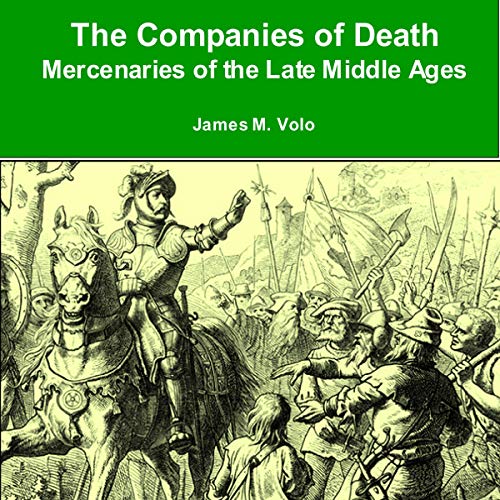
The Companies of Death: Mercenaries of the Late Middle Ages
Summary
During the rise of feudalism, the best weapon systems of the day had only been available to the select few, usually the lords and knights of the realm who had the income that could support them. As technology advanced, the crossbow, arbalest, and firearms were developed and a relatively untrained foot soldier could kill a knight with a single shot, canceling out a lifetime of mounted discipline. The more egalitarian methods of military organization in the Late Middle Ages and the Rennaisance challenged the nobility’s supremacy on the battlefield and ushered in the age of a more modern form of warfare with its more cynical and predatory aspect — the professional mercenary. The true interest in the centuries of the High Middle Ages lies with the gradual evolution of new forms of military efficiency, which ended in the establishment of a military caste as the chief power in war and the human mechanism of government. The 15th century in particular was an era of change in military science. Many of the same forces that inspired the Renaissance in science, art, literature, governance, and society brought about changes in the right form of war. It was in this environment that the condottieri flourished. These mercenary bands of professional warriors largely replaced the knights of a more chivalric era.
©2020 James M Volo (P)2020 James M Volo

Worth Fighting For
Summary
From New York Times and USA Today best-selling author Laura Kaye… Getting in deep has never felt this good... Commercial diver Tara Hunter nearly lost everything in an accident that saw her medically discharged from the navy. With the help of the Warrior Fight Club, she’s fought hard to overcome her fears and get back in the water where she’s always felt most at home. At work, she’s tough, serious, and doesn’t tolerate distractions. Which is why finding her gorgeous one-night stand on her new dive team is such a problem. Former navy deep-sea diver Jesse Anderson just can’t seem to stop making mistakes - the latest being the hot-as-hell night he’d spent with his new partner. This job is his second chance, and Jesse knows he shouldn’t mix business with pleasure. But spending every day with Tara’s smart mouth and sexy curves makes her so damn hard to resist. Joining Tara’s wounded warrior MMA training program seems like the perfect way for Jesse to blow off steam - except now they’re getting in deep and taking each other down day and night. And even though it breaks all the rules, their inescapable attraction might just be the only thing truly worth fighting for.
©2019 Laura Kaye (P)2019 Audible, Inc.

Returning Home by the Sea
Summary
Returning Home by the Sea is book 10 in Traci Hall’s Read by the Sea Contemporary Military Romance series. You can read them all in any order. We hope you enjoy Returning Home by the Sea.
Captain Brayden Hamilton nearly died in Mosul, and now his married life is under fire. He offers his wife, Zoe, a divorce to protect her from wounds he has yet to divulge. When she finds out, she’s furious, and hurt - she knew what she was getting into when she married a man in the military.
Can these two mend the injuries from more than one kind of war and have their love triumph in the end?
©2016 Traci Hall (P)2018 Traci Hall

Victory City
Summary
From John Strausbaugh, author of City of Sedition and The Village, comes the definitive history of Gotham during the World War II era. New York City during World War II wasn't just a place of servicemen, politicians, heroes, GI Joes, and Rosie the Riveters, but also of quislings and saboteurs; of Nazi, fascist, and communist sympathizers; of war protesters and conscientious objectors; of gangsters and hookers and profiteers; of latchkey kids and bobby-soxers, poets and painters, atomic scientists and atomic spies. While the war launched and leveled nations, spurred economic growth, and saw the rise and fall of global fascism, New York City would eventually emerge as the new capital of the world. From the Gilded Age to VJ-Day, an array of fascinating New Yorkers rose to fame, from Mayor Fiorello La Guardia to Franklin and Eleanor Roosevelt, Langston Hughes to Joe Louis, to Robert Moses and Joe DiMaggio. In Victory City, John Strausbaugh returns to tell the story of New York City's war years with the same richness, depth, and nuance he brought to his previous books, City of Sedition and The Village, providing listeners with a groundbreaking new look into the greatest city on earth during the most transformative - and costliest - war in human history. PLEASE NOTE: When you purchase this title, the accompanying PDF will be available in your Audible Library along with the audio.
©2018 John Strausbaugh (P)2018 Hachette Audio

Forgotten Fifteenth
Summary
November 1943 to May 1945. The US Army Air Forces waged an unprecedentedly dogged and violent campaign against Hitler's vital oil production and industrial plants on theThird Reich's southern flank. Flying from southern Italy, far from the limelight enjoyed by the Eighth Air Force in England, the Fifteenth Air Force engaged in high-risk missions spanning most of the European continent. The story of the Fifteenth Air Force deserves a prideful place in the annals of American gallantry. In Forgotten Fifteenth, Barrett Tillman brings into focus a seldom-seen multinational cast of characters, including pilots from Axis nations Romania, Hungary, and Bulgaria and many more remarkable individuals. They were the first generation of fliers - few of them professionals - to conduct a strategic bombing campaign against a major industrial nation. They suffered steady attrition and occasionally spectacular losses. In so doing, they contributed to the end of the most destructive war in history. Forgotten Fifteenth is the first-ever detailed account of the Fifteenth Air Force in World War II and the brave men that history has abandoned. This book is a must-read for military history enthusiasts, veterans, and current servicemen and their families.
©2014 Barrett Tillman (P)2014 Blackstone Audio

Battle of Midway - World War II
Summary
The Japanese attack on Pearl Harbor on December 7, 1941 had dealt a catastrophic blow to the US Navy, but it had not knocked out all of the US carriers. That was an omission that Admiral Isoroku Yamamoto, Japan’s fleet commander, intended to rectify by invading a site close to Pearl Harbor. The surprise attack on Pearl Harbor had worked out well for the Japanese - why not try another one on Midway Island? The plan was to destroy the Americans when they launched a counterattack. Japan, then, would rule the Pacific and continue the expansion of its empire. What Yamamoto didn’t know was that Japanese fleet codes had been broken and that Pacific Fleet Commander Admiral Chester Nimitz, privy to what the Japanese planned to do, was able to place the American carriers where they would catch the Japanese off guard as they prepared to launch air strikes on Midway Island. Inside, you will hear about: Not ready for war The crucial codebreaker Nimitz, commander in chief Preparing for battle The battle that changed the tide of war The legacy of the Battle of Midway And much more! After the Battle of Midway, the Japanese were forced into the position of trying to defend the territory they had previously taken; their dreams of expanding their acquisitions and becoming the dominant power in the Pacific were gone. The tide of war in the Pacific had shifted.
©2018 Hourly History (P)2018 Hourly History

Washington's Immortals
Summary
In August 1776, a little over a month after the Continental Congress had formally declared independence from Britain, the revolution was on the verge of a sudden and disastrous end. General George Washington found his troops outmanned and outmaneuvered at the Battle of Brooklyn, and it looked like there was no escape. But thanks to a series of desperate rear-guard attacks by a single heroic regiment, famously known as the Immortal 400, Washington was able to evacuate his men, and the nascent Continental Army lived to fight another day. Today, only a modest rusted and scarred metal sign near a dilapidated auto garage marks the mass grave where the bodies of the "Maryland Heroes" lie - 256 men "who fell in the Battle of Brooklyn". In Washington's Immortals, best-selling military historian Patrick K. O'Donnell brings to life the forgotten story of this remarkable band of brothers. Known as "gentlemen of honor, family, and fortune", they fought not just in Brooklyn but also in key battles, including Trenton, Princeton, Camden, Cowpens, Guilford Courthouse, and Yorktown, where their heroism changed the course of the war. Drawing on extensive original sources, from letters to diaries to pension applications, O'Donnell pieces together the stories of these brave men - their friendships, loves, defeats, and triumphs. He explores their arms and tactics, their struggles with hostile loyalists and shortages of clothing and food, their development into an elite unit, and their dogged opponents, including British general Lord Cornwallis. And through the prism of this one group, O'Donnell tells the larger story of the Revolutionary War. Washington's Immortals is gripping and inspiring boots-on-the-ground history, sure to appeal to a wide audience.
©2016 Patrick K. O’Donnell (P)2016 Blackstone Audio, Inc.