Stephen Paul Aulridge Jr. has narrated 44 audiobooks on Listento.it by 25 authors, with an average listener rating of 4.1★ across 103 ratings. The most-rated is How to Be Miserable.

How to Be Miserable
Summary
In How to Be Miserable, psychologist Randy Paterson outlines 40 specific behaviors and habits which - if followed - are sure to lead to a lifetime of unhappiness. On the other hand, if you do the opposite, you may yet join the ranks of happy people everywhere! There are stacks upon stacks of self-help books that will promise you love, happiness, and a fabulous life. But how can you pinpoint the exact behaviors that cause you to be miserable in the first place? Sometimes when we're depressed, or just sad or unhappy, our instincts tell us to do the opposite of what we should - such as focusing on the negative, dwelling on what we can't change, isolating ourselves from friends and loved ones, eating junk food, or overindulging in alcohol. Sound familiar? This tongue-in-cheek guide will help you identify the behaviors that make you unhappy and discover how you - and only you - are holding yourself back from a life of contentment. You'll learn to spot the tried-and-true traps that increase feelings of dissatisfaction, foster a lack of motivation, and detract from our quality of life - as well as ways to avoid them. So, get ready to live the life you want (or not?). This fun, irreverent guide will light the way.
©2016 Randy J. Patterson (P)2016 Wetware Media

The Worry Trick
Summary
Are you truly in danger or has your brain simply "tricked" you into thinking you are? In The Worry Trick, psychologist and anxiety expert David Carbonell shows how anxiety hijacks the brain and offers effective techniques to help you break the cycle of worry, once and for all. Anxiety is a powerful force. It makes us question ourselves and our decisions, causes us to worry about the future, and fills our days with dread and emotional turbulence. Based in acceptance and commitment therapy (ACT) and cognitive behavioral therapy (CBT), this audiobook is designed to help you break the cycle of worry. Worry convinces us there's danger, and then tricks us into getting into fight, flight, or freeze mode - even when there is no danger. The techniques in this audiobook, rather than encouraging you to avoid or try to resist anxiety, show you how to see the trick that underlies your anxious thoughts, and how avoidance can backfire and make anxiety worse. If you're ready to start observing your anxious feelings with distance and clarity - rather than getting tricked once again - this audiobook will show you how.
©2016 David A. Carbonell (P)2016 Wetware Media

My Inventions: The Autobiography of Nikola Tesla
Summary
Nikola Tesla was a Serbian-American inventor, electrical engineer, mechanical engineer, physicist, and futurist, who is best known for his contributions to the design of the modern alternating current (AC) electricity supply system. Born and raised in the Austrian Empire, Tesla received an advanced education in engineering and physics in the 1870s and gained practical experience in the early 1880s working in telephony and at Continental Edison in the new electric power industry. He emigrated to the United States in 1884, where he would become a naturalized citizen. He worked for a short time at the Edison Machine Works in New York City before he struck out on his own. With the help of partners to finance and market his ideas, Tesla set up laboratories and companies in New York to develop a range of electrical and mechanical devices. His alternating current (AC) induction motor and related polyphase AC patents, licensed by Westinghouse Electric in 1888, earned him a considerable amount of money and became the cornerstone of the polyphase system that the company would eventually market. Attempting to develop inventions he could patent and market, Tesla conducted a range of experiments with mechanical oscillators/generators, electrical discharge tubes, and early X-ray imaging. He also built a wireless-controlled boat, one of the first ever exhibited. Tesla became well known as an inventor and would demonstrate his achievements to celebrities and wealthy patrons at his lab, and was noted for his showmanship at public lectures.
Public Domain (P)2018 Dreamtown Publishing

Rage
Summary
Do you or someone you care about experience episodes of extreme and unpredictable anger? Intense rages that threaten relationships, jobs, property - or worse? The first thing you need to know is that you are not alone. Researchers estimate that some seven percent of Americans may at some time experience a condition called intermittent explosive disorder (IED), which is characterized by reoccurring periods of extraordinary anger, and millions more have less frequent yet equally damaging experiences with rage. The second thing you need to know is that there is help. Rage can be calmed and controlled with good advice and a practical, effective plan for change. From renowned anger expert Ronald Potter-Efron, this book breaks down rage into four types: In survival rage, anger is triggered by a sense of danger or threat; feelings of helplessness can trigger impotence rage; the third type, abandonment rage, is triggered by a fear of losing a cherished relationship; and shame rage occurs when someone feels very disrespected. Rage briefly discusses how the brain functions during extreme emotion, and then it turns to the task of helping you stop episodes of rage - right now! In classic Potter-Efron style, the book places the responsibility for control squarely on the shoulders of the angry individual. There is no room in this dangerous situation for whys and becauses. Instead, Rage offers no-nonsense, step-by-step anger management tools that really work.
©2007 Ronald Potter-Efron (P)2017 Wetware Media

The User's Guide to the Human Mind
Summary
Your mind is not built to make you happy; it's built to help you survive. So far, it's done a great job! But in the process, it may have developed some bad habits, like avoiding new experiences or scrounging around for problems where none exist. Is it any wonder that worry, bad moods, and self-critical thoughts so often get in the way of enjoying life? Based in acceptance and commitment therapy (ACT), The User's Guide to the Human Mind is a road map to the puzzling inner workings of the human mind, replete with exercises for overriding the mind's natural impulses toward worry, self-criticism, and fear, and helpful tips for acting in the service of your values and emotional well-being - even when your mind has other plans.
©2011 Shawn T. Smith (P)2015 Wetware Media

The Physics of Angels
Summary
What are angels? Many people believe in angels, but few can define these enigmatic spirits. Now visionary theologian Matthew Fox and acclaimed biologist Rupert Sheldrake - pioneers in modern religious thinking and scientific theory - launch a groundbreaking exploration into the ancient concept of the angel and restore dignity, meaning, and joy to the time-honored belief in these heavenly beings. Angels constitute one of the most fundamental themes in human spiritual and religious experience. All cultures acknowledge the existence of spirits at levels beyond the human. In the West we call them angels, but they go under different names in other traditions. (Native Americans, for example, call them "spirits.") We are entering a new phase of both science and theology. Fox and Sheldrake explore many significant questions raised by both traditions about the existence and role of consciousness beyond the human level. This dialog between Fox and Sheldrake concentrates on three giants of the Western tradition whose treatment of angels is particularly broad, deep, and influential. They are Dionysius the Areopagite, a Syrian monk whose classic work The Celestial Hierarchies was written in the sixth century; Hildegard of Bingen, a German abbess of the twelfth century; and St. Thomas Aquinas, a philosopher-theologian of the thirteenth century. Fox and Sheldrake have selected their most important and relevant passages about angels, and each is followed by a discussion exploring their meaning from both a theological and a scientific perspective. Also explored are the fascinating parallels between Thomas Aquinas speaking of angels in the Middle Ages and Albert Einstein speaking of photons in this century. Hence the title of this book, The Physics of Angels. The exploration of angels in a living cosmos enlivens and enriches both religion and science and contributes to the deepening exploration of consciousness - on this planet and beyond.
©2014 Matthew Fox and Rupert Sheldrake (P)2015 Wetware Media

The Awakened Introvert
Summary
Introverts are powerful observers and creators. If you are an introvert, this book will show you how to tap in to your inherent introvert strengths and awaken your potential using mindfulness meditations and cognitive behavioral techniques. In a world that favors the outgoing, gregarious extrovert, being an introvert can be difficult. But the truth is that introverts have distinct advantages - as long as they know how to use them. Unlike extroverts, who draw their energy from social interaction, your energy comes from quiet reflection. Is it any wonder, then, that mindfulness can help you hone your natural talents? In The Awakened Introvert, mindfulness expert and card-carrying introvert Arnie Kozak provides a comprehensive set of mindfulness and cognitive behavioral tools to help you maximize your introvert strengths (such as rich access to your interior) while minimizing your introvert weaknesses (such as a tendency toward worry and rumination). In the book, you'll learn powerful strategies to help you monitor your energy; recharge after social interactions; improve social and communication skills; and take advantage of your capacity for quiet reflection and sweet, sweet solitude. If you're looking to unlock the full potential of your unique introvert brain, this book provides a fun, practical, and authentic user's manual.
©2015 Arnie Kozak (P)2015 Wetware Media
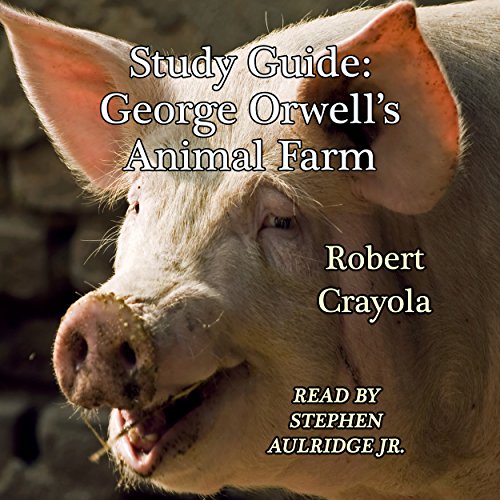
Study Guide: George Orwell's Animal Farm
Summary
George Orwell's Animal Farm is a dark fable showing the dangers of propaganda and totalitarianism. With this new guide, you will have an even greater understanding of the book. Included in this guide: a biography of author George Orwell, a look at the novel's historical context, its literary elements, detailed chapter summaries, analysis, and suggestions for essays. This is the definitive guide to Animal Farm - concise, easy to understand, and guaranteed to add to your enjoyment of this classic story.
©2016 Robert Crayola (P)2016 Robert Crayola

Good Is the New Cool
Summary
Marketing has an image problem. Media-savvy millennials, and their younger Gen Z counterparts, no longer trust advertising, and they demand increased social responsibility from their brands - while still insisting on cutting-edge products with on-trend design. As always, brands need to be cool - but now they need to be good, too. It's a tall order, and with new technology empowering consumers to bypass advertisements altogether, it won't be long before the old, advertising-based marketing model goes the way of the major label. If only there was a new model, one that allowed companies to address environmental, civic, and economic issues in a way that grew their brand and business, while giving back to society, and re-branding branding as a powerful force for good. Enter Good is the New Cool, a bold new manifesto from marketing experts Afdhel Aziz and Bobby Jones. In provocative, whip-smart, and streetwise style, they take aim at conventional marketing, posing the questions few have had the vision and courage to ask: If the system is broken, how can we fix it? Rather than sinking money into advertising, why not create a new model, in which great marketing optimizes life? With seven revolutionary new principles and insights and interviews from a new generation of marketers, social entrepreneurs, and leaders of such brands as Zappos, Citibank, The Honest Company, as well as the culture creators working with artists like Lady Gaga, Pharrell, and Justin Bieber, this rule-breaking book is the new business model for the 21st century, and a call to action for anyone interested in building a better tomorrow. This visionary book won’t just change your business—it will change the world.
©2016 Afdhel Aziz and Bobby Jones (P)2016 Wetware Media, LLC

World War I: A History from Beginning to End
Summary
World War I, or the Great War, was believed to be "the war to end all wars". Because of the incredible extent of destruction and the staggering number of wounded and dead, even those who lived through it could scarcely comprehend its horror. Beginning in 1914, alliances between powerful nations soon plunged the world into a global conflict. Fighting - including miserable trench warfare - broke out in practically every corner of Europe and spread around the world to Africa, Asia, and the Middle East. Inside you will hear about.... The Causes of World War I The War in Europe: The Western Front The War in the Balkans and the Ottoman Empire The United States Russia and the War in Eastern Europe The Impact of World War I And much more! Even the peace treaty in 1919, which occurred during a deadly worldwide influenza pandemic, brought no relief; another world war, intricately connected to the first, would break out in only two short decades.
©2017 Hourly History (P)2018 Hourly History

Raising Hell
Summary
Thirsty? Take one reckless party boy. (That's me.) Add an irresistible, hunky math teacher. (He's stupid-hot and driving me crazy.) Throw in one ice-princess baby sister who hates my guts. (We'll work on that later.) And you get: One HELL-raising cocktail of trouble. Welcome to my life. Please drink responsibly. Contains mature themes.
©2018 Daryl Banner (P)2019 Tantor

Connecting with Coincidence
Summary
We've all experienced or heard of surprising events and unexplainable coincidences - money that seems to come from nowhere, a spontaneous idea that turns into a life-changing solution, meeting your soul mate on a flight you weren't supposed to take, or families being reunited by accident after years of separation. Often these coincidences are explained as being controlled by a higher power or pure chance. But for the first time since Carl Jung's work comes bold new research that explains scientifically how we can identify, understand, and perhaps even control the frequency of coincidences in our everyday lives. Bernard Beitman, a leading expert on coincidence studies, proposes a greater personal responsibility that depends partly upon newly discovered "grid cells" located in the brain, near the hippocampus. But neuroscience cannot complete the entire puzzle, and in this fascinating guide, Beitman provides the missing piece. While analyzing true stories of synchronicity from around the globe and throughout history, he shares key personality characteristics and situational factors that contribute to the occurrence of meaningful coincidences in our lives. Where other books on coincidences tend to be theoretical, inspirational, or story collections only, Beitman's book is the first to provide a scientific understanding and practical ways in which listeners can use them in their own lives. He reveals: How to activate your observing, self so you don't miss synchronistic moments How serendipity can offer insights into solving problems or making difficult decisions Why stress activates meaningful coincidences Which states of mind impede our ability to experience synchronicity How to interpret the meaning of a coincidence Why being attuned to coincidences is a learned skill - and how to hone your sensitivity
©2016 Bernard B. Beitman (P)2016 Wetware Media

American Maelstrom: The 1968 Election and the Politics of Division
Summary
American Maelstrom captures the full drama of the watershed election of 1968, establishing this year as the hinge between the decline of political liberalism, the ascendancy of conservative populism, and the rise of anti-government attitudes that continue to dominate the nation's political discourse. This sweeping and immersive book, equal parts compelling analysis and thrilling narrative, takes us to the very source of our modern politics of division. In 1965, Lyndon Johnson announced the most ambitious government agenda in decades. Three years later, everything had changed. Johnson's approval ratings had plummeted; the liberal consensus was shattered; the war in Vietnam splintered the nation; and the politics of civil rights had created a fierce white backlash. The National Committee for an Effective Congress warned of a "national nervous breakdown". The election of 1968 was immediately caught up in a swirl of powerful forces, and the nine men who sought the nation's highest office that year attempted to ride them to victory - or merely survive them. On the Democratic side, Eugene McCarthy energized the anti-war movement; George Wallace spoke to the working-class white backlash; Robert Kennedy took on the mantle of his slain brother. Entangled in Vietnam, Johnson, stunningly, opted not to run again, scrambling the odds. On the Republican side, Richard Nixon outhustled Nelson Rockefeller, Ronald Reagan, and George Romney, by navigating between the conservative and moderate wings of the Republican Party. The assassinations of Martin Luther King, Jr. and Kennedy seemed to push the country to the brink of chaos, a chaos reflected in the Democratic Convention in Chicago, a televised horror show. Vice President Hubert Humphrey emerged as the nominee, and nearly overcame the lead long enjoyed by Nixon, who, by exploiting division and channeling the national yearning for order, would be the last man standing.
©2016 Michael A. Cohen (P)2016 Wetware Media

The Sumerians: A History from Beginning to End
Summary
The Sumerians settled in the area known as Mesopotamia, between the Tigris and Euphrates Rivers, around 5,000 years ago. They produced many fundamental changes to the way in which human societies developed - these were the first city-builders, the first people to use wheeled vehicles, the first methodical astronomers, and the first people to develop a sophisticated written language. The Sumerians also produced art, music, and literature as well as created some of the first professional soldiers the world had ever seen. But for all that we know about the Sumerians, one central mystery remains: We have no idea where the Sumerians came from when they suddenly arrived in Mesopotamia 5,000 years ago. Many people have put forward answers ranging from the plausible to the esoteric to the (literally) out of this world, but none of the solutions suggested to date appears to provide a complete or final answer. From this audiobook you will learn about... The Black Heads Arrive The Conquest of Sumer Sumerian Society and Religion Technology and Writing Music and Art Mysteries of the Sumerians And much more! When looking at how Homo sapiens have developed from primitive tribes of hunter-gatherers to today’s urban dwellers, the Sumerians represent one of the biggest and most dramatic single periods of change ever achieved by the human race. This is the story of the advanced, ingenious, and mysterious Sumerians.
©2018 Hourly History (P)2019 Hourly History

World War II Stalingrad: A History from Beginning to End
Summary
The Battle of Stalingrad, perceived by historians as the most important battle of World War II and regarded by Russians as the most significant battle in their country’s history, cannot be viewed solely as a military engagement between two powerful, long-time foes. The Soviet Union, which had climbed to power from the shambles of the 1917 Revolution that saw communism overthrow the czar, and Germany, which had risen from the ashes of World War I’s Treaty of Versailles, certainly had a complicated history. Stalingrad was a battle between the Allies and the Axis Powers; it was a struggle between the Soviet Union and Germany for victory; and it was also a test of wills between Josef Stalin and Adolf Hitler, two totalitarian dictators who were willing to do whatever was necessary to demonstrate the supremacy of their systems of government. Inside you will read about.... Josef Stalin: man of steel Adolf Hitler: a quest for vengeance Operation Barbarossa The Stalingrad Street Fighting Academy The heroes of Stalingrad And much more! Stalin had succeeded Vladimir Lenin as the leader of the Soviet Union, and his entry upon the world stage ushered in a reign of absolute power as he bent a battered nation to conform to his will. Adolf Hitler, leader of the National Socialist German Workers Party, was elected chancellor of Germany in 1933 and promptly turned the beleaguered nation into a launch pad for Aryan domination. As their armies met at Stalingrad for a long and bloody struggle that would ultimately tally two million civilian and military casualties, the world would watch as two brutal regimes challenged one another while the fate of the free world hung in the balance.
©2017 Hourly History (P)2017 Hourly History

Metal
Summary
Where survival is the meaning of life. A speculative fiction serial of adventure novellas set in a strange and punishing world. In book one, Metal, a woman finds herself in two different worlds, as two different people. In one she is a criminal, sentenced to a new and terrible punishment. In the other, she is a stranger and then a prophet, granted the visions of God.
©2018 Erec Stebbins (P)2018 Erec Stebbins

Hollywood Murders and Scandals
Summary
Hollywood Murders and Scandals: Tinsel Town After Dark is a collection of some of the most famous murders, infamous scandals, and Hollywood crimes going right back to the beginnings of Hollywood itself. From Fatty Arbuckle to Charles Manson and Frances Farmer to O.J. Simpson, the stories of celebrity crimes will capture your imagination as they describe the backstories of the major characters, the circumstances of the crimes, and the results of the investigations. Included are: Beautiful Evelyn Nesbit's murderously jealous husband The gruesome Black Dahlia case The Bugsy Siegel mystery Anna Nicole Smith's untimely death And much more. Included is a short history of the place called Hollywood from its humble beginnings as a one-hut bump in the road to the glitzy, glamorous hotspot it is today. Many of your questions about these Hollywood murders will be answered, and you will be amazed by all the facts and theories contained in this book associated with these tales of celebrity murders. Click "buy" above to get your copy of Hollywood Murders and Scandals: Tinsel Town After Dark now!
©2014 Maica International LC (P)2015 Maica International LLC

The Nurture Effect
Summary
A fascinating look at the evolution of behavioral science, the revolutionary way it's changing the way we live, and how nurturing environments can increase people's well-being in virtually every aspect of our society, from early childhood education to corporate practices. If you want to know how you can help create a better world, listen to this book. What if there were a way to prevent criminal behavior, mental illness, drug abuse, poverty, and violence? Written by behavioral scientist Tony Biglan, and based on his ongoing research at the Oregon Research Institute, The Nurture Effect offers evidence-based interventions that can prevent many of the psychological and behavioral problems that plague our society. For decades behavioral scientists have investigated the role our environment plays in shaping who we are, and their research shows that we now have the power within our own hands to reduce violence, improve cognitive development in our children, increase levels of education and income, and even prevent future criminal behaviors. By cultivating a positive environment in all aspects of society - from the home to the classroom and beyond - we can ensure that young people arrive at adulthood with the skills, interests, assets, and habits needed to live healthy, happy, and productive lives. The Nurture Effect details over 40 years of research in the behavioral sciences as well as the author's own research. Biglan illustrates how his findings lay the framework for a model of societal change that has the potential to reverberate through all environments within society.
©2015 Anthony Biglan (P)2015 Wetware Media

The Four Freedoms
Summary
The specter of global war loomed large in President Franklin Roosevelt's mind as he prepared to present his 1941 State of the Union address. He believed the United States had a role to play in the battle against Nazi and fascist aggression already underway in Europe, yet his rallying cry to the nation was about more than just national security or why Americans should care about a fight still far overseas. He instead identified how Americans defined themselves as a people, with words that resonated and defined the parameters of American politics and foreign policy for generations. Roosevelt framed America's role in the conflict, and ultimately its role in forging the post-war world to come, as a fight for freedom. Four freedoms, to be exact: freedom of speech, freedom from want, freedom of religion, and freedom from fear. In this new look at one of the most influential presidential addresses ever delivered, historian Jeffrey A. Engel joins together with five other leading scholars to explore how each of Roosevelt's freedoms evolved over time, for Americans and for the wider world. They examine the ways in which the word "freedom" has been used by Americans and others, across decades and the political spectrum. However, they are careful to note that acceptance of the freedoms has been far from universal - even within the United States. Freedom from want, especially, has provoked clashes between those in favor of an expanded welfare state and proponents of limited government from the 1940s to the present day. In this sweeping look at the way American conceptions of freedom have evolved over time, The Four Freedoms brings to light a new portrait of who Americans were in 1941 and who they have become today in their own eyes - and in the eyes of the entire world.
©2016 Oxford University Press (P)2016 Wetware Media

Theodore Roosevelt: A Life from Beginning to End
Summary
There was truly no one like Theodore Roosevelt. From a sickly boy, Teddy (as the world came to know him) would transform himself into the apex of vigor and energy. From husband, father, and rancher to hunter, governor, and president of the United States, Theodore Roosevelt led a most extraordinary life. Inside you will hear about.... Early Life & Education Early Political Career and Marriage The Old West and a New Beginning Early Public Life Becoming a National Figure Governor and Vice President Presidency Post-Presidency Election of 1912 and Final Years This was a man who did many things and did them outstandingly well. Roosevelt's willingness to go the extra mile, to put fear in the back seat, were qualities that he saw in his beloved country as well. America is a better place for having known Theodore Roosevelt.
©2016 Hourly History (P)2018 Hourly History