The Philosophy category has 1,858 audiobooks on Listento.it, with an average listener rating of 4.5★ across 25,891 ratings. The most-rated is 12 Rules for Life.

This Is Water: The Original David Foster Wallace Recording
Summary
Some Thoughts, Delivered on a Significant Occasion, about Living a Compassionate Life Only once did David Foster Wallace give a public talk on his views on life, during a commencement address given in 2005 at Kenyon College. This is the audio recording of David Foster Wallace delivering that very address. How does one keep from going through their comfortable, prosperous adult life unconsciously? How do we get ourselves out of the foreground of our thoughts and achieve compassion? The speech captures Wallace's electric intellect as well as his grace in attention to others. After his death, it became a treasured piece of writing reprinted in The Wall Street Journal and the London Times, commented on endlessly in blogs, and emailed from friend to friend. Writing with his one-of-a-kind blend of causal humor, exacting intellect, and practical philosophy, David Foster Wallace probes the challenges of daily living and offers advice that renews us with every listen.
©2005 David Foster Wallace (P)2010 Hachette

The Manual
Summary
"If it is beyond your power to control, let it go." "Do not wish that all things will go well with you, but that you will go well with all things." "In this way, you overcome life's challenges, rather than being overcome by them." Epictetus (c. AD 50-135) was a former Roman slave (he was also lame in one leg, and walked with a crutch) who went on to become a great teacher. His philosophy, Stoicism, was practical, not theoretical - aimed at relieving human suffering here and now. The Manual is a collection of Epictetus' essential teachings and pithy sayings, compiled by one of his students. It is the most accessible and actionable guide to Stoic philosophy, as relevant today as it was in the Roman Empire. This new edition, published by Ancient Renewal, is rendered in contemporary English by Sam Torode.
©2017 Sam Torode (P)2017 Sam Torode

Becoming a Barbarian
Summary
Becoming a Barbarian won't teach you how to swing a battle axe or crush your enemies (so that you can see them driven before you and then hear the lamentation of their women). Becoming a Barbarian is a follow-up to Donovan's cult hit, The Way of Men. Good, modern, civilized Western men today are expected to think like "citizens of the world" - obligated to everyone and no one. Natural, meaningful tribal connections have been substituted with synthetic, disposable consumer identities. Without a sense of who they are and what group they have a place in, modern men are becoming increasingly detached, disoriented, vulnerable, and ever more easily manipulated. Becoming a Barbarian attacks the emasculated emptiness of life in the modern West and shows men how to think tribally again. It reveals the weaknesses of universalistic thinking, and challenges listeners to become the kind of men who could go all-in and devote their lives to one group of people above all others. Becoming a Barbarian is about finding a tribe, finding a purpose, and choosing to live the kind of life that undermines the narrative of the Empire.
©2016 Jack Donovan (P)2016 Jack Donovan

The Art of Communicating
Summary
Zen master Thick Nhat Hanh, best-selling author of Peace is Every Step and one of the most respected and celebrated religious leaders in the world, delivers a powerful path to happiness through mastering life's most important skill: How do we say what we mean in a way that the other person can really hear? How can we listen with compassion and understanding? Communication fuels the ties that bind, whether in relationships, business, or everyday interactions. Most of us, however, have never been taught the fundamental skills of communication - or how to best represent our true selves. Effective communication is as important to our well-being and happiness as the food we put into our bodies. It can be either healthy (and nourishing) or toxic (and destructive). In this precise and practical guide, Zen master and Buddhist monk Thick Nhat Hanh reveals how to listen mindfully and express your fullest and most authentic self. With examples from his work with couples, families, and international conflicts, The Art of Communicating helps us move beyond the perils and frustrations of misrepresentation and misunderstanding to learn the listening and speaking skills that will forever change how we experience and impact the world.
©2013 Unified Buddhist Church (P)2013 HarperCollinsPublishers

A Book of Five Rings
Summary
This special edition of A Book of Five Rings contains one hour of traditional Japanese flute (shakuhachi) and 43 minutes of music by traditional japanese ensemble. The music appears track by track at the end of the two and a half hour audiobook and is included as wonderful compliment to this dynamic and elegant listening experience. Legendary 17th-century swordsman Miyamoto Musashi’s exposition of sword fighting, strategy, and Zen philosophy. Required listening for any martial artist, business person, or student of strategy.
©2014 Trout Lake Media (P)2014 Trout Lake Media

Knowledge and Decisions
Summary
This reissue of Thomas Sowell’s classic study of decision making, which includes a preface by the author, updates his seminal work in the context of The Vision of the Anointed. Sowell, one of America’s most celebrated public intellectuals, describes in concrete detail how knowledge is shared and disseminated throughout modern society. He warns that society suffers from an ever-widening gap between firsthand knowledge and decision making—a gap that threatens not only our economic and political efficiency but our very freedom. This is because actual knowledge is being replaced by assumptions based on an abstract and elitist social vision of what ought to be. Knowledge and Decisions, a winner of the 1980 Law and Economics Center Prize, was heralded as a landmark work and selected for this prize “because of its cogent contribution to our understanding of the differences between the market process and the process of government.” In announcing the award, the center acclaimed that the “contribution to our understanding of the process of regulation alone would make the book important, but in reemphasizing the diversity and efficiency that the market makes possible, [this] work goes deeper and becomes even more significant.” Thomas Sowell is currently a scholar in residence at the Hoover Institution, Stanford University. He has been published in both academic journals and such popular media as the Wall Street Journal, Forbes, and Fortune and writes a syndicated column for newspapers across the country.
©1980 Basic Books, Inc. Preface 1996 by Thomas Sowell (P)2012 Blackstone Audio, Inc.

The Second Mountain
Summary
Number-one New York Times best seller Everybody tells you to live for a cause larger than yourself, but how exactly do you do it? The best-selling author of The Road to Character explores what it takes to lead a meaningful life in a self-centered world. Every so often, you meet people who radiate joy - who seem to know why they were put on this earth, who glow with a kind of inner light. Life, for these people, has often followed what we might think of as a two-mountain shape. They get out of school, they start a career, and they begin climbing the mountain they thought they were meant to climb. Their goals on this first mountain are the ones our culture endorses: to be a success, to make your mark, to experience personal happiness. But when they get to the top of that mountain, something happens. They look around and find the view...unsatisfying. They realize: This wasn’t my mountain after all. There’s another, bigger mountain out there that is actually my mountain. And so they embark on a new journey. On the second mountain, life moves from self-centered to other-centered. They want the things that are truly worth wanting, not the things other people tell them to want. They embrace a life of interdependence, not independence. They surrender to a life of commitment. In The Second Mountain, David Brooks explores the four commitments that define a life of meaning and purpose: to a spouse and family, to a vocation, to a philosophy or faith, and to a community. Our personal fulfillment depends on how well we choose and execute these commitments. Brooks looks at a range of people who have lived joyous, committed lives, and who have embraced the necessity and beauty of dependence. He gathers their wisdom on how to choose a partner, how to pick a vocation, how to live out a philosophy, and how we can begin to integrate our commitments into one overriding purpose. In short, this audiobook is meant to help us all lead more meaningful lives. But it’s also a provocative social commentary. We live in a society, Brooks argues, that celebrates freedom, that tells us to be true to ourselves, at the expense of surrendering to a cause, rooting ourselves in a neighborhood, binding ourselves to others by social solidarity and love. We have taken individualism to the extreme - and in the process we have torn the social fabric in a thousand different ways. The path to repair is through making deeper commitments. In The Second Mountain, Brooks reveals what can happen when we put commitment-making at the center of our lives.
©2019 David Brooks (P)2019 Random House Audio

The Science of Self-Empowerment
Summary
In this audiobook, New York Times best-selling author and 2018 Templeton Award nominee Gregg Braden crosses the traditional boundaries of science and spirituality to answer the timeless question at the core of our existence - Who are we? - and to reveal science-based techniques that awaken our uniquely human experiences of deep intuition, precognition, advanced states of self-healing, and much more! In one of the great ironies of the modern world, the science that was expected to solve life’s mysteries has done just the opposite. New discoveries have led to more unanswered questions, created deeper mysteries, and brought us to the brink of forbidden territory when it comes to explaining our origin and existence. The Science of Self-Empowerment invites us on a journey beyond Darwin’s theory of evolution to explore these discoveries and the facts they reveal: Fact 1. Our origin - Modern humans appeared suddenly on earth approximately 200,000 years ago, with the advanced brain, nervous system, and capabilities that set them apart from all other known forms of life already developed, rather than having developed slowly and gradually over a long period of time. Fact 2. Missing physical evidence - The relationships shown on the conventional tree of human evolution are speculative connections only. While they are believed to exist, a 150-year search has failed to produce the physical evidence that confirms the relationships shown on the evolutionary family tree. Fact 3. New DNA evidence - The comparison of DNA between ancient Neanderthals, previously thought to be our ancestors, and early humans tells us that we did not descend from the Neanderthals. Fact 4. A rare DNA fusion - Advanced genome analysis reveals that the DNA that sets us apart from other primates, including in our advanced brain and nervous system, is the result of an ancient and precise fusion of genes occurring in a way that suggests something beyond evolution made our humanness possible. Fact 5. Our extraordinary abilities - We are born with the capacity to self-heal, to self-regulate longevity, to activate an enhanced immune response, and to experience deep intuition, sympathy, empathy, and, ultimately, compassion - and to do each of these on demand. Beyond any reasonable doubt, The Science of Self-Empowerment reveals that we’re not what we’ve been told, and much more than we’ve ever imagined. Note: This audiobook is based on The Science of Self-Empowerment by Gregg Braden, a book previously published as Human by Design.? PLEASE NOTE: When you purchase this title, the accompanying PDF will be available in your Audible Library along with the audio.
©2018 Hay House (P)2018 Hay House

The Way of Zen
Summary
Discover how the understanding and practice of Zen can bring peace and enlightenment into your daily life in this classic work. Narrated by Sean Runnette, this audio program presents Alan Watts's classic bestseller, introducing Western listeners to Zen Buddhism and elaborating on the key concepts including: The history of Zen The principles and practice of Zen The tradition of Za-Zen (meditation) and the Koan The integration of Zen into every aspect of life The Way of Zen presents an understandable, inspirational, and spiritually rewarding exploration of Zen Buddhism - a way of liberation - that may be one of the most precious gifts of Asia to the world.
©1957 Pantheon Books (P)2015 Macmillan Audio
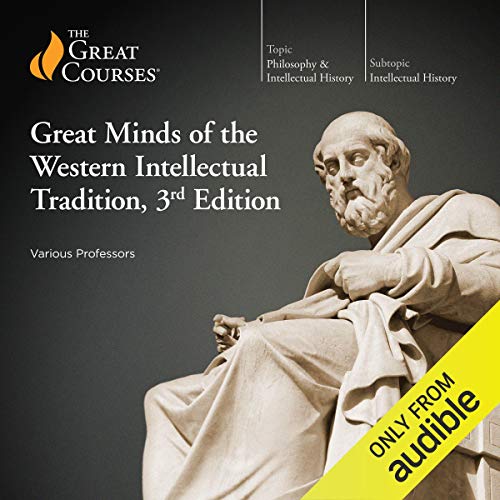
Great Minds of the Western Intellectual Tradition, 3rd Edition
Summary
For 3,000 years, mankind has grappled with fundamental questions about life. What is real? Who or what is God? When is it legitimate for one person to have power over others? What is justice? Beauty? This 84-lecture, 12-professor tour of Western philosophical tradition covers more than 60 of history's greatest minds and brings you a comprehensive survey of the history of Western philosophy from its origins in classical Greece to the present. It took 3,000 years for the debate chronicled in these lectures to reach maturity. With this series of lectures, you can encompass it by the end of next month. You'll travel chronologically through the history of the Western world, charting the intriguing development of Western philosophy and drawing fascinating connections between thinkers separated by the gulf of time and space. You'll acquaint yourself with the Greek Pre-Socratics (the world's first scientific thinkers) and examine in detail the insights of three towering figures: Socrates, his student Plato, and Plato's student, Aristotle. You'll examine the contributions to philosophy from biblical traditions and the great minds of the Christian age. Then, you'll mark the critical schism that developed between the claims of faith and those of science and participate in the breathless discovery found during the Enlightenment, which reveled in the new freedom of human potential and scientific expansion. You'll study the provocative philosophical responses (by the Existentialists and others) to the challenges raised by the new scientific consciousness. And you'll conclude with an overview of the work of Derrida and other late 20th-century philosophers and theorists. The full list of lecturers includes Professors Alan Charles Kors, Darren Staloff, Dennis Dalton, Douglas Kellner, Jeremy Adams, Jeremy Shearmur, Kathleen M. Higgins, Louis Markos, Mark Risjord, Phillip Cary, Robert C. Solomon, and Robert H. Kane. PLEASE NOTE: When you purchase this title, the accompanying reference material will be available in your Library section along with the audio.
©2000 The Teaching Company, LLC (P)2000 The Great Courses

Eichmann in Jerusalem
Summary
Sparking a flurry of heated debate, Hannah Arendt's authoritative and stunning report on the trial of German Nazi leader Adolf Eichmann first appeared as a series of articles in The New Yorker in 1963. This revised edition includes material that came to light after the trial, as well as Arendt's postscript directly addressing the controversy that arose over her account. A major journalistic triumph by an intellectual of singular influence, Eichmann in Jerusalem is as shocking as it is informative - an unflinching look at one of the most unsettling (and unsettled) issues of the 20th century.
©1963 Hannah Arendt (P)2011 Tantor

The Book
Summary
Modern Western culture and technology is inextricably tied to the belief in the existence of a self as a separate ego, separated from and in conflict with the rest of the world. In this classic book, Watts provides a lucid and simple presentation of an alternative view based on Hindu and Vedantic philosophy.
©1966 Alan Watts (P)2015 Macmillan Audio

The New Human Rights Movement
Summary
Society is broken. We can design our way to a better one. In our interconnected world, self-interest and social interest are rapidly becoming indistinguishable. If current negative trajectories remain, including growing climate destabilization, biodiversity loss, and economic inequality, an impending future of ecological collapse and societal destabilization will make "personal success" virtually meaningless. Yet our broken social system incentivizes behavior that will only make our problems worse. If true human rights progress is to be achieved today, it is time we dig deeper - rethinking the very foundation of our social system. In this engaging, important work, Peter Joseph, founder of the world's largest grassroots social movement - the Zeitgeist Movement - draws from economics, history, philosophy, and modern public-health research to present a bold case for rethinking activism in the 21st century. Arguing against the long-standing narrative of universal scarcity and other pervasive myths that defend the current state of affairs, The New Human Rights Movement illuminates the structural causes of poverty, social oppression, and the ongoing degradation of public health, and it ultimately presents the case for an updated economic approach. Joseph explores the potential of this grand shift and how we can design our way to a world where the human family has become truly sustainable. The New Human Rights Movement reveals the critical importance of a unified activism working to overcome the inherent injustice of our system. This book warns against what is in store if we continue to ignore the flaws of our socioeconomic approach, while also revealing the bright and expansive future possible if we succeed. Will you join the movement? PLEASE NOTE: When you purchase this title, the accompanying reference material will be available in your Library section along with the audio.
©2017 Gentle Machine Productions LLC (P)2017 Blackstone Audio, Inc.

A Brief History of Vice
Summary
History has never been more fun - or more intoxicating. Guns, germs, and steel might have transformed us from hunter-gatherers into modern man, but booze, sex, trash talk, and tripping built our civilization. Cracked editor Robert Evans brings his signature dogged research and lively insight to uncover the many and magnificent ways vice has influenced history, from the prostitute-turned-empress who scored a major victory for women's rights to the beer that helped create - and destroy - South America's first empire. And Evans goes deeper than simply writing about ancient debauchery; he recreates some of history's most enjoyable (and most painful) vices and includes guides so you can follow along at home. You'll learn how to: Trip like a Greek philosopher Rave like your Stone Age ancestors Get drunk like a Sumerian Smoke a nose pipe like a pre-Columbian Native American A celebration of the brave, drunken pioneers who built our civilization one seemingly bad decision at a time, A Brief History of Vice explores a side of the past that mainstream history books prefer to hide.
©2016 Robert Evans (P)2016 Penguin Audio

The Meaning of Life: Perspectives from the World's Great Intellectual Traditions
Summary
What is the meaning of life? It's a question every thoughtful person has pondered at one time or another. Indeed, it may be the biggest question of all - at once profound and universal, but also deeply personal. We want to understand the world in which we live, but we also want to understand how to make our own lives as meaningful as possible; to know not only why we're living, but that we're doing it with intention, purpose, and ethical commitment. But how, exactly, do we find that meaning, and develop that commitment? How can we grasp why we are here? Or how we should proceed? And to whom, exactly, we should listen as we shape the path we will walk? This comprehensive 36-lecture series from a much-honored scholar is an invigorating way to begin or continue your pursuit of these questions, and it requires no previous background in philosophical or religious thought. It offers a rigorous and wide-ranging exploration of what various spiritual, religious, and philosophical traditions from both the East and West have contributed to this profound line of questioning, sharing insights from sources that include ancient Indian texts, such as: The Bhagavad-Gita Foundational Chinese texts like the Daodejing and the Chuang Tzu Classical Western texts, such as Aristotle's Nichomachean Ethics and Marcus Aurelius's Meditations Modern philosophers and writers like David Hume, Immanuel Kant, Friedrich Nietzsche, and Leo Tolstoy The unique perspectives offered by Native Americans, in this case, the Lakota Sioux medicine man and writer, John Lame Deer More recent and contemporary philosophers, such as Mohandas Gandhi and the Dalai Lama PLEASE NOTE: When you purchase this title, the accompanying reference material will be available in your Library section along with the audio.
©2011 The Teaching Company, LLC (P)2011 The Great Courses

Mastery
Summary
Drawing on Zen philosophy and his expertise in the martial art of aikido, best-selling author George Leonard shows how the process of mastery can help us attain a higher level of excellence and a deeper sense of satisfaction and fulfillment in our daily lives. Whether you're seeking to improve your career or your intimate relationships, increase self-esteem or create harmony within yourself, this inspiring prescriptive guide will help you master anything you choose and achieve success in all areas of your life. In Mastery, you'll discover: The five essential keys to mastery Tools for mastery How to master your athletic potential The three personality types that are obstacles to mastery How to avoid pitfalls along the path And more
©1991 George Leonard (P)2018 Tantor

Plus malin que le Diable
Summary
La peur est l'outil favori d'un démon créé de toutes pièces par l’homme. - Napoléon Hill En 1938, peu de temps après la parution de son best-seller "Réfléchissez et devenez riche", Napoléon Hill révèle comment il a réussi à décrypter le code du Diable, le forçant à lui livrer tous ses précieux secrets. Le manuscrit qui fut le résultat de cette rencontre allégorique, trop controversé pour l’époque, est resté caché aux yeux du monde durant plus de soixante-dix ans. Grâce à son don légendaire pour révéler le potentiel des hommes, Napoléon Hill creuse en profondeur pour identifier quels sont les plus grands obstacles que nous devons affronter dans l'accomplissement de nos buts personnels. Il passe au crible les racines de la peur, de la procrastination, de la jalousie et de la colère, autant de dissonances orchestrées par le Diable pour nous mener à notre perte. Hill nous révèle alors les sept principes secrets qu'il a arrachés aux mains du démon, qui permettront à chacun de triompher de son combat personnel. Fascinant, provocant et stimulant, "Plus malin que le Diable" nous montre la voie pour tracer notre propre chemin vers le succès, l'harmonie et l'accomplissement, dans une période où prédominent la peur et l’incertitude.
©2013 Aska Editions (P)2018 Aska Editions

The Swerve
Summary
Pulitzer Prize, General Nonfiction, 2012 National Book Award, Nonfiction, 2012 Renowned historian Stephen Greenblatt’s works shoot to the top of the New York Times best-seller list. With The Swerve, Greenblatt transports listeners to the dawn of the Renaissance and chronicles the life of an intrepid book lover who rescued the Roman philosophical text On the Nature of Things from certain oblivion. Nearly six hundred years ago, a short, genial, cannily alert man in his late 30s took a very old manuscript off a library shelf, saw with excitement what he had discovered, and ordered that it be copied. That book was the last surviving manuscript of an ancient Roman philosophical epic by Lucretius—a beautiful poem containing the most dangerous ideas: that the universe functioned without the aid of gods, that religious fear was damaging to human life, and that matter was made up of very small particles in eternal motion, colliding and swerving in new directions. The copying and translation of this ancient book—the greatest discovery of the greatest book-hunter of his age—fueled the Renaissance, inspiring artists such as Botticelli and thinkers such as Giordano Bruno; shaped the thought of Galileo and Freud, Darwin and Einstein; and had a revolutionary influence on writers such as Montaigne and Shakespeare, and even Thomas Jefferson.
©2011 Stephen Greenblatt (P)2011 Recorded Books, LLC

Zen Golf
Summary
In chapters such as "During Your Swing Is Not the Time to Give Yourself a Lesson", "Isn't Where You Have to Play It From Punishment Enough?" and "How to Enjoy a Bad Round of Golf," the author guides golfers with simple yet powerful techniques to prepare for, execute, and, equally important, respond to the results of any golf shot. The author, Dr. Joseph Parent, is a PGA Tour Instructor who draws on his teaching experience to offer special methods that have led to amazing improvements in the games of professionals and amateurs alike. Zen Golf offers a fresh perspective for golf and for life. Rather than focus on what's wrong with us (what's broken, flawed, or missing) we can take the attitude that there is something fundamentally, essentially right with us. Through mindful awareness, distractions and negativity can be recognized and cleared away. Clear, concise, and enlightening, Zen Golf introduces a unique combination of modern psychology, Buddhist wisdom, and professional golf instruction. By applying classic insights and stories to the challenges of golf, Zen Golf shows you how to make your mind an ally instead of an enemy: how to stay calm, clear the interference that leads to poor shots, and eliminate bad habits and mental mistakes. Zen Golf shapes ancient philosophies into new teachings, leading golfers to the effortless focus and unconditional confidence of being in "the zone."
©2002 Joseph Parent (P)2003 Mental Game Mastery

The Unfettered Mind
Summary
This classic samurai-era text fused Japanese swordsmanship with Zen and influenced the direction that the art has taken ever since. Written by the 17th-century Zen master Takuan Soho (1573-1645), The Unfettered Mind is a book of advice on swordsmanship and the cultivation of right mind and intention. It was written as a guide for the samurai Yagyu Munenori, who was a great swordsman and rival to the legendary Miyamoto Musashi. Takuan was a giant in the history of Zen; he was also a gardener, calligrapher, poet, author, adviser to samurai and shoguns, and a pivotal figure in Zen painting. He was known for his brilliance and acerbic wit. In these succinct and pointed essays, Takuan is concerned primarily with understanding and refining the mind - both generally and when faced with conflict. The Unfettered Mind was a major influence on the classic manifestos on swordsmanship that came after it, including Miyamoto Musashi's Book of Five Rings and Yagyu Munenori's Life-Giving Sword.
©1986, 2002 William Scott Wilson (P)2014 Audible Inc.