The Philosophy category has 1,858 audiobooks on Listento.it, with an average listener rating of 4.5★ across 25,891 ratings. The most-rated is 12 Rules for Life.

Meditations of Marcus Aurelius
Summary
This audiobook is the most affordable version of Meditations by Marcus Aurelius that also has high quality, masterfully engineered audio. We modify audio for your pleasure. We use a computer-assisted dynamic-leveling process to ensure audio stays within an optimal listening range. Noise-gate technology is used in all books to eliminate all background and room noise disturbances for your enjoyment of the book. We are dedicated to providing you with the best possible audio experience at the best possible price. Enjoy this classic to the fullest!
©2020 Orange Island Book Shop (P)2020 Orange Island Book Shop

La philosophie islamique
Summary
Ce livre audio présente pour la première fois des entretiens d'Henry Corbin (1903-1978) découvreur, traducteur et éditeur des grands philosophes et mystiques de l'islam. En accord avec Daniel Gastambide (ayant-droit moral d'Henry Corbin), l'Institut National de l'Audiovisuel et Frémeaux & Associés sous la direction de Christine Goémé redonnent la parole au grand passeur qu'était Henry Corbin pour nous offrir une histoire de la pensée orientale et occidentale, qui nous rappelle les liens intellectuels entre les philosophies de l'Islam et ceux du Judaïsme et du Christianisme. L'œuvre d'Henry Corbin n'a jamais été aussi contemporaine dans la légitimité des ponts entre les grandes religions monothéistes et d'une manière générale entre les cultes et les savoirs, sans jamais renoncer à leurs singularités. Le travail de sélection de ces enregistrements présentant la voix incarnée d'Henry Corbin, a été réalisé par Christine Goémé avec le souci d'offrir un large panorama de tous les islams et d'en promouvoir toute la richesse. Mais ce travail trouve aussi toute sa légitimité dans l'impérieuse nécessité de rappeler à l'humanité du XXIe siècle naissant et amnésique l'importance de son héritage intellectuel provenant de l'histoire des relations orient - occident.
©2005 Frémeaux & Associés / DP (P)2005 Frémeaux & Associés / DP

Stoicism
Summary
Are you tired of being afraid of what’s to come in life? Do you wish you could better control your reactions to adverse situations? Are you looking for teachings, exercises, and a moral compass that can guide you to a better way of living? You’ve come to the right place. This book takes you step-by-step through the philosophy of Stoicism, from its birth to the passions, virtues, and key principles that serve as the foundation of its teachings. After looking at the history of Stoicism, we explore the philosophy as a whole, discussing the irrational passions, good passions, virtues, physics, logic, and ethics, all of which are integral parts of living as a stoic. After learning about what Stoicism can teach you, you will have the chance to begin practicing its ways yourself with simple exercises, daily living advice, and practical guidance to make your journey as smooth as possible. It won’t be easy to change your life, but it will be worth it. As a whole, Stoicism will teach you: Wh?t is st?????m? B?l??f? ?nd principles ?f St?????m with h??t?r? Key pr?n???l?? Stoic virtues Old St?????m v? m?d?rn St?????m St?????m rules t? follow ?n th? modern er? Stoic practices that will help you thrive in this modernity Meditation And so much more! It’s never too late to learn how to live. Stoicism offers a reprieve from a way of life that doesn’t offer the greatest happiness. It teaches that mastery over our minds and our reactions is the key to achieving eudemonia, or true happiness. Stoicism isn’t just a way of thinking. It’s a way of living, and it’s about to change your life. Don’t wait any longer to take control of your life. Click “Add to Cart” and start living like a stoic today.
©2019 Danile James Hollins (P)2020 Daniel James Hollins

A Foray into the Worlds of Animals and Humans
Summary
Is the tick a machine or a machine operator? Is it a mere object or a subject? With these questions, the pioneering biophilosopher Jakob von Uexküll embarks on a remarkable exploration of the unique social and physical environments that individual animal species, as well as individuals within species, build and inhabit. This concept of the umwelt has become enormously important within posthumanist philosophy, influencing such figures as Heidegger, Merleau-Ponty, Deleuze and Guattari, and, most recently, Giorgio Agamben, who has called Uexküll "a high point of modern antihumanism." A key document in the genealogy of posthumanist thought, A Foray into the Worlds of Animals and Humans advances Uexküll's revolutionary belief that nonhuman perceptions must be accounted for in any biology worth its name; it also contains his arguments against natural selection as an adequate explanation for the present orientation of a species' morphology and behavior. A Theory of Meaning extends his thinking on the umwelt, while also identifying an overarching and perceptible unity in nature. Those coming to Uexküll's work for the first time will find that his concept of the umwelt holds out new possibilities for the terms of animality, life, and the whole framework of biopolitics itself.
©2010 Regents of the University of Minnesota (P)2015 Redwood Audiobooks

The P.R.I.M.E.R. Goal Setting Method
Summary
A comprehensive guide to setting goals.
©2018 Damon Zahariades (P)2018 Damon Zahariades

Trost der Philosophie
Summary
Geldmangel? Liebeskummer? Frustriert? Ihnen kann geholfen werden. An sechs typischen Krisen aus dem täglichen Leben führt Alain de Botton geistreich und amüsant vor, wie jedermann Trost, Rat und Ansporn in der Philosophie findet. In essayistischen Porträts geht er auf eine Reise durch 2400 Jahre abendländische Philosophiegeschichte und zeigt anhand der Leben und Werke von Sokrates, Epikur, Seneca, Montaigne, Schopenhauer und Nietzsche wie ein etwas anderer - nämlich philosophischer - Blick auf die Welt das Leben erträglicher machen kann. Eine glänzende Einführung in den Gebrauch der Philosophie, die schon lange gefehlt hat. Es helfen bei: Unbeliebtheit: Sokrates / Christoph Waltz, Geldmangel: Epikur / Jürgen Tarrach, Frustration: Seneca / August Zirner, Unvollkommenheit: Montaigne / Hansa Czypionka, gebrochenem Herzen: Schopenhauer / Monica Bleibtreu, Schwierigkeiten: Nietzsche / Jasmin Tabatabai.
©2001 S. Fischer Verlag (P)2017 tacheles! / ROOF Music
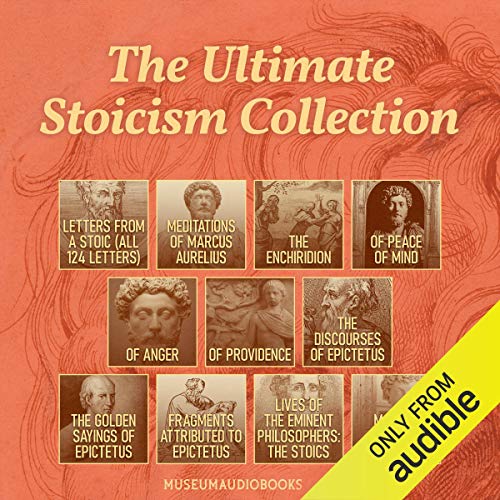
The Ultimate Stoicism Collection
Summary
Stoicism, a school of Hellenistic thought founded in Athens in the third century BC, was one of the most sublime philosophies in the history of Western civilization. It is a way of living that focuses on reality instead of fantasy or idealism. According to its teachings, the path to peace and happiness is found in accepting the moment as it presents itself, by not allowing oneself to be ruled by the desire for pleasure or by the fear of pain. The Ultimate Stoicism Collection includes: Letters from a Stoic (All 124 Letters) was written by Seneca during his retirement and sent to his friend Lucilius Junior, a procurator of Sicily. Seneca's major contribution to Stoicism was to humanize a system that could appear cold and unrealistic. The letters reveal how far in advance of his time Seneca's ideas were, for example his disgust at the shows in the Roman arena or his criticism of the treatment of slaves. Meditations of Marcus Aurelius is a series of personal writings by Marcus Aurelius, Roman emperor from 161 to 180 AD, recording his private notes to himself and ideas on Stoic philosophy. The Enchiridion is a collection of the most profound teachings of Epictetus who taught that philosophy is a way of life and not just a matter of theory. The Enchiridion is a canonical text of Stoic philosophy and contains all the fundamentals. Among them is the principle of not being concerned with that which is out of one’s control. Misfortune should not disturb the individual at all and should not be perceived negatively. Epictetus teaches that the only genuine value exists in virtuous action and accepting everything that happens in the world. He believed that one should do what is right and remain indifferent to criticism. Of Peace of Mind is a dialogue written by Seneca the Younger during the years 49 to 62 AD. It concerns the state of mind of Seneca's friend Annaeus Serenus, and how to cure Serenus of anxiety, worry, and disgust with life. Of Anger: With respect to the emotions, Seneca distinguishes between involuntary reactions and full-blown emotions, which involve assent and thus are voluntary. They are voluntary in the sense that assent is in the agent’s power. This is a key piece of Stoic doctrine - that whether we are foolish or wise, it is in our power to assent or not assent to impressions. "Of Providence" is a short essay in the form of a dialogue in six brief sections, to deal with the problem of the coexistence of the Stoic design of providence with the evil in the world. The dialogue is opened by Lucilius complaining with his friend Seneca that adversities and misfortunes can happen to good men too. How can this fit with the goodness connected with the design of providence? Seneca answers according to the Stoic point of view. The Discourses of Epictetus is a series of informal lectures, compiled by Seneca’s pupil Arrian. The Stoic emphasis on endurance, self-restraint, and the power of the will to withstand calamity could often appear cold and inhuman. Epictetus, however, offers the most humane interpretation of Stoic ideals by using humor, imaginary conversations, and homely comparisons to put his message across. It is a practical philosophy that directs students to focus attention on their opinions, anxieties, passions, and desires. The Golden Sayings of Epictetus: In these aphorisms, the philosopher reflects on our mortality and the knowledge that we will suffer in this life. However, each of us has the choice to endure with dignity those setbacks that we cannot control, he contends. Acceptance is core in Stoic doctrine. The wisdom of Epictetus has its roots in Socrates, confirming that we get upset by our judgement’s of circumstances, not by the circumstance itself. Fragments Attributed to Epictetus: Epictetus taught that philosophy is a way of life, not just a theoretical discipline. The idea that we should only focus our efforts on what is inside our sphere of choice and that we ought to train ourselves to be indifferent to what is outside that sphere is repeated throughout his Discourses and these Fragments. To Epictetus, all external events are beyond our control, and we should calmly accept whatever happens. However, individuals are responsible for their own actions, which they can examine and control through self-discipline. Lives of the Eminent Philosophers is devoted to the Stoics like Zeno of Citium, Ariston of Chios, Herillus, Dionysius the Renegade, Cleanthes, and Sphaerus. Marcus Aurelius Biography covers the life, the times, and the philosophy of Marcus Aurelius (121-180). The 17th emperor of Rome preserved and protected the Empire, mainly by keeping the Parthians in the east and the northern barbarians at bay.
Public Domain (P)2020 Museum Audiobooks

Neville Goddard Lecture Series: Volume III
Summary
The Neville Goddard Lecture Series will be presented in a 12-volume set, 25 lectures per volume. This volume, Volume III, contains the following lectures: Esau and Jacob, Esau - Jacob - Israel, Eschatology - the Doctrine of the End, Eschatology - the Drama of the End, Eternal States, Eternity Within, Every Natural Effect, Experiencing Scripture, Faith, Hope and Love, Faith in God, Faith, Family Portrait, Feed My Sheep, Feel Deeply, Follow Me, Follow the Pattern, Fourfold Vision, Freedom, Fulfillment of God's Plan, Fundamentals, Gifts Bestowed by God, God Became Man, God-Given Talent, God Is Light, and God Only Acts. The Neville Goddard Lecture Series has been chosen as a Gnostic Audio Selection.
©2014 Audio Enlightenment (P)2018 Audio Enlightenment

On Language
Summary
Described by the New York Times as "arguably the most important intellectual alive," Noam Chomsky is known throughout the world for his highly influential writings on language and politics. Featuring two of Chomsky's most popular and enduring books in one omnibus volume, On Language contains some of the noted linguist and political critic's most informal and accessible work to date, making it an ideal introduction to his thought. In Part I, "Language and Responsibility" (1979), Chomsky presents a fascinating self-portrait of his political, moral, and linguistic thinking through a series of interviews with Mitsou Ronat, the noted French linguist. In Part II, "Reflections on Language" (1975), Chomsky explores the more general implications of the study of language and offers incisive analyses of the controversies among psychologists, philosophers, and linguists over fundamental questions of language.
©1977 Language and Responsibility Flammarion; English translation and revisions of Language and Responsibility 1979 Noam Chomsky; Reflections on Language 1975 Noam Chomsky (P)2014 Audible, Inc.

Kant and the Problem of Metaphysics
Summary
In 1929, Martin Heidegger (1889-1976) published his remarkable book Kant and the Problem of Metaphysics. The Kantbuch, as Heidegger often called it, is regarded by many as a vital supplement to the unfinished second part of Heidegger’s most influential work, Being and Time, which was published two years earlier in 1927. Kant and the Problem of Metaphysics is seen both as a landmark in the evolution of Heidegger’s own thinking and as a notable contribution to Kantian scholarship, even though Heidegger would later modify his position considerably on some of the questions raised. Its genesis is attributed to an encounter between Heidegger and Ernst Cassirer, the German philosopher trained in the Neo-Kantian Marburg school, a meeting which took place at the second Davos Hochschulkurs, or philosophy conference in Switzerland. The two men discussed and debated Kant’s work in depth and the encounter led to Heidegger adapting his interpretation of Kant’s ideas, focusing principally on the schematism of the categories. While his phenomenological interpretation of the ideas expressed in the Critique of Pure Reason is at times tendentious and controversial, and did not convince Cassirer, the dialectical interplay the that can be gleaned between these three great minds is fascinating. From his phenomenological existential standpoint Heidegger analyses Kant’s thinking and organises his work into four sections, subdivided into 45 subsections. The first two sections consider the laying of the foundations of metaphysics and how this intellectual undertaking was carried out. The topics under consideration are mind-bendingly varied, and some are notoriously challenging and difficult to grasp. They range from: the foundations of ontology to the elucidation of space and time as pure intuitions; ontological synthesis; the problems of categories and the role of transcendental logic; the transcendence of finite reasoning as the basic purpose of the transcendental deduction; and the importance of image, schema and schema-image, schematism and subsumption. Section three focuses on the transcendental imagination as the formative centre of ontological knowledge and its relation to intuition and reason. It also considers the inherently temporal character of the transcendental imagination and the temporal character of the self. Section four goes on to explore the foundations of metaphysics in philosophical anthropology, the problem of finitude in man and the metaphysics of Dasein as fundamental ontology, its goals and how the idea of fundamental ontology relates to the Critique of Pure Reason. Kant and the Problem of Metaphysics is read with clarity and precision by Martyn Swain for Ukemi Audiobooks. Translation by James S. Churchill.
Public Domain (P)2020 Ukemi Productions Ltd

Empower Your Thoughts
Summary
Random distractions defeating your focus? Struggling to develop a positive mindset? Fearful thoughts and worry creating stress and anxiety? When your thoughts are given a free pass to act without restraint, your mind becomes a machine set to autopilot. You become immersed in anxiety and worry that lead to fear-based decisions and inaction. Your negative thoughts, if allowed to take over your mind unhinged, could sabotage future opportunity and rob you of positive experiences you should be enjoying. Empower Your Thoughts will give you back the power to think freely again, to express ideas without restraint, and to explore the freedom of creativity - the greatest freedom there is. By listening to it, you'll be able to transform your thoughts with practical, actionable steps that bring real results. Written by best-selling author, coach and personal development trainer Scott Allan, Empower Your Thoughts is focused on taking clear action toward your goals and dreams. With specific strategies, sage advice, and practical activities designed to help you develop a positive mental mindset, you'll be able to eliminate mental clutter and live a more meaningful, peaceful life.
©2019 Scott Allan (P)2019 Scott Allan

Moralia: Volume 2
Summary
Lucius Mestrius Plutarchus (46 ce - after 119) was born in Chaeronea, Boeotia, to a wealthy Greek family and assumed his full Latin name on becoming a Roman citizen. He made the most of his varied background and experience as a philosopher, magistrate, ambassador and priest at the Delphic Temple of Apollo, to become one of the most important biographers and essayists of classical Greek and Roman times. His Parallel Lives, which recounts and describes the personalities and achievements of the great figures of the era, is his most well-known (and voluminous) text. But Moralia, his collection of essays on a rich variety of subjects, continues to fascinate and educate. Volume 2 comprises 17 essays which are arguably even wider ranging than the Ethical Essays in Volume 1, opening with ‘On Listening to Lectures’, in which he warns against the habit of ‘the great majority of persons who practise speaking before they have acquired the habit of listening'. Plutarch is didactic, entertaining, informative and at times controversial. He considers atheism in ‘Superstition’, asks ‘Were the Athenians more famous in War or in Wisdom?' and in ‘On Love of Wealth’ confirms that money can’t buy you love: nor ‘peace of mind, greatness of spirit, serenity, confidence, and self-sufficiency'. Plutarch’s fascination with history and biography is also apparent here with some absorbing tales in ‘Sayings of Kings and Commanders’, ‘Sayings of Spartan Women’ and ‘Bravery of Women’. Taking another tack, he turns his attention to the political sphere in ‘A Philosopher ought to Converse especially with Men in Power’. And he gives advice ‘To an Uneducated Ruler’, pointing out that ‘most kings and rulers are so foolish as to act like unskillful sculptors, who think their colossal figures look large and imposing if they are modelled with their feet far apart, their muscles tense, and their mouths wide open’ - advice that is just as relevant to rulers in the 21st century. Throughout these essays there is humour, whimsy and wisdom, but above all Plutarch demonstrates an engaging humanity in his survey of man, in all his greatness and his foibles. Matthew Lloyd Davies is an ideal representative. Translations by Richard Shilleto.
Public Domain (P)2020 Ukemi Productions Ltd

Ideas
Summary
As philosophy professor Taylor Carman explains in his helpful introduction, Edmund Husserl (1859-1938) was the founder of modern phenomenology, one of the most important and influential movements of the 20th century. Ideas, published in 1913 – its full title is Ideas for a Pure Phenomenology and Phenomenological Philosophy – was the key work. It is arguably ‘the most fundamental and comprehensive statement of the fundamental principles of Husserl’s mature philosophy’. Carman continues, ‘What is phenomenology? It is, in short, an attempt to describe human experience as it is lived, prior to our reflecting on and theorizing about it, or indeed about the world that it reveals to us.’ Philosophy, Husserl proposed, had often become so immersed in the realm of abstraction and speculation that it had lost sight of fundamentals – in particular, a sense of reality, of man’s place in the world. He called the concrete texture of lived experience ‘the phenomena’ and the purpose of Husserl’s phenomenology was to bring philosophical attention and enquiry back to the ordinary awareness of ourselves and the world. As Carman declares, the object of Husserl’s phenomenological investigation, is consciousness. Ideas is divided into four parts: Part 1: Essence and Cognition of Essence; Part II: The Fundamental Phenomenological Outlook; Part III: Procedure of Pure Phenomenology in Respect of Methods and Problems; and Part IV: Reason and Reality (Wirklichkeit). This book and Husserl’s subsequent work had a strong influence on the existential movement of the 20th century, in particular the work of Martin Heidegger (1889-1976), Jean-Paul Sartre (1905-198) and Maurice Merleau-Ponty (1908-1961). Phenomenology, Carman says unequivocally, became a 20th century movement which earned a permanent place in the history of philosophy and is indispensable for an adequate understanding of modern European thought. Husserl’s Ideas for a Pure Phenomenology and Phenomenological Philosophy is where it began. The text is presented in an exemplary clear reading by Leighton Pugh.
Public Domain (P)2020 Ukemi Productions Ltd

Colloqui con se stesso
Summary
I pensieri, raccolti in questo opera, tratto da "Ad se Ipsum", "A Se stesso", o "Colloqui con se stesso", com'è conosciuto dai più, di Marco Aurelio, racchiudono un estratto dei ricordi, delle riflessioni, e delle osservazioni più significative, che il filosofo romano mise per iscritto in dodici libri, nel corso della sua vita, che si svolse nel secondo secolo dopo Cristo. Questa fondamentale opera in versione audiolibro è imperdibile, essenziale, di facile comprensione, ed offre parecchi spunti di riflessione. Più che un monito contro le illusioni che spesso ingannano, Il filosofo mette in luce, di volta in volta, secondo gli argomenti trattati, un metodo, una regola morale, che può essere una guida sicura, per destreggiarsi tra i tranelli mentali e non, che inevitabilmente fanno parte del quotidiano di ognuno di noi. E sopra a tutto, c'è la Natura Universale, che ha già stabilito il respiro di ogni essere, la sua funzione, il suo a disposizione. Saper quindi cogliere quello che di bello, oppure brutto, la vita offre, non sempre è una capacità innata, ma gli esseri umani, essendo stati dotati di numerosi talenti, hanno la possibilità di farlo. O perlomeno di cercare di farlo. Marco Aurelio, l'imperatore filosofo, ci lascia questi "preziosi" pensieri, che ancora oggi hanno un senso, perché pur in tempi che sono molto diversi da quelli in cui l'opera è stata scritta, le situazioni si ripetono, e il libero arbitrio e la lucidità, sono essenziali, oggi più che mai.
©2013 Public domain (P)2013 GOODmood
![Cover art for Meditaciones [Meditations]](https://m.media-amazon.com/images/I/514XBbgP+dL._SL500_.jpg)
Meditaciones [Meditations]
Summary
Ideas que han cambiado el mundo. Por primera vez en audiolibro A lo largo de la historia, algunos libros han cambiado el mundo. Han transformado la manera en que nos vemos a nosotros mismos y a los demás. Han inspirado el debate, la discordia, la guerra y la revolución. Han iluminado, indignado, provocado y consolado. Han enriquecido vidas, y también las han destruido. Taurus publica las obras de los grandes pensadores, pioneros, radicales y visionarios cuyas ideas sacudieron la civilización y nos impulsaron a ser quienes somos. Las Meditaciones del gran emperador-filósofo romano Marco Aurelio son sencillas aunque profundas obras de filosofía estoica que, a día de hoy, continúan ofreciendo a muchos orientación y consuelo con su elocuencia, sabiduría y humildad. Please note: This audiobook is in Spanish.
©2014 Penguin Random House Grupo Editorial, S.A.U (P)2019 Penguin Random House Grupo Editorial, S.A.U.

Friedrich Nietzsche: Beyond Good and Evil, Thus Spoke Zarathustra, Human, All Too Human, and the Antichrist
Summary
This collection of Friedrich Nietzsche’s most famous works contains Beyond Good and Evil, Thus Spoke Zarathustra, Human, All Too Human, and The Antichrist. Beyond Good and Evil: Prelude to a Philosophy of the Future is a work that further explores the ideas in Thus Spoke Zarathustra, with a more critical and polemical approach. In Beyond Good and Evil, Nietzsche accuses past philosophers of lacking critical sense and blindly accepting dogmatic premises in their consideration of morality. Thus Spoke Zarathustra is a philosophical novel dealing with ideas such as the "eternal recurrence of the same", the parable on the "death of God", and the "prophecy" of the Übermensch. Human, All Too Human: A Book for Free Spirits examines a variety of concepts in short paragraphs or sayings. In The Antichrist, Nietzsche attacks Christianity, contending that pity has a depressive effect, is harmful to life, and preserves that which should naturally be destroyed. For a noble morality, pity is a weakness, but for Christianity, it is a virtue.
Public Domain (P)2020 Museum Audiobooks

Sun Tzu Said: Classic Warfare for the Modern Mind
Summary
Sun Tzu was a famous Chinese general whose mastery of strategy was so exceptional that he reportedly transformed 180 courtesans into skilled soldiers in a single training session. While that episode was likely exaggerated, historians agree that Sun Tzu defeated the Ch'u, Qi, and Chin states for King Ho-Lu, forging his empire. In 510 BC, Master Tzu recorded his winning strategies in Art of War, the earliest surviving and most revered tome of its kind. With methods so powerful they can conquer an adversary's spirit, you can use Master Tzu's strategies to overcome any challenge, from warfare to self-defense to business negotiations. This audiobook starts with the classic 1910 translation of Art of War, adds modern and historical insight, and demonstrates how to put the master's timeless wisdom to use in your everyday life. In this fashion, the Art of War becomes accessible for the modern mind, simultaneously entertaining, enlightening, and practical.
©2020 Kris Wilder (P)2021 Kris Wilder

The Case Against Perfection
Summary
Breakthroughs in genetics present us with a promise and a predicament. The promise is that we will soon be able to treat and prevent a host of debilitating diseases. The predicament is that our newfound genetic knowledge may enable us to manipulate our nature - to enhance our genetic traits and those of our children. Although most people find at least some forms of genetic engineering disquieting, it is not easy to articulate why. The Case Against Perfection explores these and other moral quandaries connected with the quest to perfect ourselves and our children. Michael Sandel argues that the pursuit of perfection is flawed for reasons that go beyond safety and fairness. The drive to enhance human nature through genetic technologies is objectionable because it represents a bid for mastery and dominion that fails to appreciate the gifted character of human powers and achievements. Carrying us beyond familiar terms of political discourse, this book contends that the genetic revolution will change the way philosophers discuss ethics and will force spiritual questions back onto the political agenda. In order to grapple with the ethics of enhancement, we need to confront questions largely lost from view in the modern world. Since these questions verge on theology, modern philosophers and political theorists tend to shrink from them. But our new powers of biotechnology make these questions unavoidable.
©2019 Dreamscape Media, LLC (P)2019 Dreamscape Media, LLC