The World category has 419 audiobooks on Listento.it, with an average listener rating of 4.5★ across 2,940 ratings. The most-rated is A Short History of Nearly Everything.

The Silk Roads
Summary
“This is history on a grand scale, with a sweep and ambition that is rare... A proper historical epic of dazzling range and achievement.” (William Dalrymple, The Guardian) The epic history of the crossroads of the world - the meeting place of East and West and the birthplace of civilization It was on the Silk Roads that East and West first encountered each other through trade and conquest, leading to the spread of ideas, cultures, and religions. From the rise and fall of empires to the spread of Buddhism and the advent of Christianity and Islam, right up to the great wars of the 20th century - this book shows how the fate of the West has always been inextricably linked to the East. Peter Frankopan realigns our understanding of the world, pointing us eastward. He vividly re-creates the emergence of the first cities in Mesopotamia and the birth of empires in Persia, Rome, and Constantinople, as well as the depredations by the Mongols, the transmission of the Black Death, and the violent struggles over Western imperialism. Throughout the millennia, it was the appetite for foreign goods that brought East and West together, driving economies and the growth of nations. From the Middle East and its political instability to China and its economic rise, the vast region stretching eastward from the Balkans across the steppe and South Asia has been thrust into the global spotlight in recent years. Frankopan teaches us that to understand what is at stake for the cities and nations built on these intricate trade routes, we must first understand their astounding pasts. Far more than a history of the Silk Roads, this book is truly a revelatory new history of the world, promising to destabilize notions of where we come from and where we are headed next.
©2016 Peter Frankopan (P)2021 Random House Audio

Why Don't We Learn from History
Summary
Much has been written on the theory of history by philosophers and historiologists, but nothing so concise and understandable as Liddell Hart’s Why Don’t We Learn from History, the kind of title that makes one wonder and consider. And consider we certainly should in an era when so much bad history and propaganda is being put before us from unknown sources by unknown authors.
©2020 B. H. Liddell Hart (P)2020 B. H. Liddell Hart

The Boundless Sea
Summary
From the author of the acclaimed The Great Sea, David Abulafia's new book guides listeners along the world's greatest bodies of water to reveal their primary role in human history. The main protagonists are the three major oceans - the Atlantic, the Pacific, and the Indian - which together comprise the majority of the earth's water and cover over half of its surface. These waterways carried goods, plants, livestock, and, of course people - free and enslaved - across vast expanses, transforming and ultimately linking irrevocably the economies and cultures of Africa, Europe, Asia, and the Americas. Far more than merely another history of exploration, The Boundless Sea tells how maritime networks gradually formed a continuum of interaction and interconnection. Working chronologically, Abulafia moves from the earliest forays of peoples taking hand-hewn canoes into uncharted waters, to the routes taken daily by supertankers in the thousands. History on the grandest scale and scope, crafted with passion and precision, this is a project few could have undertaken. Abulafia, whom The Atlantic calls "superb writer with a gift for lucid compression and an eye for the telling detail", proves again why he ranks as one of the world's greatest storytellers.
©2019 David Abulafia (P)2021 Tantor

The Olmecs
Summary
Many ancient civilizations are described as mysterious, but none provide as many puzzles and unanswered questions as the Olmecs. These people arrived in lands near the Gulf of Mexico around 1500 BCE and brought with them entirely new concepts in terms of engineering, agriculture, and religion. The problem is we have no idea where they came from or how they developed these new ideas. Then, around 400 BCE, the Olmecs vanished as suddenly and inexplicably as they appeared, leaving behind no written records but providing a legacy of beliefs and ideas which permeated virtually every Mesoamerican culture that followed. In this audiobook you will hear about: Origins The Olmec enigma The fall of San Lorenzo Were-jaguars and feathered serpents The rise of La Venta The disappearance of the Olmecs And much more! Respected scholars take very different views on the Olmec civilization. Some feel that the Olmecs must have come to Central America from somewhere else entirely, while others are adamant that they are indigenous people. Some historians believe that the Olmecs were simply one of several cultures that emerged at around the same time, while others are vehement that this is the mother culture from which all subsequent Mesoamerican cultures descended. Less than 100 years ago, there wasn’t even agreement on whether these people had existed at all. There are very few cultures as important as the Olmecs about which we know so little. This book attempts to convey the story of the mysterious Olmecs and their unique and fascinating artifacts.
©2019 Hourly History (P)2019 Hourly History

Blacklisted by History
Summary
Accused of creating a bogus Red scare and smearing countless innocent victims in a five-year reign of terror, Senator Joseph McCarthy is universally remembered as a demagogue, a bully, and a liar. History has judged him such a loathsome figure that even today, a half-century after his death, his name remains synonymous with witch hunts. But that conventional image is all wrong, as veteran journalist and author M. Stanton Evans reveals in this groundbreaking book. The long-awaited Blacklisted by History, based on six years of intensive research, dismantles the myths surrounding Joe McCarthy and his campaign to unmask Communists, Soviet agents, and flagrant loyalty risks working within the U.S. government. Evans’ revelations completely overturn our understanding of McCarthy, McCarthyism, and the Cold War. Drawing on primary sources, Evans presents irrefutable evidence of a relentless Communist drive to penetrate our government, influence its policies, and steal its secrets. Most shocking of all, he shows that U.S. officials supposedly guarding against this danger not only let it happen but actively covered up the penetration. All of this was precisely as Joe McCarthy contended. Evans shows that practically everything we’ve been told about McCarthy is false, including conventional treatment of the famous 1950 speech at Wheeling, West Virginia, that launched the McCarthy era, the Senate hearings that casually dismissed his charges, and much more. In the end, Senator McCarthy was censured by his colleagues and condemned by the press and historians. Blacklisted by History provides the first accurate account of what McCarthy did and, more broadly, what happened to America during the Cold War. It is a revealing exposé of the forces that distorted our national policy in that conflict and our understanding of its history since.
©2007 M. Stanton Evans (P)2010 Blackstone Audio, Inc.

The Confessions of Nat Turner, the Leader of the Late Insurrections in Southampton, VA
Summary
The late insurrection in Southampton has greatly excited the public mind, and led to a thousand idle, exaggerated, and mischievous reports. It is the first instance in our history of an open rebellion of the slaves, and attended with such atrocious circumstances of cruelty and destruction, as could not fail to leave a deep impression, not only upon the minds of the community where this fearful tragedy was wrought but throughout every portion of our country, in which this population is to be found. Public curiosity has been on the stretch to understand the origin and progress of this dreadful conspiracy, and the motives which influences its diabolical actors. The insurgent slaves had all been destroyed, or apprehended, tried, and executed (with the exception of the leader), without revealing any thing at all satisfactory, as to the motives which governed them, or the means by which they expected to accomplish their object. Everything connected with this sad affair was wrapped in mystery, until Nat Turner, the leader of this ferocious band, whose name has resounded throughout our widely extended empire, was captured. This "great bandit" was taken by a single individual, in a cave near the residence of his late owner, on Sunday, the 13th of October, without attempting to make the slightest resistance, and on the following day safely lodged in the jail of the county. His captor was Benjamin Phipps, armed with a shot gun well charged. Nat's only weapon was a small light sword which he immediately surrendered, and begged that his life might be spared. Since his confinement, by permission of the jailor, I have had ready access to him, and finding that he was willing to make a full and free confession of the origin, progress, and consummation of the insurrectionary movements of the slaves of which he was the contriver and head.
Public Domain (P)2021 Rolled Scroll Publishing

The Search for Life on Mars
Summary
From The War of the Worlds to The Martian and to the amazing photographs sent back by the robotic rovers, Curiosity and Opportunity, Mars has excited our imaginations as the most likely other habitat for life in the solar system. Now the red planet is coming under scrutiny as never before. As new missions are scheduled to launch this year from the United States and China, and with the European Space Agency's ExoMars mission now scheduled for 2022, this book recounts in full the greatest scientific detective story ever. For the first time in 40 years, the missions heading to Mars will look for signs of ancient life on the world next door. It is the latest chapter in an age-old quest that encompasses myth, false starts, red herrings, and bizarre coincidences - as well as triumphs and heartbreaking failures. This book, by two journalists with deep experience covering space exploration, is the definitive story of how life's discovery has eluded us to date, and how it will be found somewhere and sometime this century. The Search for Life on Mars is based on more than 100 interviews with experts at NASA’s Jet Propulsion Laboratory and elsewhere, who share their insights and stories. While it looks back to the early Mars missions such as Viking 1 and Viking 2, the book's focus is on the experiments and revelations from the most recent ones - including Curiosity, which continues to explore potentially habitable sites where water was once present, and the Mars InSight lander, which has recorded more than 450 marsquakes since its deployment in late 2018 - as well as on the Perseverance and ExoMars rover missions ahead. And the book looks forward to the newest, most exciting frontier of all: the day, not too far away, when humans will land, make the red planet their home, and look for life directly.
©2020 Arcade (P)2020 Novel Audio

Remarkable Creatures
Summary
Just 150 years ago, most of our world was an unexplored wilderness. Our sense of its age was vastly off the mark. And what we believed to be the history of our own species consisted of fantastic myths and fairy tales; fossils, known for millennia, were seen as the bones of dragons and other imagined creatures. How did we learn so much so quickly?
Remarkable Creatures celebrates the pioneers who replaced our fancies with the even more remarkable real story of how our world evolved. Inspired by Humboldt, the first group we meet - Darwin, Wallace, and Bates - returned from their explorations with the makings of the theory of evolution. The second group undertook expeditions that produced some of the most spectacular finds in paleontology: Eugene Dubois uncovered Java Man, the first claimed missing link between apes and humans; Charles Walcott located pre-Cambrian life in the Grand Canyon and Cambrian life in the Burgess Shale; and Roy Chapman Andrews unearthed dinosaur eggs in the Gobi desert of Mongolia. The discovery of the kinship of dinosaurs and birds and the emergence of the "fishapod" formed more links in the evolutionary chain, as did the work of Louis and Mary Leakey, who for five decades searched for our deepest past in East Africa.
The final section of the book moves into the laboratory and the future, following the trailblazers who discovered a time clock in our DNA and extracted ancient DNA from extinct species.
Join Carroll and his cast of naturalists for a rousing voyage through the most dramatic adventures and important discoveries in two centuries of natural history.
©2009 Brilliance Audio, Inc.

Finding the Elephant
Summary
In California, in a mill race on an undistinguished stream, an astonishing discovery was made. It was gold. Gold said to be so plentiful that it just lay there waiting to be picked up. Nuggets of gold that you could just bend down and put in your pocket. Big nuggets, some weighing six ounces or more. A 6 oz. nugget was worth $120 in 1849. Today? $3000 in today’s dollars! How excited would you be to look down on the ground and pick up $3000? And it could be easily had. All you had to do was get to California and grab a shovel. You didn’t need an education. You didn’t need a family connection. You didn’t need anyone’s permission. You just had to get there and start digging. Every eager and aggressive second son, or stuck in a rut store clerk, dreamed of striking it rich in California and coming back with pockets stuffed with golden nuggets. Easy. It would be so easy. All it would take was a little effort to dig it up. But there was also something else. Land. More land than any single individual could farm. Untold acres of land that had never been touched by a plow and had lain undisturbed for millions of years. There was so much land available that the United States Homestead Act was offering it to all comers for FREE. FREE LAND. All you had to do was stake a claim, register it, and live on it for five years. Then it was yours. In the 19th century, most of the world farmed. But in America you could farm land that was owned by YOU, not someone else. That meant that your crop was entirely yours, not just a small portion of it. That meant that you were your own boss. In America, there was no limit on what you could accomplish. No class distinction, no rules to follow, no one to tell you what you could do or what you couldn’t do. Freedom. Liberty. A new start. Is it any wonder that people came from around the globe seeking a new life? Come to America. Here was where you had a chance to live your own life on your own terms. Getting here was the first challenge.
©2020 Stuart J Kamille (P)2021 Stuart J Kamille

Hitler's Secret Jewish Psychic
Summary
A treasure trove filled with fascinating anecdotes about the tiny ripples that have caused big waves in history, Hitler's Secret Jewish Psychic will cure you of two misconceptions: the first being that history is relentlessly boring and the second that significant historical events are caused by significant and great causes. Here you'll unearth a multitude of facts you never knew were true. You'll learn some unbelievable things about some of the most prominent figures in history. (Picasso was stillborn until his uncle revived him by blowing cigar smoke in his face!) You'll discover facts about some of the most famous wars in history. (Japan actually manufactured balloons carrying deadly diseases, which they attempted to send over the Pacific Ocean to the United States.) Other strange facts include: The career Fidel Castro almost chose over his leadership of Cuba Where Eli Whitney got the idea for his invention of the cotton gin What almost happened during the Wrights brothers' first successful flight Why certain literary works almost never saw the light of publication What day should have really been designated Independence Day The truth behind Winston Churchill's daring escape from a Boer War prisoner-of-war camp Franklin Roosevelt's campaign cover-up The behind-the-scenes beliefs of Isaac Newton And many more! It is true that many things you hear should be taken with a pinch of salt; nothing proves this so much as Hitler's Secret Jewish Psychic, where you will discover the outrageous secrets history has tried (and failed) to keep.
©2010 Phil Mason (P)2014 Audible Inc.

History of the Barbarians
Summary
If you want to discover the captivating history of the barbarians, then keep listening.... Seven captivating manuscripts in one book: Celts: A Captivating Guide to Ancient Celtic History and Mythology, Including Their Battles Against the Roman Republic in the Gallic Wars The Vandals: A Captivating Guide to the Barbarians That Conquered the Roman Empire During the Transitional Period from Late Antiquity to the Early Middle Ages The Gallic Wars: A Captivating Guide to the Military Campaigns that Expanded the Roman Republic and Helped Julius Caesar Transform Rome into the Greatest Empire of the Ancient World Sarmatians and Scythians: A Captivating Guide to the Barbarians of Iranian Origins and How These Ancient Tribes Fought Against the Roman Empire, Goths, Huns, and Persians The Goths: A Captivating Guide to the Visigoths and Ostrogoths Who Sacked Rome and Played an Essential Role in the Fall of the Western Roman Empire Attila the Hun: A Captivating Guide to the Ruler of the Huns and His Invasions of the Roman Empire Anglo-Saxons: A Captivating Guide to the People Who Inhabited Great Britain from the Early Middle Ages to the Norman Conquest of England In part one of this book, you will learn: Who were the Celts? The Celtic migrations The many Celtic tribes of Europe The Celtiberians The Gallic Wars The Insular Celts Celtic warriors Celtic way of life Celtic religion Celtic art And much, much more! In part two of this book, you will learn: Origins of the Vandals From the Danube to Africa Rise of the Vandal Kingdom Downfall of the Vandals Vandal society Religion, culture, and the Vandals And much, much more! In part three of this book, you will learn: Ancient Gaul Gaius Julius Caesar The Helvetii Celts The Helvetian War Ariovistus, the German King Battle of the Sabis The Germanic War United Gaul Versus Caesar of Rome The Battle of Alesia And much, much more! In part four of this book, you will learn: Origins of the Scythians and Sarmatians Art, culture, and religion Economy and society Warfare and conquest End of the Scythians and Sarmatians And much, much more! In part five of this book, you will learn: Who were the Goths? Names, origins, and early settlements History of the Goths: relations with Romans, Gothic kingdoms Ostrogothic and Visigothic rulers The culture of Goths: religion, customs, social hierarchy Everyday life of Goths: jobs and division of labor, housing and architecture, art, written works And much, much more! In part six of this book, you will learn: The origins of Attila and the Huns The wars of the Huns before Attila An alliance between the Huns and the Romans Attila attacks the Byzantines. Attila attacks the Byzantines again. Attila foils a Byzantine plot. Attila’s diplomatic strategy evolves in the west. Attila raids Gaul. Attila raids Italy. The disintegration of Attila’s kingdom And much, much more! In part seven of this book, you will learn: Anglo-Saxons arrive Early Anglo-Saxons: origins and pre-settlement history The culture of Anglo-Saxons: religion, customs, social hierarchy, early Christianity Everyday life of Anglo-Saxon England: jobs and division of labor, food and drink, clothes, architecture, travel, wars, gender and age norms, art, written works And much, much more! So if you want to learn more about history of the Barbarians, scroll up and click the "add to cart" button!
©2020 Captivating History (P)2020 Captivating History

635 Tage im Eis
Summary
Am Anfang steht der Plan von der erstmaligen Durchquerung des weißen Kontinents. Doch das gewaltige Naturwunder Antarktis wird im Jahr 1915 für die Crew der "Endurance" zur Hölle aus Eis. Beharrlich verfolgt Expeditionsleiter Sir Ernest Shackleton bald nur noch ein Ziel: 28 Männer lebend wieder in die Zivilisation zurückzubringen. Die faszinierende Geschichte einer Irrfahrt ans Ende der Welt. "Gebt mir Scott als wissenschaftlichen Expeditionsleiter, gebt mir Amundsen für eine störungsfreie und effiziente Polar-Expedition, aber wenn sich das Schicksal gegen euch verschwören zu haben scheint, dann fallt auf die Knie und betet um Shackleton." >> Diese ungekürzte Hörbuch-Fassung genießt du exklusiv nur bei Audible.
©2011 Audible Studios (P)2011 Audible Studios
![Cover art for Dictadura y Guerra Civil en Guatemala: La cruenta lucha por el poder [Dictatorship and Civil War in Guatemala: The Bloody Struggle for Power]](https://m.media-amazon.com/images/I/51d2Q+G1P+L._SL500_.jpg)
Dictadura y Guerra Civil en Guatemala: La cruenta lucha por el poder [Dictatorship and Civil War in Guatemala: The Bloody Struggle for Power]
Summary
Entre 1960 y 1996, Guatemala sufrió las consecuencias de una espantosa y larga guerra civil, la cual dejó un profundo impacto en este país americano. El llamado Genocidio Guatemalteco, donde fallecieron más de 200,000 personas, es un claro ejemplo de ello. Please note: This audiobook is in Spanish.
©2015 Online Studio Productions (P)2015 Online Studio Productions

Haitian Revolution: A Captivating Guide to the Abolition of Slavery
Summary
Explore How the Slaves Freed Themselves in the Haitian Revolution The Haitian Revolution was a slave rebellion that began in 1791 in the French colony of Saint-Domingue, now known as Haiti. On this small island, the tyrants were the slave owners, people who not only denied their slaves freedom, but felt justified in killing them. The Haitian Revolution began to change the way slaves were viewed all over the world. Although it took nearly another 100 years to eradicate slavery in the west, the parallels between what the Americans and French had done to the slaves was impossible to ignore. The Haitian Revolution was the first and only time that a slave rebellion resulted in a new state. Some of the topics covered in this audiobook include: The wealth from Saint-Domingue Beginning of the end of the French Colony Planning of one of the most historic revolutions in history The Revolution begins The Revolution spreads Ripples of events in Europe The abolishment of slavery and the British response Toussaint Louverture's rise to power The defeat of Britain and a newfound respect Napoleon's rise and its initial effect on Saint-Domingue The end of the Revolution Lasting effects - beyond the Island Haiti today And more! Listen to this audiobook now to learn more about the Haitian Revolution.
©2017 Captivating History (P)2017 Captivating History
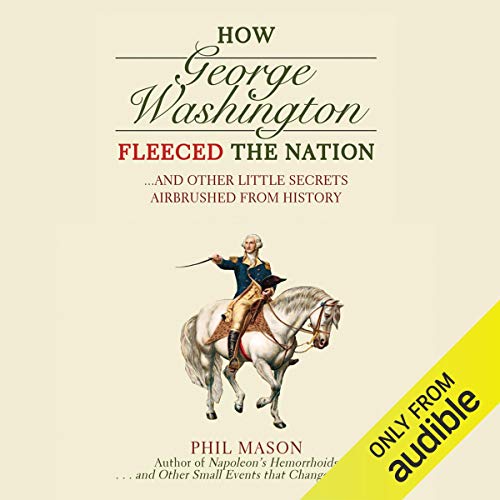
How George Washington Fleeced the Nation
Summary
The hidden quirks and shortcomings of history’s leading figures will change the way you think about history. Our view of the famous is one-dimensional—leading figures from history are summarized in history textbooks with one or two lines: Churchill the war-time genius, Gandhi the poor ascetic—but nobody is perfect and even the famous have their quirks and hidden secrets. How George Washington Fleeced the Nation reveals the often hilarious, sometimes shocking, and always highly informative foibles of the great and the good. Einstein, the most brilliant man who lived, regularly forgot his shoes and never learned to drive. Hitler possibly has a Jewish ancestor. Picasso avoided paying restaurant bills by doodling on their napkins instead. Prepared to be shocked, amused, and outraged at what they didn’t teach you in high school.
©2010 Phil Mason (P)2012 Audible, Inc.

Periodic Tales
Summary
Like the alphabet, the calendar, or the zodiac, the periodic table of the chemical elements has a permanent place in our imagination. But aside from the handful of common ones (iron, carbon, copper, gold), the elements themselves remain wrapped in mystery. We do not know what most of them look like, how they exist in nature, how they got their names, or of what use they are to us. Unlocking their astonishing secrets and colorful pasts, Periodic Tales is a passionate journey through mines and artists' studios, to factories and cathedrals, into the woods and to the sea to discover the true stories of these fascinating but mysterious building blocks of the universe.
©2011 Hugh Aldersey-Williams (P)2015 Tantor

The Crusades and Silk Road
Summary
If you want to discover the captivating history of the Crusades and Silk Road, then pay attention.... Two captivating manuscripts in one audiobook: The Crusades: A Captivating Guide to the Military Expeditions During the Middle Ages That Departed from Europe with the Goal to Free Jerusalem and Aid Christianity in the Holy Land The Silk Road: A Captivating Guide to the Ancient Network of Trade Routes Established During the Han Dynasty of China and How It Connected the East and West Here are just some of the topics covered in part one of this audiobook: The First Crusade (1095-1099) - The Pope Calls the Faithful to Arms The Armies of the First Crusade Engage with the Enemy The Aftermath of the First Crusade The Second Crusade (1147-1149) - The Beginnings of the Kingdom of Jerusalem The Third Crusade (1189-1192) - The King’s Crusade The Fourth Crusade (1202-1204) - The Latin Empire of Constantinople and the Children’s Crusade The Fifth Crusade (1217-1221) The Sixth Crusade (1228) - The Holy Roman Emperor Frederick II Takes the Cross The Seventh Crusade (1248-1254) The Eighth Crusade (1270) And much, much more! Here are just some of the topics covered in part two of this audiobook: Rome, Silk, and Ancient Geography Han Silk Production and Trade The Kingdom of Loulan Buddhists along the Silk Road Turfan: An Oasis on the Silk Road The Legend of Prester John Genghis Khan, Ruler of the Whole World The Lord of Xanadu, Kublai Khan: The Emperor of China Marco Polo Visits Kublai Khan’s China The Final Years of Kublai Khan And much, much more! So, if you want to learn more about the Crusades and Silk Road, get this audiobook now!
©2020 Captivating History (P)2020 Captivating History

This Fleeting World
Summary
This Fleeting World is the smallest book of big history, telling the story of the universe and history of humanity in less than five hours. Prize-winning historian David Christian covers it all in this compact, accessible, and inspiring guide to the history of everything from stars and empires to cities to the World Wide Web, capitalism, and globalization. David Christian's approach to human history and big history is a call to action based on a profound and fresh understanding of our place in the universe. This book is essential for our time. David Christian asks big questions. Will contemporary challenges lead to the emergence of a new global system capable of ecological, economic, and political stability? Or is the accelerating pace of change a prelude to a sudden, sharp collapse that will drive many parts of the world back to the productivity levels of the early agrarian era? He presents our origin story and the history of women and men across the entire world within the framework of the universe explaining, for example, that the chemicals we are made of come from supernovae. He tells the human story as a story of changes: changes in the ways we produce and distribute food, move from place to place, organize ourselves into communities, explore and populate our environment, and both create and respond to crises. He gives us maps of time, history on different temporal-spatial scales, and even offers paths to locate evidence that might challenge his big story. Big history leads to strategies for building a more sustainable world, and Berkshire Publishing is proud to offer this new edition of a big history for our common future. The 2018 edition has been expanded and updated for the general listener.
©2018 Berkshire Publishing (P)2018 Berkshire Publishing

The Decline of the West
Summary
The Decline of the West - Volume 1 published in 1917, Volume 2 in 1922 - has exercised and challenged opinion ever since. It was a huge undertaking by Oswald Spengler (1880-1936), formerly an unpublished historian and philosopher who set out to radically reconsider history - the rise and fall of world civilisations and their cultures. His primary view was to reject the established Eurocentric paradigm (ancient/classical, Medieval - and, following the Renaissance - modern) and to take a totally new perspective. First and foremost, his intention was to offer a world overview; and on that basis to present and discuss the premise that the story of the history of man followed a fundamental pattern wherever on the globe it arose. Of particular interest to him were the characteristics of the separate and distinct cultures (established through developments in science, mathematics and the arts). The major cultures he identifies are Babylonian, Egyptian, Chinese, Indian, Mesoamerican (Mayan-Aztec), classical (Greek/Roman), Arabian and Western (European and American). Spengler offered another division - three distinct phases: Magian (societies dominated by monotheism - Persian as well as Semitic religions), Apollonian (ancient Greece and Rome) and Faustian (the ‘modern Western societies’ of his time). All these civilisations can be seen to emerge and decline in seasonal form depicted in terms of spring, summer, autumn, winter. Within the context of this map comes the detail. Spengler drew on his broad reading to tell the story, to make the links, to ink in the patterns. His breadth of sources and insights of observations and (strongly defined) opinions is fascinating and often persuasive but sometimes contentious. Inevitably, for such an ambitious work, it has garnered controversy since it first appeared. Certainly for a generation it was required reading. First appearing in Germany (it was finally released in one volume in 1923 and translated into other languages) its reception was coloured by the timing. Both admired and criticised, it had its base in a Germany undergoing severe economic and psychological difficulties, only to be swept aside by the rise of Nazism. Spengler rejected the racism of Nazism, but his strong attitudes (acknowledging, unapologetically, the effect of ‘imperial' individuals on history, whether through military, political or commercial activities) were often characterised as unfailingly right-wing. Not surprisingly, The Decline of the West has been in and out of fashion in the academic world, but also in its more popular appeal. However, in the dramatically changing world of the 21st century, there are resonances which are impossible to ignore. ‘The man of action is always conscienceless,’ said Goethe, one of Spengler’s two main mentors (the other is Nietzsche). But Spengler is unequivocal in his conclusion - as one commentator wrote, ‘Spengler’s prophecy that Western Europe would lose its world hegemony has been fulfilled. Must Western culture also go under?’ Spengler has been accused of pessimism, and The Decline of the West is certainly an uncompromising book to read. But in the preface he is essentially circumspect about his purpose: ‘Is there a logic of history? Is there, beyond all the casual and incalculable elements of the separate event, something that we may call a metaphysical structure of historic humanity, something that is essentially independent of outward forms - social, spiritual and political - which we see so clearly?’ Peter Wickham brings his extensive background in the recording of major classical texts to make this immense work an absorbing listening experience. Translation: Charles Francis Atkinson. PLEASE NOTE: When you purchase this title, the accompanying PDF will be available in your Audible Library along with the audio.
Public Domain (P)2021 Ukemi Productions Ltd