Stephen McLaughlin has narrated 24 audiobooks on Listento.it by 26 authors, with an average listener rating of 4.6★ across 202 ratings. The most-rated is The Iron Flower.

The Iron Flower
Summary
Dark forces are on the rise in this sweeping sequel to The Black Witch by critically acclaimed author Laurie Forest. Elloren Gardner and her friends were only seeking to right a few wrongs when they rescued a Selkie and freed a military dragon. The last thing they expected was to be thrust into a realm-wide underground resistance against Gardnerian conquest. While the Resistance struggles to fight back against the harsh rulings of the Mage Council, more and more Gardnerian soldiers descend upon the University…led by none other than Lukas Grey, now commander of the nearby military base. Though Elloren tries to keep him at arm's length, Lukas is determined to tie himself to her, still convinced that she is the heir to the power of the Black Witch, a legacy of magic that will decide the future of all Erthia. As his own magic calls out to her, seeking to awaken a dark force within, Elloren finds it more and more difficult to believe that she's truly powerless, as her uncle always claimed. As she navigates the dangerous line of insurgency, Elloren must find a way to stay true to what she knows is right and protect everyone she loves...even if that means protecting them from herself.
©2018 Laurie Forest (P)2018 Harlequin Enterprises, Limited

Power Phone Scripts
Summary
Start closing sales like top producers! Have you ever found yourself at a loss for what to say when the gatekeeper asks you what your call is about? Have your palms ever sweated when the decision maker shuts you down with "I wouldn't be interested"? Has your heart taken a fast dive into your stomach when, at the start of your presentation, your prospect tells you that they've thought about it and are just going to pass? If you're in sales, then the question isn't "Have you ever felt this way?" but rather "How often do you feel this way?" Are you finally ready to learn how to confidently and effectively overcome these objections, stalls, and blow-offs? If so, Power Phone Scripts was written for you! Unlike other books on sales that tell you what you should do (like build value - hard to do when the prospect is hanging up on you!), Power Phone Scripts provides word-for-word scripts, phrases, questions, and comebacks that you can use on your very next call. Learn to overcome resistance, get through to the decision maker, and then, once you have him or her on the phone, make an instant connection and earn the right to have a meaningful conversation. You'll be equipped with proven questions, conversation starters, and techniques to learn whether or not they are even right for your product or service, and, if they aren't, who else in their company or another department might be. Power Phone Scripts is the sales manual you've been looking for: over 500 proven, current, and non-salesy phrases, rebuttals, questions, and conversation openers that will instantly make you sound more confident - just like the top producing sales pros do right now. Gone will be your call reluctance; gone will be your fear of calling prospects back for presentations and demos; gone will be the fear of asking for the sale at the end of your pitch! This practical guide is filled with effective scripts for prospecting, emailing, voice mails, closes, and tons of rebuttals to recurring objections you get like: "It costs too much" "We already have a vendor for that" "I'm going to need to think about it" "I need to talk to the boss or committee" And so many others More than just phone scripts, this book provides practical, comprehensive guidance that every inside sales rep needs. Conquer concerns, provide answers, motivate action, and be the conduit between your prospect's problems and your solution. Actionable, fun, and designed to work within the current sales environment, this invaluable guide is your ticket to the top of the leader board. With Power Phone Scripts, you will never be at a loss of what to say to a prospect or client. If you're ready to join the big league, Power Phone Scripts is the playbook you need to win at inside sales.
©2017 Mike Brooks (P)2017 Audible, Inc.
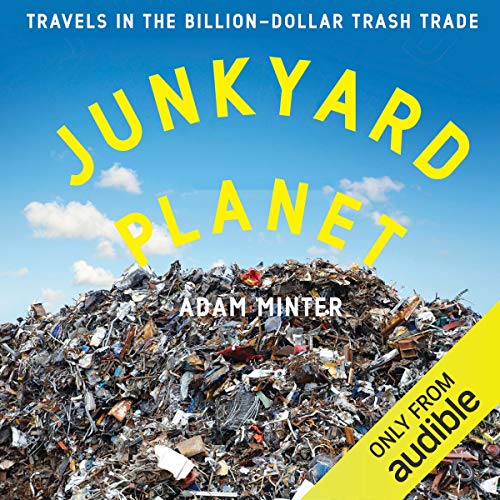
Junkyard Planet
Summary
When you drop your Diet Coke can or yesterday's newspaper in the recycling bin, where does it go? Probably halfway around the world, to people and places that clean up what you don't want and turn it into something you can't wait to buy. In Junkyard Planet, Adam Minter - veteran journalist and son of an American junkyard owner - travels deeply into a vast, often hidden, multibillion-dollar industry that's transforming our economy and environment. Minter takes us from back-alley Chinese computer recycling operations to high-tech facilities capable of processing a jumbo jet's worth of recyclable trash every day. Along the way, we meet an unforgettable cast of characters who've figured out how to build fortunes from what we throw away: Leonard Fritz, a young boy "grubbing" in Detroit's city dumps in the 1930s; Johnson Zeng, a former plastics engineer roaming America in search of scrap; and Homer Lai, an unassuming barber turned scrap titan in Qingyuan, China. Junkyard Planet reveals how "going green" usually means making money - and why that's often the most sustainable choice, even when the recycling methods aren't pretty. With unmatched access to and insight on the junk trade, and the explanatory gifts and an eye for detail worthy of a John McPhee or William Langewiesche, Minter traces the export of America's recyclables and the massive profits that China and other rising nations earn from it. What emerges is an engaging, colorful, and sometimes troubling tale of consumption, innovation, and the ascent of a developing world that recognizes value where Americans don't. Junkyard Planet reveals that we might need to learn a smarter way to take out the trash.
©2013 Adam Minter (P)2013 Audible, Inc.

A Duke by Default
Summary
New York City socialite and perpetual hot mess Portia Hobbs is tired of disappointing her family, friends, and - most importantly - herself. An apprenticeship with a struggling swordmaker in Scotland is a chance to use her expertise and discover what she's capable of. And it turns out that she excels at aggravating her gruff silver-fox boss...when she's not having inappropriate fantasies about his sexy Scottish burr. Tavish McKenzie doesn't need a rich, spoiled American telling him how to run his armory...even if she is infuriatingly good at it. Tav tries to rebuff his apprentice - and his attraction to her - but when Portia accidentally discovers that he's the secret son of a duke, rough-around-the-edges Tav becomes her newest makeover project. Forging metal into weapons and armor is one thing, but when desire burns out of control and the media spotlight gets too hot to bear, can a commoner turned duke and his posh apprentice find lasting love?
©2018 Alyssa Cole (P)2018 Dreamscape Media, LLC

12 Major World Religions
Summary
For billions of people, having a religious belief system provides purpose in life. For some, religion serves as a guide for moral behavior. Today’s world is one in which our understanding of world religions is both understatedly important, as well as increasingly complex. After many years exploring the foundations of various world religions, Jason Boyett has written this comprehensive, easy-to-understand exploration of the 12 major world religions through a meticulous, yet unbiased lens. 12 Major World Religions offers an impartial look at where each of these belief systems intersects, how they differ, and why some have been - or are currently - misunderstood. PLEASE NOTE: When you purchase this title, a PDF of reference material not included in the narration will be available in your Audible Library along with the audio.
©2016 Zephyros Press, Berkeley, California (P)2018 Audible, Inc.

Wooden
Summary
A provocative and revelatory new biography of the legendary UCLA coach John Wooden, by one of America's top college basketball writers. No college basketball coach has ever dominated the sport like John Wooden. His UCLA teams reached unprecedented heights in the 1960s and '70s, capped by a run of ten NCAA championships in twelve seasons and an eighty-eight-game winning streak, records that stand to this day. Wooden also became a renowned motivational speaker and writer, revered for his "Pyramid of Success." Seth Davis of Sports Illustrated and CBS Sports has written the definitive biography of Wooden, an unflinching portrait that draws on archival research and more than two hundred interviews with players, opponents, coaches, and even Wooden himself. Davis shows how hard Wooden strove for success, from his All-American playing days at Purdue through his early years as a high school and college coach to the glory days at UCLA, only to discover that reaching new heights brought new burdens and frustrations. Davis also reveals how at the pinnacle of his career Wooden found himself on questionable ground with alumni, referees, assistants, and even some of his players. His was a life not only of lessons taught, but also of lessons learned. Woven into the story as well are the players who powered Wooden's championship teams - Kareem Abdul-Jabbar, Bill Walton, Walt Hazzard, and others - many of whom speak frankly about their coach. The portrait that emerges from Davis's remarkable biography is of a man in full, whose life story still resonates today.
©2014 Seth Davis (P)2014 Audible Inc.

No Banners, No Bugles
Summary
The unheralded story of how salvage helped the Allies win back North Africa. By the time America joined World War II, Edward Ellsberg had already earned his place as one of the world’s great marine salvage engineers, and his best-selling accounts of raising doomed submarines and histories of classic diving operations had made him a literary star. With America’s entry into the war, Ellsberg returned to active duty with no easy assignment: clearing the vital port at Massawa, Eritrea, with no men, no equipment, and no budget. No Banners, No Bugles picks up with Ellsberg stationed at Oran, Algeria, an important Mediterranean harbor as the Allies prepare for Operation Torch, the fight to reclaim North Africa from the Axis powers. Following his success at Massawa, Ellsberg must sort out the disorganized mess left by the Vichy French and find a way to open the port, though his flagging health proves to be a dangerous obstacle. As General Eisenhower’s chief of salvage in the Mediterranean, Ellsberg needs to clear harbors all across North Africa. No Banners, No Bugles is the riveting story of how Ellsberg the miracle worker tackled his greatest mission yet.
©1949 Edward Ellsberg and Lucy Buck Ellsberg (P)2014 Audible Inc.

Jefferson and Hamilton
Summary
A spellbinding history of the epic rivalry that shaped our republic: Thomas Jefferson, Alexander Hamilton, and their competing visions for America.From the award-winning author of Almost a Miracle and The Ascent of George Washington, this is the rare work of scholarship that offers us irresistible human drama even as it enriches our understanding of deep themes in our nation's history. The decade of the 1790s has been called the age of passion. Fervor ran high as rival factions battled over the course of the new republic - each side convinced that the others' goals would betray the legacy of the Revolution so recently fought and so dearly won. All understood as well that what was at stake was not a moment's political advantage, but the future course of the American experiment in democracy. In this epochal debate, no two figures loomed larger than Thomas Jefferson and Alexander Hamilton. Both men were visionaries, but their visions of what the United States should be were diametrically opposed. Jefferson, a true revolutionary, believed passionately in individual liberty and a more egalitarian society, with a weak central government and greater powers for the states. Hamilton, a brilliant organizer and tactician, feared chaos and social disorder. He sought to build a powerful national government that could ensure the young nation's security and drive it toward economic greatness. Jefferson and Hamilton is the story of the fierce struggles - both public and, ultimately, bitterly personal - between these two titans. It ended only with the death of Hamilton in a pistol duel, felled by Aaron Burr, Jefferson's vice president. Their competing legacies, like the twin strands of DNA, continue to shape our country to this day. Their personalities, their passions, and their bold dreams for America leap from the page in this epic new work from one of our finest historians.
©2013 John Ferling (P)2013 Audible, Inc.

Before Columbus
Summary
A companion book for young listeners based on 1491: New Revelations of the Americas Before Columbus, the groundbreaking best seller by Charles C. Mann.
©2009 Charles C. Mann and Downtown Bookworks Inc. (P)2016 Audible, Inc.
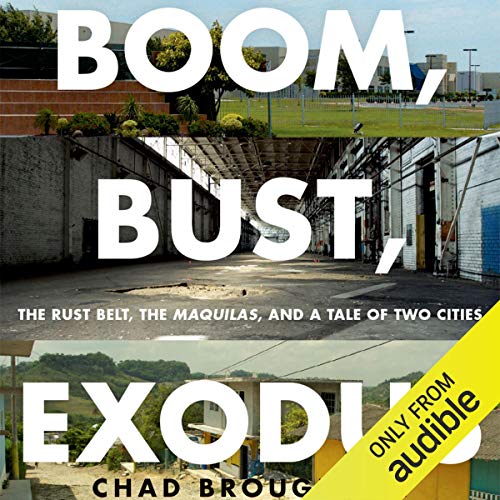
Boom, Bust, Exodus
Summary
In 2002, the town of Galesburg, a slowly declining Rustbelt city of 33,000 in western Illinois, learned that it would soon lose its largest factory, a Maytag refrigerator plant that had anchored Galesburg's social and economic life for decades. Workers at the plant earned $15.14 an hour, had good insurance, and were assured a solid retirement. In 2004, the plant was relocated to Reynosa, Mexico, where workers sometimes spent 13-hour days assembling refrigerators for $1.10 an hour. In Boom, Bust, Exodus, Chad Broughton offers a ground-level look at the rapid transition to a globalized economy, from the perspective of those whose lives it has most deeply affected. We live in a commoditized world, increasingly divorced from the origins of the goods we consume; it is easy to ignore who is manufacturing our smart phones and hybrid cars; and where they come from no longer seems to matter. And yet, Broughton shows, the who and where matter deeply, and in this audiobook he puts human faces to the relentless cycle of global manufacturing. It is a tale of two cities. In Galesburg, where parts of the empty Maytag factory still stand, a hollowed out version of the American dream, the economy is a shadow of what it once was. Reynosa, in contrast, has become one of the exploding post-NAFTA "second-tier cities" of the developing world, thanks to the influx of foreign-owned, export-oriented maquiladoras - an industrial promised land throbbing with the energy of commerce, legal and illegal. And yet even these distinctions, Broughton shows, cannot be finely drawn: Families in Reynosa also struggle to get by, and the city is beset by violence and a ruthless drug war. Those left behind in the post-Industrial decline of Galesburg, meanwhile, do not see themselves as helpless victims: They have gone back to school, pursued new careers, and learned to adapt and even thrive.
©2015 Chad Broughton (P)2014 Audible Inc.

Crouching Tiger
Summary
Will there be war with China? This book provides the most complete and accurate assessment of the probability of conflict between the United States and the rising Asian superpower. Equally important, it lays out an in-depth analysis of the possible pathways to peace. Written like a geopolitical detective story, the narrative encourages listener interaction by starting each chapter with an intriguing question that often challenges conventional wisdom. Based on interviews with more than 30 top experts, the author highlights a number of disturbing facts about China's recent military buildup and the shifting balance of power in Asia: the Chinese are deploying game-changing "carrier killer" ballistic missiles; some of America's supposed allies in Europe and Asia are selling highly lethal weapons systems to China in a perverse twist on globalization; and, on the US side, debilitating cutbacks in the military budget send a message to the world that America is not serious about its "pivot to Asia". In the face of these threatening developments, the book stresses the importance of maintaining US military strength and preparedness and strengthening alliances, while warning against a complacent optimism that relies on economic engagement, negotiations, and nuclear deterrence to ensure peace. Accessible to listeners from all walks of life, this multidisciplinary work blends geopolitics, economics, history, international relations, military doctrine, and political science to provide a better understanding of one of the most vexing problems facing the world. Cover design by Jacqueline Nasso Cooke.
©2015 Prometheus Books (P)2016 Audible, Inc.

American Psychosis
Summary
In 1963, President John F. Kennedy delivered an historic speech on mental illness and retardation. He described sweeping new programs to replace "the shabby treatment of the many millions of the mentally disabled in custodial institutions" with treatment in community mental health centers. This movement, later referred to as "deinstitutionalization," continues to impact mental health care. Though he never publicly acknowledged it, the program was a tribute to Kennedy's sister Rosemary, who was born mildly retarded and developed a schizophrenia-like illness. Terrified she'd become pregnant, Joseph Kennedy arranged for his daughter to receive a lobotomy, which was a disaster and left her severely retarded. Fifty years after Kennedy's speech, E. Fuller Torrey's audiobook provides an inside perspective on the birth of the federal mental health program. On staff at the National Institute of Mental Health when the program was being developed and implemented, Torrey draws on his own first-hand account of the creation and launch of the program, extensive research, one-on-one interviews with people involved, and recently unearthed audiotapes of interviews with major figures involved in the legislation. As such, this book provides historical material previously unavailable to the public. Many now wonder why public mental illness services are so ineffective. At least one-third of the homeless are seriously mentally ill, jails and prisons are grossly overcrowded, largely because the seriously mentally ill constitute 20 percent of prisoners, and public facilities are overrun by untreated individuals. As Torrey argues, it is imperative to understand how we got here in order to move forward towards providing better care for the most vulnerable.
©2014 E. Fuller Torrey (P)2014 Audible Inc.

Baseball before We Knew It
Summary
It may be America's game, but no one seems to know how or when baseball really started. Theories abound, myths proliferate, but reliable information has been in short supply - until now, when Baseball before We Knew It brings fresh new evidence of baseball's origins into play. David Block looks into the early history of the game and of the 150-year-old debate about its beginnings. He tackles one stubborn misconception after another, debunking the enduring belief that baseball descended from the English game of rounders and revealing a surprising new explanation for the most notorious myth of all - the Abner Doubleday - Cooperstown story. Block's book takes listeners on an exhilarating journey through the centuries in search of clues to the evolution of our modern National Pastime. Among his startling discoveries is a set of long-forgotten baseball rules from the 1700s. Block evaluates the originality and historical significance of the Knickerbocker rules of 1845, revisits European studies on the ancestry of baseball which indicate that the game dates back hundreds, if not thousands of years, and assembles a detailed history of games and pastimes from the Middle Ages onward that contributed to baseball's development. In its thoroughness and reach, and its extensive descriptive bibliography of early baseball sources, this audiobook is a unique and invaluable resource - a comprehensive and reliable account of baseball before it was America's game.
©2005 David Block (P)2014 Audible Inc.
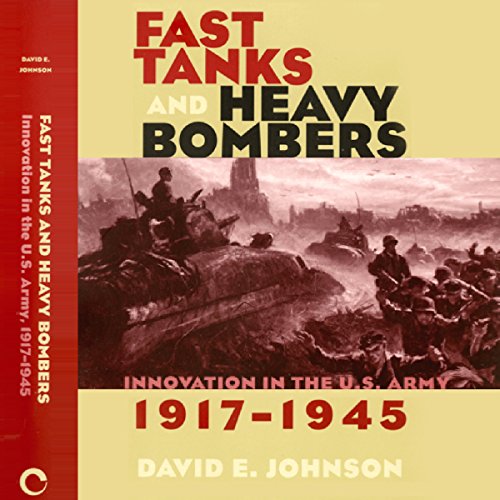
Fast Tanks and Heavy Bombers
Summary
The US Army entered World War II unprepared. In addition, lacking Germany's blitzkrieg approach of coordinated armor and air power, the army was organized to fight two wars: one on the ground and one in the air. Previous commentators have blamed Congressional funding and public apathy for the army's unprepared state. David E. Johnson believes instead that the principal causes were internal: army culture and bureaucracy, and their combined impact on the development of weapons and doctrine. Johnson examines the US Army's innovations for both armor and aviation between the world wars, arguing that the tank became a captive of the conservative infantry and cavalry branches, while the airplane's development was channeled by air power insurgents bent on creating an independent air force. He maintains that as a consequence, the tank's potential was hindered by the traditional arms, while air power advocates focused mainly on proving the decisiveness of strategic bombing, neglecting the mission of tactical support for ground troops. Minimal interaction between ground and air officers resulted in insufficient cooperation between armored forces and air forces. Fast Tanks and Heavy Bombers makes a major contribution to a new understanding of both the creation of the modern US Army and the Army's performance in World War II. The book also provides important insights for future military innovation.
©1998 Cornell University (P)2017 Audible, Inc.

Bottled & Sold
Summary
Peter Gleick knows water. A world-renowned scientist and freshwater expert, Gleick is a MacArthur Foundation "genius", and according to the BBC, an environmental visionary. And he drinks from the tap. Why don't the rest of us? Bottled & Sold shows how water went from being a free natural resource to one of the most successful commercial products of the last 100 years - and why we are poorer for it. It's a big story and water is big business. Every second of every day in the United States, a thousand people buy a plastic bottle of water, and every second of every day a thousand more throw one of those bottles away. That adds up to more than 30 billion bottles a year and tens of billions of dollars of sales. Are there legitimate reasons to buy all those bottles? With a scientist's eye and a natural storyteller's wit, Gleick investigates whether industry claims about the relative safety, convenience, and taste of bottled versus tap hold water. And he exposes the true reasons we've turned to the bottle, from fear mongering by business interests and our own vanity to the breakdown of public systems and global inequities. "Designer" H2O may be laughable, but the debate over commodifying water is deadly serious. It comes down to society's choices about human rights, the role of government and free markets, the importance of being "green", and fundamental values. Gleick gets to the heart of the bottled water craze, exploring what it means for us to bottle and sell our most basic necessity.
©2010 Peter H. Gleick (P)2013 Audible, Inc.

Censors at Work
Summary
This absorbing history by a brilliant scholar and writer deepens our understanding of how censorship works. With his uncanny ability to spark life in the past, Robert Darnton re-creates three historical worlds in which censorship shaped literary expression in distinctive ways. In 18th-century France, censors, authors, and booksellers collaborated in making literature by navigating the intricate culture of royal privilege. Even as the king's censors outlawed works by Voltaire, Rousseau, and other celebrated Enlightenment writers, the head censor himself incubated Diderot's great Encyclopedie by hiding the banned project's papers in his Paris townhouse. Relationships at court trumped principle in the Old Regime. Shaken by the Sepoy uprising in 1857, the British Raj undertook a vast surveillance of every aspect of Indian life, including its literary output. Years later the outrage stirred by the British partition of Bengal led the Raj to put this knowledge to use. Seeking to suppress Indian publications that it deemed seditious, the British held hearings in which literary criticism led to prison sentences. Their efforts to meld imperial power and liberal principle fed a growing Indian opposition. In Communist East Germany, censorship was a component of the party program to engineer society. Behind the unmarked office doors of Ninety Clara-Zetkin Street in East Berlin, censors developed annual plans for literature in negotiation with high party officials and prominent writers. A system so pervasive that it lodged inside the authors' heads as self-censorship, it left visible scars in the nation's literature. By rooting censorship in the particulars of history, Darnton's revealing study enables us to think more clearly about efforts to control expression past and present.
©2014 Robert Darnton (P)2014 Audible Inc.

Flowers in the Blood
Summary
The incredible and complex history of opium throughout the world. Opium has played a dramatic and varied role in human history, inspiring religious veneration, scientific exploration, the bitterest rancor, and the most fanciful ecstasy. Now, authors Jeff Goldberg and Dean Latimer have provided a complete, insightful history of opium. Flowers in the Blood lifts the veil of mystery that has surrounded opium down through the ages. Inside, discover: Why a three-thousand-year-old statue of a Greek goddess was crowned with poppies The formulas for Hippocrates’s ancient opium remedies Why the Islamic councils of the wise vilified hashish but venerated opium Why there was no opium problem in nineteenth-century England and America despite unprecedented and unrestricted consumption of opiates What really provoked the Opium Wars in China Why John Jacob Astor quit the opium trade The unique role played by Chinese opium in the birth of the American labor movement Along the way, the authors provide details of the addictions of S. T. Coleridge, Thomas De Quincey, and other literary opium-eaters of the nineteenth century, as well as chronicling the progress of antidrug laws and the ongoing search for an addiction cure. Originally published in 1981, this edition of Flowers in the Blood has been updated with a new preface by Goldberg. At times disconcerting, raising serious questions about attitudes and approaches toward powerful drugs and their control, Flowers in the Blood is an essential addition to the literature of opium, and a wide-awake look at the stuff that dreams (and nightmares) are made of.
©2014 Jeff Goldberg and Dean Latimer. Introduction by William Burroughs (P)2013 Audible, Inc.

Wall Street
Summary
Wall Street is an unending source of legend - and nightmares. It is a universal symbol of both the highest aspirations of economic prosperity and the basest impulses of greed and deception. Charles R. Geisst's Wall Street is at once a chronicle of the street itself - from the days when the wall was merely a defensive barricade built by Peter Stuyvesant - and an engaging economic history of the United States, a tale of profits and losses, enterprising spirits, and key figures that transformed America into the most powerful economy in the world. The audiobook traces many themes, like the move of industry and business westward in the early 19th century, the rise of the great Robber Barons, and the growth of industry from the securities market's innovative financing of railroads, major steel companies, and Bell's and Edison's technical innovations. And because "The Street" has always been a breeding ground for outlandish characters with brazen nerve, no history of the stock market would be complete without a look at the conniving of ruthless wheeler-dealers and lesser known but influential rogues. This updated edition covers the historic, almost apocalyptic events of the 2008 financial crisis and the overarching policy changes of the Obama administration. As Wall Street and America have changed irrevocably after the crisis, Charles R. Geisst offers the definitive chronicle of the relationship between the two, and the challenges and successes it has fostered that have shaped our history.
©1997 Charles R. Geisst (P)2014 Audible Inc.

Pen and Ink Witchcraft
Summary
Indian peoples made some 400 treaties with the United States between the American Revolution and 1871, when Congress prohibited them. They signed nine treaties with the Confederacy, as well as countless others over the centuries with Spain, France, Britain, Mexico, the Republic of Texas, Canada, and even Russia, not to mention individual colonies and states. In retrospect, the treaties seem like well-ordered steps on the path of dispossession and empire. The reality was far more complicated. In Pen and Ink Witchcraft, eminent Native American historian Colin G. Calloway narrates the history of diplomacy between North American Indians and their imperial adversaries, particularly the United States. Treaties were cultural encounters and human dramas, each with its cast of characters and conflicting agendas. Many treaties, he notes, involved not land, but trade, friendship, and the resolution of disputes. Far from all being one-sided, they were negotiated on the Indians' cultural and geographical terrain. When the Mohawks welcomed Dutch traders in the early 1600s, they sealed a treaty of friendship with a wampum belt with parallel rows of purple beads, representing the parties traveling side-by-side, as equals, on the same river. But the American republic increasingly turned treaty-making into a tool of encroachment on Indian territory. Calloway traces this process by focusing on the treaties of Fort Stanwix (1768), New Echota (1835), and Medicine Lodge (1867), in addition to such events as the Peace of Montreal in 1701 and the treaties of Fort Laramie (1851 and 1868). His analysis demonstrates that native leaders were hardly dupes. The records of negotiations, he writes, show that "Indians frequently matched their colonizing counterparts in diplomatic savvy and tried, literally, to hold their ground." Each treaty has its own story, Calloway writes, but together they tell a rich and complicated tale of moments in American history when civilizations collided.
©2013 Oxford University Press (P)2014 Audible Inc.

War on the Basepaths
Summary
During his 24-year career, Ty Cobb was an MVP, a Triple Crown-winner, and a 12-time batting champion and was elected in the inaugural ballot for the National Baseball Hall of Fame (along with Honus Wagner, Babe Ruth, Christy Mathewson, and Walter Johnson). As someone who retired from the game over 85 years ago, he is still the leader for career batting average; second in runs, hits, and triples; and a mainstay in dozens of other categories. However, when most people think of "The Georgia Peach", they're reminded of his reputation as a "dirty" player. It was said that he got so many of his steals because he would sharpen his metal cleats and "spike" the second basemen if they would try to tag him out. It's also said that he was rude, nasty, a racist, and hated by peers and the press alike. As author Tim Hornbaker did for Charles Comiskey in Turning the Black Sox White, War on the Basepaths is an unbiased biography of one of the greatest players ever to grace a baseball diamond. Based on detailed research and analysis, Tim Hornbaker offers the full story of Cobb's life and career, some of which has been altered for almost a century. While he retired in 1928 and passed away in 1961, War on the Basepaths will show how Ty Cobb really was and place listeners in the box seats of his incredible life.
©2015 Tim Hornbaker (P)2015 Audible, Inc.