Andrew Cullum has narrated 14 audiobooks on Listento.it by 8 authors, with an average listener rating of 4.4★ across 43 ratings. The most-rated is Harlequin.

Harlequin
Summary
The first book in Bernard Cornwell's best-selling Grail Quest series, in a bright and bold repackage. The year is 1342. The English, led by Edward III, are laying waste to the French countryside. The army may be led by the King, but it is the archers, the common men, who are England's secret weapon. The French know them as Harlequins. Thomas of Hookton is one of these archers. But he is also on a personal mission: To avenge his father's death and retrieve a stolen relic. Thomas begins a quest that will lead him through fields smeared with the smoke of fires set by the rampaging English, until at last the two armies face each other on a hillside near the village of Crécy.
©2008 Bernard Cornwell (P)2014 HarperCollins Publishers

Heretic
Summary
A sharp, skilled and utterly fearless archer in the army of King Edward III, young Thomas of Hookton has been making his way through France for three years now, fighting fiercely alongside the English troops. But being a soldier in the great Hundred Years War is only a means to an end: Thomas of Hookton is hot on the trails of the man who brutally slaughtered his father and stole his only treasure - rumored to be the Holy Grail - from the ancient church of Hookton. All Europe wants the grail, and though many doubt it even exists, no one would willingly allow an enemy to find Christendom's most precious relic. To seek revenge and reclaim what's rightfully his, Thomas finds himself in a murderous race with the dangerous black rider who keeps cunningly eluding his grasp. In the tradition of Ken Follett and Edward Rutherford, Heretic is the third book in Bernard Cornwell's remarkable new series about the search for the Holy Grail.
©2003 Bernard Cornwell (P)2014 HarperCollins Publishers

Nicomachean Ethics and Eudemian Ethics
Summary
Aristotle’s Nicomachean Ethics and Eudemian Ethics represent, in many ways, the Western classical springboard for the systematic study and implementation of ethics, the optimum behaviour of the individual. (By contrast, Aristotle’s Politics concerns the optimum blueprint for the city-state.) It is in the hands of each individual, he argues in these books on personal ethics, to develop a character which bases a life on virtue, with positive but moderate habits. The Nicomachean Ethics, the primary work (the title is said to come from his son Nicomachus and is generally regarded as having been essentially notes for lectures), is divided into 10 books. It opens with a statement on who should study ethics and why and that the pursuance of moral virtue leads to happiness. Courage, temperance, magnanimity, honesty and friendship are among the many qualities considered. Aristotle also outlines some of the obstacles to developing virtue. Throughout, the emphasis is placed on the practical advantages of developing positive ethics – this is practical philosophy. The Eudemian Ethics (named after a pupil of Aristotle, Eudemus of Rhodes) is a shorter work, and in fact its chapters four, five and six are identical to chapters five, six and seven in the Nicomachean Ethics. (They are not replicated in this recording of the Eudemian Ethics.) It is now widely felt by scholars that this work preceded the Nicomachean Ethics and therefore offers Aristotle’s earlier thoughts on the subject. Despite the similarities, the Eudemian Ethics contains other material (the virtue of ‘mildness’ appears) and places different emphases or expansions in certain areas; for example, it offers a particularly detailed consideration of the key concepts of virtue, wisdom and pleasure. In both these important books, the characteristically clear and systematic manner with which Aristotle deals with the whole question of ethics makes an audio recording especially accessible. The works are read with a persuasive clarity by Andrew Cullum. Nicomachean Ethics translation: W D Ross. Eudemian Ethics translation: H. Rackham.
Public Domain (P)2018 Ukemi Productions Ltd

Heretic
Summary
The eagerly anticipated follow-up to the number one best seller Vagabond, this is the third installment in Bernard Cornwell's Grail Quest series, in a bright and bold repackage. It is 1347. The Hundred Years War has been suspended. The truce releases English archer Thomas of Hookton to pursue his arch enemy and resume his quest for the most prized relic in Christendom: the Holy Grail. Heading south, Thomas and his men-at-arms begin lightning raids to draw out his enemy. But fate takes an unexpected hand when the plague strikes. What had been a landscape of castles, monasteries, vineyards and villages becomes death's kingdom and the need for the grail, as a sign of God's favour, is more urgent than ever.
©2003 Bernard Cornwell (P)2014 HarperCollins Publishers Limited

The Golden Bough
Summary
The Golden Bough, the monumental study of religious rites and practices in ‘primitive’ societies, was one of the earliest influential texts in anthropology. Its author, Sir James Frazer, surveyed the wide range of cultural habits, taboos and beliefs in communities across the world concluding that there was an observable pattern in the way magic developed into religion, though formal expression emerged in different ways. It was a study that he continued for many years, with initial volumes appearing in 1890 and growing in size until the 12-volume edition was published in 1915. In 1922, Frazer produced his own single volume edition which is presented here. His starting point was the ‘remarkable rule which regulated the succession to the priesthood of Diana at Aricia’, where the incumbent would remain in position until slain in combat by his successor. Further study showed Frazer that this was a familiar pattern in both religion and rule. The more he compared unconnected early societies the more similarities he found - a pattern which suggested the universal existence of basic human tendencies. His multifaceted analysis of magic and religion considers topics as various as tree worship, taboo, sacrifice, myths of Adonis and Osiris, the Corn-Mother, the transference of evil, public scapegoats and much else. He draws on evidence for these from many different societies - ranging from Babylonian, African, and Jewish to Khazar, European and Mexican. The Golden Bough was, and remains, a remarkable achievement for its breadth and detail and proved a huge influence on numerous international figures including psychologists Sigmund Freud and C. G Jung, writers and poets James Joyce, T. S. Eliot, and Robert Graves, the mythologist Joseph Campbell and the contemporary critic Camille Paglia. The Golden Bough helped to establish anthropology as a science. But Frazer’s methods and conclusions also drew criticism from later professionals whose detailed field studies produced a more nuanced view on rituals, beliefs and practices. Nevertheless, The Golden Bough remains a remarkable, fascinating and colourful document with its extensive range and detail on human practice. Andrew Cullum presents this challenging, important work with clarity and sustained interest. A PDF containing chapter headings is available for download to aid the listener and show the scope of the work. It also contains a reproduction of Turner’s painting The Golden Bough, which set Frazer along his path. PLEASE NOTE: When you purchase this title, the accompanying reference material will be available in your Library section along with the audio on our Desktop Site.
Public Domain (P)2020 Ukemi Productions Ltd

The Fressingfield Witch
Summary
The Fressingfield Witch is a fictional murder mystery based on true events. Two of Suffolk's darkest cases of witchcraft are weaved together in one compelling story. Scores of innocent women died during the Suffolk witch trials. Fear and uncertainty swept the land. Years later and two unexplained deaths in the village of Fressingfield stir up rumours of witchcraft again. Private Detective Lawrence Harpham agrees to investigate. But Lawrence is still tormented by the loss of his family in a house fire. Can he overcome his own demons and discover who is behind the flurry of deaths? The sins of the fathers return to haunt in this intricately plotted Victorian murder mystery.
©2017 Jacqueline Beard (P)2020 W F Howes

The End of the Cold War
Summary
The dismantling of the Berlin Wall in 1989 and the spread of Perestroika throughout the former Soviet bloc was a sea change in world history. Here, acclaimed Russian historian Robert Service examines precisely how that change came about. Drawing on a vast and largely untapped range of sources, he builds a picture of the two men who spearheaded the breakthrough: Ronald Reagan, president of the United States; and Mikhail Gorbachev, last general secretary of the Soviet Union. Authoritative, compelling and meticulously researched, this is political history at its best.
©2016 Robert Service (P)2016 Oakhill Publishing
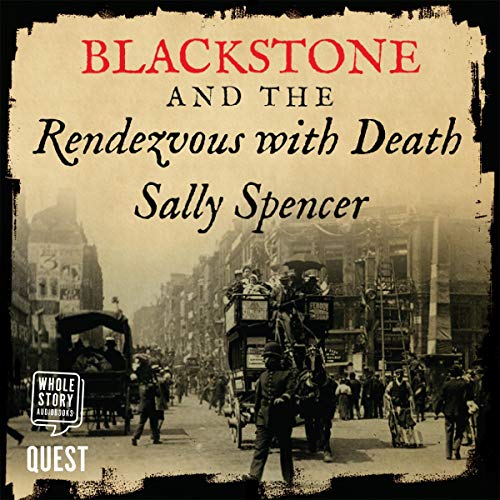
Blackstone and the Rendezvous with Death
Summary
Blackstone and the Rendezvous with Death is an expertly plotted Victorian mystery that will keep listeners guessing to the last minute. The body of a young man fished out of the Thames is of little interest to Londoners caught up in the excitement of Queen Victoria’s Diamond Jubilee celebrations. Yet to Inspector Sam Blackstone, the case is as puzzling as any he has ever come across. Why should a corpse dressed in the rags of a commoner have the face of a gentleman? And if this man does belong to noble stock, why has no one come forward to claim the body? As his investigation proceeds, Blackstone finds himself entering the world of the aristocracy. Death seems to stalk him, and as each new clue leads to nothing more than a new murder, Blackstone comes to realise that he is caught up in what may turn out to be the most horrendous crime of the century.
©2019 Sally Spencer (P)2019 W. F. Howes Ltd

Optimal Money Flow
Summary
Extremes in income and wealth inequality are leading us closer to a highly insecure and unstable economy. Neoclassical, monetarist, Keynesian, and other economic paradigms have proven inadequate to explain this phenomenon. While many books promote redistribution as an issue of fairness, Lawrence C. Marsh's Optimal Money Flow explicitly sets aside the fairness issue to argue instead that redistribution is imperative for economic efficiency, stability, and maximum economic growth. Marsh introduces his unique money flow paradigm as the replacement for other economic paradigms that have failed at addressing the situation we face today. Marsh's money flow paradigm views the flow of money to the top of the wealth pyramid as inherent, inevitable, and inexorable to the free enterprise system. This new paradigm requires that government assume its rightful responsibility to direct sufficient money flow from the top to the bottom (like a heart pumping blood throughout the body) in order to maximize employment, economic growth, and efficient resource allocation. In a healthy economy, the money then flows naturally back up to the top in a circulatory flow. Optimal Money Flow provides an abundance of stimulating, original ideas for readers who appreciate books at the intersection of economics and politics. One such idea is Marsh's ''My America'' personal accounts. This new policy tool would serve as an alternative to the Fed buying US Treasury securities in New York financial markets, which just lowers interest rates and boosts stock and bond prices. Instead, a ''My America'' Federal Reserve bank account would be created for every American, into which money could be injected directly to provide consumers with cash to stimulate demand when the economy slows. Conservatives will appreciate two aspects of this approach: The people, not the government, decide how to spend the money, and it does not increase taxes or add to the national debt, while it simultaneously avoids excessive inflation through prudent monetary management. It also uses less money and has a more direct and immediate impact on consumer demand than the purchase of US Treasury securities. Lawrence Marsh sees government as the heart of the free enterprise system--where it does and should play an active part in maintaining and ensuring efficient and equitable resource allocation in an economy. Previous economic paradigms viewed government as an external, alien force outside the system, but Marsh promotes a very different approach. While he acknowledges there is efficiency in the market for ordinary goods and services, he sees contagion effects and inefficiency in many financial markets. With higher levels of globalization, low levels of unionization, and more rapid technological change, a new type of business cycle has emerged--one in which rising middle-class debt and stock market bubbles have replaced price and wage inflation as the source of economic instability. Marsh believes government can contribute to the efficiency of the free enterprise system by better aligning marginal costs and marginal benefits, and that in the long run, government can greatly enhance efficiency, productivity, and economic growth. Marsh also takes on the commonly held notion of a static fight over a fixed economic pie with the assertion that this view must be replaced with one of a dynamic process that maximizes the growth rate of the economic pie for everyone - by keeping the money flowing to all parts of the economy. Optimal Money Flow's important message and unique proposals deliver a fresh view of the interconnectedness of the globe and an updated understanding of the underlying economic forces that shape our lives today - including international trade and how one country's decisions now impact the rest of the world.
©2020 Lawrence C. Marsh (P)2020 Greenleaf Book Group

The Scole Confession
Summary
Overstrand 1895. Lawrence Harpham and Violet Smith are witnesses to suicide while on holiday. Beneath the body lies a bible belonging to a murdered man. Clues lead to the violent death of a bookseller and a chilling confession from the past. From Norfolk to Liverpool, investigations point to the unsolved murder of Fanny Nunn in the town of Diss. But how are the murders connected? Why do the parish registers contain so many unnatural deaths? As Lawrence and Violet close in on the killer, Lawrence discovers a long-kept secret about his wife’s death. Can he overcome his demons, and will they stop the murders before more lives are lost?
©2020 Jacqueline Beard (P)2020 W F Howes

The Cambridge History of Warfare
Summary
The new edition of The Cambridge History of Warfare, written and updated by a team of eight distinguished military historians, examines how war was waged by Western powers across a sweeping timeframe beginning with classical Greece and Rome, moving through the Middle Ages and the early modern period, down to the wars of the 21st century in Afghanistan, Iraq, and Syria. The book stresses five essential aspects of the Western way of war: a combination of technology, discipline, and an aggressive military tradition with an extraordinary capacity to respond rapidly to challenges and to use capital rather than manpower to win. Although the focus remains on the West, and on the role of violence in its rise, each chapter also examines the military effectiveness of its adversaries and the regions in which the West's military edge has been - and continues to be - challenged.
©2020 Geoffrey Parker (P)2021 Upfront Books

The Ripper Deception
Summary
A tragic death in Ipswich leaves clues to the mysterious demise of Edmund Gurney in Brighton. Private Detective Lawrence Harpham investigates leaving his partner Violet to unravel a series of strange disturbances at a Suffolk rectory. Both inquiries lead unexpectedly to Whitechapel and the murder of Frances Coles. Was Frances a Ripper victim and is her murder linked to the autumn of terror? Jack is back – or is he?
©2019 Jacqueline Beard (P)2020 W F Howes

Politics
Summary
The title Politics literally means ‘the things concerning the city’. Here, Aristotle considers the important role that politics plays in the life of the community and its contribution to harmonious and virtuous existence. It is divided into eight books and was a cornerstone in political philosophy for centuries despite certain features - including attitudes towards slaves and women - clearly placing its conclusions and advice within the confines of Athenian society of the fourth century BCE. Aristotle’s fundamental view is that the individual needs the city more than the city needs the individual, not least because a well-ordered city-state offers obvious benefits beyond simply self-protection and commerce. It makes possible a broader life, allowing in addition education and leisure, leading its citizens towards a life of virtue. In book two, Aristotle considers the best regime for the city, looking at the three main forms of his time - democracy, oligarchy/aristocracy and monarchy. He considers the qualification to be a citizen and participate in the political process - offering a wider view than Plato, for example. Revolution, change, constitutional developments, insurrections - these issues of instability are discussed with references to specific examples. And in later books he proposes the conditions for the best state, the ideal state, ‘for a state is not a community of living beings only, but a community of equals, aiming at the best life possible’. Aristotle’s Politics is a seminal text and is read here by Andrew Cullum with clarity and purpose. Translation: Benjamin Jowett.
Public Domain (P)2019 Ukemi Productions Ltd
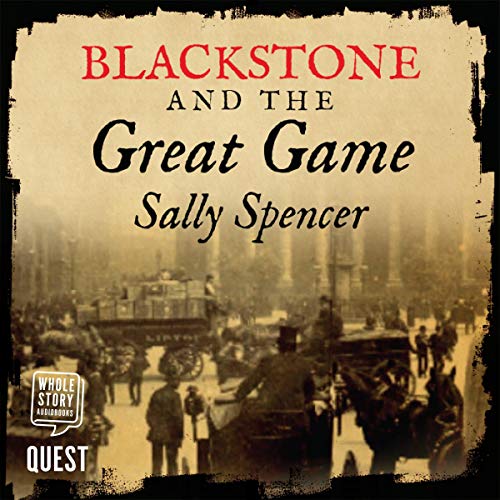
Blackstone and the Great Game
Summary
A series of kidnappings seemed like straightforward, run-of-the-mill crimes at first, but Inspector Sam Blackstone soon realises they are anything but. This gang is so ruthless that it shocks even the hardened London criminal underworld. And it is plain to Blackstone that this is just a preliminary skirmish - that the gang ultimately intends to play for much larger stakes. But Blackstone's problems are only just beginning. When the son of the visiting Maharajah of Chandrapore is taken in a full-on ambush, Blackstone realises that the previous kidnappings were just practice for a plot that impacts not only Britain, but it’s whole Empire. Blackstone finds himself caught up in a game of cat and mouse, frantically trying to pin down the loose threads to find the lost prince before it’s too late.
©2019 Sally Spencer (P)2019 W. F. Howes Ltd