Charlton Griffin has narrated 72 audiobooks on Listento.it by 51 authors, with an average listener rating of 4.7★ across 434 ratings. The most-rated is The Decline and Fall of the Roman Empire.
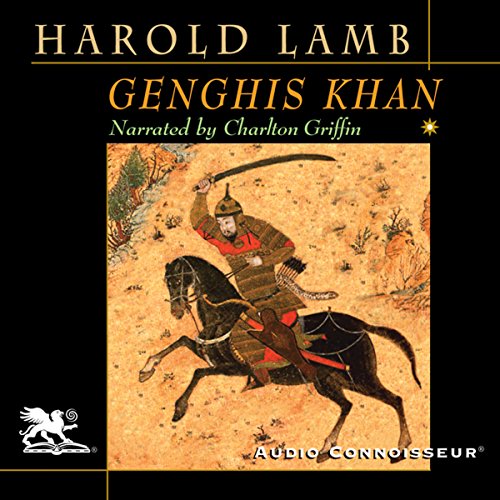
Genghis Khan
Summary
In the early 13th century, a simple nomad chieftain managed to cobble together a powerful kingdom in the highlands of northern Asia, which was subsequently to challenge the greatest powers of the day. He was triumphant in all directions. This leader was Timujin, whose name meant "Iron Man". He became Genghis Khan, "Universal Ruler", the greatest conqueror ever known - a warrior feared from the British Isles to the tip of the Korean peninsula. Known by many names, including "The Scourge of God", Genghis Khan sent his Mongol armies ranging over most of the Eurasian land mass. He first sent his hordes of cavalry crashing into China, then turned on the ancient Persian Shah before smashing the Muslim Caliphate. He left smoldering ruins and depopulated nations in his tracks. Instead of measuring his progress in miles, we measure it today by degrees of latitude and longitude. The tough, barbaric Mongolians were welded into the finest, most highly disciplined force of mobile fighting men assembled up to that period. Mongol leadership, unlike those of other armies, was based strictly on merit. Incompetence was not tolerated among the Khan's generals. The lightning quick movements and encircling tactics of Mongol horsemen baffled their opponents time after time. In fact, under Genghis Khan, they were never defeated. At the Great Khan's death in 1227, there were hardly any worthy opponents left to fight anywhere in the world.
©2007 Audio Connoisseur (P)2007 Audio Connoisseur

Rome and the Mediterranean Vol. 1
Summary
Polybius says that he wrote his Histories "to find out by what means and by what political system the entire world was brought under the domination of Rome..." And as he states, it was an event totally without precedent. Within the short space of about 50 years Rome went from being a provincial leader of an Italian confederacy to become the Mistress of the Mediterranean: Caput Mundi. "Surely there can be no one so shallow or so apathetic of character that he has no desire to know how and under what type of government the Romans were able in less than fifty-three years to bring under their control almost the whole of the civilized world, a passage of events which is unique to history." Indeed. And who better to write such a history than the brilliant Polybius? Polybius was one of the first historians to attempt to present history as a sequence of causes and effects, based upon a careful examination of tradition and a keen scrutiny of the facts. Of all ancient historians, only Thucydides is considered the greater. Tragically, much of The Histories has been lost. But what remains is singularly dramatic and crucially important. It was Polybius who first made Rome's struggle with Hannibal comprehensible to scholars and later generations of historians. He is still our primary source for information about Hannibal and the events of the first half of the second century B.C. Livy used him as a source, as did Plutarch. And although much is missing, much remains: a review of the First Punic War, a detailed description of the Second Punic War, comparisons of the characters of Scipio and Hannibal, comparisons of the Greek phalanx to the Roman legion, a study of the Roman constitution, the dazzling intrigues of the Hellenistic monarchies, and much more. Volume 1 begins with a review of events leading up to Hannibal's invasion of Italy. The amazing account of Hannibal's crossing of the Alps is one of the highlights of this volume. Volume 1 ends with Hannibal...
©2008 Public Domain (P)2008 Audio Connoisseur

The Aeneid
Summary
The Aeneid represents one of the greatest cultural and artistic achievements of Western Civilization. Within the brooding and melancholy atmosphere of Virgil's pious masterpiece lies the mythic story of Aeneas and his flight from burning Troy, taking with him across the Mediterranean the survivors of the Greek onslaught. Aeneas, after many travails and adventures, including a love affair with Dido Queen of Carthage and a visit to the underworld to see his father, ends up in Italy. He fights and wins a war against mighty Turnus and his Latins, thereby founding the city of Rome and beginning that line of Roman aristocracy which was to end with the great Caesars. With this mighty epic, Virgil glorified the Roman Empire and Augustus in the divine light of Olympian predestination, suggesting a higher power at work in the affairs of Rome. But ultimately, The Aeneid suggests that violence cannot be justified, and that mankind must deal with the consequences of violence whether born of malevolent gods or men. The greatness of The Aenied lies in its ability to envelope the listener in an aura of spiritual longing, an effect that hitherto had never been accomplished in ancient literature. This was one of the reasons why The Aeneid remained so popular throughout the Middle Ages. Early Christians were greatly impressed by the pious, noble quality of the hero Aeneas, and to them Virgil was an accessible bridge between the pagan world and their own. And his work remained the model for epic poetry right through the Renaissance and beyond. Dante, Shakespeare, and Milton owe a debt of gratitude to Virgil and The Aeneid which can never be repaid. The Aeneid is organized into 12 books. This recording includes a brief synopsis of the story prior to the beginning of each book in order to help the listener understand the action of the verse.
©2004 Audio Connoissuer

The Jewish War
Summary
In AD 66, nationalist and religious revolutionaries in Judaea led a ferocious revolt of the Jewish people against the authority of mighty Rome, culminating in the greatest upheaval and savagery the world had known up to that time. By the end of the conflict seven years later, over one million Jews had perished and tens of thousands were sold into slavery. Until the Holocaust, it remained the greatest tragedy ever endured by a people. How had this once prosperous region been laid low, and by what process did its fratricidal feuds take it down a slippery slope to utter annihilation? Fortunately for us, there was an eyewitness to the historical events: Joseph ben Matthias, known to posterity as Flavius Josephus. In beautifully written and clearly understood prose, Josephus sets out to explain the origin of the conflict. He describes how the fanatical zealots came to dominate the political life of Judaea, illustrates how the Romans were drawn into the fight, and shows how the war was carried on by both sides, ending with the famous siege of the fortress of Masada. The Jewish War is one of the most important histories to survive from ancient times, dealing as it does with a subject of which there are very few sources. This is an engaging and heartfelt chronicle by an eyewitness who lived through it all.
Public Domain (P)2012 Audio Connoisseur
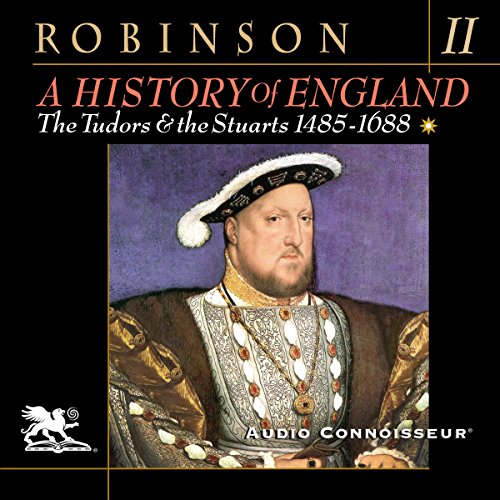
A History of England, Volume 2: The Tudors and the Stuarts: 1485 - 1688
Summary
Cyril Robinson's magnificent history continues with volume two in this four-part series. We now follow the fortunes of two great royal dynasties: Tudor and Stuart. Great names from England's past tumble out one after the other. Henry VIII takes the English out of the Catholic fold. His daughter, Elizabeth, defeats the Spanish Armada of 1588. The arrogance of Charles I leads him to the scaffold. Civil War and Puritanism follow, led by the intrepid Oliver Cromwell. Charles II returns triumphantly in 1661 and leads England into the Restoration period. But the feckless James II manages to get himself chased out of England. The volume ends with the accession of William of Orange and the resurgence of Protestant representative government. Democracy finally gains a permanent foothold in England. PLEASE NOTE: When you purchase this title, the accompanying reference material will be available in your My Library section along with the audio.
Public Domain (P)2015 Audio Connoisseur

A History of England, Volume 3: William III to Waterloo: 1689-1815
Summary
In volume three of Cyril Robinson's famous history of England, we now enter a crucial phase in which political and economic power both change hands. Parliament now dominates the nation's political discourse, and, led by its brilliant Whig leader, Robert Walpole, this party maintains itself in power for a century. It is a stagnant century of corrupt politics and even more corrupt government magistrates and bureaucrats. But it is also the century that will usher in the greatest change humankind has ever seen. The Industrial Revolution completely alters every aspect of society. And, meanwhile, war is the motive power behind everything, as England pits itself against the mightiest and most feared power in Europe, the France of the Bourbons and, later, Napoleon. In a tumultuous 125-year period, the English fight and win three out of four great wars, losing their American colonies but gaining a worldwide trading empire. Follow along in this exciting third volume of a four-part series as England's greatest heroes confront and bring down the greatest military genius of the era, Napoleon Bonaparte. Often going it alone, Britannia places her fate in the hands of two men...Nelson and Wellington. PLEASE NOTE: When you purchase this title, the accompanying reference material will be available in your Library section along with the audio.
Public Domain (P)2015 Audio Connoisseur

The Complete Works of Tacitus: Volume 1: The Annals, Part 1
Summary
In the pantheon of ancient men of letters, none hold a more venerated position than the Roman historian, Tacitus, venerated alike for the accuracy of his chronicles as well as for the superiority of his style. He was a writer of unexcelled genius and consummate skill. But his work fell into oblivion not long after his death, and has come down to us based on the text of a single tattered manuscript from the Middle Ages. Tacitus was born sometime before A.D. 62 during the reign of Nero. He died shortly before or after the accession of the emperor Hadrian, around A.D. 120. Almost nothing is known of him. The Annals cover that period of Roman history from the reign of Tiberius to that of Nero. Parts of the work are missing, including a few sections from Tiberius, all the sections on Caligula, the early reign of Claudius, and the last two years of Nero's life. But what remains is breathtaking in its scope and velocity. Tacitus takes us on a mad river rafting voyage down a raging torrent of history. The story fluctuates between events at the court in Rome to the battlefields of Germany, between the bravest deeds of selfless courage and the most sordid acts of vengeful hostility. Nothing escapes the jaded eye of Tacitus as we experience the decadence of Rome in all its haughty grandeur. Part 1 of The Annals begins with the death of Augustus and provides a brief look at his accomplishments and reign before proceeding with the story of Tiberius. Along with events at Rome, we are also taken to the scene of conflict in Parthia and Germany. We witness the rise of the evil Sejanus and learn how he poisoned the mind of Tiberius and turned his rule into a reign of terror. This production uses the famous translation by Church and Brodribb, considered the finest in the English language. The Annals concludes in Volume 2 of The Complete Works of Tacitus.
Public Domain (P)2006 Audio Connoisseur

The Odyssey
Summary
The Odyssey is the greatest adventure story ever written, and one of the great epic masterpieces of Western literature For almost 3,000 years, it has been a storehouse of ancient Greek folklore and myth. It is also our very first novel, if we think of it in terms of romantic plot development, realistic characterizations, frequent change of scene, and heroic dramatic devices. These elements continue to make it far more popular than its kindred piece, The Iliad. No other character in world literature has inspired as many literary works as Odysseus ("Ulysses" in Latin). The story concerns an incident in the Trojan War and the difficulties of its hero, Odysseus, as he attempts to reach his home. Although possessing courage, stamina and power, it is his powerful mind that ultimately enables him to reach his destination and slay his adversaries. Odysseus is the very model of the worldly, well-traveled, persevering man. With his diplomacy, quick wit, and shrewd resourcefulness, he survives one catastrophe and set-back after another.
Public Domain (P)2010 Audio Connoisseur

A History of England, Volume 1: Early and Middle Ages to 1485
Summary
The history of England can be said to have begun with the arrival of Julius Caesar in 54 BC. Four hundred years later, Romano British civilization came to an end with the withdrawal of Roman military protection and the onslaught by successive waves of Germanic invasions. Angles, Saxons, Jutes, Danes, and Norsemen ravaged Britain for almost 500 years. The native Celtic peoples were displaced and driven westward into present-day Wales, where their descendants dwell to this day. Although various Saxon and Danish kingdoms rose and fell, it was not until the Saxon king Alfred the Great consolidated the three great kingdoms of England into one and repelled the Danish invaders in the late ninth century that the concept of a unified, English nationstate came into being. But the Norman invasion of 1066 was about to alter everything. And chaos and misery were to follow. Be sure to hear all four volumes of this magnificent chronicle by master historian Cyril Robinson. PLEASE NOTE: When you purchase this title, the accompanying reference material will be available in your My Library section along with the audio.
Public Domain (P)2015 Audio Connoisseur

The History of Rome, Volume 3: Books 21-25
Summary
The incredible saga of Hannibal and his invasion of Italy in 218 B.C. is the subject of this third volume of Livy's magnificent history. As only Livy can describe it, we are swept into the era of the Second Punic War and given a ringside view of the leadership of both sides. The stirring account of Hannibal crossing the Alps, the brutal description of Cannae, and the relentless Roman siege of Syracuse are some of the highlights of this remarkable story. Never has the undaunted courage of the Roman soldier been more fully accounted for, and never has the language of history been more dramatically set down as it has in the searing pages of Titus Livy. The Hannibalic War lives on in this mighty epic of ancient literary history. Livy's The History of Rome continues in an additional three volumes.
Public Domain (P)2011 Audio Connoisseur

The Great Age of Discovery, Volume 2
Summary
As the 18th century approached its midpoint, commercial and military competition between the European states became fierce. And whoever obtained accurate information about distant lands would hold an advantage. Were there continental landmasses in the Pacific? Was there a Northwest Passage to Japan and China? What lay in the interior of Africa? Was it possible to cross the Sahara? Where did the rivers Nile and Congo originate? The concluding volume of The Great Age of Discovery follows the explorations that mapped the vast Pacific ocean and the menacing interior of Africa. The names of three men figure prominently in this saga: Captain James Cook, David Livingstone, and Henry Morton Stanley. But there were many equally brave men who are not so well known and whose incredible achievements deserve recognition. Author Paul Herrmann gives them their due with grace and vigor. There have never been explorers like these, and probably never will be again. Through frightening storms at sea, vast wastelands of sand, and dark, impenetrable jungle, these men carried the light of knowledge so that all who followed after could see.
©2005 Audio Connoisseur

Alexander the Great
Summary
This is the incredible story of the world's greatest conqueror, a man who single handedly changed the course of history...and who was worshipped as a god. There have been many attempts in the 2,300 years since Alexander's death to tell the epic story of this enigmatic soldier. His deeds read like the stuff of legends. Of all the chroniclers of Alexander, and there have been many famous ones, including Plutarch and Ptolemy, none have given us a clearer and truer account than the one by Arrian. Writing 450 years after Alexander's death, Arrian had the advantage of hindsight and the unique ability to sift through important historical material which is now lost. He was able to judge the motives of many of the detractors of Alexander and to set the record straight in many instances. Alexander's aims have always been a topic of intense debate and this history will tell you what this brilliant tactician was trying to accomplish and why. From his first encounter with the Persians at the Battle of the Granicus to his last battle on the banks of the Indus River, thrill to the extraordinary exploits of Alexander the Great as he turns the ancient world upside down. After his passing, nothing would ever again be the same....
©2004 Audio Connoisseur (P)2004 Audio Connoisseur

The Georgics
Summary
Virgil's Georgics ranks as one of the most precious pastoral poems ever written, and it has served as a model for its type ever since. Georgics means "of or relating to agriculture or rural life" and it comes from the Greek word "georgicus". Virgil's main theme in this, his second great work after The Eclogues, was the importance of peace both in the spiritual and physical sense. One arrives at this peace through embracing the hard life of the farmer and also coming to an understanding of one's place in the universe. Virgil used the Greek poet Hesiod as his guide for describing why the cheerful acceptance of laboring on a farm was salutary. (Hesiod's Works and Days is an attempt by the poet to explain to an estranged brother why his work on the family farm would make him a better person.) As for an understanding of one's place in the universe, Virgil used as his model the Epicurean philosophy in the poetry of his fellow Roman, Lucretius. But although Virgil absorbed the incredible poetry of both Hesiod and Lucretius, he did not copy them. His work is entirely his own. The Georgics is an amazing synthesis of the scientific and the spiritual, which continues to amaze us to this day. This great poem is organized into four parts, or books. Its ostensible subject is farming and the correct seasons for the various chores of the farmer: the cultivation of vines and the planting of trees, farm animals and their diseases, and, finally, how to care for bees. Though Virgil claims that his aim is to teach, the real result is to inspire us with the genius of his poetic ability.
©2007 Audio Connoisseur (P)2007 Audio Connoisseur

Idylls of the King
Summary
The Arthurian legend of Camelot has been told many times, but never better than by Alfred Tennyson. Employing some of the most stirring and beautiful blank verse ever written, Tennyson crafted his version of the Knights of the Round Table over the course of nearly fifty years, completing it in 1885. Despite the length of time, Tennyson managed to maintain a high level of style and continuity throughout. His gift for sublime and evocative metaphor and simile has never been matched, and in this case has produced some of the most memorable lines of narrative poetry in the history of English literature. Although Sir Thomas Mallory's Le Morte d'Arthur has been called the backbone of the Arthurian legend, Tennyson's Idylls of the King is the flesh and blood. Tennyson's epic poem consists of 12 loosely connected episodes of the knights at Camelot, Arthur himself appearing as an almost Christ-like figure among them. However, though Arthur's knights represent the highest and most virtuous ideals, they sometimes fail to live up to those ideals, and their tragic flaws eventually lead to disaster. But it is this very tension between the flawed knight struggling with his own weaknesses as he confronts evil that gives Idylls of the King its compelling qualities. Some of the most dramatic scenes in the poem concern the vicissitudes of love and the daunting ethical challenges such love poses for a knight: jealousy, betrayal, and adultery. Tennyson's vision of glorious quests, Christian valor, doomed love, manly jousts, and bitter destiny have dazzled readers for well over 100 years. These endlessly inspiring, enduring lines of verse are not only entertaining, but enlightening as well. The timeless Idylls will no doubt continue to enthrall mankind for centuries to come.
Public Domain (P)2007 Audio Connoisseur

The Dark Ages: 476-918
Summary
The Dark Ages is the story of the birth of Western civilization. It was a harrowing crucible of war, destruction, and faith. For over 100 years, Charles Oman's famous history has remained one of the finest sources for the study of this period. Covering a period of 500 years and an area stretching from Northern Germany to Egypt, this is the definitive history that will alter your conceptions of a period of history that gave birth to the civilization we live in today. Table of contents: Chapter 1: Odoacer and Theodoric, 476-493 Chapter 2: Theodoric King of Italy, 493-526 Chapter 3: The Emperors at Constantinople, 476-527 Chapter 4: Chlodovech and the Franks in Gaul, 481-511 Chapter 5: Justinian and His Wars, 528-540 Chapter 6: Justinian (Continued), 540-565 Chapter 7: The Earlier Frankish Kings and Their Organisation of Gaul, 511-561 Chapter 8: The Visigoths in Spain, 531-603 Chapter 9: The Successors of Justinian, 565-610 Chapter 10: Decline and Decay of the Merovingians, 561-656 Chapter 11: The Lombards in Italy and the Rise of the Papacy, 568-653 Chapter 12: Heraclius and Muhammed, 610-641 Chapter 13: The Decline and Fall of the Visigoths, 603-711 Chapter 14: The Contest of the Eastern Empire and the Caliphate, 641-717 Chapter 15: The History of the Great Mayors of the Palace, 656-720 Chapter 16: The Lombards and the Papacy, 653-743 Chapter 17: Charles Martel and His Wars, 720-741 Chapter 18: The Iconoclast Emperors: State of the Eastern Empire in the Eighth Century, 717-802 Chapter 19: Pippin the Short: Wars of the Franks and Lombards, 741-768 Chapter 20: Charles the Great: Early Years, 768-785...Conquest of Lombardy and Saxony Chapter 21: The Later Wars and Conquests of Charles the Great, 785-814 Chapter 22: Charles the Great and the Empire Chapter 23: Louis the Pious, 814-840 Chapter 24: Disruption of the Frankish Empire: The Coming of the Vikings, 840-855 Chapter 25: The Darkest Hour, 855-887: From the Death of Lothair I to the Deposition of Charles the Fat Chapter 26: Italy and Sicily in the Ninth Century, 827-924 Chapter 27: Germany, 888-918 Chapter 28: The Eastern Empire in the Ninth Century, 802-912 Chapter 29: The End of the Ninth Century in Western Europe: Conclusion
Public Domain (P)2016 Audio Connoisseur

A History of Greece, Volume 1
Summary
A History of Greece is the thrilling story of the rise to power and influence of the greatest civilization the world has ever known. As Cyril Robinson's exquisite narrative unfolds, we find ourselves plunged into mankind's greatest and most magnificent adventure. The story begins in Minoan Crete, but quickly shifts to a dimly understood mainland culture. We follow the heroic deeds of the Mycenians and the Trojan War, the glorious artistic and intellectual triumphs of the Ionians, the turmoil of the Doric invasion and resultant dark age, the slow recovery culminating in the epic Persian wars and the renewed splendor of Periclean Athens. In the fifth century B.C., philosophy, literature, art, and architecture reach a pinnacle in Athens which no civilization has ever equaled. But civil strife soon follows and eventually embroils all of Greece.
©2001 Audio Connoisseur

Rome and the Mediterranean Vol. 2
Summary
After 18 years of desperate struggle, Rome has gradually turned the tide against Hannibal, and now the Carthaginian finds himself bottled up in the toe of Italy while Scipio ruthlessly tightens the noose around Carthage on the African mainland. Knowing that Hannibal must sooner or later abandon Italy and come to the aid of his countrymen, the brilliant Roman commander prepares for the inevitable test of strength. It is not long in coming. Volume 2 of Rome and the Mediterranean brings to an end the long and violent struggle between Scipio and Hannibal. The grand spectacle of naval and land battles, the political intrigue and tribal quarrels, and the interminable squabbles among the Greek city states...all comes to an end. Roman hegemony is now complete. If for no other reason, the pleasure of reading Polybius is his penetrating character analysis of the leading men of his day. There is something peculiarly modern about Polybius, though in his own day he was criticized for his lack of "style". In fact, by the time of the third century A.D., he had largely been forgotten in the West. He was resurrected in the Renaissance and found greater and greater support among republican thinkers, especially those of the Founding Fathers of the American Revolution. Until recently, Polybius was read only by those interested in Roman Republican and Greek Hellenistic history. However, his spectacular ability to draw the reader into the drama of the historical narrative has made him popular among modern readers, and all the more so as he is the primary source for those events in ancient history which are today considered not only of the utmost importance, but also of enduring interest. It is a great pity that his work did not survive intact, though we should consider ourselves fortunate to have what is left.
©2008 Public Domain (P)2008 Audio Connoisseur

Suleiman the Magnificent: Sultan of the East
Summary
Suleiman the Magnificent is the story of the Ottoman Turks' greatest leader. He came to power at the early age of 25 in 1520. Before his death in 1566, he had altered the power structure and geography of Eastern Europe, and Turkey had become the dominant naval power in the Mediterranean. Suleiman's reign would mark the high tide of Turkish power in Asia Minor and Europe. His widespread conquests began with the taking of Belgrade and the surrender of Rhodes then surged on to Budapest, Tabriz, Baghdad, Aden, and Algiers, making the Turks' power feared and respected as far west as Paris and London. This is a stirring drama of conquest and naked power. It is also the personal story of the sultan and his household and the less spectacular - but in some ways more deadly - play and counterplay of ambition and jealousy in the palace...particularly in the harem. It is a time of great adventure and great romance.
©1951 Harold Lamb (P)2016 Audio Connoisseur

Roman History, Volume 2
Summary
Volume Two of Dio Cassius brings to a close his sweeping historical work, Roman History. This volume begins with book 50 and the struggle between Octavian and Mark Antony. Octavian's victory is the beginning of the Principate and a new direction in Roman history. Dio takes a prolonged look at the reign of Augustus. He follows this with the history of the following emperors: Tiberius, Gaius (Caligula), Claudius, Nero, Galba, Otho, Vitellius, Vespasian, Titus, Domitian, Nerva, Trajan, Hadrian, Antoninus Pius, Lucius Verus, Marcus Aurelius, Commodus, Pertinax, Didius Julianus, Septimius Severus, Caracalla, Geta, Macrinus, Diadumenian, Elagabalus, and Alexander Severus. Much of our information about the emperors who followed Commodus is only available in the work of Dio Cassius. Please note that book 72 is no longer extant.
Public Domain (P)2017 Audio Connoisseur

The Flame of Islam
Summary
"The year 1169 dawned upon a quiet East. Along this frontier of Christianity, nothing unusual was taking place. Nothing ominous, that is. And in that part of the East known as the Holy Land, the crusaders went about their affairs without misgivings." So opens Harold Lamb's magnificent history. However, out of the chaos of Muslim tribal warfare and regional animosity arose a military genius such as Islam had never known: Saladin. Uniting the sultanates of Cairo and Damascus, Saladin created a single powerful state. Luring the crusaders into an ill-considered confrontation, he destroyed their army at the Battle of Hattin in 1187, leaving the few remaining crusaders clinging perilously to a series of towns and forts along the Levantine coast. Into this desperate situation stepped the most formidable warrior of the age, Richard the Lion-Hearted. Hear the incredible tales of valor and futility as King Richard attempts to retake Jerusalem. And after him, many other kings would come forward....
©1930 Estate of Harold Lamb (P)2012 Audio Connoisseur