Charlton Griffin has narrated 72 audiobooks on Listento.it by 51 authors, with an average listener rating of 4.7★ across 434 ratings. The most-rated is The Decline and Fall of the Roman Empire.

Count Luna
Summary
Count Luna is the story of Alexander Jessiersky, an Austrian aristocrat who presides over a Viennese transport company. As World War II opens, Jessiersky, who detests the Nazis, is asked by his board of directors to acquiesce in the confiscation of a neighboring parcel of land in order to accommodate expanded war business. Jessiersky refuses to go along, but because of inattention or laziness his board carries out the land seizure behind his back. The owner, a certain Count Luna, is sent to a concentration camp on a trumped up charge. When Jessiersky discovers the deed, he is enraged. But his efforts to free Luna are in vain. Years later, at the end of the war, Jessiersky is convinced that Luna has survived his ordeal and is seeking vengeance. With one mysterious event succeeding another, Jessiersky begins to sink into an obsessive, murderous paranoia over Luna. It is an obsession that finally ends years later in the labyrinthine catacombs of Rome.... Alexander Lernet-Holenia, (1895 - 1977), was born into the aristocracy of the Austro-Hungarian Empire. A soldier himself, he watched that empire crumble to dust and closely observed its effects on Central Europe. His writings, which include a copious number of poems, plays, and novels, are among the greatest works in modern German literature. Count Luna is a masterpiece of psychological profiling and employs elements of romanticism, naturalism, expressionism, and magic realism. The literary merit of Lernet-Holenia is secure in the line of masters like Dostoyevsky and Mann, and his work remains some of the most important of the 20th century. Count Luna is one of his greatest achievements. It is the spellbinding work of a master writer at the height of his power.
©1955 Estate of Alexander Lernet-Holenia (P)2003 Audio Connoisseur

The Satyricon
Summary
The moral cesspool that Rome had become in the first century AD is the subject of The Satyricon by Petronius. The work itself was originally quite a long one, perhaps as long as a thousand pages. The extant portion, however, is only a small fraction of the original. The work contains a mixture of prose and verse, serious and comic elements, and erotic and decadent passages. It possesses a sophisticated humor and a very ironic tone. It is the creation of a Roman gentleman whose insights were keen. The most famous part of this book is the description of Trimalchio’s banquet. It is a marvelous glimpse of the utter degradation and opulence on display in the home of a fabulously wealthy freedman. We are also provided with informal table talk that abounds in vulgarisms and solecisms which give us insight into the unknown Roman proletariat. From start to finish, The Satyricon is one of the best descriptions we have of daily life among the common denizens of Rome. This version was translated by W. C. Firebaugh.
Public Domain (P)2020 Audio Connoisseur

The Persian Wars, Volume 1
Summary
Unquestionably, Herodotus has left mankind one of the world's greatest works of literature. But what, precisely, is it? The Persian Wars is part history, part geography, part anthropology...and completely entertaining. It possesses a charm that is legendary. However, over and above this, Herodotus has succeeded for all time in brilliantly expressing the conflict between the ideal of the free man defending his liberty within a state based on the rule of law, and that of the despot who bases his rule on brute force and whose subjects are considered slaves. In his writing we experience the impact of that great intellectual, moral, and ethical force that set the Greeks apart from the rest of the Ancient World. The Persian Wars is a magnificent epic of human triumph over the forces of tyranny, of the struggle over two diametrically opposed concepts of government...between which man must still choose today. The first four books of The Persian Wars serve as an introduction to the actual conflict itself. In this leisurely unwinding of events, people, and places, Herodotus provides the listener with a fascinating glimpse of the Ancient World. It is a marvelous journey into an exotic time filled with strange and savage tribes, beautiful cities and monuments, and - as always - born along on that inimitable charm that is unique to Herodotus. Translation by George Rawlinson.
©2003 Audio Connoisseur

Charlemagne
Summary
Charlemagne, who was born around 747, was the first recognized emperor to rule from western Europe since the fall of the Western Roman Empire. The expanded Frankish state that Charlemagne founded is called the Carolingian Empire. More than anyone else, it was the great Frankish ruler who provided the basis for the civilization which we today call “Western European” as opposed to the classical European civilization that had preceded it. Charlemagne is referred to as the "Father of Europe" because he united most of Western Europe for the first time since the classical era. He even united parts of Europe that had never been under Frankish or Roman rule. And his reign spurred the Carolingian Renaissance, a period of energetic, cultural, and intellectual activity within the Western Church. His pursuit of reforms in myriad institutions is legendary: administrative, military, economic, monetary, educational, religious, writing, and political. He kept amazingly accurate accounts of his estates, some of which still survive. Charlemagne died in 814 and was laid to rest in Aachen Cathedral in his imperial capital city of Aachen, located in present-day Germany. Listen as this great history by Richard Winston, considered the finest in the English language, takes you back to the exciting 8th century and the dynamic adventures of one of history’s greatest men. This recording also includes a brief introduction on the social and religious structure of the 8th century.
©1954 Estate of Richard Winston (P)2021 Audio Connoisseur

The Italian Renaissance
Summary
In all of human history there has never been an era as richly endowed with human creativity as the Italian Renaissance. When the economic boom of the Late Middle Ages had allowed a flourishing and wealthy merchant class to emerge, a plethora of artists, sculptors, architects, and thinkers followed in their wake. In an astonishingly short period of time, Italy was transformed mentally, physically, and spiritually. Powerful commercial centers like Florence, Venice, and Milan became independent. Artists like Michaelangelo and Cellini threw off the customs of the past and forged new symbols of Man, while others, like the gentle aristocrat Baldassare Castiglione, were attempting to civilize the behavior of society with gentlemanly manners. From north to south, Italian cities were literally reborn with an energy and enthusiasm that has never repeated itself anywhere. This great historical essay tells you why this extraordinary event occurred and why it finally died out, though its effects lasted hundreds of years. Ironically, all the great pomp and splendor of the Italian Renaissance was accompanied by some of the worst violence and mayhem that Italy has ever experienced. In the midst of splendor unheard of, men murdered, stole, raped, lied, and cuckolded friend and foe. Horrible torture, brutal war, and poisonous political intrigue went hand in hand with the most sumptuous artistic and literary output in European history. Follow this incredible story to understand the Italian Renaissance in ways you never conceived.
©2004 Audio Connoisseur
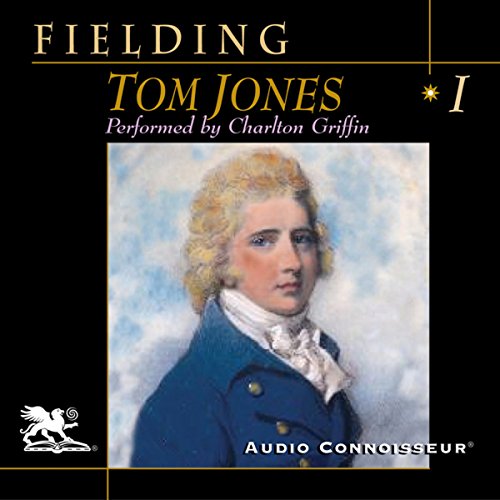
Tom Jones, Volume 1
Summary
Volume 1: Introduction and Books 1-6Tom Jones is a splendid Hogarthian panorama of 18th-century English life and morals, encompassing both city and country, and comprising some of the greatest comic characters in British literature. First published in 1749, it was an instant success and has gone on to become a classic of its genre. Quite simply, there has never been anything like it. This long, riotously hilarious novel begins in the country at the estate of Squire Allworthy. In a long, leisurely unwinding, we are introduced to all the characters and discover all the main plot elements. Tom has been adopted by the squire after being mysteriously discovered there as an infant. When he grows up, he falls in love with the beautiful Sophia Western from a neighboring estate.After the initial introductory sections, the novel begins to unwind furiously as our hero, Tom Jones, finds himself embroiled in one moral dilemma after another. Mr. Allworthy's nephew, Blifil, conspires to turn the good squire against him, and Tom is disinherited and kicked out. Meanwhile, Sophia's boorish father tries to force her to marry the priggish Blifil. She runs away at about the same time that Tom leaves home, and the rest of the novel essentially follows the adventures of Sophia and Tom as their stories join, separate, and intertwine repeatedly. The novel ends in London, where all the loose ends are tidied up and all the secrets are finally revealed. Tom Jones is essentially divided into three parts, with the first being set in the countryside, the second in various inns on the road to London, and the third entirely in London.Tom Jones continues in Volume 2 and concludes with Volume 3.
Public Domain (P)2007 Audio Connoisseur

Napoleon
Summary
Between 1796 and 1815, the continent of Europe was held in thrall by one of the most remarkable personalities of modern times, a man whose name was on the lips of every man, woman, and child: Napoleon Bonaparte. Certainly, one would have to go back to the time of Charlemagne to find his equal on the field of battle, in the halls of diplomacy, or in the courts of jurisprudence. Napoleon not only remade France, he remade it to suit his own personal preferences. Although not himself a revolutionary, Napoleon was nevertheless determined to wipe away the stultifying remnants of the ancient regime once and for all and to replace it with a society firmly grounded on republican principles...at least outwardly. The fact of the matter was, Napoleon played the role of a tyrant. And although he spoke on behalf of the common man, his ultimate bequest to the people of France was a prolonged war stretching from the Iberian peninsula to the streets of Moscow, from the farmland of Holland to the Nile River, and leaving behind the greatest carnage ever known up to that time. His wars were terrifying. And yet, we are still fascinated to this day by the incredible energy, resourcefulness, and sheer brilliance of his military strategy. With precision and panache, H. A. L. Fisher has written the definitive short biography of Napoleon, a book still treasured by historians and scholars to this day, and a work that still holds a prominent place in any bibliography of the Corsican. Written only 97 years after Waterloo, this classic biography remains the best of its type: a succinct, concise portrait of an egotistical genius whose powerful will directed the course of world events for an entire generation. Even to this day, the name Napoleon still gives rise to conflicting emotions.
©2004 Audio Connoisseur

The Persian Wars, Volume 2
Summary
Starting with Book Five, Volume 2 of The Persian Wars enters directly into the intrigues between the Greeks and Persians. Darius, infuriated with Athens because of her support for the liberation of the Ionian Greeks, initiates the first invasion of Greece, which ends with the Athenian victory at Marathon in 490 B.C. When Xerxes ascends the Persian throne a few years later, the war is resumed on a vastly greater scale. In some of the most wonderful prose of all time, Herodotus describes the events culminating in the naval battle of Salamis and the clash of armies at Plataea. Translation by George Rawlinson.
©2003 Audio Connoisseur

Doctor Zhivago
Summary
Winner of the 1958 Nobel Prize for Literature, Doctor Zhivago has gone on to take its place among the classics of Russian literature. Its author, Boris Pasternak, began the novel before WWI but did not complete it until 1956. Essentially, the story is about Russia before and after the October Revolution of 1917. There are many characters who float into and out of the story, the main one being Yuri Zhivago. As the tale unwinds, we encounter the decadence of pre-war Czarist Russia, the harrowing experience of WWI, and the sudden exhilaration of revolution. But exhilaration gives way to the horror of civil war and Bolshevik terror. Throughout these waves of alarming change, Yuri Zhivago strives to understand the tumult, to accept it, and to understand himself and come to terms with life. The main themes are loneliness, disillusionment with revolution, and the unpredictability of life punctuated by coincidence. Doctor Zhivago remains one of the great philosophical novels of the 20th century because so many of its profound, thought-provoking ideas are still relevant in the chaos of 21st-century politics. The storm of war, of revolution, of human passions, and of nature are recreated in one of modern history’s most titanic novels. This recording is from the translation by Max Hayward and Manya Harari.
©1957 Boris Pasternak (P)2020 Audio Connoisseur

The Twelve Caesars
Summary
From the dignified grace of Augustus to the cruel debauchery of Nero, this history chronicles all the vices and virtues of the first 12 rulers of Imperial Rome. The Twelve Caesars was written based on the information of eyewitnesses and public records. It conveys a very accurate picture of court life in Rome and contains some of the raciest and most salacious material to be found in all of ancient literature. The writing is clear, simple and easy to understand, and the numerous anecdotes of juicy scandal, bitter court intrigue, and murderous brigandage easily hold their own against the most spirited content of today's tabloids.
Public Domain (P)2009 Audio Connoisseur

The Persian Wars
Summary
Unquestionably, Herodotus has left mankind one of the world's greatest works of literature. The Persian Wars is part history, part geography, part anthropology...and completely entertaining. It possesses a charm that is legendary. But, over and above this, Herodotus has succeeded for all time in brilliantly expressing the conflict between the ideal of the free man defending his liberty within a state based on the rule of law, and that of the despot who bases his rule on brute force and whose subjects are considered slaves. In his writing we experience the impact of that great intellectual, moral, and ethical force that set the Greeks apart from the rest of the Ancient World. The Persian Wars is a magnificent epic of human triumph over the forces of tyranny, of the struggle over two diametrically opposed concepts of government...between which man must still choose today.
Public Domain (P)2013 Audio Connoisseur

The Greatest American Poetry
Summary
Elliott Gould, Burt Reynolds, Meryl Streep, and a host of other celebrities read over 100 poems by four of America's greatest poets. Walt Whitman celebrates the brash and rugged individualism of his country in exuberant language. The spare, precise language of Emily Dickinson conveys her penetrating vision of the natural world and an acute understanding of the most profound human truths. Robert Frost draws his inspiration from everyday incidents, common situations, and rural imagery. Pulitzer Prize winner Carl Sandburg's poetry embodies a love of and compassion for the common man that earned him the nickname "poet of the people".
Copyright (P) and ©1998 Dove Audio, Inc.