Derek Le Page has narrated 11 audiobooks on Listento.it by 11 authors, with an average listener rating of 4.5★ across 187 ratings. The most-rated is In the Dream House.

In the Dream House
Summary
In the Dream House is Carmen Maria Machado's engrossing and wildly innovative account of a relationship gone bad, and a bold dissection of the mechanisms and cultural representations of psychological abuse. Tracing the full arc of a harrowing relationship with a charismatic but volatile woman, Machado struggles to make sense of how what happened to her shaped the person she was becoming. And it's that struggle that gives the book its original structure: each chapter is driven by its own narrative trope - the haunted house, erotica, the bildungsroman - through which Machado holds the events up to the light and examines them from different angles. She looks back at her religious adolescence, unpacks the stereotype of lesbian relationships as safe and utopian, and widens the view with essayistic explorations of the history and reality of abuse in queer relationships. Machado's dire narrative is leavened with her characteristic wit, playfulness, and openness to inquiry. She casts a critical eye over legal proceedings, fairy tales, Star Trek, and Disney villains, as well as iconic works of film and fiction. The result is a wrenching, riveting book that explodes our ideas about what a memoir can do and be.
©2019 Carmen Maria Machado (P)2019 HighBridge, a division of Recorded Books

Capital: Volume 1
Summary
It can be said of very few books that the world was changed as a result of its publication - but this is certainly the case of Capital: A Critique of Political Economy by Karl Marx (1818-1883). Volume 1 appeared (in German) in 1867, and the two subsequent volumes appeared at later dates after the author's death - completed from extensive notes left by Marx himself. Marx, famously writing in the Reading Room of the British Museum, set out to draw on theories of labour, money and economics developed by many key figures in previous centuries and then present a vivid picture of the effect of (as he saw it) the vicious exploitation of labour and the power-play and greed of that class of unprincipled businessmen - the capitalists. He starts by considering commodity, value and exchange. In doing so he looks at the basic processes involved in labour productivity and how it turns into excessive surplus value at the expense of the labourer himself. But do not think that that this is a dry analysis of the nuts and bolts of economics. Soon Marx, from extensive research, begins to outline the horrifying effect of the industrial revolution (for all its benefits) on the working man, woman and child, the blighting of their lives and slow, oh so slow, march of correcting Acts of Parliaments through the 19th century. These two threads - exploitation economics and the personal plight of the worker - continue to be developed side by side and intertwine with conclusions to become a truly powerful and emotional polemic. Sometimes it becomes clear that his observations are hugely relevant to our 24 hour life, our gig economy and our international economy, with a frightening percentage of world wealth being held in a few hands. This is not an easy book but, especially in the hands of Derek Le Page, who has incorporated all the relevant footnotes (and they are extensive), it is a compelling listen. Whatever the nightmare of 20th century communism, to ignore this book is misjudge it. Marx said, 'Philosophers have previously tried to explain the world; our task is to change it'. And he meant it. Translation: Samuel Moore and Edward Aveling.
Public Domain (P)2018 Ukemi Productions Ltd

Utilitarianism/On Liberty
Summary
John Stuart Mill (1808-1873) was a torchbearer for liberal thought in the 19th century, including liberty of the individual and freedom of speech, and he championed women's suffrage in Parliament. A remarkable man - he learned Greek aged three and at eight had read Herodotus, Xenophon and Plato - he campaigned all his life for a just society. These two essays are his key works. In Utilitarianism (published in 1863, four years after On Liberty), Mill observes that 'the principle of utility' equates to the 'greatest-happiness principle' and that this should be the basis of an ethical life. Mill expands on this view in five chapters and deals with difficulties and criticisms, including the balance of individual versus general happiness. In On Liberty (published in 1859 and written with his wife, Harriet Taylor, who died a year earlier), Mill applied his already established views on utilitarianism to the society and the state. He discusses the necessary balances between authority and liberty; the individual must have freedom, but within a utilitarian (greatest-happiness principle) compass. Nevertheless, he considers the 'tyranny of the majority', and he acknowledges that in certain societies rule by command may benefit the majority. But he emphasises the fundamental importance of individual liberty, so long as it does not harm others. Though it has had its critics, On Liberty remains a key document and has a special resonance for world politics today.
Public Domain (P)2016 Ukemi Productions Ltd

Capital: Volume 2
Summary
It was the close friendship and professional association between Karl Marx and Friedrich Engels that enabled Marx’s full vision presented in Capital: A Critique of Political Economy to come to fruition. Following Marx’s death in 1883, Engels was able to step into the breach and, drawing on Marx’s extensive notes and writings, complete volume 2 of Capital, leading to its publication in 1885. Here, Marx turns his attention to the money owner, the money lender, the wholesale merchant, the trader and the entrepreneur or 'functioning capitalist.' The work is divided into three parts: 'The Metamorphosis of Capital and Their Circuits'; 'The Turnover of Capital'; and finally 'The Reproduction and Circulation of the Aggregate Social Capital'. Though more theoretical and perhaps thus more challenging than volume 1, Marx’s intentions in volume 2 were clear: ‘We investigate...the social intertwining of different capitals, of the component parts of capital and of revenue.’ By looking at the ‘movement of commodities and of money’, Marx was able to clarify the patterns involved in the capitalist mode of production. This is clear in the subtitle of volume 2: The Process of Circulation of Capital. Translation: Samuel Moore and Edward Aveling.
Public Domain (P)2018 Ukemi Productions Ltd

The Psychopathology of Everyday Life
Summary
The Psychopathology of Everyday Life, which appeared first in 1901 and was then expanded in a series of subsequent editions, has proved to be one of Freud's most popular works, and one of his most influential during his lifetime. It was here that he proposed that many slips and errors of memory common to the average man in everyday life actually signals unconscious issues that beset the individual, and, if examined, can be extremely revealing. Freud opens the work with the following statement: 'During the year 1898 I published a short essay on the Psychic Mechanism of Forgetfulness. I shall now repeat its contents and take it as a starting-point for further discussion. I have there undertaken a psychologic analysis of a common case of temporary forgetfulness of proper names, and from a pregnant example of my own observation I have reached the conclusion that this frequent and practically unimportant occurrence of a failure of a psychic function - of memory - admits an explanation which goes beyond the customary utilization of this phenomenon.' This 'phenomenon' was a personal matter for Freud himself. He observed its frequent and varied appearance as an important tool in his psychoanalytic work. He analyses the subject through 12 chapters, including Forgetting of Proper Names, Foreign Words, Childhood and Concealing Memories, Mistakes in Speech, Reading and Writing, Erroneously Carried-out Actions, and Determinism, Chance and Superstitious Beliefs. The Psychopathology of Everyday Life is a key work in psychology and psychoanalysis, yet very accessible. It is presented in a clear and direct manner by Derek Le Page.
Public Domain (P)2016 Ukemi Productions Ltd

The Interpretation of Dreams
Summary
The Interpretation of Dreams by Sigmund Freud is one of the most significant books of the 20th century. Though dreams and their role in human consciousness have been a continuing thread in religion and art and life down the centuries, Freud's look at the subject through the prism of his emerging practice and study of psychoanalysis provided a startlingly new and challenging perspective. First published in German in 1899, it sold slowly; but over the following decade he revised and expanded it in response to his experiences working with patients, reviewing his own dreams, and discussions and debates with colleagues. It was translated into numerous languages. In this extensive work he considers the meaning of dreams experienced by individuals generation after generation: dreams of flying, of death, of anger, of sex, of fear, of power. What do they signify, in general terms and in relation to individuals and their own personal situations? In this seminal book, Freud relates and discusses case histories and the effects of analysis. The remembered dreams have navigated the various passages of unconscious and preconscious filters to emerge into daylight, undergoing internal censorship and wish fulfilment and change and many other factors. So what are these dreams really saying or revealing? What anxiety or hope are they signaling? Sexuality plays a key role - this book contains the first emergence of Freud's Oedipus complex, among other sexual issues. The Interpretation of Dreams is not an easy book - Freud himself produced an abridged version. But its influence on the 20th century, and particularly on Western awareness and society, cannot be underestimated. This classic translation of The Interpretation of Dreams by A. A. Brill dates from 1932 and contains all the major revisions made by Freud, and his footnotes. It has an important place in the audio recordings of Freud's major work, read clearly by Derek Le Page for Ukemi Audiobooks.
Public Domain (P)2017 Ukemi Productions Ltd

Three Essays on the Theory of Sexuality, Beyond the Pleasure Principle, The Ego and the Id
Summary
Here are three key works by Sigmund Freud which, published in the first decades of the 20th century, underpinned his developing views and had such a dramatic effect on world society. In the uncompromising Three Essays on the Theory of Sexuality (1905), he declared that 'sexual aberrations' are not limited to the insane but exist in 'normal' people to a greater or lesser degree. The three essays are divided between sexual perversions, childhood sexuality and puberty. Twenty-first century society has opened and developed the subject considerably, but it is still salutary to return to one of the most important early discussions. Freud presents the force of the unconscious in the sexual instinct and complexes such as the castration complex and the Oedipus complex, the latter of which he first noted in The Interpretation of Dreams. In Beyond the Pleasure Principle (1920) Freud corrects his earlier view that libido or sexual drive is the overwhelming force behind human activity. Now he balances the drive of 'Eros' with 'Thanatos', the destruction or death principle. Along with the pleasure principle, he argues, there lies a tendency for people to self-harm in many ways, either literally or by replaying painful events or thoughts of the past - deliberately invoking 'unpleasure' (psychological discomfort or pain). Beyond the Pleasure Principle remains one of the most criticised texts in the Freud oeuvre. In The Ego and the Id (1923), Freud outlined his study of the human psyche, the result of many years of psychoanalytical practice. Based on the concepts of the 'conscious' and 'unconscious', three elements in the psychic apparatus come into play - the id (instinctual trends), the superego (the critical and moralising role) and the ego (the more conscious control that decides between the two). In the recording, the three works presented here are not only of interest in themselves but show the developing nature of Freud's thought and work over two decades. They are read clearly by Derek Le Page.
Public Domain (P)2017 Ukemi Productions Ltd

Formative Early Writings by Karl Marx
Summary
Though Karl Marx is best known for Capital and The Communist Manifesto, his revolutionary thoughts and ideas had developed over decades spent in study, discussion and association with a variety of organisations throughout Europe and the US, intent on challenging the establishment order. These six very different texts show how Marx’s ideas evolved and how increasingly fierce his views became. In A Criticism of Hegel’s Philosophy of Right (1843) (only the introduction was completed), Marx proposes that the working class has a key part to play in the redemption of humanity. This short work contains one of his most famous epigrams, his criticism of religion as ’the opium of the people’. His growing concerns for the material and economic conditions under which the mass of the population live were revealed in On the Jewish Question (1843), in which he declares that it is not religion that alienates people but their living conditions. Marx had been influenced by early views on materialism by - among others - Ludwig Feuerbach, but in the 11 short comments contained in Theses on Feuerbach (written in 1843 but not published until 1888 by Engels), Marx made it clear that it was necessary to go past theory and invest in practical activity. As he declares in the last comment, ‘Philosophers have hitherto only interpreted the world in various ways; the point is to change it.’ The German Ideology (1846) was another polemic against philosophers in which Marx - and Engels - could also propose their view on world history: ‘Morality, religion, metaphysics, all the rest of ideology and their corresponding forms of consciousness, thus no longer retain the semblance of independence. They have no history, no development; but men, developing their material production and their material intercourse, alter, along with this their real existence, their thinking and the products of their thinking. Life is not determined by consciousness, but consciousness by life.’ The 18th Brumaire of Louis Napoleon (1852) shows another side of Marx the writer: the historian. But in relating the French coup of 1851, when Louis-Napoleon became dictator, Marx wrote from his platform of increasingly strong views on class struggle and the capitalist state. The Critique of Political Economy (1859) effectively previews Capital - but of particular interest here is the preface, in which he gives an account of the development of his philosophical, political and economic views and his materialist approach to history.
Public Domain (P)2018 Ukemi Productions Ltd

Capital Volume 3
Summary
After the detailed history and workings of the development of capitalism in Capital Volumes I and 2, Marx set out, in Capital Volume 3 to consider the future of capitalism, its direction and its inevitable fall from a series of crises and faults intrinsic to the system itself. Published in 1894, 11 years after the death of Marx himself, Capital Volume 3 was the product of the untiring and meticulous work of Friedrich Engels working from Marx’s outline and notes and carried the subtitle The Process of Capitalist Production as a Whole. In seven parts, Marx and Engels were determined to demonstrate that private property, competition and the market economy driven by the profit motive must lead to the demise of capitalism. They were convinced that only the curbing of the individual profit motive can lead to the end of the mass poverty and the destitution that was evident to Marx, Engels and many others concerned with the social inequities of civilisation continuing throughout history. The following comes from chapter 5: 'Capitalist production, when considered in isolation from the process of circulation and the excesses of competition, is very economical with the materialised labour incorporated in commodities. Yet, more than any other mode of production, it squanders human lives, or living-labour, and not only blood and flesh, but also nerve and brain. Indeed, it is only by dint of the most extravagant waste of individual development that the development of the human race is at all safeguarded and maintained in the epoch of history immediately preceding the conscious reorganisation of society.' The seven parts of Capital Volume 3 are: The conversion of Surplus-Value into Profit and the Rate of Surplus-Value into the Rate of Profit. Conversion of Profit into Average Profit. The Law of the Tendency of the Rate of Profit to Fall. Conversion of Commodity-Capital and Money-Capital into Commercial Capital and Money-Dealing Capital (Merchant's Capital). Division of Profit Into Interest and Profit of Enterprise. Interest Bearing Capital. Transformation of Surplus-Profit into Ground Rent. Revenues and Their Sources. Derek Le Page, in his masterly but temperate reading, sustains and clarifies the arguments and vision of Marx and Engels which had, and continues to have, such an impact on the world. In support of this unabridged recording there is a downloadable PDF which sets out some of the tables used by the authors. Translation: Institute of Marxism-Leninism, Moscow. PLEASE NOTE: When you purchase this title, the accompanying reference material will be available in your Library section along with the audio on our Desktop Site.
Public Domain (P)2019 Ukemi Productions Ltd

Appearances Greeting a Point of View
Summary
Twelve little oddities - an assortment of the bizarre, unexpected, charming, unsettling, and downright peculiar. Into darkness or light, there are many ways to escape. The full list of narrators includes: Chris Constantine, Susi Roberts, Liz Hume, Derek Le Page, Alex Rees Oliviere, Elizabeth Ollier, Matthew Lloyd Davies, and Ruth Urquhart.
©2013 JJ Marsh (P)2014 New Chapter Audiobooks
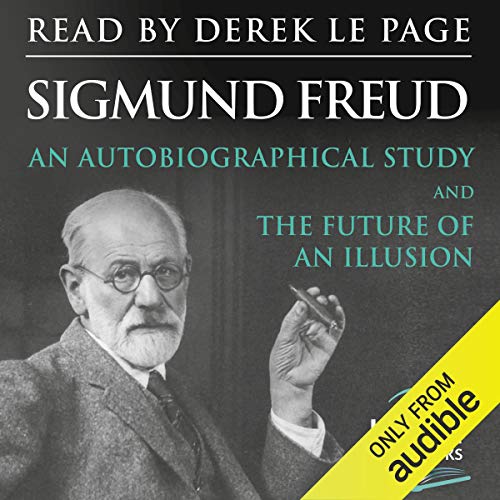
An Autobiographical Study and The Future of an Illusion
Summary
Sigmund Freud (1856-1939) reveals himself in this autobiography, which is simultaneously an account of the early history of psychoanalysis, to have been an outsider from the start. This fascinating account describes the journey of a young, Jewish doctor setting out to find his way in the world of professional medicine, his relationships and collaborations, friendships made and lost and his investigations into cocaine, hypnosis and the cathartic method which contributed to the evolution of his conceptual framework and practices. He acknowledges his debts to Josef Breuer, Jean Martin Charcot and others, who provided him with the seeds of his theory of sexual repression, which in turn led him to investigate the sex lives of neurasthenics and the symptoms of anxiety neurosis. All of these were key elements in the creation of the scientific discipline of psychoanalysis. He highlights the importance of patient observation and describes in detail the processes by which he identified the aetiological factors pertaining to different kinds of disorder. His account of the discoveries that made the genesis of psychoanalysis possible and the difficulties that had to be overcome to truly internationalise it and thereby consolidate his legacy is a remarkable reflection on his life’s work. He describes his time in the United States and the results of meeting with Harvard neurologist James J. Putnam and the philosopher William James. He outlines how the transition from catharsis to psychoanalysis was far more than a mere name change or a cosmetic exercise but was informed by his studies in infantile sexuality and the biphasic onset of human sexual life, as well as the conceptualisation of the existence of the ego, id and superego. He charts his life’s path, outlining how he came to integrate insights deriving from the Oedipus complex postulate, the free association method and the transference hypothesis, into his work; and he mentions most of the major figures in the field in passing, including Carl Gustav Jung and Alfred Adler, who split from his approach to develop their own methods. In The Future of an Illusion he considers the role of religion in culture and critically assesses the nature of the sacred experience and religious thinking. In order to avoid the dangers of producing a science biased monologue, he carries out a kind of dialectic discussion between science and religion, expounding his own rational beliefs but juxtaposing them with those of a hypothetical defender of the religious position, both of which voices are skilfully brought to life in Derek Le Page’s reading. He argues logically and systematically in the rational humanistic tradition that the scientific approach leads to an awakening of the mind and an awareness that religion is essentially a kind of wish fulfilment, an illusion, albeit one that makes life more bearable and satisfying for millions of believers. Science, he concludes, is not an illusion, but it would be illusory to imagine that the truths it offers could be obtained in any other way.
©2019 Sigmund Freud (P)2019 Ukemi Productions Ltd