Joe Ochman has narrated 17 audiobooks on Listento.it by 17 authors, with an average listener rating of 4.6★ across 985 ratings. The most-rated is Antifragile.
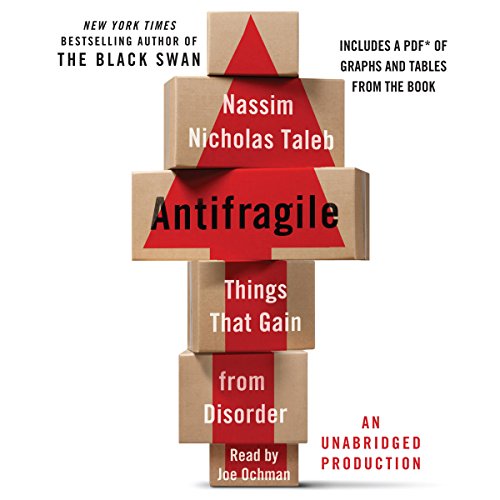
Antifragile
Summary
From the best-selling author of The Black Swan and one of the foremost thinkers of our time, Nassim Nicholas Taleb, a book on how some things actually benefit from disorder. In The Black Swan Taleb outlined a problem, and in Antifragile he offers a definitive solution: how to gain from disorder and chaos while being protected from fragilities and adverse events. For what Taleb calls the "antifragile" is actually beyond the robust, because it benefits from shocks, uncertainty, and stressors, just as human bones get stronger when subjected to stress and tension. The antifragile needs disorder in order to survive and flourish. Taleb stands uncertainty on its head, making it desirable, even necessary, and proposes that things be built in an antifragile manner. The antifragile is immune to prediction errors. Why is the city-state better than the nation-state, why is debt bad for you, and why is everything that is both modern and complicated bound to fail? The audiobook spans innovation by trial and error, health, biology, medicine, life decisions, politics, foreign policy, urban planning, war, personal finance, and economic systems. And throughout, in addition to the street wisdom of Fat Tony of Brooklyn, the voices and recipes of ancient wisdom, from Roman, Greek, Semitic, and medieval sources, are heard loud and clear. Extremely ambitious and multidisciplinary, Antifragile provides a blueprint for how to behave - and thrive - in a world we don't understand, and which is too uncertain for us to even try to understand and predict. Erudite and witty, Taleb’s message is revolutionary: What is not antifragile will surely perish. Please note: The bleeps in the audio are intentional and are as written by the author. No material is censored, and no audio content is missing. PLEASE NOTE: When you purchase this title, the accompanying PDF will be available in your Audible Library along with the audio.
©2012 Nassim Nicholas Taleb (P)2012 Random House Audio

Skin in the Game
Summary
Number-one New York Times best seller A bold work from the author of The Black Swan that challenges many of our long-held beliefs about risk and reward, politics and religion, finance and personal responsibility. In his most provocative and practical book yet, one of the foremost thinkers of our time redefines what it means to understand the world, succeed in a profession, contribute to a fair and just society, detect nonsense, and influence others. Citing examples ranging from Hammurabi to Seneca, Antaeus the Giant to Donald Trump, Nassim Nicholas Taleb shows how the willingness to accept one's own risks is an essential attribute of heroes, saints, and flourishing people in all walks of life. As always both accessible and iconoclastic, Taleb challenges long-held beliefs about the values of those who spearhead military interventions, make financial investments, and propagate religious faiths. Among his insights: For social justice, focus on symmetry and risk sharing. You cannot make profits and transfer the risks to others, as bankers and large corporations do. You cannot get rich without owning your own risk and paying for your own losses. Forcing skin in the game corrects this asymmetry better than thousands of laws and regulations. Ethical rules aren't universal. You're part of a group larger than you, but it's still smaller than humanity in general. Minorities, not majorities, run the world. The world is not run by consensus but by stubborn minorities asymmetrically imposing their tastes and ethics on others. You can be an intellectual yet still be an idiot. "Educated philistines" have been wrong on everything from Stalinism to Iraq to low carb diets. Beware of complicated solutions (that someone was paid to find). A simple barbell can build muscle better than expensive new machines. True religion is commitment, not just faith. How much you believe in something is manifested only by what you’re willing to risk for it. The phrase "skin in the game" is one we have often heard but have rarely stopped to truly dissect. It is the backbone of risk management, but it's also an astonishingly rich worldview that, as Taleb shows in this book, applies to all aspects of our lives. As Taleb says, "The symmetry of skin in the game is a simple rule that's necessary for fairness and justice and the ultimate BS-buster," and "Never trust anyone who doesn't have skin in the game. Without it, fools and crooks will benefit, and their mistakes will never come back to haunt them."
©2018 Nassim Nicholas Taleb (P)2018 Random House Audio
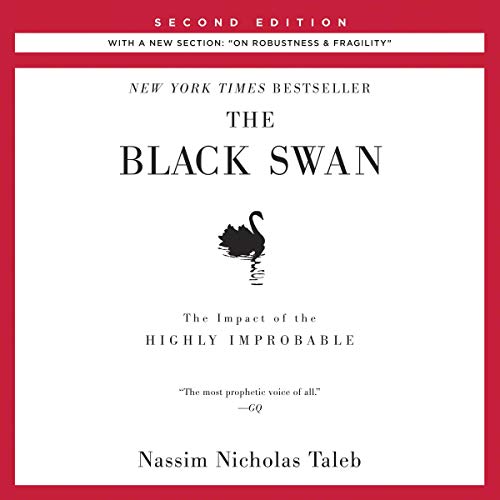
The Black Swan, Second Edition: The Impact of the Highly Improbable: With a new section: "On Robustness and Fragility"
Summary
The Black Swan is a stand-alone book in Nassim Nicholas Taleb’s landmark Incerto series, an investigation of opacity, luck, uncertainty, probability, human error, risk, and decision-making in a world we don’t understand. The other books in the series are Fooled by Randomness, Antifragile, Skin in the Game, and The Bed of Procrustes. A black swan is a highly improbable event with three principal characteristics: It is unpredictable; it carries a massive impact; and, after the fact, we concoct an explanation that makes it appear less random, and more predictable, than it was. The astonishing success of Google was a black swan; so was 9/11. For Nassim Nicholas Taleb, black swans underlie almost everything about our world, from the rise of religions to events in our own personal lives. Why do we not acknowledge the phenomenon of black swans until after they occur? Part of the answer, according to Taleb, is that humans are hardwired to learn specifics when they should be focused on generalities. We concentrate on things we already know and time and time again fail to take into consideration what we don’t know. We are, therefore, unable to truly estimate opportunities, too vulnerable to the impulse to simplify, narrate, and categorize, and not open enough to rewarding those who can imagine the “impossible”. For years, Taleb has studied how we fool ourselves into thinking we know more than we actually do. We restrict our thinking to the irrelevant and inconsequential, while large events continue to surprise us and shape our world. In this revelatory book, Taleb explains everything we know about what we don’t know, and this second edition features a new philosophical and empirical essay, “On Robustness and Fragility”, which offers tools to navigate and exploit a Black Swan world. Elegant, startling, and universal in its applications, The Black Swan will change the way you look at the world. Taleb is a vastly entertaining writer, with wit, irreverence, and unusual stories to tell. He has a polymathic command of subjects ranging from cognitive science to business to probability theory. The Black Swan is a landmark book - itself a black swan. Includes a bonus pdf of tables and figures. Praise for Nassim Nicholas Taleb “The most prophetic voice of all.” (GQ) Praise for The Black Swan: “[A book] that altered modern thinking.” (The Times, London) “A masterpiece.” (Chris Anderson, Editor-in-chief of Wired, author of The Long Tail) “Hugely enjoyable - compelling...easy to dip into.” (Financial Times) PLEASE NOTE: When you purchase this title, the accompanying PDF will be available in your Audible Library along with the audio.
©2010 Nassim Nicholas Taleb (P)2018 Random House Audio

Fooled by Randomness: The Hidden Role of Chance in Life and in the Markets
Summary
Fooled by Randomness is a stand-alone book in Nassim Nicholas Taleb’s landmark Incerto series, an investigation of opacity, luck, uncertainty, probability, human error, risk, and decision-making in a world we don’t understand. The other books in the series are The Black Swan, Antifragile, Skin in the Game, and The Bed of Procrustes. Fooled by Randomness is the word-of-mouth sensation that will change the way you think about business and the world. Nassim Nicholas Taleb - veteran trader, renowned risk expert, polymathic scholar, erudite raconteur, and New York Times best-selling author of The Black Swan - has penned a modern classic that turns on its head what we believe about luck and skill. This book is about luck - or more precisely, about how we perceive and deal with luck in life and business. Set against the backdrop of the most conspicuous forum in which luck is mistaken for skill - the world of trading - Fooled by Randomness provides captivating insight into one of the least understood factors in all our lives. Presented in an entertaining narrative style, the author tackles major intellectual issues related to the underestimation of the influence of happenstance on our lives. The book is populated with an array of characters, some of whom have grasped, in their own way, the significance of chance: the baseball legend Yogi Berra; the philosopher of knowledge Karl Popper; the ancient world’s wisest man, Solon; the modern financier George Soros; and the Greek voyager Odysseus. We also meet the fictional Nero, who seems to understand the role of randomness in his professional life but falls victim to his own superstitious foolishness. However, the most recognizable character of all remains unnamed - the lucky fool who happens to be in the right place at the right time - he embodies the “survival of the least fit”. Such individuals attract devoted followers who believe in their guru’s insights and methods. But no one can replicate what is obtained by chance. Are we capable of distinguishing the fortunate charlatan from the genuine visionary? Must we always try to uncover nonexistent messages in random events? It may be impossible to guard ourselves against the vagaries of the goddess Fortuna, but after listening to Fooled by Randomness, we can be a little better prepared. Includes bonus pdf of tables and figures. Praise for Fooled by Randomness: Named by Fortune One of the Smartest Books of All Time A Financial Times Best Business Book of the Year PLEASE NOTE: When you purchase this title, the accompanying PDF will be available in your Audible Library along with the audio.
©2008 Nassim Nicholas Taleb (P)2019 Random House Audio
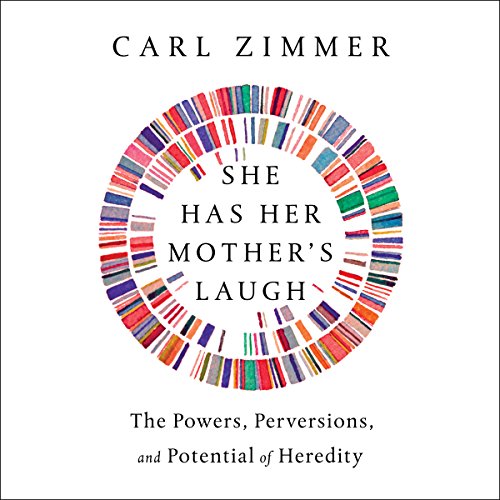
She Has Her Mother's Laugh
Summary
2019 PEN/E.O. Wilson Literary Science Writing Award Finalist "Science book of the year" (The Guardian) One of New York Times 100 notable books for 2018. One of Publishers Weekly's top 10 books of 2018. One of Kirkus' best books of 2018. One of Mental Floss' best books of 2018. One of Science Friday's best science books of 2018. “Extraordinary” (New York Times Book Review) "Magisterial" (The Atlantic) "Engrossing" (Wired) "Leading contender as the most outstanding nonfiction work of the year." (Minneapolis Star-Tribune) Celebrated New York Times columnist and science writer Carl Zimmer presents a profoundly original perspective on what we pass along from generation to generation. Charles Darwin played a crucial part in turning heredity into a scientific question, and yet he failed spectacularly to answer it. The birth of genetics in the early 1900s seemed to do precisely that. Gradually, people translated their old notions about heredity into a language of genes. As the technology for studying genes became cheaper, millions of people ordered genetic tests to link themselves to missing parents, to distant ancestors, to ethnic identities.... But, Zimmer writes, "Each of us carries an amalgam of fragments of DNA, stitched together from some of our many ancestors. Each piece has its own ancestry, traveling a different path back through human history. A particular fragment may sometimes be cause for worry, but most of our DNA influences who we are - our appearance, our height, our penchants - in inconceivably subtle ways." Heredity isn't just about genes that pass from parent to child. Heredity continues within our own bodies, as a single cell gives rise to trillions of cells that make up our bodies. We say we inherit genes from our ancestors - using a word that once referred to kingdoms and estates - but we inherit other things that matter as much or more to our lives, from microbes to technologies we use to make life more comfortable. We need a new definition of what heredity is, and, through Carl Zimmer's lucid exposition and storytelling, this resounding tour de force delivers it. Weaving historical and current scientific research, his own experience with his two daughters, and the kind of original reporting expected of one of the world's best science journalists, Zimmer ultimately unpacks urgent bioethical quandaries arising from new biomedical technologies but also longstanding presumptions about who we really are and what we can pass on to future generations.
©2018 Carl Zimmer (P)2018 Penguin Audio

Countdown to Zero Day
Summary
Top cybersecurity journalist Kim Zetter tells the story behind the virus that sabotaged Iran’s nuclear efforts and shows how its existence has ushered in a new age of warfare - one in which a digital attack can have the same destructive capability as a megaton bomb. In January 2010, inspectors with the International Atomic Energy Agency noticed that centrifuges at an Iranian uranium enrichment plant were failing at an unprecedented rate. The cause was a complete mystery - apparently as much to the technicians replacing the centrifuges as to the inspectors observing them. Then, five months later, a seemingly unrelated event occurred: A computer security firm in Belarus was called in to troubleshoot some computers in Iran that were crashing and rebooting repeatedly. At first, the firm’s programmers believed the malicious code on the machines was a simple, routine piece of malware. But as they and other experts around the world investigated, they discovered a mysterious virus of unparalleled complexity. They had, they soon learned, stumbled upon the world’s first digital weapon. For Stuxnet, as it came to be known, was unlike any other virus or worm built before: Rather than simply hijacking targeted computers or stealing information from them, it escaped the digital realm to wreak actual, physical destruction on a nuclear facility. In these pages, Wired journalist Kim Zetter draws on her extensive sources and expertise to tell the story behind Stuxnet’s planning, execution, and discovery, covering its genesis in the corridors of Bush’s White House and its unleashing on systems in Iran - and telling the spectacular, unlikely tale of the security geeks who managed to unravel a sabotage campaign years in the making. But Countdown to Zero Day ranges far beyond Stuxnet itself.
©2014 Kim Zetter (P)2014 Random House Audio

ADD-Friendly Ways to Organize Your Life: Second Edition
Summary
Acclaimed professional organizer Judith Kolberg and Dr. Kathleen Nadeau, renowned ADHD clinical psychologist, are back with an updated edition of their classic text for adults with ADD. Their collaboration offers the best understanding and solutions for adults who want to get and stay organized. Listeners will enjoy all new content on organizing digital information, managing distractions, organizing finances, and coping with the "black hole" of the Internet. This exciting new resource offers three levels of strategies and support: self-help, non-professional assistance from family and friends, and professional support; allowing the listener to determine the appropriate level of support.
©2017 Taylor & Francis (P)2017 Gildan Media, LLC

Future Grace
Summary
Explore this stunning quality of God’s grace: It never ends! In this revision of a foundational work, John Piper reveals how grace is not only God’s undeserved gift to us in the past, but also God’s power to make good happen for us today, tomorrow, and forever. True life for the follower of Jesus really is a moment-by-moment trust that God is dependable and fulfills his promises. This is living by faith in future grace, which provides God's mercy, provision, and wisdom - everything we need - to accomplish his good plans for us. In Future Grace, chapter by chapter - one for each day of the month - Piper reveals how cherishing the promises of God helps break the power of persistent sin issues like anxiety, despondency, greed, lust, bitterness, impatience, pride, misplaced shame, and more. Ultimate joy, peace, and hope in life and death are found in a confident, continual awareness of the reality of future grace.
©2012 John Piper (P)2012 Random House Audio

Wishes Won't Bring Riches
Summary
In this lost classic, the pioneering motivational coach teaches how to make the crucial leap from faith to action in bringing your dreams to life. Believe in yourself.... Have faith. We often hear these expressions. But faith is not enough. We need Applied Faith. In three hard-hitting chapters, motivational master Napoleon Hill teaches you how to transform belief to action, and faith into real-life plans. Application. Enthusiasm. Action. These are the three keys required to do more than just "believe in yourself" - but to actually BE the person you want to be. Wishes Won't Bring Riches provides you with the missing link necessary to go from visualizing your dreams to living them.
©2018 Napoleon Hill (P)2018 Penguin Audio

The City Game
Summary
The powerful story of a college basketball team who carried an era's brightest hopes - racial harmony, social mobility, and the triumph of the underdog - but whose success was soon followed by a shocking downfall "A masterpiece of American storytelling." (Gilbert King, Pulitzer Prize-winning author of Devil in the Grove) Named One of the Best Sports Books of the Year by The New York Times Book Review The unlikeliest of champions, the 1949-50 City College Beavers were extraordinary by every measure. New York's City College was a tuition-free, merit-based college in Harlem known far more for its intellectual achievements and political radicalism than its athletic prowess. Only two years after Jackie Robinson broke the Major League Baseball color barrier - and at a time when the National Basketball Association was still segregated - every single member of the Beavers was either Jewish or African American. But during that remarkable season, under the guidance of the legendary former player Nat Holman, this unheralded group of city kids would stun the basketball world by becoming the only team in history to win the NIT and NCAA tournaments in the same year. This team, though, proved to be extraordinary in another way: During the following season, all of the team’s starting five were arrested by New York City detectives, charged with conspiring with gamblers to shave points. Almost overnight, these beloved heroes turned into fallen idols. The story centers on two teammates and close friends, Eddie Roman and Floyd Layne, one white, one black, each caught up in the scandal, each searching for a path to personal redemption. Though banned from the NBA, Layne continued to devote himself to basketball, teaching the game to young people in his Bronx neighborhood and, ultimately, with Roman’s help, finding another kind of triumph - one that no one could have anticipated. Drawing on interviews with the surviving members of that championship team, Matthew Goodman has created an indelible portrait of an era of smoke-filled arenas and Borscht Belt hotels, when college basketball was far more popular than the professional game. It was a time when gangsters controlled illegal sports betting, the police were on their payroll, and everyone, it seemed, was getting rich - except for the young men who actually played the games. Tautly paced and rich with period detail, The City Game tells a story both dramatic and poignant: of political corruption, duplicity in big-time college sports, and the deeper meaning of athletic success.
©2019 Matthew Goodman (P)2019 Random House Audio

Chasing Phil
Summary
A thrilling true crime caper, bursting with colorful characters and awash in '70s glamour, that spotlights the FBI's first white-collar undercover sting.
The Thunderbird Motel, 1977. J. J. Wedick and Jack Brennan - two fresh-faced, maverick FBI agents - were about to embark on one of their agency's first wire-wearing undercover missions. Their target? Charismatic, globetrotting con man Phil Kitzer, whom some called the world's greatest swindler. From the Thunderbird, the three men took off to Cleveland, to Miami, to Hawaii, to Frankfurt, to the Bahamas - meeting other members of Kitzer's crime syndicate and powerful politicians and businessmen he fooled at each stop. But as the young agents, playing the role of protégés and coconspirators, became further entangled in Phil's outrageous schemes over their months on the road, they also grew to respect him - even care for him. Meanwhile, Phil began to think of Jack and J. J. as best friends, sharing hotel rooms and inside jokes with them and even competing with J. J. in picking up women.
Phil Kitzer was at the center of dozens of scams in which he swindled millions of dollars, but the FBI was mired in a post-Watergate malaise and slow to pivot toward a new type of financial crime that is now all too familiar. Plunging into the field with no undercover training, the agents battled a creaky bureaucracy on their adventures with Phil, hoping the FBI would recognize the importance of their mission. Even as they grew closer to Phil, they recognized that their endgame - the swindler's arrest - was drawing near....
Anchored by larger-than-life characters, framed by exotic locales and an irresistible era, Chasing Phil is high drama and a propulsive listen, delivered by an effortless storyteller.
©2017 David Howard (P)2017 Random House Audio

The Revolution Was Televised
Summary
A mob boss in therapy. An experimental, violent prison unit. The death of an American city, as seen through a complex police investigation. A lawless frontier town trying to talk its way into the United States. A corrupt cop who rules his precinct like a warlord. The survivors of a plane crash trying to make sense of their disturbing new island home. A high school girl by day, a monster fighter by night. A spy who never sleeps. A space odyssey inspired by 9/11. An embattled high school football coach. A polished ad exec with a secret. A chemistry teacher turned drug lord. These are the subjects of 12 shows that started a revolution in TV drama: The Sopranos. Oz. The Wire. Deadwood. The Shield. Lost. Buffy the Vampire Slayer. 24. Battlestar Galactica. Friday Night Lights. Mad Men. Breaking Bad. These 12 shows, and the many more they made possible, ushered in a new golden age of television, one that made people take the medium more seriously than ever before. Alan Sepinwall became a TV critic right before this creative revolution began, was there to chronicle this incredible moment in pop culture history, and along the way changed the nature of television criticism, according to Slate. The Revolution Was Televised is the story of these 12 shows, as told by Sepinwall and the people who made them, including David Chase, David Simon, David Milch, Damon Lindelof and Carlton Cuse, Vince Gilligan, and more.
©2013 Alan Sepinwall (P)2013 Random House

Island of Vice
Summary
When young Theodore Roosevelt was appointed police commissioner of New York City, he had the astounding gall to try to shut down the brothels, gambling joints, and after-hours saloons. This is the story of how TR took on Manhattan vice... and vice won. In the 1890s, New York City was America’s financial, manufacturing, and entertainment capital, and also its preferred destination for sin, teeming with forty thousand prostitutes, glittery casinos, and all-night dives. Police captains took hefty bribes to see nothing while reformers writhed in frustration. In Island of Vice, Richard Zacks paints a vivid portrait of the lewd underbelly of 1890s New York, and of Theodore Roosevelt, the puritanical, cocksure police commissioner resolved to clean it up. Writing with great wit and zest, Zacks explores how young Roosevelt goes head to head with Tammany Hall, takes midnight rambles with muckraker Jacob Riis, and tries to convince two million New Yorkers to enjoy wholesome family fun. When Roosevelt’s crackdown succeeds too well, even his supporters turn on him, and TR discovers that New York loves its sin more than its salvation. With cameos by Stephen Crane, Mark Twain, and a horde of very angry cops, Island of Vice is an unforgettable snapshot of turn-of-the-century New York in all its seedy glory and a brilliant miniature of one of America’s most colorful presidents.
©2012 Richard Zacks (P)2012 Random House Audio

Are You Smart Enough to Work at Google?
Summary
You are shrunk to the height of a nickel and thrown in a blender. The blades start moving in 60 seconds. What do you do? If you want to work at Google, or any of America's best companies, you need to have an answer to this and other puzzling questions. Are You Smart Enough to Work at Google? guides listeners through the surprising solutions to dozens of the most challenging interview questions. The book covers the importance of creative thinking, ways to get a leg up on the competition, what your Facebook page says about you, and much more. Are You Smart Enough to Work at Google? is a must listen for anyone who wants to succeed in today's job market. PLEASE NOTE: When you purchase this title, the accompanying PDF will be available in your Audible Library along with the audio.
©2012 William Poundstone (P)2012 Random House

Law of the Jungle
Summary
The gripping story of one American lawyer's obsessive crusade - waged at any cost - against Big Oil on behalf of the poor farmers and indigenous tribes of the Amazon rainforest. Steven Donziger, a self-styled social activist and Harvard educated lawyer, signed on to a budding class action lawsuit against multinational Texaco (which later merged with Chevron to become the third-largest corporation in America). The suit sought reparations for the Ecuadorian peasants and tribes people whose lives were affected by decades of oil production near their villages and fields. During 20 years of legal hostilities in federal courts in Manhattan and remote provincial tribunals in the Ecuadorian jungle, Donziger and Chevron's lawyers followed fierce no-holds-barred rules. Donziger, a larger-than-life, loud-mouthed showman, proved himself a master orchestrator of the media, Hollywood, and public opinion. He cajoled and coerced Ecuadorian judges on the theory that his noble ends justified any means of persuasion. And in the end, he won an unlikely victory, a $19 billion judgment against Chevon - the biggest environmental damages award in history. But the company refused to surrender or compromise. Instead, Chevron targeted Donziger personally, and its counter-attack revealed damning evidence of his politicking and manipulation of evidence. Suddenly the verdict, and decades of Donziger's single-minded pursuit of the case, began to unravel. Written with the texture and flair of the best narrative nonfiction, Law of the Jungle is an unpauseable story in which there are countless victims, a vast region of ruined rivers and polluted rainforest, but very few heroes.
©2014 Paul M. Barrett (P)2014 Random House Audio

Life's Edge
Summary
“Carl Zimmer is one of the best science writers we have today.” (Rebecca Skloot, author of The Immortal Life of Henrietta Lacks) We all assume we know what life is, but the more scientists learn about the living world - from protocells to brains, from zygotes to pandemic viruses - the harder they find it is to locate life’s edge. Carl Zimmer investigates one of the biggest questions of all: What is life? The answer seems obvious until you try to seriously answer it. Is the apple sitting on your kitchen counter alive, or is only the apple tree it came from deserving of the word? If we can’t answer that question here on Earth, how will we know when and if we discover alien life on other worlds? The question hangs over some of society’s most charged conflicts - whether a fertilized egg is a living person, for example, and when we ought to declare a person legally dead. Life's Edge is an utterly fascinating investigation that no one but one of the most celebrated science writers of our generation could craft. Zimmer journeys through the strange experiments that have attempted to recreate life. Literally hundreds of definitions of what that should look like now exist, but none has yet emerged as an obvious winner. Lists of what living things have in common do not add up to a theory of life. It's never clear why some items on the list are essential and others not. Coronaviruses have altered the course of history, and yet many scientists maintain they are not alive. Chemists are creating droplets that can swarm, sense their environment, and multiply. Have they made life in the lab? Whether he is handling pythons in Alabama or searching for hibernating bats in the Adirondacks, Zimmer revels in astounding examples of life at its most bizarre. He tries his own hand at evolving life in a test tube with unnerving results. Charting the obsession with Dr. Frankenstein's monster and how Coleridge came to believe the whole universe was alive, Zimmer leads us all the way into the labs and minds of researchers working on engineering life from the ground up. Cover image Courtesy of the MRC Laboratory of Molecular Biology. © MRC Laboratory of Molecular Biology/Madeline Lancaster
©2021 Carl Zimmer (P)2021 Penguin Audio

Don't Know Much About Geography: Revised and Updated Edition
Summary
From bestselling author Kenneth C. Davis comes a treasure trove of answers to questions about our world. Was there an Atlantis? What's the smallest country in the world? What's the difference between a jungle and a rain forest? Kenneth C. Davis, author of Don't Know Much About® History, Don't Know Much About the Civil War and Don't Know Much About the Bible, turns his inimitable wit and wide-ranging knowledge to the subject of geography, and proves once and for all that there is a lot more to it than labeling countries on a map. From often amusing perceptions people have had through the ages about the world and the universe to the changing map of today, Davis shows how geography is really a great crossroad of many fields: biology, meteorology, astronomy, history, economics, and even politics. In this lively, entertaining, and endlessly fascinating presentation, you'll hear about the personalities that helped shape the world and learn the answers to questions that have vexed most of us since grade school. Along the way, Davis offers an affectionate ode to the earth: a celebration of the earth, a searching investigation of the destruction of our habitat, and a practical guide to saving our home planet. For anyone who has felt geographically ignorant ever since gas stations stopped handing out free maps, Don't Know Much About Geography is enormously informative entertainment.
©1993 Reed Business Information, Inc. (P)2013 Random House Audio