David Christopher Lane has 32 audiobooks on Listento.it, narrated by 23 narrators, with an average listener rating of 4.7★ across 7 ratings. The most-rated is Ramana.

The Astral Plane Debates
Summary
The human dilemma is that we have an innate tendency to conflate our current brain state with how reality apart from ourselves really is, forgetting, in the process, that our subjective experiences may be inaccurate or misleading representations of our objective surroundings. There are, of course, good evolutionary reasons for why this is the case, since in our struggle for survival, we have to rely on our mental maps (and take them seriously) in order to find food, ward or fight off enemies, secure housing, find mates, protect offspring, and so on. But often, our internal projections can be deceiving, especially if our relatively stable waking state gets biochemically altered. Cognitive impairments such as Alzheimer’s, dementia, amnesia, bipolar disorder, and fever-induced deliriums dramatically change how we interact and interpret the world around us. We can also consciously manipulate our consciousness by ingesting a variety of drugs, each providing a slightly different lens by which to see ourselves and others. In religion, there is a long history of individuals who have had inner visions and inspirations that they have taken to be revelations from God or a higher power and have created their own unique movements on the basis of it. That such mystical encounters may be only byproducts of their own minds and have nothing to do with angels or divine beings doesn’t arise, since its evidential reality is too overwhelming to doubt. What we confront here is a perennial conundrum. Given that mystical experiences are plentiful and that our brains seemed almost universally wired for them, the outstanding question that remains is one of explanation: How do we best interpret and adjudicate these apparently transcendental excursions and how? Richard Feynman and John Lilly, though friends, debate this issue.
©2020 David Christopher Lane (P)2020 David Christopher Lane

The Unknowing Sage
Summary
Faqir Chand (1886-1981) was a remarkable Indian sage who spent over 75 years practicing an ancient meditation technique, popularly known today as surat shabd yoga, which attempts to induce a consciously controlled near-death experience. This book contains Faqir Chand's unique autobiography which was dictated shortly before his death in Urdu and translated during his lifetime into English at the personal request of Professor David Christopher Lane. It also includes a seasoned selection of Faqir Chand's radical teachings as well as several introductory essays and pertinent interviews.
©1980 David Christopher Lane (P)2016 David Christopher Lane

Baba Faqir Chand's Illuminations: The London Satsangs of 1980
Summary
I am fortunate to be able to publish Baba Faqir Chand's satsangs as presented to Harjit Singh Sandhu and skillfully translated by Pulkit Bose. First as a series in Sach Khand: The Journal of Radhasoami Studies and now in book form. These talks that were given in London, England, in 1980 are genuinely remarkable for their utmost clarity and penetrating insights into the nature of spirituality. Baba Faqir Chand is unique amongst masters, since he (unlike so many other gurus) was exceptionally honest about his experiences and what he learned from them over the course of his long life. Perhaps Faqir's most fundamental realization was that inner visions are a projection of one's own mind and not due to the religious leaders that we attribute to them. As Faqir said so pointedly on many occasions, “Now, you see no Jesus Christ comes from without in anybody's visions. No Rama, no Krishna, no Buddha, and no Baba Faqir comes from without to anybody. The visions are only because of the impressions and suggestions that a disciple has already accepted in his mind. These impressions and suggestions appear to him like a dream. No body comes from without. This is the plain truth.” I have had the privilege of knowing Baba Faqir Chand personally and have read almost everything available by him in English. He has provided us with an amazing cornucopia of wisdom on such subjects as karma, meditation, and ethical living. Yet, I must confess, that I find the satsangs that he gave to Harjit Singh Sandhu and Simret Kaur Sandhu in London, England, in 1980, to be unique. They are extraordinarily powerful in their import and reveal in a nutshell the very essence of Faqir Chand's radical thinking. I have read through these satsangs several times and in each instance I discover something new in them. Faqir's satsangs are akin to a multifaceted jewel, shining forth with crystalline illuminations.
©2018 David Christopher Lane (P)2018 David Christopher Lane

The Enchanted Land
Summary
This book describes the life and work of eight Indian mystics, including Ramana Maharshi, Sawan Singh, Paramahansa Yogananda, Baba Faqir Chand, Sushil Kumar, Tripta Devi, and Pratap Singh. Includes the author's personal interaction with several of them, as well as a detailed account of shabd yoga and the inner journey that occurs during meditation.
©1984, 2008, 2015 David Christopher Lane (P)2016 David Christopher Lane

Pali Buddha: The Dhammapada
Summary
The MSAC Philosophy Group is pleased to announce a new edition of that timeless classic in spiritual literature, The Dhammapada. Attributed to Buddha, this early text in Buddhism sheds a clear light on the teachings of the four noble truths and the eightfold path. This translation is from Max Mueller, the famous 19th century Indologist.
©2008 MSAC Philosophy Group (P)2018 MSAC Philosophy Group

Ramana
Summary
This small book contains two parts: 1) the words of Ramana on his spiritual methodology: "Who Am I?" And 2) an original essay by Dr. David Christopher Lane describing, in brief, the life and work of this most remarkable Indian sage, who is more influential today, decades after his death, than ever before.
©2019 David Christopher Lane (P)2019 David Christopher Lane

The Virtual Philosophers
Summary
This edited volume by the MSAC Philosophy Group includes a variety of essays by different authors on virtual reality, augmented reality, artificial intelligence, and those computational pioneers and thinkers who have advanced our understanding of a digital future.
©2019 David Christopher Lane (P)2020 David Christopher Lane

The Mystic-Sage of the Punjab
Summary
This is a small book on the great mystic-sage, Maharishi Shiv Brat Lal, who authored hundreds of books in Urdu, Hindi, and English. He is most famous today as the guru of Baba Faqir Chand, the unknowing sage of Hoshiarpur. Touches upon shabd yoga and Radhasoami and gives an outline of Maharishi's biography.
©2020 David Christopher Lane (P)2020 David Christopher Lane

Rai Salig Ram: A Glimpse of His Life and Work
Summary
This book provides an introduction into the fascinating life and work of one of the great Indian mystics of the 19th century, who was a contemporary of Sri Ramakrishna. It is surprising that Rai Salig Ram, who is such a pivotal figure in the history of Radhasoami, is not better known among satsangis in the Beas related branches of the movement. In contrast, in the Agra connected satsangs - Soami Bagh, Dayal Bagh, and Peepal Mandi - Huzur Maharaj (as Salig Ram is honorifically called) is deeply revered since he is regarded as the chief successor and Gurumukh of Shiv Dayal Singh, the esteemed founder of Radhasoami. Most of the earliest literature on Radhasoami comes from Salig Ram, who penned a number of books in Hindi on the practice of surat shabd yoga meditation. Salig Ram, who was highly respected by the British authorities, eventually got promoted to be the Postmaster General of the North-Western Provinces, the first Indian to hold such a position. But despite this remarkable achievement, Salig Ram was more interested in spirituality and his guru to whom he was steadfast in his devotion, serving him day and night. Having visited Dayalbagh, Soami Bagh, and other Radhasoami centers in Agra that owe their existence to Huzur Maharaj, I felt that it was important to make his work better known in the West. This small volume is designed as an introductory glimpse into the remarkable life and teachings of Rai Salig Ram. To accomplish this aim, I decided it would be best to include excerpts from the earliest known biographies of Huzur Maharaj. These include, Shiv Brat Lal Varman's A Truly Holy Life, Max Müller's brief chapter on Salig Ram in his small book, Ramakrishna: His Life and Sayings, and Partap Singh's biography of Soamiji Maharaj, which presents a highly effusive account of Huzur Maharaj and his one-pointed adoration of his spiritual guru.
©2018 David Christopher Lane (P)2018 David Christopher Lane

Bliss Land
Summary
This edited collection of essays about cosmic consciousness was selected and edited by Professor David Christopher Lane. Includes excerpts from Yogananda, Bucke, St. Teresa of Avila, Ramakrishna, Ramana Maharshi, Huxley, The Tibetan Book of the Dead, and more. With an introduction and conclusion by Dr. Lane.
©2020 MSAC Philosophy Group (P)2020 David Christopher Lane

Churchland Controversy
Summary
This book explores the philosophical work of Patricia Churchland and her groundbreaking studies in neurophilosophy, a field she helped to create. Includes a critical analysis of her latest work on near-death experiences and some of her controversial findings. Also included is a special interview conducted by Professor Meredith Doran dating back to 1990 which details Churchland's work on consciousness and the brain. Discusses whether NDEs are part and parcel of the brain or something trans-neurological.
©2016 David Christopher Lane (P)2016 David Christopher Lane
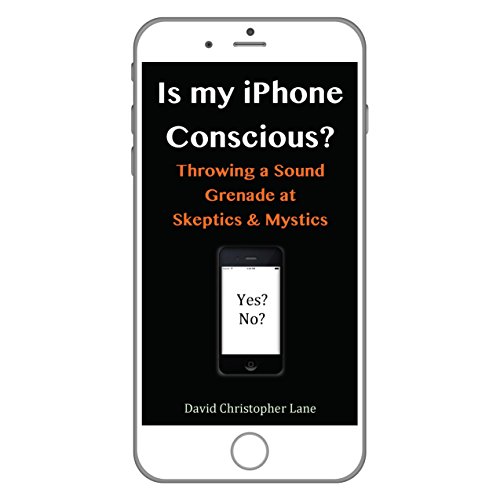
Is My iPhone Conscious?
Summary
Can science ultimately explain consciousness? This little book explores the subject from both a purely physicalist perspective and also from an Eastern philosophy angle.
©2008, 2017 David Christopher Lane (P)2017 David Christopher Lane

Doubting Mind
Summary
This book, edited by Professor David Christopher Lane from Mt. San Antonio College, contains 13 distinct essays each written by a different author on the following famous skeptics: Brian Cox Sam Harris Phillip J. Klass James Randi Eugenie Scott Christopher Hitchens Paul Krugman Joe Nickell Ray Hyman Susan Blackmore Adam Savage Martin Gardner Harry Houdini The authors include: Hee June Park, Veronica Ramirez, Tyler Cardena-Wagers, Hannah Esqueda, Jenny Wang, (Justin) Yuan-Chun Hsu, Cesar Hernandez, Jiselle Ramirez, Alexander Mendez, Kimberley Cang, Brian Tam, Tiffany Wang, and Felisha Jacobus.
©2020 MSAC Philosophy Group (P)2020 David Christopher Lane

Maya: The Physics of Deception
Summary
This audiobook explores the ancient Indian concept of Maya. Utilizing the latest research in neuroscience and physics, this work explains why Maya (or the notion of illusion) is an important concept and better understood today in light of science, even though ancient rishis had glimpsed its importance thousands of years ago.
©2017 David Christopher Lane (P)2017 David Christopher Lane

The Unconscious Prisoner
Summary
This book contains an introduction by Professor David Christopher Lane on why the feeling of free will is an evolutionary hack. It contains judicious selections from the writings of Bertrand Russell, William James (for free will), Arthur Schopenhauer, and other philosophers and scientists on the issue of free will and determinism.
©2020 David Christopher Lane (P)2020 David Christopher Lane

Cosmic Creationism: Ken Wilber's Theory of Evolution
Summary
I first critiqued Ken Wilber on his misunderstanding of evolution back in 1996, right after his book A Brief History of Everything was published. It has now been 18 years and if anything, Wilber has become even more firmly entrenched in his new brand of creationism, which ironically mimics much of what Christian fundamentalists object to about Darwinianism. And Wilber doesn't have to look far for alternative theories about how the universe came into being (see Stephen Hawking's Grand Design or Sean Carroll's From Eternity to Here for starters) without resorting to Eros pushing Chaos aside inside an atom so it can mate with others and create anew. Yes, we can debate the merits of evolution and astrophysics in trying to understand how the universe and life came into being. But in so doing, it is important to accurately present the arguments we oppose. Wilber has shown a tendency to abdicate that responsibility in his rush to push his creationist agenda. In so doing, and by avoiding the pertinent criticisms of Frank Visser and others, Wilber continues to tarnish his intellectual reputation. This book contains a series of essays analyzing Ken Wilber's views on evolution and intelligent design.
©1997, 2010, 2014 David Christopher Lane (P)2016 David Christopher Lane

Baba Faqir Chand
Summary
This book presents a glimpse into the fascinating life and work of Baba Faqir Chand, the famous "unknowing" sage of India. Faqir explains in vivid details how gurus do not know about the miracles and visions attributed to them. He also explains the secrets behind surat shabd yoga practice and provides a detailed description of how to transcend visionary phenomena.
©2015 David Christopher Lane (P)2017 David Christopher Lane

Why Living Today Is Better Than Yesterday
Summary
According to Steven Pinker in his new book, Enlightenment Now, the best time is precisely now. The only thing holding us back is waking up to it. Lest we forget, we are the lucky 8 billion who have been favored to be born human. We are, in sum, winners in the Darwinian lottery of life. This audiobook provides an illustrated glimpse into Pinker's idea that things have gotten better on planet Earth. Also provides new insights into a concept called "The Meta-Person Project".
©2018 David Christopher Lane (P)2018 David Christopher Lane

Promissory Metaphysics: Confusing Methodology for Soteriology
Summary
Promissory materialism is one of the standard canards that has been frequently used against science, particularly in the study of consciousness. This two-word invective gets repeatedly invoked whenever researchers argue that we will understand self-awareness in the future because then we will have a more robust and comprehensive neuroscience. Yet, anti-materialist critics (usually of a spiritual or religious bent) are anxious to know how long we have to wait for an answer, since this type of assurance has been trotted out for decades without any foreseeable payoff. Thus, instead of showing a requisite patience, which anyone familiar with studying nature knows too well takes more time than expected, some distinguished thinkers, such as the late Sir John Eccles, who in 1963 won the Nobel prize in physiology/medicine for his work on the “biophysical properties of synaptic transmission” argued that the belief that the mind could be reduced to the brain was a “superstition without a rational foundation”. Indeed, Eccles went on to suggest that “The more we discover about the brain, the more clearly do we distinguish between the brain events and the mental phenomena, and the more wonderful do both the brain events and the mental phenomena become.” Moreover, Eccles was of the firm conviction that such “promissory materialism [was] a religious belief held by dogmatic materialists”. The ironic, underlying twist here that oftentimes gets overlooked is that Eccles himself was a lifelong practicing Roman Catholic who believed in psychokinesis and miracles.This little booklet argues for a more materialist view first, before succumbing to transcendental temptations.
©2020 David Christopher Lane (P)2020 David Christopher Lane

Inner Visions and Running Trains
Summary
Surprisingly, one of the more lucid insights on the philosophy of the Tibetan Book of the Dead comes from a Hindu mystic, named Baba Faqir Chand, who apparently was not familiar with the original Tibetan text or its English translation. Although Faqir was not conversant with the Bardo Thotrol, he was nevertheless steeped in its philosophy as taught to him by his guru, Shiv Brat Lal of Gopiganj. Faqir Chand, like his lama counterparts, spent much of his life in meditation, attempting to consciously go through the dying process in order to prepare himself for his final exit. However, unlike others of his kind, Faqir left a detailed account of his some 70-plus years of meditation (ranging from three to 12 hours daily) which led up to his enlightenment. The result is a richly detailed account which provides a thorough understanding of how inner visions and the like are projected in the intermediate stages between life and death.
©2018 David Christopher Lane (P)2018 David Christopher Lane