Harlow Giles Unger has 10 audiobooks on Listento.it, narrated by 9 narrators, with an average listener rating of 4.3★ across 3 ratings. The most-rated is John Marshall.

John Quincy Adams
Summary
He fought for Washington, served with Lincoln, witnessed Bunker Hill, and sounded the clarion against slavery on the eve of the Civil War. He negotiated an end to the War of 1812, engineered the annexation of Florida, and won the Supreme Court decision that freed the African captives of La Amistad. He served his nation as minister to six countries, secretary of state, senator, congressman, and president. John Quincy Adams was all of these things and more. In this masterful biography, award-winning author Harlow Giles Unger reveals Adams as a towering figure in the nation’s formative years and one of the most courageous figures in American history - which is why he ranked first in John F. Kennedy’s Pulitzer Prize-winning Profiles in Courage. A magisterial biography and a sweeping panorama of American history from the Washington to Lincoln eras, Unger’s John Quincy Adams follows one of America’s most important yet least known figures. Harlow Giles Unger, a former distinguished visiting fellow in American history at George Washington’s Mount Vernon, is a veteran journalist, broadcaster, educator, and historian. He is the author of 20 books, including several biographies of America’s Founding Fathers. He has also authored histories of the early Republic as well as numerous books on American education. He lives in New York.
©2012 Harlow Giles Unger (P)2012 Blackstone Audio, Inc.
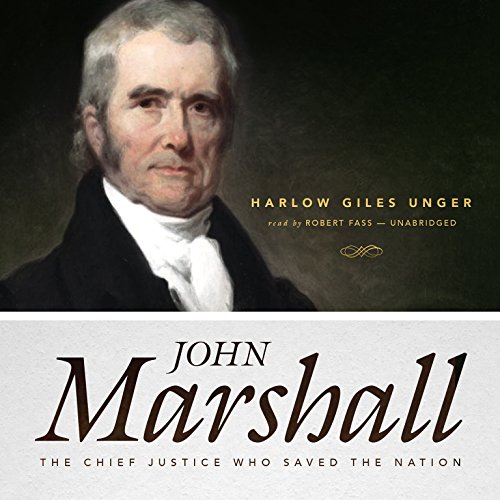
John Marshall
Summary
A soul-stirring biography of John Marshall, the young Republic's great chief justice who led the Supreme Court to power and brought law and order to the nation. In the political turmoil that convulsed America after George Washington's death, the surviving Founding Fathers went mad - literally pummeling each other in Congress and challenging one another to deadly duels in their quest for power. Out of the political intrigue, one man emerged to restore calm and dignity to the government: John Marshall. The longest-serving chief justice in American history, Marshall transformed the Supreme Court from an irrelevant appeals court into the powerful and controversial branch of government that Americans today either revere or despise. Drawing on rare documents, Harlow Giles Unger shows how, with nine key decisions, Marshall rewrote the Constitution, reshaped government, and prevented Thomas Jefferson from turning tyrant. John Adamscalled his appointment of Marshall to chief justice his greatest gift to the nation and "the pride of my life".
©2014 Harlow Giles Unger (P)2014 Blackstone Audio, Inc.

The Last Founding Father
Summary
In this lively and compelling biography, Harlow Giles Unger reveals the dominant political figure of a generation. A fierce fighter in four critical Revolutionary War battles and a courageous survivor of Valley Forge and a near-fatal wound at the Battle of Trenton, James Monroe (1751 - 1831) went on to become America's first full-time politician, dedicating his life to securing America's national and international durability. Decorated by George Washington for his exploits as a soldier, Monroe became a congressman, a senator, U.S. minister to France and Britain, governor of Virginia, secretary of state, secretary of war, and finally America's fifth president. The country embraced Monroe's dreams of empire and elected him to two terms, the second time unanimously. Mentored by each of Americas first four presidents, Monroe was unquestionably the best prepared president in our history. Like David McCullough's John Adams and Jon Meacham's recent book on Andrew Jackson, this new biography of Monroe is both a solid listen and a stellar scholarship history in the grand tradition.
©2009 Harlow Giles Unger (P)2009 Audible, Inc.

Lion of Liberty
Summary
Known to generations of Americans for his stirring call to arms, “Give me liberty or give me death,” Patrick Henry is all but forgotten today as the first of the Founding Fathers to call for independence, the first to call for revolution, and the first to call for a bill of rights. If Washington was the “Sword of the Revolution” and Jefferson, “the Pen”, Patrick Henry more than earned his epithet as “the Trumpet” of the Revolution for rousing Americans to arms in the Revolutionary War. Henry was one of the towering figures of the nation’s formative years and perhaps the greatest orator in American history. To this day, many Americans misunderstand what Patrick Henry’s cry for “liberty or death” meant to him and to his tens of thousands of devoted followers in Virginia. A prototype of the 18th- and 19th-century American frontiersman, Henry claimed individual liberties as a “natural right” to live free of “the tyranny of rulers”—American, as well as British. Henry believed that individual rights were more secure in small republics than in large republics, which many of the other Founding Fathers hoped to create after the Revolution. Henry was one of the most important and colorful of our Founding Fathers—a driving force behind three of the most important events in American history: the War of Independence, the enactment of the Bill of Rights, and, tragically, as America’s first important proponent of states’ rights, the Civil War. Harlow Giles Unger, a former distinguished visiting fellow in American history at George Washington’s Mount Vernon, is a veteran journalist, broadcaster, educator, and historian. His books include The Last Founding Father and four other biographies of America’s Founding Fathers, plus many more. He lives in New York.
©2010 Harlow Giles Unger (P)2010 Blackstone Audio, Inc.

Henry Clay
Summary
A compelling new biography of America's most powerful speaker of the House, who held the divided nation together for three decades and who was Lincoln's guiding light. In a little-known chapter of early American history, a fearless Kentucky lawyer rids Congress of corruption and violence in an era when congressmen debated with bullets as well as ballots. Harlow Giles Unger reveals how Henry Clay, the youngest congressman ever elected speaker of the House, rewrote congressional rules and established the speaker as the most powerful elected official after the president. During five decades of public service - as congressman, senator, secretary of state, and four-time presidential candidate - Clay produced historic compromises that postponed civil war for 50 years. Lincoln called Clay "the man for whom I fought all my life". An action-packed narrative history, Henry Clay is the story of one of the most courageous congressmen in American history.
©2015 Harlow Giles Unger (P)2015 Blackstone Audio, Inc.

Dr. Benjamin Rush
Summary
A gripping, often startling biography of the Founding Father of an America that other Founding Fathers forgot - an America of women, African Americans, Jews, Roman Catholics, Quakers, indentured workers, the poor, the mentally ill, and war veterans Ninety percent of Americans could not vote and did not enjoy rights to life, liberty, or the pursuit of happiness when our Founding Fathers proclaimed, "all men are created equal." Alone among those who signed the Declaration of Independence, Benjamin Rush heard the cries of those other, deprived Americans and stepped forth as the nation's first great humanitarian and social reformer. Remembered primarily as America's leading, most influential physician, Rush led the Founding Fathers in calling for abolition of slavery, equal rights for women, improved medical care for injured troops, free health care for the poor, slum clearance, citywide sanitation, an end to child labor, free universal public education, humane treatment and therapy for the mentally ill, prison reform, and an end to capital punishment. Using archival material from Edinburgh, London, Paris, and Philadelphia, as well as significant new materials from Rush's descendants and historical societies, Harlow Giles Unger's new biography restores Benjamin Rush to his rightful place in American history as the Founding Father of modern American medical care and psychiatry. PLEASE NOTE: When you purchase this title, the accompanying PDF will be available in your Audible Library along with the audio.
©2018 Harlow Giles Unger (P)2018 Hachette Audio

American Tempest
Summary
On Thursday, December 16, 1773, an estimated seven dozen men, many amateurishly disguised as Indians—then a symbol of freedom—dumped about £10,000 worth of tea in the harbor. Whatever their motives at the time, they unleashed a social, political, and economic firestorm that would culminate in the Declaration of Independence two and a half years later. The Boston Tea Party provoked a reign of terror in Boston and other American cities, with Americans inflicting unimaginable barbarities on each other. Tea parties erupted in American cities up and down the colonies. The turmoil stripped tens of thousands of Americans of their dignity, their homes, their properties, and their birthrights—in the name of liberty and independence. Nearly 100,000 Americans left the land of their forefathers forever in what was history’s largest exodus of Americans from America. Nonetheless, John Adams called the Boston Tea Party nothing short of “magnificent.” And he went on to say that the “destruction of tea is so bold, so daring, so firm…it must have important consequences.” Ironically, few if any Americans today—even those who call themselves Tea Party Patriots—would be able to name even one of the estimated eighty participants in the original Boston Tea Party. Nor are many Americans aware of the “important consequences” of the Tea Party. The acute shortage of tea that followed the Tea Party, of course, helped transform Americans into coffee drinkers, but its effects went far beyond culinary tastes. The Tea Party would affect so many American minds, hearts, and souls that it helped spawn a new, independent nation whose citizens would govern themselves.
©2011 Harlow Giles Unger (P)2011 Blackstone Audio, Inc.

Improbable Patriot
Summary
Pierre-Augustin Caron de Beaumarchais was an 18th-century French inventor, famed playwright, and upstart near-aristocrat in the court of King Louis XVI. In 1776, he conceived an audacious plan to send aid to the American rebels. What's more, he convinced the king to bankroll the project, and singlehandedly carried it out. By war's end, he had supplied Washington's army with most of its weapons and powder, though he was never paid or acknowledged by the United States. To some, he was a dashing hero - a towering intellect who saved the American Revolution. To others, he was pure rogue - a double-dealing adventurer who stopped at nothing to advance his fame and fortune. In fact, he was both, and more: an advisor to kings, an arms dealer, and author of some of the most enduring works of the stage, including The Marriage of Figaro and The Barber of Seville.
©2011 Harlow Giles Unger (P)2018 Tantor

Thomas Paine and the Clarion Call for American Independence
Summary
From New York Times best-selling author and Founding Fathers' biographer Harlow Giles Unger comes the astonishing biography of the man whose pen set America ablaze, inspiring its revolution, and whose ideas about reason and religion continue to try men's souls. Thomas Paine's words were like no others in history: they leaped off the page, inspiring readers to change their lives, their governments, their kings, and even their gods. In an age when spoken and written words were the only forms of communication, Paine's aroused men to action like no one else. The most widely read political writer of his generation, he proved to be more than a century ahead of his time, conceiving and demanding unheard-of social reforms that are now integral elements of modern republican societies. Among them were government subsidies for the poor, universal housing and education, pre- and post-natal care for women, and universal social security. An Englishman who emigrated to the American colonies, he formed close friendships with Benjamin Franklin, Thomas Jefferson, and James Madison, and his ideas helped shape the Declaration of Independence and the Bill of Rights. However, the world turned against Paine in his later years. While his earlier works, Common Sense and Rights of Man, attacked the political and social status quo here on earth, The Age of Reason attacked the status quo of the hereafter. Former friends shunned him, and the man America had hailed as the muse of the American Revolution died alone and forgotten. Packed with action and intrigue, soldiers and spies, politics and perfidy, Unger's Thomas Paine is a much-needed new look at a defining figure. PLEASE NOTE: When you purchase this title, the accompanying PDF will be available in your Audible Library along with the audio.
©2019 Harlow Giles Unger (P)2019 Hachette Audio

'Mr. President'
Summary
Although the framers gave the president little authority, Washington knew whatever he did would set precedents for generations of his successors. To ensure their ability to defend the nation, he simply ignored the Constitution when he thought it necessary and reshaped the presidency into what James Madison called a "monarchical presidency." Modern scholars call it the "imperial presidency." A revealing new look at the birth of American government, "Mr.President" describes George Washington's assumption of office in a time of continual crisis, as riots, rebellion, internecine warfare, and attacks by foreign enemies threatened to destroy the new nation. Drawing on rare documents and letters, Unger shows how Washington combined political cunning, daring, and sheer genius to seize ever-widening powers to solve each crisis. In a series of brilliant but unconstitutional maneuvers, Washington forced Congress to cede control of the four pillars of executive power: war, finance, foreign affairs, and law enforcement. Then, in the absence of Congress, he sent troops to fight Indian wars, crush tax revolts, and put down threats of secession by three states. Constantly weighing preservation of the Union against preservation of individual liberties and states' rights, Washington assumedmore power with each crisis. Often only a breath away from reestablishing the tyranny he pledged to destroy in the Revolutionary War, he imposed law andorder across the land while ensuring individual freedom and self-government.
©2013 Harlow Giles Unger (P)2013 Blackstone Audio, Inc.