John Lescault has narrated 26 audiobooks on Listento.it by 29 authors, with an average listener rating of 4.6★ across 125 ratings. The most-rated is Who We Are and How We Got Here.

Who We Are and How We Got Here
Summary
A groundbreaking book about how ancient DNA has profoundly changed our understanding of human history Geneticists like David Reich have made astounding advances in the field of genomics, which is proving to be as important as archaeology, linguistics, and written records as a means to understand our ancestry. In Who We Are and How We Got Here, Reich allows listeners to discover how the human genome provides not only all the information a human embryo needs to develop but also the hidden story of our species. Reich delves into how the genomic revolution is transforming our understanding of modern humans and how DNA studies reveal deep inequalities among different populations, between the sexes, and among individuals. Provocatively, Reich's book suggests that there might very well be biological differences among human populations but that these differences are unlikely to conform to common stereotypes. Drawing upon revolutionary findings and unparalleled scientific studies, Who We Are and How We Got Here is a captivating glimpse into humankind - where we came from and what that says about our lives today. A New York Times best-seller in Science Books. A #1 Amazon.com bestseller in the Biochemistry List.
©2018 David Reich (P)2018 Blackstone Audio, Inc.

The Practicing Stoic
Summary
The great insights of the Stoics are spread over a wide range of ancient sources. This book brings them all together for the first time. It systematically presents what the various Stoic philosophers said on every important topic, accompanied by an eloquent commentary that is clear and concise. The result is a set of philosophy lessons for everyone - the most valuable wisdom of ages past made available for our times, and for all time.
©2018 Ward Farnsworth (P)2018 Blackstone Audio, Inc.

Napoleon Hill's Keys to Success
Summary
Compiled from editorials, articles, speeches and unpublished manuscripts, Napoleon Hill’s Keys to Success is a complete exploration of Hill’s success philosophy and his seventeen essential principles of personal achievement. In this audiobook you will learn the secrets of Developing definiteness of purpose Creating a positive attitude Building self-discipline Cultivating creative vision Perfecting your personality And more Filled with mental exercises, self-analysis techniques and straightforward advice, Napoleon Hill’s Keys to Success is a must listen for anyone seeking a life of health, wealth and happiness.
©1994, 2007 The Napoleon Hill Foundation (P)1996 The Napoleon Hill Foundation. Published by Brilliance Audio.

The Iliad & The Odyssey
Summary
Little is known about the Ancient Greek oral poet Homer, the supposed 8th century BC author of the world-read Iliad and his later masterpiece, The Odyssey. These classic epics provided the basis for Greek education and culture throughout the classical age and formed the backbone of humane education through the birth of the Roman Empire and the spread of Christianity. If Homer did in fact exist, this supposedly blind poet was from some region of Greek-controlled Asia-Minor and recited his poems at festivals and political assemblies. In this extraordinary two volume audio set, the glorious saga again unfolds, telling the story of courage and magical adventure in Ancient Greece. The Iliad, the first of Homer's epic poems, tells of the counsel of Nestor, Achilles's slaying of Hector, and the defeat of the Trojans by the Greeks. In The Odyssey, in his perilous journey home after the Trojan War, Odysseus must pass through the land of the Cyclopes, encounter Circe the Enchantress, and face the terrible Charybdis and the six headed serpent Scylla. Both epics are translated here by Samuel Butler.
(P)2002 Commuters Library

Why Not Socialism?
Summary
Is socialism desirable? Is it even possible? In this concise book, one of the world's leading political philosophers presents with clarity and wit a compelling moral case for socialism and argues that the obstacles in its way are exaggerated. There are times, G. A. Cohen notes, when we all behave like socialists. On a camping trip, for example, campers wouldn't dream of charging each other to use a soccer ball or for fish that they happened to catch. Campers do not give merely to get, but relate to each other in a spirit of equality and community. Would such socialist norms be desirable across society as a whole? Why not? Whole societies may differ from camping trips, but it is still attractive when people treat each other with the equal regard that such trips exhibit. But however desirable it may be, many claim that socialism is impossible. Cohen writes that the biggest obstacle to socialism isn't, as often argued, intractable human selfishness - it's rather the lack of obvious means to harness the human generosity that is there. Lacking those means, we rely on the market. But there are many ways of confining the sway of the market: there are desirable changes that can move us toward a socialist society in which, to quote Albert Einstein, humanity has "overcome and advanced beyond the predatory stage of human development." The book is published by Princeton University Press.
©2009 Princeton University Press (P)2010 Redwood Audiobooks

Beautiful Losers
Summary
One of the best-known experimental novels of the 1960s, Beautiful Losers is Cohen's most defiant and uninhibited work. As imagined by Cohen, hell is an apartment in Montreal, where a bereaved and lust-tormented narrator reconstructs his relations with the dead. In that hell, two men and a woman twine impossibly and betray one another again and again. Memory blurs into blasphemous sexual fantasy - and redemption takes the form of an Iroquois saint and virgin who has been dead for 300 years but still has the power to save even the most degraded of her suitors. By turns vulgar, rhapsodic, and viciously witty, Beautiful Losers explores each character's attainment of a state of self-abandonment, in which the sensualist cannot be distinguished from the saint.
©2018 Leonard Cohen (P)2018 Blackstone Audio, Inc.

The Autobiography of Andrew Carnegie and The Gospel of Wealth
Summary
His good friend Mark Twain dubbed him "St. Andrew." British Prime Minister William Gladstone called him an "example" for the wealthy. Such terms seldom apply to multimillionaires. But Andrew Carnegie was no run-of-the-mill steel magnate. At age 13 and full of dreams, he sailed from his native Dunfermline, Scotland, to America. The story of his success begins with a $1.20-a-week job at a bobbin factory. By the end of his life, he had amassed an unprecedented fortune - and given away more than 90 percent of it for the good of mankind. Here, in one volume, are two impressive works by Andrew Carnegie himself: his autobiography and The Gospel of Wealth, a groundbreaking manifesto on the duty of the wealthy to give back to society all of their fortunes. And he practiced what he preached, erecting 1,600 libraries across the country, founding Carnegie Mellon University, building Carnegie Hall, and performing countless other acts of philanthropy because, as Carnegie wrote, "The man who dies thus rich dies disgraced."
Public Domain (P)2018 Blackstone Audio, Inc.

Journal of a Trapper
Summary
In 1834, Osborne Russell joined an expedition from Boston, which proceeded to the Rocky Mountains to capitalize on the lucrative salmon and fur trade. Beginning at the age of 20, he detailed the life of a trapper in his journal and recorded his adventures through treacherous terrain, encounters with dangerous wildlife, and confrontations with the natives of the Rockies. Osbourne would remain there - hunting, trapping, and living off the land - for the next nine years. Journal of a Trapper is his remarkable account as he developed into an experienced trapper and a seasoned mountain man of the Rockies.
Public Domain (P)2019 Blackstone Audio, Inc.

Ancient Greece, Second Edition
Summary
In this compact yet comprehensive history of ancient Greece, Thomas R. Martin brings alive Greek civilization from its Stone Age roots to the fourth century BC. Focusing on the development of the Greek city-state and the society, culture, and architecture of Athens in its Golden Age, Martin integrates political, military, social, and cultural history in a book that will appeal to students and general audiences alike. Now in its second edition, this classic work now features updates throughout.
©2017 Blackstone Audio, Inc. (P)2017 Blackstone Audio, Inc.

Ancient Rome
Summary
With commanding skill, Thomas R. Martin tells the remarkable and dramatic story of how a tiny, poor, and threatened settlement grew to become, during its height, the dominant power in the Mediterranean world for 500 years. Encompassing the period from Rome's founding in the eighth century BC through Justinian's rule in the sixth century AD, he offers a distinctive perspective on the Romans and their civilization by employing fundamental Roman values as a lens through which to view both their rise and spectacular fall. Interweaving social, political, religious, and cultural history, Martin interprets the successes and failures of the Romans in war, political organization, quest for personal status, and in the integration of religious beliefs and practices with government. He focuses on the central role of social and moral values in determining individual conduct as well as decisions of state, from monarchy to republic to empire. Striving to reconstruct ancient history from the ground up, he includes frequent references to ancient texts and authors, encouraging readers to return to the primary sources. Comprehensive, concise, and accessible, this masterful account provides a unique window into Rome and its changing fortune.
©2018 Thomas R. Martin (P)2018 Blackstone Audio, Inc.

I and Thou
Summary
Martin Buber’s I and Thou has long been acclaimed as a classic. Many prominent writers have acknowledged its influence on their work; students of intellectual history consider it a landmark; and the generation born after World War II considers Buber one of its prophets. Buber’s main proposition is that we may address existence in two ways: (1) that of the “I” toward an “It,” toward an object that is separate in itself, which we either use or experience; (2) that of the “I” toward “Thou,” in which we move into existence in a relationship without bounds. One of the major themes of the book is that human life finds its meaningfulness in relationships. All of our relationships, Buber contends, bring us ultimately into relationship with God, who is the Eternal Thou. The need for a new English translation had been felt for many years. The old version was marred by many inaccuracies and misunderstandings, and its recurrent use of the archaic “thou” was seriously misleading. Professor Walter Kaufmann, a distinguished writer and philosopher in his own right who was close to Buber, retranslated the work at the request of Buber’s family. He added a wealth of informative footnotes to clarify obscurities and bring the reader closer to the original and wrote an extensive prologue that opened up new perspectives on the book and on Buber’s thought. This volume provided a new basis for all subsequent discussions of Buber. Martin Buber (1878–1965) was a Jewish philosopher, theologian, Bible translator, and editor of Hasidic tradition. He was also known as one of the paramount spiritual leaders of the twentieth century and is best known as the author of I and Thou - the basic formulation of his philosophy of dialogue - and for his appreciation of Hasidism, which made a deep impact on Christian as well as Jewish thinkers. Fleeing Nazi Germany in 1938, he immigrated to Israel, where he taught social philosophy at the Hebrew University.
©1970 Charles Scribner’s Sons (Translation); Prologue 1970 by Walter Kaufmann (P)2011 Blackstone Audio, Inc.

The Octopus: A Story of California
Summary
Like the tentacles of an octopus, the railroad in California reached out across the state, grasping everything of value in the state. Based on the bloody Mussel Slough Tragedy - a conflict between wheat farmers and the Southern Pacific Railroad - The Octopus is a stunning novel chronicling the twilight of the frontier West. A depiction of the tensions between the railroad, the ranchers, and the ranchers’ League. The book emphasizes the control of “forces” - such as the power of railroad monopolies - over individuals. No one was truly innocent, as the farmers employed the same if not similar tactics as the monopolistic railroad companies, such as subversion, coercion, and violence.
©2004 Frank Norris (P)2020 Blackstone Publishing

The God Who Is There, 30th Anniversary Edition
Summary
In 2006, Christianity Today voted The God Who Is There as one of the top 50 books that have shaped evangelicals. For decades, The God Who Is There has been the landmark book that changed the way the church sees the world. In Francis Schaeffer's remarkable analysis, we learn where the clashing ideas about God, science, history, and art came from and where they are going. This edition includes a foreword by James W. Sire that places Schaeffer's seminal work in the context of the intellectual turbulence of the early 21st century. More than ever, The God Who Is There demonstrates how historic Christianity can fearlessly confront the competing philosophies of the world. The God who has always been there continues to provide the anchor of truth and the power of love to meet the world's deepest problems.
©2016 Francis A. Schaeffer (P)2016 Blackstone Audio, Inc.

Farnsworth's Classical English Style
Summary
Say it with style - on paper or in person. This book explains why the best writing sounds that way, with hundreds of examples from Lincoln, Churchill, and other masters of the language. Farnsworth shows how small choices about words, sentences, and paragraphs put force into writing and speech that have stood the test of time. This is must for anyone who wants to speak or write with clear, persuasive, enjoyable, unforgettable style.
©2020 Ward Farnsworth (P)2020 Blackstone Publishing

Valley of the 99
Summary
Small ranchers in Harmony, Oregon, are up against it with the price of cattle down and Skull Ranch, owned by a syndicate, trying to buy them out. Dan Riley spends a month trying to find a bank to help them, but he fails. When the editor of The Clarion is shot, the ranchers blame Black Mike Sand, the manager of Skull, in spite of the circumstances of the shooting. As pressure mounts, Riley is determined to find out who is really in charge of the syndicate, and the only man willing to help him is Andrew Daniels, a former newspaper man whose courage comes from a bottle. Ex-gunman Rod Devers has started up a ranch, but small things going wrong on his land make him think someone might be trying to drive him out. In addition, the $2,000 he borrowed to buy his herd is coming due in a few months, and he refuses to marry his fiancée until he's debt free. His brother George ramrods the Spade, the biggest ranch in the area owned by Karl Hermann, who is on his way to Spade. The two-bit ranchers are convinced Hermann is coming to grab up all the land, and they organize a group of vigilantes, the 99, to protect themselves. When Rod refuses to join the 99 and accepts his brother’s offer of a temporary job to protect Hermann and his daughter during their visit, the small ranchers turn against him.
©2020 Wayne D. Overholser (P)2020 Blackstone Publishing
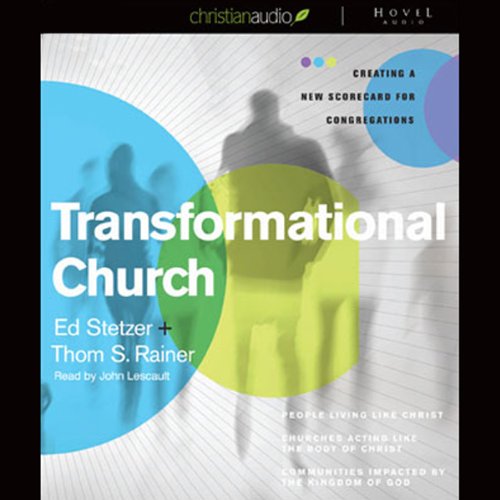
Transformational Church
Summary
Churches committed to following Christ's example want this world changed for the sake of eternity. While the supernatural piece of making that happen goes without saying, how does a body of believers do its part to be in that "sweet spot" where true spiritual transformation occurs? In Transformational Church, best-selling research authors Ed Stetzer and Thom S. Rainer survey 50,000 churches—then narrow the scope down to 500 congregations—for a qualitative answer. Their book, the most comprehensive study of the modern American church to date, contains a wealth of indispensable new data, nuanced insights, and how-to guidance, all centered on this key finding: "Transformational churches make disciples whose lives are being transformed by the gospel, so that people engage the culture around them for its ultimate transformation. Deeply committed to the essential foundations of discipleship (worship, community, and mission), transformational churches practice their faith and make disciples through vibrant leadership, prayerful dependence upon God, and relational intentionality. And they do so paying mind to their unique context and with a missionary mindset."
©2010 Thom S. Rainer (P)2010 christianaudio.com

Henry Clay
Summary
A compelling new biography of America's most powerful speaker of the House, who held the divided nation together for three decades and who was Lincoln's guiding light. In a little-known chapter of early American history, a fearless Kentucky lawyer rids Congress of corruption and violence in an era when congressmen debated with bullets as well as ballots. Harlow Giles Unger reveals how Henry Clay, the youngest congressman ever elected speaker of the House, rewrote congressional rules and established the speaker as the most powerful elected official after the president. During five decades of public service - as congressman, senator, secretary of state, and four-time presidential candidate - Clay produced historic compromises that postponed civil war for 50 years. Lincoln called Clay "the man for whom I fought all my life". An action-packed narrative history, Henry Clay is the story of one of the most courageous congressmen in American history.
©2015 Harlow Giles Unger (P)2015 Blackstone Audio, Inc.

Last Call for Blackford Oakes
Summary
Over 20 years ago, William F. Buckley, Jr. launched the dashing character of Blackford Oakes like a missile over the literary landscape. This newly minted CIA agent - brainy, bold, and complex - began his career by saving the queen of England and quickly took his place in the pantheon of master spies drawn up by Somerset Maugham, Graham Greene, and John le Carré. Against the backdrop of Cold War intrigue, in this, his 11th outing, Oakes crosses swords with Kim Philby, perhaps the highest ranking in the parade of defectors to the Soviet Union. Oakes is now himself a master spy, this time working outside the ambit of the director and around agency rules. His romance with an able and worldly Soviet doctor is consolation for the death of his beloved Sally. But after his return to Washington, he receives dismaying news. It is inevitable that the great Soviet spy and the renowned American agent will meet again - this time with deadly consequences.
©2005 William F. Buckley, Jr. (P)2016 Blackstone Audio, Inc.

The Cotton Kingdom
Summary
In 1853, Frederick Law Olmsted was working for the New York Times when he journeyed to the southern slave states and wrote one of the most important pro-abolition discourses. The Cotton Kingdom recounts his daily observations of the curse of slavery: the poverty it brought to both black and white people, the inadequacies of the plantation system, and the economic consequences and problems associated with America’s most “peculiar institution.” Disproving the opinion that “cotton is king”, Olmsted examined the huge differences between the economies of the northern and southern states, contrasting the more successful, wealthy, and progressive North with the South, which was stubbornly convinced of the necessity of slavery. Hailed as one of the most convincing and influential antislavery arguments, Olmsted’s work was widely praised, with London’s Westminster Review declaring, “it is impossible to resist his accumulated evidence.”
Public Domain (P)2019 Blackstone Publishing, Inc.

Third Thoughts
Summary
A wise, personal, and wide-ranging meditation on science and society by the Nobel Prize-winning author of To Explain the World. For more than four decades, one of the most captivating and celebrated science communicators of our time has challenged the public to think carefully about the foundations of nature and the inseparable entanglement of science and society. In Third Thoughts, Steven Weinberg casts a wide net: from the cosmological to the personal, from astronomy, quantum mechanics, and the history of science to the limitations of current knowledge, the art of discovery, and the rewards of getting things wrong. Winner of the Nobel Prize in Physics and author of the classic The First Three Minutes, Weinberg shares his views on some of the most fundamental and fascinating aspects of physics and the universe. But he does not seclude science behind disciplinary walls or shy away from politics, taking on what he sees as the folly of manned spaceflight, the harms of inequality, and the importance of public goods. His point of view is rationalist, realist, reductionist, and devoutly secularist. Weinberg is that great rarity, a prize-winning physicist who is entertaining and accessible. The essays in Third Thoughts, some of which appear here for the first time, will engage, provoke, and inform - and never lose sight of the human dimension of scientific discovery and its consequences for our endless drive to probe the workings of the cosmos.
©2018 Steven Weinberg (P)2018 Blackstone Audio, Inc.