Peter FitzSimons has 13 audiobooks on Listento.it, narrated by 10 narrators, with an average listener rating of 4.8★ across 93 ratings. The most-rated is Crushing.

Crushing
Summary
Follow God's process for growth and learn how you can benefit from life's challenging experiences with this audiobook by best-selling inspirational author T.D. Jakes. In this insightful audiobook, number one New York Times best-selling author T.D. Jakes wrestles with the age-old questions: Why do the righteous suffer? Where is God in all the injustice? In his most personal offering yet, Bishop Jakes tells crushing stories from his own journey - the painful experience of learning his young teenage daughter was pregnant, the agony of watching his mother succumb to Alzheimer's, and the shock and helplessness he felt when his son had a heart attack. Bishop Jakes wants to encourage you that God uses difficult, crushing experiences to prepare you for unexpected blessings. If you are faithful through suffering, you will be surprised by God's joy, comforted by his peace, and fulfilled with his purpose. Crushing will inspire you to have hope, even in your most difficult moments. If you trust in God and lean on him during setbacks, he will lead you through.
©2019 T. D. Jakes (P)2019 Hachette Audio

Mutiny on the Bounty
Summary
The mutiny on HMS Bounty, in the South Pacific on 28 April 1789, is one of history's truly great stories - a tale of human drama, intrigue and adventure of the highest order - and in the hands of Peter FitzSimons it comes to life as never before. Commissioned by the Royal Navy to collect breadfruit plants from Tahiti and take them to the West Indies, the Bounty's crew found themselves in a tropical paradise. Five months later, they did not want to leave. Under the leadership of Fletcher Christian, most of the crew mutinied soon after sailing from Tahiti, setting Captain William Bligh and 18 loyal crewmen adrift in a small open boat. In one of history's great feats of seamanship, Bligh navigated this tiny vessel for 3,618 nautical miles to Timor. Fletcher Christian and the mutineers sailed back to Tahiti, where most remained and were later tried for mutiny. But Christian, along with eight fellow mutineers and some Tahitian men and women, sailed off into the unknown, eventually discovering the isolated Pitcairn Island - at the time not even marked on British maps - and settling there. This astonishing story is historical adventure at its very best, encompassing the mutiny, Bligh's monumental achievement in navigating to safety, and Fletcher Christian and the mutineers' own epic journey from the sensual paradise of Tahiti to the outpost of Pitcairn Island. The mutineers' descendants live on Pitcairn to this day, amid swirling stories and rumours of past sexual transgressions and present-day repercussions. Mutiny on the Bounty is a sprawling, dramatic tale of intrigue, bravery and sheer boldness, told with the accuracy of historical detail and total command of story that are Peter FitzSimons' trademarks.
©2018 Peter FitzSimons (P)2018 Hachette Australia Audio

Batavia
Summary
The story begins in 1629, when the pride of the Dutch East India Company, the Batavia, is on its maiden voyage en route from Amsterdam to the Dutch East Indies, laden down with the greatest treasure to leave Holland. The magnificent ship is already boiling over with a mutinous plot that is just about to break into the open when, just off the coast of Western Australia, it strikes an unseen reef in the middle of the night. While Commandeur Francisco Pelsaert decides to take the longboat across 2,000 miles of open sea for help, his second-in-command Jeronimus Cornelisz takes over, quickly deciding that 250 people on a small island is unwieldy for the small number of supplies they have.
Quietly, he puts forward a plan to 40 odd mutineers how they could save themselves, kill most of the rest, and spare only a half-dozen or so women, including his personal fancy, Lucretia Jansz - one of the noted beauties of Holland - to service their sexual needs. A reign of terror begins, countered only by a previously anonymous soldier, Wiebbe Hayes, who begins to gather to him those are prepared to do what it takes to survive....
©2011 Peter FitzSimons (P)2011 Bolinda Publishing Pty Ltd
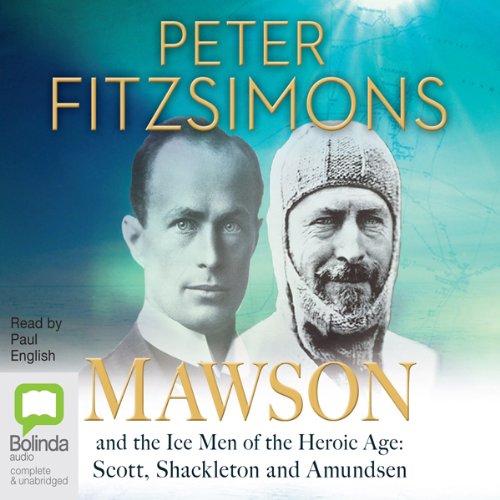
Mawson and the Ice Men of the Heroic Age
Summary
Australia's best-selling nonfiction author of all time. Douglas Mawson, born in 1882 and knighted in 1914, was Australia's greatest Antarctic explorer. On 2 December 1911, he led an expedition from Hobart to explore the virgin frozen coastline below, 2000 miles of which had never felt the tread of a human foot. After setting up Main Base at Cape Denision and Western Base on Queen Mary Land, he headed east on an extraordinary sledging trek with his companions, Belgrave Ninnis and Dr Xavier Mertz. After five weeks, tragedy struck. Ninnis was swallowed whole by a snow-covered crevasse, and Mawson and Mertz realised it was too dangerous to go on. With the scant food and provisions they had left, turning back was almost equally perilous. Their dwindling supplies forced them to kill their dogs to feed the other dogs, at first, and then themselves. Hunger, sickness and despair eventually got the better of Mertz, and he succumbed to madness and then to death. Mawson found himself all alone, 160 miles from safety, with next to no food. Peter FitzSimons tells the staggering tale of Mawson's survival, despite all the odds, arriving back just in time to see his rescue ship disappearing over the horizon. He also masterfully interweaves the stories of the other giants from the Heroic Age of Polar Exploration - Scott of the Antarctic, Sir Ernest Shackleton and Roald Amundsen - to bring the jaw-dropping events of this bygone era dazzlingly back to life.
©2011 Peter FitzSimons (P)2011 Bolinda Publishing Pty Ltd

Tobruk
Summary
In the early days of April 1941, the 14,000 Australian forces garrisoned in the Libyan town of Tobruk were told to expect reinforcements and supplies within eight weeks. Eight months later these heroic, gallant, determined "Rats of Tobruk" were rescued by the British Navy having held the fort against the might of Rommel's never-before-defeated Afrika Corps.
Like Gallipoli and Kokoda, the siege of Tobruk is an iconic battle in Australia's military history. Under ceaseless attack from Rommel's men, the Australian defense held strong. In Tobruk, Peter FitzSimons relates the personal histories and stories not only of the men who defended the garrison against the German onslaught but of the Desert Fox, Erwin Rommel, and the powers back in both Berlin and Britain.
©2006 Peter FitzSimons (P)2007 Bolinda Publishers Pty Ltd.

Kokoda (by Peter FitzSimons)
Summary
For Australians, Kokoda is the iconic battle of World War II, yet few people know just what happened and just what our troops achieved. Now, best-selling author Peter FitzSimons tells the Kokoda story in a gripping, moving story for all Australians. Conditions on the track were hellish - rain was constant, the terrain close to inhospitable, food and ammunition supplies were practically non-existent, and the men constantly battled malaria and dysentery, as well as the Japanese. Kokoda was a defining battle for Australia - a small force of young, ill-equipped Australians engaged a highly experienced and hitherto unstoppable Japanese force on a narrow, precarious jungle track - and defeated them.
©2005 Peter FitzSimons (P)2013 Audiobook recording produced by Evan Croker.

Charles Kingsford Smith and Those Magnificent Men
Summary
Known to millions of Australians simply as "Smithy", Sir Charles Kingsford Smith was one of Australia's true 20th-century legends. In an era in which aviators were superstars, Smithy was among the greatest and, throughout his amazing career, his fame in Australia was matched only by that of Don Bradman Among other achievements, Kingsford Smith was the first person to fly across the Pacific. He broke the record for the fastest flight from England to Australia, and at one point he held more long-distance flying records than anyone else on the planet. If that wasn't enough, Smithy was also a war hero, receiving the Military Cross for gallantry in action after being shot - and losing three toes - during one of many flying missions during World War I. Smithy was not the lone adventurer of the skies. Early aviation drew to it a company of daredevils who all challenged gravity and fear. This comprehensive biography, written with typical flair by best-selling author Peter FitzSimons, covers the triumphs and tragedies of not only Kingsford Smith's daring and controversial life but also those of his companion aviators.
©2009 Peter FitzSimons (P)2009 Bolinda Publishing

Eureka
Summary
In 1854, Victorian miners fought a deadly battle under the flag of the Southern Cross at the Eureka Stockade. Though brief and doomed to fail, the battle is legend in both our history and in the Australian mind. Henry Lawson wrote poems about it, its symbolic flag is still raised, and even the nineteenth-century visitor Mark Twain called it: "a strike for liberty". Was this rebellion a fledgling nation’s first attempt to assert its independence under colonial rule? Or was it merely rabble-rousing by unruly miners determined not to pay their taxes? In his inimitable style, Peter FitzSimons gets into the hearts and minds of those on the battlefield, and those behind the scenes, bringing to life Australian legends on both sides of the rebellion.
©2012 Peter FitzSimons (P)2012 Bolinda Publishing Pty Ltd

Nancy Wake
Summary
In the early 1930s, Nancy Wake was a young woman enjoying a bohemian life in Paris. By the end of the Second World War, she was the Gestapo's most wanted person. As a naive, young journalist, Nancy Wake witnessed a horrific scene of Nazi violence in a Viennese street. From that moment, she declared that she would do everything in her power to rid Europe of the Nazis.
What began as a courier job here and there became a highly successful escape network for Allied soldiers, perfectly camouflaged by Nancy's high-society life in Marseille. Her network was soon so successful – and so notorious – that she was forced to flee France to escape the Gestapo, who had dubbed her 'the white mouse' for her knack of slipping through its traps. But Nancy was a passionate enemy of the Nazis and refused to stay away.
Supplying weapons and training members of a powerful underground fighting force, organising Allied parachute drops, cycling four hundred kilometres across a mountain range to find a new transmitting radio – nothing seemed too difficult in her fight against the Nazis. Peter FitzSimons reveals Nancy Wake's compelling story, a tale of an ordinary woman doing extraordinary things.
©2002 Peter Fitzsimons (P)2010 Bolinda Publishing Pty Ltd

The Invisible String
Summary
With half a million copies sold, this accessible, best-selling phenomenon about the unbreakable connections between loved ones has healed a generation of readers - children and adults alike - and has been updated with an afterword from the author. Parents, educators, therapists, and social workers alike have declared The Invisible String the perfect tool for coping with all kinds of separation anxiety, loss, and grief. In this relatable and reassuring contemporary classic, a mother tells her two children that they're all connected by an invisible string. "That's impossible!" the children insist, but still they want to know more: "What kind of string?" The answer is the simple truth that binds us all: An Invisible String made of love. Even though you can't see it with your eyes, you can feel it deep in your heart, and know that you are always connected to the ones you love. Does everybody have an Invisible String? How far does it reach? Does it ever go away? This heartwarming picture book for all ages explores questions about the intangible yet unbreakable connections between us, and opens up deeper conversations about love. Recommended and adopted by parenting blogs, bereavement support groups, hospice centers, foster care and social service agencies, military library services, church groups, and educators, The Invisible String offers a very simple approach to overcoming loneliness, separation, or loss with an imaginative twist that children easily understand and embrace, and delivers a particularly compelling message in today's uncertain times. "This book is a beautiful way to begin to try, as parents, to instill in children the impenetrable power of the heart, the energy of love, and the flow that can be felt from the grace in every moment." (Tony Robbins)
©2018 Patrice Karst (P)2019 Little, Brown Young Readers

Breaker Morant
Summary
The epic story of the Boer War and Harry 'Breaker' Morant: drover, horseman, bush poet - murderer or hero? Most Australians have heard of the Boer War of 1899 to 1902 and of Harry 'Breaker' Morant, a figure who rivals Ned Kelly as an archetypal Australian folk hero. Born in England and emigrating to Queensland in 1883 in his early 20s, Morant was a charming but reckless man who established a reputation as a rider, polo player and writer. He submitted ballads to The Bulletin that were published under the name 'The Breaker' and counted Banjo Paterson as a friend. When appeals were made for horsemen to serve in the war in South Africa, Morant joined up, first with the South Australian Mounted Rifles and then with a South African irregular unit, the Bushveldt Carbineers. In October 1901 Morant and two other Australians, Lieutenants Peter Handcock and George Witton, were arrested for the murder of Boer prisoners. Morant and Handcock were court-martialled and executed in February 1902 as the Boer War was in its closing stages, but the debate over their convictions continues to this day. Does Breaker Morant deserve his iconic status? Who was Harry Morant? What events and passions led him to a conflict that was essentially an Imperial war, played out on a distant continent under a foreign flag? Was he a scapegoat for British war crimes or a criminal himself? With his trademark brilliant command of story, Peter FitzSimons unravels the many myths and fictions that surround the life of Harry Morant. The truths FitzSimons uncovers about 'The Breaker' and the part he played in the Boer War are astonishing - and, in the hands of this master storyteller, make compelling listening.
©2020 Peter FitzSimons (P)2020 Hachette Australia Pty Ltd

Burke and Wills
Summary
The iconic Australian exploration story - brought to life by Peter FitzSimons, Australia's storyteller. 'They have left here today!' he calls to the others. When King puts his hand down above the ashes of the fire, it is to find it still hot. There is even a tiny flame flickering from the end of one log. They must have left just hours ago. Melbourne, 20 August 1860. In an ambitious quest to be the first Europeans to cross the harsh Australian continent, the Victorian Exploring Expedition sets off, with 15,000 well-wishers cheering them on. Led by Robert O'Hara Burke, a brave man totally lacking in the bush skills necessary for his task; surveyor and meteorologist William Wills; and 17 others, the expedition took 20 tons of equipment carried on six wagons, 23 horses and 26 camels. Almost immediately plagued by disputes and sackings, the expeditioners battled the extremes of the Australian landscape and weather: its deserts, the boggy mangrove swamps of the Gulf, the searing heat and flooding rains. Food ran short, and, unable to live off the land, the men nevertheless mostly spurned the offers of help from the local indigenous people. In desperation, leaving the rest of the party at the expedition's depot on Coopers Creek, Burke, Wills, Charley Gray and John King made a dash for the Gulf in December 1860. Bad luck and bad management would see them miss by just hours a rendezvous back at Coopers Creek, leaving them stranded in the wilderness with practically no supplies. Only King survived to tell the tale. Yet, despite their tragic fates, the names of Burke and Wills have become synonymous with perseverance and bravery in the face of overwhelming odds. They live on in our nation's history - and their story remains immediate and compelling.
©2017 Peter FitzSimons (P)2017 Hachette Australia

James Cook
Summary
The name Captain James Cook is one of the most recognisable in Australian history - an almost mythic figure who is often discussed, celebrated, reviled and debated. But who was the real James Cook? This Yorkshire farm boy would go on to become the foremost mariner, scientist, navigator and cartographer of his era, and to personally map a third of the globe. His great voyages of discovery were incredible feats of seamanship and navigation. Leading a crew of men into uncharted territories, Cook would face the best and worst of humanity as he took himself and his crew to the edge of the known world - and beyond. With his masterful storytelling talent, Peter FitzSimons brings the real James Cook to life. Focusing on his most iconic expedition, the voyage of the Endeavour, where Cook first set foot on Australian and New Zealand soil, FitzSimons contrasts Cook against another figure who looms large in Australasian history: Joseph Banks, the aristocratic botanist. As they left England, Banks, a rich, famous playboy, was everything that Cook was not. The voyage tested Cook's character and would help define his legacy. Now, 240 years after James Cook's death, FitzSimons reveals what kind of man James was at heart. His strengths, his weaknesses, his passions and pursuits, failures and successes. James Cook reveals the man behind the myth.
©2019 Peter FitzSimons (P)2019 Hachette Australia Audio