Stephen Guise has 4 audiobooks on Listento.it, narrated by 2 narrators, with an average listener rating of 4.6★ across 228 ratings. The most-rated is How to Be an Imperfectionist: The New Way to Self-Acceptance, Fearless Living, and Freedom from Perfectionism.

How to Be an Imperfectionist: The New Way to Self-Acceptance, Fearless Living, and Freedom from Perfectionism
Summary
I remember when I aimed for perfect workouts: 30 minutes was the minimum. I was in lousy shape. I remember when I aimed for perfect dating: it couldn't be awkward, forced, or uncertain. I didn't talk to women I was interested in. I remember when I aimed for perfect writing: I wanted 1,000+ words of quality material per day. I played video games instead. I carefully avoided mistakes, endlessly ruminated about what I didn't do, and what I did do wasn't enough. Then, I became an imperfectionist. Everything changed. I had fun stories to tell, like the lesbian pizza incident and the most nervous "Hi" ever spoken by a human being. I learned more. I laughed more. I lived more. I got in great shape, read more books, and improved my social skills. I wrote Mini Habits, which is being translated into a dozen languages. I found I could mess up and still win. Perfectionism is a naturally limiting mindset. For example, kids are taught to color inside the lines, and any color outside the lines is considered a mistake that must be corrected. Imperfectionism frees us to live outside the lines, where possibilities are infinite, mistakes are allowed, and self-judgment is minimal. While the freedom of imperfectionism is impactful, it does not preclude us from having problems. Imperfectionists aren't so ironic as to have perfect lives, they're just happier, healthier, and more productive at doing what matters.
©2015 Stephen Guise (P)2015 Stephen Guise

Mini Habits
Summary
One afternoon - after another failed attempt to get motivated to exercise - I (accidentally) started my first mini habit. I initially committed to do one push-up, and it turned into a full workout. I was shocked. This "stupid idea" wasn't supposed to work. I was shocked again when my success with this strategy continued for months (and to this day). I had to consider that maybe I wasn't the problem in those 10 years of mediocre results. Maybe it was my prior strategies that were ineffective, despite being oft-repeated as "the way to change" in countless books and blogs. I was right. Is there a scientific explanation for this? As I sought understanding, I found a plethora of scientific studies that had answers, with nobody to interpret them correctly. Based on the science - which you'll find peppered throughout Mini Habits - we've been doing it all wrong. You can succeed without the guilt, intimidation, and repeated failure associated with such strategies as "getting motivated," New Year's Resolutions, or even "just doing it." In fact, you need to stop using those strategies if they aren't giving you great results. They don't work because they all require you to fight against your subconscious brain (a fight not easily won). It's only when you start playing by your brain's rules and taking your human limitations seriously--as mini habits show you how to do - that you can achieve lasting change.
©2013 Stephen Guise (P)2014 Stephen Guise
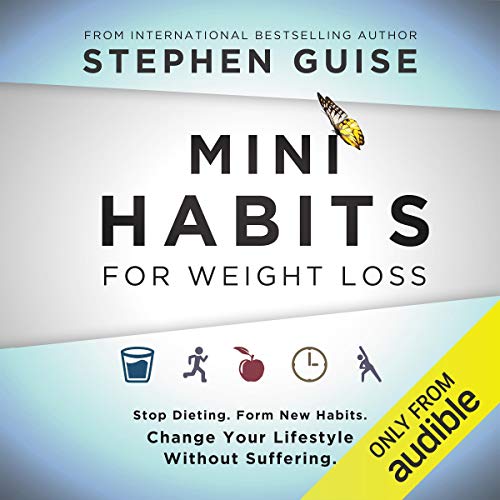
Mini Habits for Weight Loss
Summary
You will never diet again. Say goodbye to calorie counting, restrictive food bans, or other forced behaviors. In Mini Habits for Weight Loss, you will learn how to lose weight naturally in the precise way your body and brain are meant to change. We've blamed ourselves for lack of discipline. That didn't help. We've blamed calories, carbs, and fat. That didn't help. We've blamed our diet formulas. That didn't help. It's time we looked at the practice of dieting. Nearly all diets are ineffective because they're based on dieting. Every person has a diet (noun), but it's only if you are trying to lose weight that you diet (verb). Dieting is eating and drinking sparingly or selectively to reduce your weight. It doesn't work. If you've tried dieting, you know that. Even the "perfect diet" with the right foods will fail if it's approached from the traditional dieting perspective. Since weight loss experts are more concerned with biology than neuroscience, we get brilliant discussions on nutrition followed by the same dumb suggestion to "immediately start eating completely different foods than the ones you're habitually used to eating, and give up everything else." Are you fighting your own body and brain? The brain resists dramatic behavioral shifts. Recognizing this and developing a strategy around it made the original Mini Habits the number-one selling self-help book in a number of countries. In Mini Habits for Weight Loss, you'll see that we also biologically resist such changes, which explains why most dieters and smoothie-cleanse aficionados lose weight in the short term, only to gain it all back (and more) when the body adjusts.
©2016 Stephen Guise (P)2017 Stephen Guise

Elastic Habits
Summary
Habits that bend don’t break. Why do so many sincere attempts to build good habits fail? We try our best to be consistent, but some days are better than others. Inevitably, we fail when "life happens", because each day we try to hit the same targets regardless of the situations we face. How, then, can we make our habits more resilient to the turbulence of life? By making them elastic. Most people associate "elastic" with yoga pants and rubber bands. But the word also means "resilient" - the ability to withstand pressure. Elastic materials are far more durable than rigid and brittle ones, which will shatter under pressure. The same is true for habits. A traditional habit is unchanging: The same behavior is done at the same time to the same level every day. It works well until the pressures of modern life break its rigid and brittle shell. Elastic habits are fluid: They can change their form and intensity to suit each unique day. They survive busy, tired, bad days. They thrive in better days. A standard habit has one win condition. An elastic habit has nine. If traditional habits are a hammer, elastic habits are your grandfather’s garage. When you’re working on a house project, it’s not a burden to have a hammer, a wrench, and a screwdriver - you just select the one you need when you need it. Elastic habits are the same. If you’re tired of the repetitive and exhausting grind to develop good habits, it’s time to give your habits the refreshing superpower of elasticity. Listen to Elastic Habits now, and you’ll soon discover the life-changing difference of good habits that adapt to your day.
©2019 Selective Entertainment LLC (P)2019 Selective Entertainment LLC