The Great Courses has 635 audiobooks on Listento.it, narrated by 479 narrators, with an average listener rating of 4.5★ across 19,831 ratings. The most-rated is A Column of Fire.

Must History Repeat the Great Conflicts of This Century?
Summary
Twice in the first half of the last century, the great powers engaged in wars that killed nearly 70 million people, with the aftermath of each shaking the international political system, changing the maps of the world, and setting the scene for the next great conflict. And for most of the past 50 years, the Cold War dominated international politics. Is this the history we are condemned to repeat? This series of eight lectures about international politics will hone your ability to approach that question with knowledge and insight. It reveals how concepts such as the balance of power and the international system interweave with and help shape history, showing you what actually happened in the great conflicts and why. The lectures will help you answer many of the key questions those concerned with creating a stable peace must answer every day; did the end of the Cold War bring peace and harmony or war and chaos? Does the United States play a dominant role in international affairs or is its role declining? Is military power still the key to world leadership, or has economic power become more important? Should the United States attempt to play the role of global police force, or should it withdraw from its overseas military commitments?
©1991 The Teaching Company, LLC (P)1991 The Great Courses

The Other 1492: Ferdinand, Isabella, and the Making of an Empire
Summary
Ask anyone about the significance of the year 1492, and you're almost certain to hear something about Christopher Columbus and the discovery of the New World. But there is also a perspective on 1492 far different than the one most of us know - one that is more complete and complex. A 1492 when there was no country called Spain and no language called Spanish. A 1492 whose biggest event - in the region that would eventually become Spain - was the surrender of the last Muslim stronghold, Granada, with the subsequent Edict of Expulsion that gave Jews three months to either convert to Christianity or leave the Kingdom of Castile and the Crown of Aragon. This 12-lecture series uses the year 1492 to examine the events that made Spain a country and an empire. It examines the centuries of developments that led up to that pivotal year in Spanish history and the consequences that followed for both Spain and the New World, presenting Spanish history from the perspective of both the victors and the defeated: the Muslims, Jews, and New World natives for whom 1492 was not a time of wonder but of terror and despair.
©2002 The Teaching Company, LLC (P)2002 The Great Courses

Quest for Meaning: Values, Ethics, and the Modern Experience
Summary
Is there an ethics that we can all agree on without stifling pluralism and freedom? What would such an ethics look like? Most important, how should you, as a thoughtful person, find your way among the moral puzzles of the modern world and its cacophony of voices and opinions? These are just some of the engaging and perplexing questions you'll tackle as you join Professor Kane for this thought-provoking, 24-lecture examination of the problems surrounding ethics in the modern world. The contemporary issues you'll consider include conflicts between public and private morality, the degree to which the law should enforce morality, the teaching of values in the schools, the role of religion in public life, the limits of liberty and privacy, individualism versus community, and the loss of shared values and the resulting discontent about politics and public discourse. Professor Kane's approach is as searching and comprehensive as any you could ask for. His lectures range over a rich array of literary, religious, and philosophical sources representing thousands of years of civilization. Most intriguingly, they spur you to ponder the possibility of recovering the ancient quest for wisdom and virtue in a way that respects the insights of modern thought and the achievements of modern pluralism. Whatever your thinking on such questions, whatever your own personal question for true meaning, you can rest assured that it will be immeasurably enriched by the harvest of reflection you glean from these compelling lectures. PLEASE NOTE: When you purchase this title, the accompanying reference material will be available in your Library section along with the audio.
©1999 The Teaching Company, LLC (P)1999 The Great Courses

Why Economies Rise or Fall
Summary
How can a nation create the conditions for economic growth and prosperity? And what, once these conditions are achieved, can it do to sustain this progress? Discover the answers (which may surprise you) in these 24 lectures that guide you through a stimulating and, above all, accessible examination of what economists know and don't know about the elusive search for economic prosperity. Here, you'll learn how countries as widely different as the United States and Vietnam have grown their economies; how countries like China and India were able to recover from economic reverses; and, most important, why the critical test of any economic policy is its ability to productively alter human behavior for everyone's ultimate benefit. By looking at economic growth as the result of incentivizing such productive behavior - "making productivity more profitable than all the alternatives" - Professor Rodriguez clears up an often-shrouded economic landscape. The result is a lecture series that brings the economic strategies chosen by nations down to street level by adding a newfound clarity to key issues: Why economies succeed or fail; how economic bubbles are created, why they burst, and how nations recover from them; the challenges posed by globalization; and more. By the end of the last lecture, you'll understand as never before both the benefits granted and the costs extracted by the "instant economy" that technology and globalization have brought us. You'll grasp what China's expected economic dominance may soon mean. And you'll have a new appreciation of the juggling act policymakers perform as they try to heed history's latest lesson in achieving national growth and maximum human happiness. PLEASE NOTE: When you purchase this title, the accompanying reference material will be available in your Library section along with the audio.
©2010 The Teaching Company, LLC (P)2010 The Great Courses

Written Communications: Being Heard and Understood
Summary
We’ve all encountered bad writing at some point in our lives. We’ve possibly even authored some ourselves. And it’s pretty clear when writing is bad. Whether you’re writing business letters, memos, emails, reports, announcements, or some other professional communication, the pragmatic communicator can be far more effective than the multiloquent one. Because we are judged by our ability to communicate with direction, focus, and confidence - along with inspiration and empathy, no matter who you are and what your goal is - getting the right message across is absolutely essential to achieving your objectives. In the 12 rewarding lectures of Written Communications: Being Heard and Understood, Professor Allison Friederichs, associate teaching professor and the associate dean for academic affairs at the University of Denver, University College, will share the secrets to sharpening your written, oral, and interpersonal communications skills. Bringing plenty of humor and enthusiasm, along with dozens of tools, examples, and exercises, Professor Friederichs takes you through each component of writing a successful business communication - from picking the right words; to ensuring the grammar and punctuation are correct; to analyzing, crafting, and editing your message. Most important, she will show you how impactful communication isn’t about you: It’s about your reader. Once you understand your audience, she’ll show you how to target the message, make appropriate word choices, incorporate sound logic, and untangle complex syntax using a combination of examples and activities. PLEASE NOTE: When you purchase this title, the accompanying PDF will be available in your Audible Library along with the audio.
©2020 The Great Courses (P)2020 The Teaching Company, LLC

Great American Bestsellers: The Books That Shaped America
Summary
Best-selling books have played a critical role in influencing the tastes and purchasing habits of American readers for more than 100 years. But there is more to America's great best-selling books than the sales figures they rake in. American bestsellers also offer us ways to appreciate and understand particular periods of American culture. In this series of 24 lectures you'll enjoy a pointed look at key best-selling works and their places within the greater fabric of American cultural history. Guided by an award-winning teacher, you'll explore representative bestsellers at various stages of American history, from the first book published in the English-speaking New World to the blockbuster authors who dominate the 21st-century publishing industry. The result is an expert look at the evolution of American culture - its tastes, its hopes, its dreams - through the unique lens of the books that have captivated its readers at various points in American history. Each of the 22 works discussed - from literary masterpieces (The Adventures of Huckleberry Finn) to enduring self-help books (How to Win Friends and Influence People) - has had a crucial and unique impact on American society. Studying these representative works will give you a deeper understanding of how American literature can both mirror the events of its time and, in many instances, have a pronounced impact on them. These lectures are your opportunity to see our nation's best-selling books as more than just popular forms of entertainment that have managed to make their authors lots of money, but as stunning microcosms of American cultural history.
©2009 The Teaching Company, LLC (P)2009 The Great Courses

Natural Law and Human Nature
Summary
Natural law is the idea that there is an objective moral order, grounded in essential humanity, that holds universal and permanent implications for the ways we should conduct ourselves as free and responsible human beings. These 24 in-depth lectures consider the arguments for natural law, the serious objections that have been raised against it, and the ways, despite all overt criticisms, it remains a vital and even pervasive force in political, moral, and social life today, even while traveling under another name. Shaping Father Koterski's historical treatment is an appreciation of just how much thought, effort, and brilliance went into formulating and defending the crucial insights of natural law theory. Among other things, you'll look at: the virtual dialogue that took place between the Ionian scientists, the Sophists, and their great interlocutors, Socrates, Plato, and Aristotle; Thomas Aquainas's Summa Theologica, which sets out the account of natural law as that type of law through which humans take part according to their nature as free, intelligent, and responsible beings; the ways, by the American Founders' design, natural law thinking is poured into the foundations of our republican experiment in ordered liberty and constitutional democracy; and the criticisms leveled against natural law by Descartes, Rousseau, and Kant. Finally, Father Koterski asks whether modern evolutionary biology can claim to have discovered truths about human nature that render natural law theory unintelligible, whether the findings of anthropological research undercut natural law, and whether accepting the idea of natural law means accepting the existence of God and vice versa.
©2002 The Teaching Company, LLC (P)2002 The Great Courses
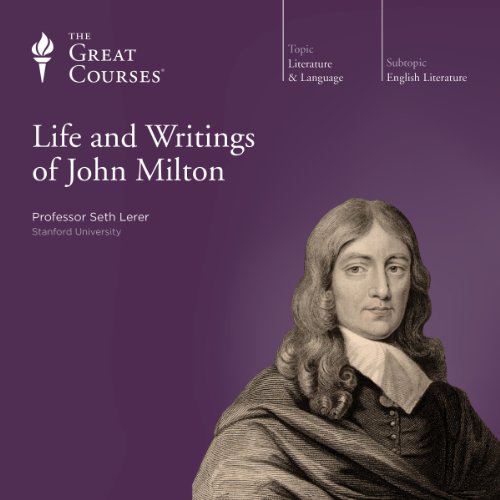
The Life and Writings of John Milton
Summary
There is no disputing that John Milton is considered one of the supreme writers in the history of English letters. Yet, for a number of reasons, many modern readers are unaware of the pleasures of his poetry and prose. These 12 lectures examine Milton's life and work in order to understand the richness and depth of his poetry, its ways of representing 17th-century English life and culture, and its impact on later writers and on English literary history as a whole. You'll learn about Milton's works in all their fullness, whether or not you've read them in the past. You'll get both an introduction to Milton's achievements and a means by which you can cultivate your own thoughts and opinions about works including Paradise Lost and Areopagitica. While Paradise Lost alone could easily be the subject of an entire lecture series, Professor Lerer chooses not to restrict himself to this unique masterwork, but rather to make it manifest in the context of its maker's life and career, and to give you a foundation on which to build your future enjoyment of Milton. Because of this, you'll get a chance to explore Milton's early poetry, "Lycidas," his various political works, Paradise Regained, Samson Agonistes, and more. Professor Lerer describes these lectures as "an invitation to the modern reader to find ways of enjoying, appreciating, valuing, and even struggling through a poetry that says as much about human nature and political life now as it did over three centuries ago." And in learning to feel the living pulse of Milton's world, you'll join generations of readers and authors, including William Wordsworth, T.S. Eliot, and Mary Shelley, who have taken inspiration from his genius.
©1999 The Teaching Company, LLC (P)1999 The Great Courses

The Everyday Guide to Wine
Summary
Every time you open a bottle of wine, you embark on a journey through a world of sensations. Yet for all its pleasurable qualities, wine can be bewildering in its mystery and complexity. Unlocking the secrets of wine is the key to heightening your appreciation of this rewarding experience. Whether you’re a novice looking to master the basics, an enthusiast who tours vineyards, or something in between, there’s no better way to learn about wine than from a wine expert. The Everyday Guide to Wine brings this rare opportunity right into your home with 24 engaging lectures delivered by acclaimed Master of Wine Jennifer Simonetti-Bryan - one of only 26 Americans to hold this coveted title. In her interactive, accessible course she gives you all the knowledge and tips you need to improve your ability to try, buy, talk about, and, most of all, enjoy wine. PLEASE NOTE: When you purchase this title, the accompanying PDF will be available in your Audible Library along with the audio.
©2010 The Great Courses (P)2010 The Teaching Company, LLC

Veiled
Summary
When a dead body turns up in the hot tub at a high-end resort on the rugged Oregon Coast, forensic investigator Lacey Campbell and her fiancé, Jack Harper, realize their vacation is over. Tragically, the dead woman is dressed in a wedding gown, even more disturbing for Lacey since she's about to become a bride. When the victim turns out to be a popular bartender with a bad-news ex-husband, it looks like a domestic quarrel turned deadly. But could there be something more sinister going on in this tight-knit community? Swept into the investigation, Lacey uncovers a killer with a morbid perspective on marriage. From master of romantic suspense Kendra Elliot comes a fast-paced tale of obsession and murder.
©2013 Kendra Elliot (P)2014 Brilliance Audio, all rights reserved.
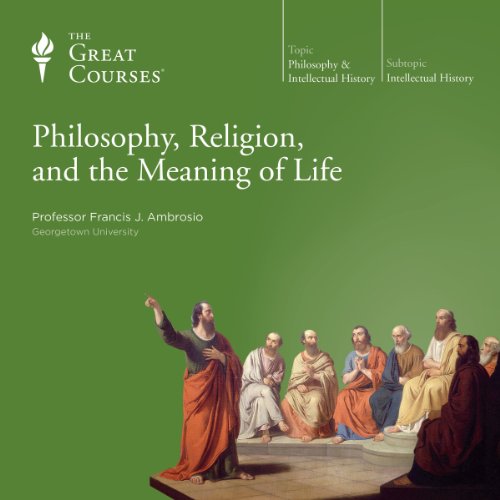
Philosophy, Religion, and the Meaning of Life
Summary
What is the meaning of life? Is human existence meaningful or absurd? If you've ever pondered these questions, you have an extraordinary adventure in store, as an award-winning teacher presents a boldly revealing inquiry into these most fundamental of human concerns. In this inspiring series of 36 lectures, Professor Ambrosio charts how these questions have been pursued and grasped through the ages, providing you with the understanding and the tools to come to terms with them in a direct, practical way. Using the key metaphorical figures of the Hero and the Saint, he leads you through the history and evolution of two Western traditions that address the question of meaning: The Greek-derived, Humanist philosophical tradition and the Judeo-Christian/Islamic theistic tradition, tracking the two archetypes as they react to and evolve with cultural changes across the centuries. But these lectures go far beyond an exercise in intellectual understanding. From the very beginning, Professor Ambrosio aims the philosophical problem of meaning squarely at the student, inviting you to actively engage with it by asking you to grapple with universal questions like, How should I live my life? What is the relationship of death to life? Is there some deep, sustainable connection between the two? Drawing on the work of thinkers from Plato and Epictetus to Simone Weil and Viktor Frankl, you'll probe the existential choices about meaning and value that exist as potentials in the fabric of our experience and that call forth the dignity and possibility of our own living.
©2009 The Teaching Company, LLC (P)2009 The Great Courses

How to Build Meaningful Relationships Through Conversation
Summary
We have conversations every day, but how many of those can be considered effective? The right conversation can help establish strong relationships, solve problems, create new opportunities, and build communities. The right conversation can change everything. But how does one prepare to have a conversation in an effective way? In 10 lectures for self-development, professional communications coach and speaker Carol Ann Lloyd teaches the best ways to communicate and listen, including how to focus on understanding, how to overcome barriers and distractions, and how to clarify intentions. When listeners step back to hear what makes conversations successful, they will learn that each component of a conversation is a piece of a larger puzzle, which only fits together when thoughtfully considered and executed. Conversations that matter take effort, and every conversation can be R.E.A.L. (Relevant, Effective, Affirming, Legitimate.) Carol Ann Lloyd also shares the three pitfalls in tough conversations...and how to avoid them. By the end of this course, listeners will have a new way of understanding the way people communicate, and will develop the confidence to live the life they want to live - one conversation at a time.
©2020 Audible Originals, LLC (P)2020 Audible Originals, LLC.

Understanding the Inventions That Changed the World
Summary
We’re surrounded by inventions. Clocks, appliances, cars, televisions, cell phones...the list goes on and on. Where did all these inventions come from? How do they work? And how do they reflect - even define - the values of our culture? Now, you can learn the remarkable stories surrounding monumental inventions - and how consequential these inventions were to history. Taught by Professor W. Bernard Carlson of the University of Virginia, who is an expert on the role of innovation in history, these 36 enlightening lectures give you a broad survey of material history, from the ancient pottery wheel to the Internet and social media. Along with recounting the famous inventions you might expect, such as the steam engine, the airplane, and the atomic bomb, this course explores a number of surprising innovations, including beer, pagodas, and the operating room. From ancient China to 21st-century America, from the English coal mines to the high-tech companies of Silicon Valley, this course takes you around the world and across the ages to introduce you to some of the most innovative moments in human civilization. This unique approach to history will boost your technology literacy and give you a completely new appreciation for the everyday objects around you. PLEASE NOTE: When you purchase this title, the accompanying PDF will be available in your Audible Library along with the audio.
©2013 The Great Courses (P)2013 The Teaching Company, LLC

Joyce's Ulysses
Summary
Ulysses depicts a world that is as fully conceived and vibrant as anything in Homer or Shakespeare. It has been delighting and puzzling readers since it was first published on Joyce's 40th birthday in 1922. And here, Professor Heffernan maps the brilliance, passion, humanity, and humor of Joyce's modern Odyssey in these 24 lectures that finally make a beguiling literary masterpiece accessible for any reader willing to give it a chance. Although they discuss selected points from the enormous body of critical scholarship on Ulysses, these lectures presuppose no special knowledge of literature or of James Joyce. Whether or not you've read Ulysses, you'll find they make an excellent guide to the many-layered pleasures of this modern epic. Illuminating the dramatic and artistic integrity behind the novel's most notoriously challenging passages, they explain why this frank, path-breaking novel was praised as a landmark and damned as obscene - even banned - as soon as it first appeared. You'll come to see Ulysses as many books at once: an inspired modern reweaving of the fabric of Homer's mighty Odyssey; a supreme synthesis of realism and symbolism; a grandly comic and at times bawdy work - a seriocomic parable about art and experience; a symphonic, kaleidoscopic portrayal of the sights, sounds, and voices of Dublin and every city; and a dazzling work of masterfully handled prose styles and narrative devices. Above all, you'll learn to read Ulysses as an unsentimental but deeply felt story that uses concrete facts of mundane life in a particular time and place to say something truly extraordinary and universal that speaks to all that is human in us. PLEASE NOTE: When you purchase this title, the accompanying reference material will be available in your Library section along with the audio.
©2001 The Teaching Company, LLC (P)2001 The Great Courses
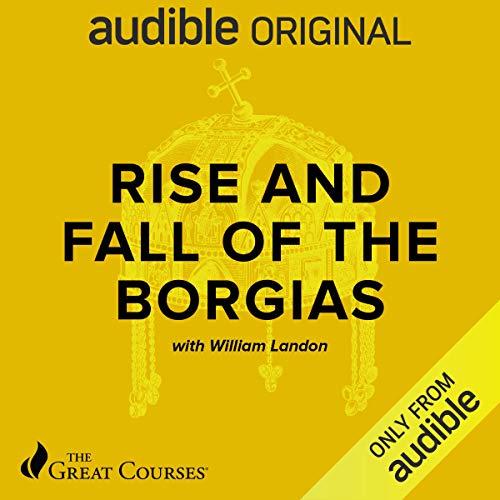
Rise and Fall of the Borgias
Summary
Since its rise to the highest ranks of power in Renaissance Europe, the Borgia family has developed a scandalous reputation. While they were indeed ostentatious, calculating, worldly, cruel—and even, occasionally, murderous—listeners may be surprised to find that the Borgias were not terribly different from other powerful and ambitious families of their day. So why has history set them apart as one of the most corrupt and reviled families in history? In the Rise and Fall of the Borgias, listeners will spend 10 revealing lectures untangling the web of rumors, speculation, and historical embellishment from what is actually known about the infamous Roman family. With Dr. William Landon, listeners will explore the historical context that helped the Borgias make their fortune and better understand how they could be both magnanimous and ruthless, pious and morally suspect. The story of the Borgias is rich with intrigue, even without the fictional enhancement it has received from the numerous films, novels, and television shows that have been created based on the family’s notoriety. Dr. Landon introduces listeners to the major players and lays bare their machinations to reach the highest offices of church and state. Were their exploits as salacious as listeners have been led to believe? Did they manipulate the papacy for their own gain? Are the rumors of incest, bribery, political assassinations, and other morally questionable behaviors true or the stuff of historical gossip? As listeners explore these and other rumors surrounding the Borgias, they will pull back the curtain on the historian’s craft and see how the story of this Renaissance dynasty has been shaped over time and how new research and a healthy dose of skepticism has allowed us to get a little closer to the truth—without losing any of the drama.
©2019 Audible Originals, LLC (P)2019 Audible Originals, LLC.

Generals and Geniuses: A History of the Manhattan Project
Summary
Generals and Geniuses: A History of the Manhattan Project Boom. On July 16, 1945, a fireball erupted in the sky over a remote desert in New Mexico - and the world changed forever. That fireball was the culmination of a dramatic race to harness the power of the atom itself in order to save the world from Nazi Germany and Imperial Japan. You know this race by another name: the Manhattan Project. In 10 riveting episodes that feel like a fast-paced thriller, acclaimed World War II historian Edward G. Lengel’s Generals and Geniuses: A History of the Manhattan Project brings the origin of the atomic bomb - and the scientific minds behind it - to vivid life. Did the Manhattan Project, and the remarkable weapon it produced, save millions of lives at the expense of the tens of thousands who died in Hiroshima and Nagasaki? And was there any way to prevent this technology from unleashing the horrors that still hang over us today? These complicated questions linger like a mushroom cloud over the story of the race to develop the world’s first atomic weapon. Featuring a cast of characters including Enrico Fermi, Franklin Delano Roosevelt, J. Robert Oppenheimer, and Harry S. Truman, and packed with international espionage, close calls, down-to-the-wire decisions, and a race against time, The Manhattan Project blends science, history, and military strategy to reveal the truth about how the world entered the nuclear age. The story of the Manhattan Project - from the first inklings of what mankind could do with the atom to the fateful bombings of Hiroshima and Nagasaki - is, above all, a human story: one that celebrates the brilliance of scientific knowledge, the brutal struggle for freedom, and the messy ethics of the human cost of war - and victory. And it’s a story whose final chapter, as you’ll discover by the end of this remarkable series, has yet to be written.
©2020 Audible Originals, LLC (P)2020 Audible Originals, LLC.

The Symphony
Summary
From its humble beginnings in the 17th-century Italian opera overture and the Baroque ripieno concerto, the symphony has evolved into one of the longest lived, and perhaps the most expressively inclusive, genres of instrumental music. Along the way, it has embraced nearly every trend to be found in Western concert music. In this series of twenty-four 45-minute lectures, Professor Greenberg guides you on a survey of the symphony. You'll listen to selections from the greatest symphonies by many of the greatest composers of the past 300 years. You'll also hear selections from some overlooked works that, undeservedly, have been forgotten by contemporary audiences. Your tour of the symphony includes an examination of how the simultaneous development of the orchestra and the opera were crucial to the birth of the symphony as a genre; a look at the earliest true symphonies that were exponents of the galant style that emerged in the period between the High Baroque and Viennese Classicism; an exploration of Haydn and Mozart, the titans of the Classical age; the sublime and iconoclastic Beethoven and his Fifth Symphony; a study of Berlioz's Symphonie Fantastique, which combined the extreme emotions and drama of the opera house with an explicit, intimately autobiographical narrative; and national developments in France, Russia, Vienna, Bohemia, Scandinavia, America, and Great Britain. The course concludes with an investigation of Dmitri Shostakovich's Tenth Symphony, which became, in Professor Greenberg's words, "a model for what the new, post-Stalin Soviet music might aspire to be-a more personally expressive, less explicitly programmatic work, one that both engaged and challenged its listeners." PLEASE NOTE: When you purchase this title, the accompanying reference material will be available in your Library section along with the audio.
©2004 The Teaching Company, LLC (P)2004 The Great Courses

The Soul and the City: Art, Literature, and Urban Living
Summary
These eight lectures are a celebration of humanity and the rich texture of human experience. They are a fascinating focus on the complex artistic representations of city life from the 18th to the 20th century. Join Professor Weinstein as he reveals the portraits of humanity that came from several of the period's greatest artists, writers, and thinkers. Among them: Painter Edvard Munch, who depicts the emptiness of urban living Poet Charles Baudelaire, who celebrates how crowds impact his imagination Author Daniel Defoe, who dramatizes the freedom the city offers people who want to change their identities Author Theodore Dreiser, who views the city as a huge, brutal, industrial machine that systematically grinds up individuals Psychoanalyst Sigmund Freud, who believes that the city is like the mind: a receptacle for the past, as well as for hidden lives and passions These lectures reveal several vital themes that appear in artists' subjective renderings of urban living: orientation (finding our way), the marketplace (exchanging goods and services), anonymity (experiencing solitude or freedom), encounters (fearing or connecting with others), history (maintaining contact with other times), and cultures (entering the cities' ever-changing cultural forms). Why use art as a guide to city life? According to Professor Weinstein, "Art usually supports what we learn from scientific studies of urban life. Art provides us with something social science cannot: a subjective rendering of city experience that is not quantifiable. Such a depiction includes our fears, desires, and dreams. Art serves as a record for these experiences."
©1991 The Teaching Company, LLC (P)1991 The Great Courses

Jewish Intellectual History: 16th to 20th Century
Summary
Over the last four centuries, a small group of thinkers attempted to answer a series of remarkably challenging questions: In a world having a history of untold suffering - especially, it seemed, for Jews - was the existence of an all-powerful and comforting God still tenable? What were the purpose and meaning of Jewish practices and customs? Could Jews still justify the notion of a chosen people in a social climate in which Jewish integration and full participation with the rest of humanity had become the norm? Although their approaches and solutions differed, most thinkers shared a common goal: to provide a continuing sense of faith, meaning, and identity for their fellow Jews. Through these 24 necessary lectures, you observe the time-honored intellectual tradition through which Judaism analyzes, rethinks, and reformulates itself. This process of preserving its essential character while still trying to accommodate itself to the modern world has kept Judaism a vital and vibrant, rather than static, religion. Professor Ruderman introduces you to a new and rich body of thinkers and thinking - particularly the prominent philosopher Benedict (Baruch) Spinoza. This course considers modern Jewish thought largely in terms of two issues: the response to Spinoza and his attack on the very viability of Judaism, and the shift in the standard by which Jews defined themselves and their faith. In the modern age, it became the non-Jewish world. With these two issues in mind, you'll consider the various thinkers according to three approaches: insiders, outsiders, and rejectionists. In Professor Ruderman's estimation, Jewish thinking is a widespread and necessary part of Jewish life, an effort to find meaning and hope in an uncertain world.
©2002 The Teaching Company, LLC (P)2002 The Great Courses

Unlocking the Hidden History of DNA
Summary
Locked inside the DNA of every species that ever lived are endless stories - about origins, ancestors, fate, and much more. Until recently, these secrets were completely inaccessible. But with the help of new technologies, scientists are now reading the hidden history of DNA, making remarkable discoveries about ourselves and our fellow species. Your gateway to this treasure trove of information is Unlocking the Hidden History of DNA, 12 informative and accessible lectures delivered by New York Times best-selling author Sam Kean. Assuming the viewer has no prior background in science, these detailed but delightful half-hour lectures cover the fundamental properties of DNA, the techniques that have unraveled its mysteries, the exciting revelations that have resulted, and the very human stories of the scientists involved - many of whom won Nobel Prizes and sparked fierce controversies along the way. You start in the mid-19th century with Austrian monk Gregor Mendel, who pioneered the science of genetics with experiments on pea plants, and the almost-forgotten discovery of DNA by Friedrich Miescher. Proceeding briskly through decades when the connection between genes and DNA were pieced together, you learn about the discovery of DNA, the race to determine its structure, and the Human Genome Project, which mapped all three billion base pairs of our DNA. Then you dig deeply into our genome to mine its secrets, including our surprising relationship to Neanderthals, when we first started wearing clothes, genetic influences on language, and our kinship with viruses. You also excavate new historical details about King Tut, Genghis Khan, King Richard III, and Presidents Thomas Jefferson and Warren Harding. Finally, you examine today’s cutting-edge DNA technology, notably a genetic engineering technique called CRISPR heralded as holding the potential for science fiction-like manipulation of our species. Genetics has come a long way since Gregor Mendel’s humble pea plants. PLEASE NOTE: When you purchase this title, the accompanying PDF will be available in your Audible Library along with the audio.
©2022 The Great Courses (P)2022 The Teaching Company, LLC