The Food & Wine category has 865 audiobooks on Listento.it, with an average listener rating of 4.4★ across 3,228 ratings. The most-rated is Kitchen Confidential.

Our Lady of Perpetual Hunger
Summary
Named a Favorite Book for Southerners in 2020 by Garden & Gun "Donovan is such a vivid writer - smart, raunchy, vulnerable and funny - that if her vaunted caramel cakes and sugar pies are half as good as her prose, well, I'd be open to even giving that signature buttermilk whipped cream she tops her desserts with a try." (Maureen Corrigan, NPR) Renowned southern pastry chef Lisa Donovan's memoir of cooking, survival, and the incredible power in reclaiming the stories of women Noted chef and James Beard Award-winning essayist Lisa Donovan helped establish some of the South's most important kitchens, and her pastry work is at the forefront of a resurgence in traditional desserts. Yet Donovan struggled to make a living in an industry where male chefs built successful careers on the stories, recipes, and culinary heritage passed down from generations of female cooks and cooks of color. At one of her career peaks, she made the perfect dessert at a celebration for food-world goddess Diana Kennedy. When Kennedy asked why she had not heard of her, Donovan said she did not know. "I do", Kennedy said, "Stop letting men tell your story." Our Lady of Perpetual Hunger is Donovan's searing, beautiful, and searching chronicle of reclaiming her own story and the narrative of the women who came before her. Her family's matriarchs found strength and passion through food, and they inspired Donovan's accomplished career. Donovan's love language is hospitality, and she wants to welcome everyone to the table of good food and fairness. Donovan herself had been told at every juncture that she wasn't enough: she came from a struggling southern family that felt ashamed of its own mixed race heritage and whose elders diminished their women. She survived abuse and assault as a young mother. But Donovan's salvations were food, self-reliance, and the network of women in food who stood by her. In the school of the late John Egerton, Our Lady of Perpetual Hunger is an unforgettable Southern journey of class, gender, and race as told at table.
©2020 Lisa Donovan (P)2020 Penguin Audio

The New Wine Rules
Summary
There are few greater pleasures in life than enjoying a wonderful glass of wine. So why does finding and choosing one you like seem so stressful? Now, becoming a happier, more confident wine drinker is easy. The first step is to forget all the useless, needlessly complicated stuff the "experts" have been telling you. In The New Wine Rules, acclaimed wine writer Jon Bonné explains everything you need to know in simple, easy-to-digest tidbits. And the news is good! For example: A wine's price rarely reflects its quality. You can drink rosé any time of year. And don't save a great bottle for anything more than a rainy day.
©2017 Jon Bonn (P)2017 Dreamscape Media, LLC

Real Food, Fake Food
Summary
You've seen the headlines: Parmesan cheese made from sawdust. Lobster rolls containing no lobster at all. Extra-virgin olive oil that isn't. Fake foods are in our supermarkets, our restaurants, and our kitchen cabinets. Award-winning food journalist and travel writer Larry Olmsted exposes this pervasive and dangerous fraud perpetrated on unsuspecting Americans. Real Food, Fake Food brings listeners into the unregulated food industry, revealing that this shocking deception extends from high-end foods like olive oil, wine, and Kobe beef to everyday staples such as coffee, honey, juice, and cheese. It's a massive bait and switch where counterfeiting is rampant and where the consumer ultimately pays the price. But Olmsted does more than show us what foods to avoid. A bona fide gourmand, he travels to the sources of the real stuff to help us recognize what to look for, eat, and savor: genuine Parmigiano-Reggiano from Italy, fresh-caught grouper from Florida, authentic port from Portugal. Real foods that are grown, raised, produced, and prepared with care by masters of their crafts.
©2016 Larry Olmsted (P)2016 HighBridge, a division of Recorded Books

Wine. All the Time.
Summary
A fresh, fun, and unpretentious guide to wine from Marissa A. Ross, official wine columnist for Bon Appétit. Does the thought of having to buy wine for a dinner party stress you out? Is your go-to strategy to pick the bottle with the coolest label? Are you tired of choosing pairings based on your wallet rather than your palate? Fear not! Bon Appétit wine columnist and Wine. All the Time. blogger Marissa A. Ross is here to help. In this utterly accessible yet comprehensive guide to wine, Ross will help listeners to understand the ins and outs of wine culture, from how to describe what they're drinking to finding the best bottle for their budget to picking the perfect red for a boyfriend's discerning parents. Told in her signature comedic voice, with personal anecdotes woven in among its lessons, Wine. All the Time. will teach listeners to sip confidently and make them laugh as they're doing it.
©2017 Marissa A. Ross (P)2017 Penguin Audio

The Billionaire's Vinegar
Summary
It was the most expensive bottle of wine ever sold. In 1985, at a heated auction by Christie's of London, a 1787 bottle of Château Lafite Bordeaux - one of a cache of bottles unearthed in a bricked-up Paris cellar and supposedly owned by Thomas Jefferson - went for $156,000 to a member of the Forbes family. The discoverer of the bottle was pop-band manager turned wine collector Hardy Rodenstock, who had a knack for finding extremely old and exquisite wines. But rumors about the bottle soon arose. Why wouldn't Rodenstock reveal the exact location where it had been found? Was it part of a smuggled Nazi hoard? Or did his reticence conceal an even darker secret? It would take more than two decades for those questions to be answered and involve a gallery of intriguing players - among them Michael Broadbent, the bicycle-riding British auctioneer who speaks of wines as if they are women and staked his reputation on the record-setting sale; Serena Sutcliffe, Broadbent's elegant archrival, whose palate is covered by a hefty insurance policy; and Bill Koch, the extravagant Florida tycoon bent on exposing the truth about Rodenstock. Pursuing the story from Monticello to London to Zurich to Munich and beyond, Benjamin Wallace also offers a mesmerizing history of wine, complete with vivid accounts of subterranean European laboratories where old vintages are dated, and of Jefferson's colorful, wine-soaked days in France, where he literally drank up the culture. Suspenseful, witty, and thrillingly strange, The Billionaire's Vinegar is the vintage tale of what could be the most elaborate con since the Hitler diaries. It is also the debut of an exceptionally powerful new voice in narrative non-fiction.
©2008 Benjamin Wallace (P)2008 Random House Audio

Cod
Summary
Author Mark Kurlansky pleasantly surprised the world with this engaging best-seller that garnered rave reviews from critics and casual readers alike. His subject for this whimsical biography is the codfish, a species remarkable for its influence on humanity. Cod, Kurlansky argues, has driven economic, political, cultural and military thinking for centuries in the lands surrounding the Atlantic Ocean. Nations like England and Germany have waged wars for cod. Vikings survived on frozen cod during their expeditions to the present America. And, it turns out, European explorers were driven toward North America in pursuit of this humble fish. Kurlansky fills this biography with fascinating anecdotes that show cod surfacing time and again throughout history. The book also serves as a wake-up call, alerting us that the species has nearly been fished out. Richard M. Davidson delivers a reading that is often amusing and always enlightening.
©1997 Mark Kurlansky (P)2001 Recorded Books, LLC

The Beginner's Guide to a Plant-Based Diet
Summary
So, you have made the big decision to take control of your health and join the whole-food plant-based diet movement. Congratulations! You have just made one of the best decisions of your life! This plant-based-diet beginners guide should help you get started. Discover the stress-free way to start a plant-based diet with easy, everyday comfort recipes. In the plant-based-diet meal plan, you’ll find: A three-week plant-based-diet meal plan and basic shopping list Eight food-based mistakes More than 70 plant-based-diet recipes from smoothies and salads to main courses and desserts, plus key macronutrient information Tips for stocking your kitchen with the essentials for your new plant-based diet Plant-based foods, especially when whole and unprocessed, have a lower calorie density, which means you will have to eat larger portions and that it will be a lot easier to lose some weight because these foods add much more bulk. One of the best motivators for people transitioning to plant-based eating comes from how great they feel and how much more than can do in their lives once they’re feeling healthier. Set aside your concerns about not knowing what to eat or feeling unsatisfied on your plant-based diet. With the plant-based-diet meal plan, you’ll enjoy delicious, simple plant-based-diet meals that you’ll want to eat time and again.
©2018 Brandon Hearn (P)2019 Brandon Hearn

The Truffle Underground
Summary
“The ultimate truffle true crime tale” (Bianca Bosker, New York Times best-selling author of Cork Dork) - a thrilling journey through the hidden underworld of the world's most prized luxury ingredient. Beneath the gloss of star chefs and crystal-laden tables, the truffle supply chain is touched by theft, secrecy, sabotage, and fraud. Farmers patrol their fields with rifles and fear losing trade secrets to spies. Hunters plant poisoned meatballs to eliminate rival truffle-hunting dogs. Naive buyers and even knowledgeable experts are duped by liars and counterfeits. Deeply reported and elegantly written, this addictive exposé documents the dark, sometimes deadly crimes at each level of the truffle’s path from ground to plate, making sense of an industry that traffics in scarcity, seduction, and cash. Through it all, a question lingers: What, other than money, draws people to these dirt-covered jewels? Praise for The Truffle Underground “Investigative journalist and first-time author Jacobs does a remarkable job reporting from the front lines of the truffle industry, bringing to vivid life French black-truffle farmers, Italian white-truffle foragers, and their marvelously well-trained dogs.” (Booklist, starred review) “In The Truffle Underground, Ryan Jacobs presents a lively exposé of the truffle industry, reporting on the crimes that ‘haunt the whole supply chain.’ . . . Even if truffles are beyond your pay grade, there is plenty of enjoyment to be had in the sheer devilment portrayed in this informative and appetizing book.” (The Wall Street Journal) “In elegant, mesmerizing prose, Ryan Jacobs has delivered a forest-to-table page-turner from the outer limits of our foodie culture, a place where colorful farmers, serial dog murderers and famous chefs grapple over a crudely foraged fungus that's traded in parking lots and bars, like heroin. The Truffle Underground is an eye-opener for anyone who's picked up a fork.” (Steve Fainaru, New York Times best-selling author of League of Denial and Pulitzer Prize-winning investigative reporter)
©2019 Ryan Jacobs (P)2019 Random House Audio

Catching Fire
Summary
Ever since Darwin and The Descent of Man, the existence of humans has been attributed to our intelligence and adaptability. But in Catching Fire, renowned primatologist Richard Wrangham presents a startling alternative: our evolutionary success is the result of cooking. In a groundbreaking theory of our origins, Wrangham shows that the shift from raw to cooked foods was the key factor in human evolution. When our ancestors adapted to using fire, humanity began. Once our hominid ancestors began cooking their food, the human digestive tract shrank and the brain grew. Time once spent chewing tough raw food could be used instead to hunt and to tend camp. Cooking became the basis for pair bonding and marriage, created the household, and even led to a sexual division of labor. Tracing the contemporary implications of our ancestors diets, Catching Fire sheds new light on how we came to be the social, intelligent, and sexual species we are today. A pathbreaking new theory of human evolution, Catching Fire will provoke controversy and fascinate anyone interested in our ancient origins - or in our modern eating habits.
©2009 Richard Wrangham (P)2009 Audible, Inc.

My Life in France
Summary
In her own words, here is the captivating story of Julia Child's years in France, where she fell in love with French food and found "her true calling". From the moment the ship docked in Le Havre in the fall of 1948 and Julia watched the well-muscled stevedores unloading the cargo to the first perfectly soigne meal that she and her husband, Paul, savored in Rouen en route to Paris, where he was to work for the USIS, Julia had an awakening that changed her life. Soon this tall, outspoken gal from Pasadena, California, who didn't speak a word of French and knew nothing about the country, was steeped in the language, chatting with purveyors in the local markets, and enrolled in the Cordon Bleu. After managing to get her degree despite the machinations of the disagreeable directrice of the school, Julia started teaching cooking classes herself, then teamed up with two fellow gourmettes, Simone Beck and Louisette Bertholle, to help them with a book they were trying to write on French cooking for Americans. Throwing herself heart and soul into making it a unique and thorough teaching book, only to suffer several rounds of painful rejection, is part of the behind-the-scenes drama that Julia reveals with her inimitable gusto and disarming honesty. This memoir is laced with wonderful stories about the French character, particularly in the world of food, and the way of life that Julia embraced so wholeheartedly. Above all, she reveals the kind of spirit and determination, the sheer love of cooking, and the drive to share that with her fellow Americans that made her the extraordinary success she became. Le voici. Et bon appetit!
©2006 Alex Prud'Homme (P)2006 Random House, Inc. Random House Audio, a division of Random House, Inc.

Lost Feast
Summary
A rollicking exploration of the history and future of our favorite foods. When we humans love foods, we love them a lot. In fact, we have often eaten them into extinction, whether it is the megafauna of the Paleolithic world or the passenger pigeon of the last century. In Lost Feast, food expert Lenore Newman sets out to look at the history of the foods we have loved to death and what that means for the culinary paths we choose for the future. Whether it's chasing down the luscious butter of local Icelandic cattle or looking at the impacts of modern industrialized agriculture on the range of food varieties we can put in our shopping carts, Newman's bright, intelligent gaze finds insight and humor at every turn. Bracketing the chapters that look at the history of our relationship to specific foods, Lenore enlists her ecologist friend and fellow cook, Dan, in a series of "extinction dinners" designed to recreate meals of the past or to illustrate how we might be eating in the future. Part culinary romp, part environmental wake-up call, Lost Feast makes a critical contribution to our understanding of food security today. You will never look at what's on your plate in quite the same way again.
©2019 Lenore Newman (P)2019 Tantor

Yes, Chef
Summary
Audie Award Nominee, Narration by the Author or Authors, 2013 It begins with a simple ritual: Every Saturday afternoon, a boy who loves to cook walks to his grandmother’s house and helps her prepare a roast chicken for dinner. The grandmother is Swedish, a retired domestic. The boy is Ethiopian and adopted, and he will grow up to become the world-renowned chef Marcus Samuelsson. This book is his love letter to food and family in all its manifestations. Marcus Samuelsson was only three years old when he, his mother, and his sister - all battling tuberculosis - walked 75 miles to a hospital in the Ethiopian capital city of Addis Adaba. Tragically, his mother succumbed to the disease shortly after she arrived, but Marcus and his sister recovered, and one year later they were welcomed into a loving middle-class white family in Göteborg, Sweden. It was there that Marcus’s new grandmother, Helga, sparked in him a lifelong passion for food and cooking with her pan-fried herring, her freshly baked bread, and her signature roast chicken. From a very early age, there was little question what Marcus was going to be when he grew up. Yes, Chef chronicles Marcus Samuelsson’s remarkable journey from Helga’s humble kitchen to some of the most demanding and cutthroat restaurants in Switzerland and France, from his grueling stints on cruise ships to his arrival in New York City, where his outsize talent and ambition finally come together at Aquavit, earning him a coveted New York Times three-star rating at the age of 24. But Samuelsson’s career of “chasing flavors”, as he calls it, had only just begun - in the intervening years, there have been White House state dinners, career crises, reality show triumphs, and, most importantly, the opening of the beloved Red Rooster in Harlem. At Red Rooster, Samuelsson has fufilled his dream of creating a truly diverse, multiracial dining room - a place where presidents and prime ministers rub elbows with jazz musicians, aspiring artists, bus drivers, and nurses. It is a place where an orphan from Ethiopia, raised in Sweden, living in America, can feel at home. With disarming honesty and intimacy, Samuelsson also opens up about his failures - the price of ambition, in human terms - and recounts his emotional journey, as a grown man, to meet the father he never knew. Yes, Chef is a tale of personal discovery, unshakable determination, and the passionate, playful pursuit of flavors - one man’s struggle to find a place for himself in the kitchen, and in the world.
©2012 Marcus Samuelsson (P)2012 Random House Audio

The Sweet Life in Paris
Summary
Like so many others, David Lebovitz dreamed about living in Paris ever since he first visited the city in the 1980s. Finally, after a nearly two-decade career as a pastry chef and cookbook author, he moved to Paris to start a new life. Having crammed all his worldly belongings into three suitcases, he arrived, hopes high, at his new apartment in the lively Bastille neighborhood. But he soon discovered it's a different world en France. From learning the ironclad rules of social conduct to the mysteries of men's footwear, from shopkeepers who work so hard not to sell you anything to the etiquette of working the right way around the cheese plate, here is David's story of how he came to fall in love with - and even understand - this glorious, yet sometimes maddening, city. When did he realize he had morphed into un vrai Parisien? It might have been when he found himself considering a purchase of men's dress socks with cartoon characters on them. Or perhaps the time he went to a bank with 135 euros in hand to make a 134-euro payment, was told the bank had no change that day, and thought it was completely normal. Or when he found himself dressing up to take out the garbage because he had come to accept that, in Paris, appearances and image mean everything. The more than 50 original recipes, for dishes both savory and sweet, such as Pork Loin with Brown Sugar-Bourbon Glaze, Braised Turkey in Beaujolais Nouveau with Prunes, Bacon and Bleu Cheese Cake, Chocolate-Coconut Marshmallows, Chocolate Spice Bread, Lemon-Glazed Madeleines, and Mocha–Crème Fraîche Cake, will have listeners running to the kitchen once they stop laughing. The Sweet Life in Paris is a deliciously funny, offbeat, and irreverent look at the city of lights, cheese, chocolate, and other confections.
©2009 David Lebovitz (P)2012 Tantor
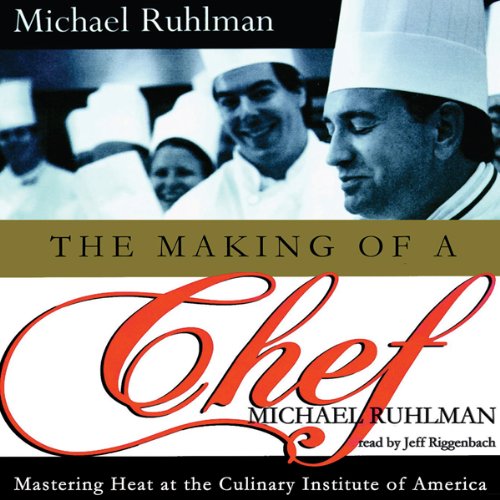
The Making of a Chef
Summary
In the ultimate food-lover's fantasy, journalist Michael Ruhlman dons chef's jacket and houndstooth-check pants to join the students in Skills One at the Culinary Institute of America, the most influential cooking school in the country. His goal is to document the training of America's chefs from the first classroom to the Culinary's final kitchen, the American Bounty Restaurant. The result becomes more than a rote reportage of a school for cooks. Ruhlman learns to cook as though his future depends upon it, and this complete immersion enables him to create the most vivid and energetic memoir of a culinary education on record.
©1997 by Michael Ruhlman (P)1998 by Blackstone Audiobooks

The Story of Sushi
Summary
Everything you never knew about sushi: its surprising origins, the colorful lives of its chefs, and the bizarre behavior of the creatures that compose it. Trevor Corson takes us behind the scenes at America's first sushi-chef training academy, as eager novices strive to master the elusive art of cooking without cooking. He delves into the biology and natural history of the edible creatures of the sea, and tells the fascinating story of an Indo-Chinese meal reinvented in 19th-century Tokyo as a cheap fast food. He reveals the pioneers who brought sushi to the United States and explores how this unlikely meal is exploding into the American heartland just as the long-term future of sushi may be unraveling. The Story of Sushi is at once a compelling tale of human determination and a delectable smorgasbord of surprising food science, intrepid reporting, and provocative cultural history.
©2007 Trevor Corson (P)2010 Audible, Inc.

History of Bourbon
Summary
Is bourbon the quintessential American liquor? Bourbon is not just alcohol—the amber-colored drink is deeply ingrained in American culture and tangled in American history. From the early days of raw corn liquor to the myriad distilleries that have proliferated around the country today, bourbon is a symbol of the United States. This course traces bourbon's entire history, from the 1700s, with Irish, Scottish, and French settlers setting up stills and making distilled spirits in the New World, through today's booming resurgence. On their tour of bourbon's fascinating, turbulent, and uniquely American evolution, listeners will explore the mysterious origins of the whiskey’s name and meet the men and women who have been championed as its inventors and made it so popular - from Daniel Boone's cousin and Baptist minister Elijah Craig to Jacob Beam and Evan Williams. In this 10-lecture journey through the story of an undeniably American libation, listeners will: Hear the stories behind the earliest bourbon whiskies right up to the current "bourbon bubble" Learn how a contemplative spirit went from agricultural product to industrial commodity Explore how - and why - bourbon played such a large role in the years of the early republic Get the facts on when and why Congress passed whiskey-protection laws Discover the surprising importance of bourbon distilleries during World War II, when the spirit became war material Go inside the Golden Age of Bourbon - a remarkable proliferation of new brands and niche markets happening now Witness the growth of brands like Jim Beam, Heaven Hill, Bulleit Bourbon, and Old Taylor Gain insights into why distilled spirits, like clothes and cars, project a message about who we are and the cultures to which we belong Join Dr. Ken Albala, a history professor who has written numerous books on food, as he lays out in expert detail the critical role bourbon has played throughout the cultural and political history of the nation.
©2019 Audible Originals, LLC (P)2019 Audible Originals, LLC.

Tender at the Bone
Summary
At an early age, Ruth Reichl discovered that "food could be a way of making sense of the world...If you watched people as they ate, you could find out who they were." Her deliciously crafted memoir, Tender at the Bone, is the story of a life determined, enhanced, and defined in equal measure by a passion for food, unforgettable people, and the love of tales well told. Beginning with Reichl's mother, the notorious food-poisoner known as the Queen of Mold, Reichl introduces us to the fascinating characters who shaped her world and her tastes, from the gourmand Monsieur du Croix, who served Reichl her first soufflé, to those at her politically correct table in Berkeley who championed the organic food revolution in the 1970s. Spiced with Reichl's infectious humor and sprinkled with her favorite recipes, Tender at the Bone is a witty and compelling chronicle of a culinary sensualist's coming-of-age.
©1998 Ruth Reichl (P)1998 Bantam Doubleday Dell Audio Publishing, Bantam Audio Publishing, A Division of Random House, Inc.

Wine Wars
Summary
Writing with wit and verve, Mike Veseth (a.k.a. the Wine Economist) tells the compelling story of the war between the market trends that are redrawing the world wine map and the terroirists who resist them. Wine and the wine business are at a critical crossroad today, transformed by three powerful forces. Veseth begins with the first force, globalization, which is shifting the center of the wine world as global wine markets provide enthusiasts with a rich but overwhelming array of choices. Two Buck Chuck, the second force, symbolizes the rise of branded products like the famous Charles Shaw wines sold in Trader Joe's stores. Branded corporate wines simplify the worldwide wine market and give buyers the confidence they need to make choices, but they also threaten to dumb down wine, sacrificing terroir to achieve marketable, McWine reliability. Will globalization and Two Buck Chuck destroy the essence of wine? Perhaps, but not without a fight, Veseth argues. He counts on "the revenge of the terroirists" to save wine's soul. But it won't be easy as wine expands to exotic new markets such as China and the very idea of terroir is attacked by both critics and global climate change. Veseth has "grape expectations" that globalization, Two Buck Chuck, and the revenge of the terroirists will uncork a favorable future for wine in an engaging tour-de-force that will appeal to all lovers of wine, whether it be boxed, bagged, or bottled.
©2011 Rowman & Littlefield Publishers, Inc. (P)2014 Audible Inc.

Culinary Reactions
Summary
When you're cooking, you're a chemist! Every time you follow or modify a recipe you are experimenting with acids and bases, emulsions and suspensions, gels and foams. In your kitchen you denature proteins, crystallize compounds, react enzymes with substrates, and nurture desired microbial life while suppressing harmful microbes. And unlike in a laboratory, you can eat your experiments to verify your hypotheses. In Culinary Reactions, author Simon Quellen Field explores the chemistry behind the recipes you follow every day. How does altering the ratio of flour, sugar, yeast, salt, butter, and water affect how high bread rises? Why is whipped cream made with nitrous oxide rather than the more common carbon dioxide? And why does Hollandaise sauce fall for "clarified" butter? This easy-to-follow primer even includes recipes to demonstrate the concepts being discussed, including Whipped Creamsicle Topping (a foam), Cherry Dream Cheese (a protein gel), and Lemonade with Chameleon Eggs (an acid indicator). It even shows you how to extract DNA from a Halloween pumpkin. You'll never look at your graduated cylinders, Bunsen burners, and beakers the same way again.
©2012 Simon Quellen Field (P)2017 Tantor

Ritz and Escoffier
Summary
In a tale replete with scandal and opulence, Luke Barr, author of the New York Times best-selling Provence, 1970, transports readers to turn-of-the-century London to discover how celebrated hotelier César Ritz and famed chef Auguste Escoffier joined forces at the Savoy Hotel to spawn the modern luxury hotel and restaurant, where women and American Jews mingled with British high society, signaling a new social order and the rise of the middle class. In early August 1889, César Ritz, a Swiss hotelier highly regarded for his exquisite taste, found himself at the Savoy Hotel in London. He had come at the request of Richard D'Oyly Carte, the financier of Gilbert & Sullivan's comic operas, who had modernized theater and was now looking to create the world's best hotel. D'Oyly Carte soon seduced Ritz to move to London with his team, which included Auguste Escoffier, the chef de cuisine known for his elevated, original dishes. The result was a hotel and restaurant like no one had ever experienced, run in often mysterious and always extravagant ways - which created quite a scandal once exposed. Barr deftly re-creates the thrilling Belle Epoque era just before World War I, when British aristocracy was at its peak, women began dining out unaccompanied by men, and American nouveaux riches and gauche industrialists convened in London to show off their wealth. In their collaboration at the still celebrated Savoy Hotel, where they welcomed loyal and sometimes salacious clients, such as Oscar Wilde and Sarah Bernhardt, Escoffier created the modern kitchen brigade and codified French cuisine for the ages in his seminal Le Guide Culinaire, which remains in print today, and Ritz, whose name continues to grace the finest hotels across the world, created the world's first luxury hotel. The pair also ruffled more than a few feathers in the process. Fine dining would never be the same - or more intriguing. Best Cookbooks and Food Books of 2018 - Huffington Post
©2018 Luke Barr (P)2018 Random House Audio