Orlando Figes has 6 audiobooks on Listento.it, narrated by 7 narrators, with an average listener rating of 4.4★ across 17 ratings. The most-rated is Crimea.

Crimea
Summary
The terrible conflict that dominated the mid-19th century, the Crimean War, killed at least 800,000 men and pitted Russia against a formidable coalition of Britain, France and the Ottoman Empire. It was a war for territory, provoked by fear that if the Ottoman Empire were to collapse then Russia could control a huge swathe of land from the Balkans to the Persian Gulf. But it was also a war of religion, driven by a fervent, populist and ever more ferocious belief by the Tsar and his ministers that it was Russia's task to rule all Orthodox Christians and control the Holy Land. Orlando Figes' major new book reimagines this extraordinary war, in which the stakes could not have been higher and which was fought with a terrible mixture of ferocity and incompetence. It was both a recognisably modern conflict - the first to be extensively photographed, the first to employ the telegraph, the first 'newspaper war' - and a traditional one, with illiterate soldiers, amateur officers and huge casualties caused by disease. Drawing on a huge range of fascinating sources, Figes also gives the lived experience of the war, from that of the ordinary British soldier in his snow-filled trench to the haunted, gloomy, narrow figure of Tsar Nicholas himself as he vows to take on the whole world in his hunt for religious salvation.
©2010 Orlando Figes (P)2018 Audible, Ltd
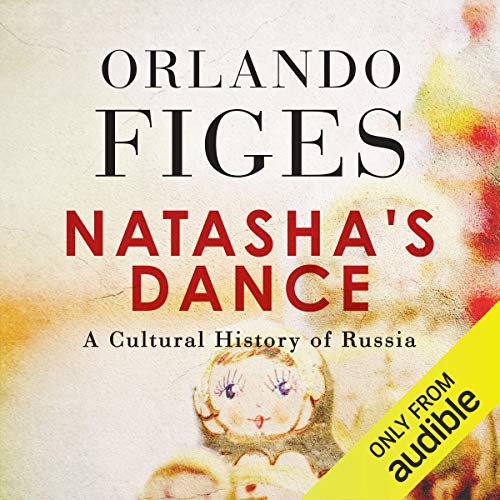
Natasha's Dance
Summary
History on a grand scale - an enchanting masterpiece that explores the making of one of the world's most vibrant civilizations. A People's Tragedy, wrote Eric Hobsbawm, did 'more to help us understand the Russian Revolution than any other book I know'. Now, in Natasha's Dance, internationally renowned historian Orlando Figes does the same for Russian culture, summoning the myriad elements that formed a nation and held it together. Beginning in the 18th century with the building of St. Petersburg - a 'window on the West' - and culminating with the challenges posed to Russian identity by the Soviet regime, Figes examines how writers, artists and musicians grappled with the idea of Russia itself - its character, spiritual essence and destiny. He skillfully interweaves the great works - by Dostoevsky, Stravinsky, and Chagall - with folk embroidery, peasant songs, religious icons and all the customs of daily life, from food and drink to bathing habits to beliefs about the spirit world. Figes' characters range high and low: the revered Tolstoy, who left his deathbed to search for the kingdom of God, as well as the serf girl Praskovya, who became Russian opera's first superstar and shocked society by becoming her owner's wife. Like the European-schooled countess Natasha performing an impromptu folk dance in Tolstoy's War and Peace, the spirit of 'Russianness' is revealed by Figes as rich and uplifting, complex and contradictory - a powerful force that unified a vast country and proved more lasting than any Russian ruler or state.
©2018 Orlando Figes (P)2018 Audible, Ltd

The Whisperers
Summary
Drawing on a huge range of sources - letters, memoirs, conversations - Orlando Figes tells the story of how Russians tried to endure life under Stalin. Those who shaped the political system became, very frequently, its victims. Those who were its victims were frequently quite blameless. The Whisperers re-creates the sort of maze in which Russians found themselves, where an unwitting wrong turn could either destroy a family or, perversely, later save it: a society in which everyone spoke in whispers - whether to protect themselves, their families, neighbours or friends - or to inform on them.
©2018 Orlando Figes (P)2018 Audible, Ltd

The Europeans
Summary
From the “master of historical narrative” (Financial Times), a dazzling, richly detailed, panoramic work - the first to document the genesis of a continent-wide European culture. The 19th century in Europe was a time of unprecedented artistic achievement. It was also the first age of cultural globalization - an epoch when mass communications and high-speed rail travel brought Europe together, overcoming the barriers of nationalism and facilitating the development of a truly European canon of artistic, musical, and literary works. By 1900, the same books were being read across the continent, the same paintings reproduced, the same music played in homes and heard in concert halls, the same operas performed in all the major theatres. Drawing from a wealth of documents, letters, and other archival materials, acclaimed historian Orlando Figes examines the interplay of money and art that made this unification possible. At the center of the book is a poignant love triangle: the Russian writer Ivan Turgenev; the Spanish prima donna Pauline Viardot, with whom Turgenev had a long and intimate relationship; and her husband Louis Viardot, an art critic, theater manager, and republican activist. Together, Turgenev and the Viardots acted as a kind of European cultural exchange - they either knew or crossed paths with Delacroix, Berlioz, Chopin, Brahms, Liszt, the Schumanns, Hugo, Flaubert, Dickens, and Dostoyevsky, among many other towering figures. As Figes observes, nearly all of civilization’s great advances have come during periods of heightened cosmopolitanism - when people, ideas, and artistic creations circulate freely between nations. Vivid and insightful, The Europeans shows how such cosmopolitan ferment shaped artistic traditions that came to dominate world culture.
©2019 Orlando Figes (P)2019 Blackstone Publishing

Just Send Me Word
Summary
"I went to get the letters for our friends, and couldn't help but feel a little envious, I didn't expect anything for myself. And suddenly-there was my name, and, as if it was alive, your handwriting." In 1946, after five years as a prisoner - first as a Soviet POW in Nazi concentration camps, then as a deportee (falsely accused of treason) in the Arctic Gulag - 29-year-old Lev Mishchenko unexpectedly received a letter from Sveta, the sweetheart he had hardly dared hope was still alive. Amazingly, over the next eight years, the lovers managed to exchange more than 1,500 messages and even to smuggle Sveta herself into the camp for secret meetings. Their recently discovered correspondence is the only known real-time record of life in Stalin's Gulag, unmediated and uncensored. Orlando Figes, author of Natasha's Dance, draws on Lev and Sveta's letters as well as KGB archives and recent interviews to brilliantly reconstruct the broader world in which their story unfolded. With the powerful narrative drive of a novel, Just Send Me Word reveals a passion and endurance that triumphed over the tragic forces of history.
©2012 Orlando Figes (P)2012 Tantor

The Customer of Tomorrow
Summary
With consumer decisions being made at increasing speed and the time it takes to win wallet-share rapidly shrinking, how can you prepare? Today's customer has more access to information and influencers, at a click or swipe, than ever before. The speed at which consumer decisions are made keeps increasing, and the time it takes for battles over wallet share to be won or lost is shrinking rapidly. Every fundamental assumption about customers is now being challenged: how they shop, where they shop, and why they shop. In this rapidly evolving environment, understanding consumers' behaviors is more critical than ever. The Customer of Tomorrow examines many of the changing behaviors, technologies, and expectations that companies must understand in order to build valuable and lasting relationships in the years to come. Drawn from the best of Knowledge@Wharton's reporting, this volume in the Knowledge@Wharton Essentials series features stories addressing: Customer loyalty in the age of big data When more data doesn't mean better customer service How to build loyal customers in the information age Why customer service is often the ignored side of social media When does it make sense to have a bricks-and-mortar location for customers? The Customer of Tomorrow will help you continue to win wallet share with customers. Gildan Media is proud to bring you another Wharton Digital Press Audiobook. These notable audiobooks contain the essential tools that can be applied to every facet of your career.
©2015 Knowledge@Wharton (P)2015 Gildan Media LLC