Bernard Mayes has narrated 12 audiobooks on Listento.it by 12 authors, with an average listener rating of 4.4★ across 42 ratings. The most-rated is Sailing Alone Around the World.
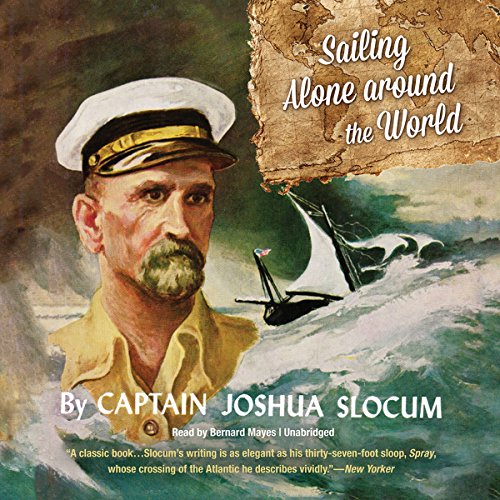
Sailing Alone Around the World
Summary
Challenged by an expert who said it couldn’t be done, Joshua Slocum, a fearless New England sea captain, set out in April 1895 to prove that a man could sail alone around the world. A little over three years and forty-six thousand miles later, the proof was complete. This is Slocum’s own account of his remarkable adventures during the historic voyage of the Spray. Whether Slocum was more accomplished as a writer or sailor is hard to say. His writing style is fast paced, witty, and exhilarating, an absorbing match to his harrowing adventures - adventures that included being chased by Moorish pirates off Gibraltar; escaping a fleet of hostile canoes; being submerged by a great wave off the Patagonian coast; an encounter with Black Pedro, “the worst murderer in Tierra del Fuego”; and foiling a nocturnal attack by savages by strewing carpet tacks on the Spray’s deck. Captain Joshua Slocum (1844–1909) was the first person to circle the globe alone entirely by sea. This remarkable achievement made Slocum the most famous North American sailor of all time.
Public Domain (P)1992 Blackstone Audio, Inc.

Two Years Before the Mast
Summary
Richard Henry Dana referred to this book as "a voice from the sea". It influenced Conrad and Melville, and has become a maritime classic that has inspired legions of men with a passion for the sea. Dana, a law student turned sailor for health reasons, sailed in 1834 aboard the brig Pilgrim on a voyage from Boston around Cape Horn to California. (Hence the city name Dana Point.) Drawing from his journals, Two Years Before the Mast gives a vivid and detailed account, shrewdly observed and beautifully described, of a common sailor's wretched treatment at sea, and of a way of life virtually unknown at that time.
(P)1995 Blackstone Audio Inc.

Human Action
Summary
Ludwig von Mises is to economics what Albert Einstein is to physics. Human Action is his greatest work: a systematic study that covers every major topic in the science of economics. It is also one of the most convincing indictments of socialism and statism ever penned. When it first appeared in 1949, it ignited an eruption of critical acclaim. Rose Wilder Lane wrote, “I think Human Action is unquestionably the most powerful product of the human mind in our time, and I believe it will change human life for the better during the coming centuries as profoundly as Marxism has changed all of our lives for the worse in this century.” Henry Hazlitt wrote, “It should become the leading text of anyone who believes in freedom, in individualism, and in a free market economy.” This book is a universally recognized classic in the field of modern economics.
©1998 Bettina Bien Greaves (P)1990 Blackstone Audio, Inc.

Socialism
Summary
Published in 1922 during those dark and dreary years of socialism’s near-complete triumph, Socialism stunned the socialist world. Mises has given us a profoundly important treatise that assaults socialism in all its guises, a work that discusses every major aspect of socialism and leaves no stone unturned. A few of the numerous topics discussed include the success of socialist ideas; life under socialism: art and literature, science and journalism; economic calculation under socialism; the ideal of equality; and Marx’s theory of monopolies. With this monumental work, Mises laid the foundations for free society. Socialism has influenced scores of influential thinkers, including Friedrich Hayek, Ayn Rand, and Milton Friedman. It is read over and over again today, all over the world, inspiring throngs of new defenders of freedom.
©1981 Margit von Mises (P)2012 Blackstone Audio, Inc.
Reflections on the Revolution in France
Summary
This famous treatise began as a letter to a young French friend who asked Edmund Burke’s opinion on whether France’s new ruling class would succeed in creating a better order. Doubtless the friend expected a favorable reply, but Burke was suspicious of certain tendencies of the Revolution from the start and perceived that the revolutionaries were actually subverting the true "social order". As a Christian - he was not a man of the Enlightenment - Burke knew religion to be man’s greatest good and established order to be a fundamental pillar of civilization. Blending history with principle and graceful imagery with profound practical maxims, this book is one of the most influential political treatises in the history of the world. Said Russell Kirk, "The Reflections must be read by anyone who wishes to understand the great controversies of modern politics." Edmund Burke (1729 - 1797) became a member of Parliament in 1765. He championed the unpopular cause of Catholic emancipation and a great part of his career became dedicated to the problem of India. The French Revolution prompted one of his best-known works, Reflections on the Revolution in France.
Public Domain (P)1990 Blackstone Audio, Inc.

The Histories
Summary
Herodotus is not only the father of the art and the science of historical writing, but also one of the Western tradition's most compelling storytellers. In tales such as that of Gyges, who murders Candaules, the king of Lydia, and usurps his throne and his marriage bed, thereby bringing on, generations later, war with the Persians, Herodotus laid bare the intricate human entanglements at the core of great historical events. In his love for the stranger, more marvelous facts of the world, he infused his magnificent history with a continuous awareness of the mythic and the wonderful. For more than a hundred generations, his supple, lucid prose has drawn readers into his panoramic vision of the war between the Greek city-states and the great empire to the east. And in the generosity of his spirit, in the instinctive empiricism that took him searching over much of the known world for information, in the care he took with sources and historical evidence, in his freedom from intolerance and prejudice, he virtually defined the rational, humane spirit that is the enduring legacy of Greek civilization.
(P) Blackstone Audiobooks

From the Earth to the Moon
Summary
The War of the Rebellion is over, and the members of the American Gun Club, bored with inactivity, look around for a new project. At last they have it: "We will build the greatest projectile the world has ever seen and make the moon our 38th state!" When From the Earth to the Moon was published in 1865, it was regarded as pure fantasy. Who could imagine a rocket that would carry men and animals through space? Today, like so many of Jules Verne's prophecies, space travel is a reality. Here's a fun adventure story that shows how Verne, with foresight that is at times almost eerily accurate, envisioned a trip to the moon.
(P)1999 Blackstone Audio Inc

The Life of Samuel Johnson
Summary
James Boswell forever changed the genre of biography when he painstakingly transformed a scholarly profusion of detail into a perceptive, lifelike portrait of Dr. Samuel Johnson. James Boswell's Life of Samuel Johnson reveals a man of outsized appetites and private vulnerabilities and is the source of much of what we know about one of the towering figures of English literature. Boswell spent a great deal of time with Johnson in his final years and from his scrupulously accurate memory and copious journal was able to faithfully record the brilliance and wit of Dr. Johnson's conversation. Boswell's aim and achievement was completeness; no detail was too small for him. On this point Dr. Johnson remarked to him, "There is nothing, sir, too little for so little a creature as man." Boswell's thirst for detail makes this indisputably the finest of many biographies of Johnson. This biography gained its unique place in literary history from the fact that its style was revolutionary. The usual style of biographers of that era was to record dry facts from the subject's public life only. Boswell differed by incorporating actual conversations of Dr. Johnson, which Boswell had previously noted down in journals, and by including many more details of personal life. The result revolutionized the genre. For both its subject and its style, The Life of Samuel Johnson is still popular with modern critics and students of the history of English thought and of English literature.
Public Domain (P)1998 Blackstone Audio, Inc.

The Law
Summary
First published as a pamphlet in 1850 in response to the socialist-communist plans and ideas being adopted in France at that time, The Law remains equally relevant today, as the same ideas are now sweeping America.
Public Domain (P)2012 Blackstone Audio, Inc

Confessions of Saint Augustine
Summary
Considered to be the first autobiographical work in history, this timeless book is completely applicable to everyone who has experienced the struggle between good and evil in his own soul. Saint Augustine, born in Constantine in 354 C.E., was raised by a devout Christian mother. He abandoned the Christianity of his upbringing and had an illegitimate son. After hearing the sermons of Ambrose, he began his great internal struggle which led to his conversion in 387 C.E. The Confessions describe his conversion, shedding light on the questions that had troubled him on his way to the Cross. Outside Scripture it is the most famous - and perhaps the most important - of all spiritual books.
(P)1992 by Blackstone Audiobooks

Mutiny on Board H.M.S. Bounty
Summary
In 1787, William Bligh, commander of the Bounty, sailed under Captain Cook on a voyage to Tahiti to collect plants of the breadfruit tree, with a view to acclimatizing the species to the West Indies. During their six-month stay on the island, his men became completely demoralized, and on the return voyage mutinied. Yet a resentful crew, coupled with ravaging storms and ruthless savages, proved to be merely stages leading up to the anxiety-charged ordeal to come. Bligh, along with 18 men, was cast adrift in an open boat only 23 feet long, with a small stock of provisions, and without a chart. His narrative, deeply personal yet objective, documents the voyage and Bligh’s relationships to his men, and thereby exposes the oft debated question of what manner of man he really was.
Public Domain (P)2000 Blackstone Audio, Inc.
The Inklings
Summary
During the 1930s at Oxford, C. S. Lewis, J. R. R. Tolkien, and Charles Williams - remarkable friends, writers, and scholars - met regularly to discuss philosophy and literature and to read aloud from their own works in progress. Calling themselves the Inklings, their circle grew. It was in this company that such classics as The Lord of the Rings, The Screwtape Letters, and The Lion, the Witch, and the Wardrobe first found an audience. Author Humphrey Carpenter was born in Oxford and was acquainted with Tolkien, Hugo Dyson, and several other Inklings. In this remarkable reconstruction of their meetings and momentous friendships, Carpenter brings to life those warm and enchanting evenings in Lewis' rooms at Magdalen College, when their imaginations ran wild. His account offers exciting insights into the influence these brilliant individuals had on each other's developing ideas and writing.
©1990 Humphrey Carpenter (P)1990 Blackstone Audio, Inc.