Dean Sluyter has narrated 11 audiobooks on Listento.it by 15 authors, with an average listener rating of 4.7★ across 58 ratings. The most-rated is Why Didn't They Teach Me This in School?.

Why Didn't They Teach Me This in School?
Summary
Why do high schools and colleges require students to take courses in English, math and science, yet have absolutely no requirements for students to learn about personal money management? Why Didn't They Teach Me This in School? 99 Personal Money Management Lessons to Live By was initially developed by the author to pass on to his five children as they entered adulthood. As it developed, the author realized that personal money management skills were rarely taught in high schools, colleges, and even in MBA programs. Unfortunately, books on the subject tend to be complicated and lengthy. This book includes eight important lessons focusing on 99 principles that will quickly and memorably enhance any individual's money management acumen. Unlike many of the personal money management books out there, this book is a quick, easily digested listen that focuses more on the qualitative side than the quantitative side of personal money management. These principles are not from a text book. Rather, they are practical principles learned by the author as he navigated through his financial life. Many are unorthodox in order to be memorable and provoke deeper thought by the listener. Not only an excellent graduation gift for high school and college students but also a great book for any adult!
©2015 Simple Strategic Solutions LLC (P)2016 Simple Strategic Solutions LLC

Shinto: The Way Home
Summary
Nine out of ten Japanese claim some affiliation with Shinto, but in the West the religion remains the least studied of the major Asian spiritual traditions. It is so interlaced with Japanese cultural values and practices that scholarly studies usually focus on only one of its dimensions: Shinto as a "nature religion", an "imperial state religion", a "primal religion", or a "folk amalgam of practices and beliefs". Thomas Kasulis' fresh approach to Shinto explains with clarity and economy how these different aspects interrelate. As a philosopher of religion, he first analyzes the experiential aspect of Shinto spirituality underlying its various ideas and practices. Second, as a historian of Japanese thought, he sketches several major developments in Shinto doctrines and institutions from prehistory to the present, showing how its interactions with Buddhism, Confucianism, and nationalism influenced its expression in different times and contexts. In Shinto's idiosyncratic history, Kasulis finds the explicit interplay between two forms of spirituality: the "existential" and the "essentialist". Although the dynamic between the two is particularly striking and accessible in the study of Shinto, he concludes that a similar dynamic may be found in the history of other religions as well. Two decades ago, Kasulis' Zen Action/Zen Person brought an innovative understanding to the ideas and practices of Zen Buddhism, an understanding influential in the ensuing decade of philosophical Zen studies. Shinto: The Way Home promises to do the same for future Shinto studies.
©2004 University of Hawaii Press (P)2012 Redwood Audiobooks

Catastrophic Care
Summary
A visionary investigation that will change the way we think about health care: how and why it is failing, why expanding coverage will actually make things worse, and how our health care can be transformed into a transparent, affordable, successful system. In 2007, David Goldhill’s father died from infections acquired in a hospital - one of more than two hundred thousand avoidable deaths per year caused by medical error. The bill was enormous - and Medicare paid it. These circumstances left Goldhill angry and determined to understand how world-class technology and personnel could coexist with such carelessness - and how a business that failed so miserably could be paid in full. Catastrophic Care is the eye-opening result. Blending personal anecdotes and extensive research, Goldhill presents us with cogent, biting analysis that challenges the basic preconceptions that have shaped our thinking for decades. Contrasting the Island of health care with the Mainland of our economy, he demonstrates that high costs, excess medicine, terrible service, and medical error are the inevitable consequences of our insurance-based system. He explains why policy efforts to fix these problems have invariably produced perverse results, and how the new Affordable Care Act is more likely to deepen than to solve these issues. Goldhill steps outside the incremental and wonkish debates to question the conventional wisdom blinding us to more fundamental issues. He proposes a comprehensive new way, where the customer (the patient) is first - a system focused on health and maintaining it, a system strong and vibrant enough for our future. If you think health care is interesting only to institutes and politicians, think again: Catastrophic Care is surprising, engaging, and brimming with insights born of questions nobody has thought to ask. Above all it is an audiobook of new ideas that can transform the way we understand a subject we often take for granted.
©2013 David Goldhill (P)2013 Random House Audio

Psychotherapy Without the Self: A Buddhist Perspective
Summary
Immersed in Buddhist psychology prior to studying Western psychiatry, Dr. Mark Epstein first viewed Western therapeutic approaches through the lens of the East. This posed something of a challenge. Although both systems promise liberation through self-awareness, the central tenet of Buddha's wisdom is the notion of no-self, while the central focus of Western psychotherapy is the self. This book, which includes writings from the past 25 years, wrestles with the complex relationship between Buddhism and psychotherapy and offers nuanced reflections on therapy, meditation, and psychological and spiritual development. A best-selling author and popular speaker, Epstein has long been at the forefront of the effort to introduce Buddhist psychology to the West. His unique background enables him to serve as a bridge between the two traditions, which he has found to be more compatible than at first thought. Engaging with the teachings of the Buddha as well as those of Freud and Winnicott, he offers a compelling look at desire, anger, and insight and helps reinterpret the Buddha's Four Noble Truths and central concepts such as egolessness and emptiness in the psychoanalytic language of our time. The book is published by Yale University Press.
©2007 Mark Epstein (P)2012 Redwood Audiobooks

Nano
Summary
It's the ultimate technology: nanotechnology - the attempt to build ordinary objects from the atoms up, molecule by molecule. So named because its building blocks are the smallest pieces of matter, nanotechnology will give us complete control over the structure of matter, allowing us to build any substance or structure permitted by the Laws of Nature. Placing atoms as if they were bricks, nano-machines could turn grass clippings into prime sirloins - directly, without cows. They could turn coal into diamond, and sheets of diamond into rocket engines. Suitably reprogrammed, the tiny machines could repair all of your body's ailing cells. Science fiction? Actually, scientists have already isolated individual atoms and moved them at will, even using them to spell out words on a scale so small that the entire Encyclopedia Britannica can be written on the head of a pin. Conceived by Nobel Prize winning physicist Richard Feynmen, and pioneered by the remarkable K. Eric Drexler, who earned the first Ph.D. in the field he created at MIT more than a decade ago, nanotechnology is astoundingly near. In Nano, acclaimed science writer Ed Regis introduces us to the visionary engineers and scientists - as well as the critics - of this imminent technological revolution and shows how their work may soon begin changing the world as we know it, with fleets of molecular assemblers churning out essential commodities without human labor, the world economy would be transformed, famine and poverty banished forever. With cell-repair devices coursing through the human body, aging could be postponed, even halted, common diseases eradicated permanently. But would this new world be a return to Eden or a rash step into a dangerous future? Programmed differently, those same molecular machines could become agents more potent than the deadliest viruses. Articulate, intelligent, and entertaining, Regis reports on the wonders and perils of this new technology, and traces its philosophical implications.
©1995 Ed Regis (P)2012 Audible, Inc.

Cooperstown Confidential
Summary
The first book to draw back the veil on the Hall of Fame, combining an insider’s history of the Hall and its players with a consideration of baseball’s place in culture. The National Baseball Hall of Fame is the holiest institution in American sports. It’s not just a place to honor great athletes. It’s where America’s pastime announces to the world what it is and what it wants to be. It’s not just a sports museum; it’s a mirror of American culture. As Zev Chafets points out, it’s no coincidence that the first black Hall of Famer, Jackie Robinson, was inducted in 1962, at the height of the civil rights movement. Or that the Hall is now planning a wing to honor Latino players. For 100 years, the story of the Hall of Fame has been deeply tied up with the story of America. For the first time, this book shows the inner workings of the Hall: the politics, the players, and the people who own and preserve it. From the history of the founding Clark family to a day on the town with the newly inducted Goose Gossage, from the battle over steroids to the economics of induction and secret campaigns by aspiring players, this is a highly irreverent and highly entertaining tour through the life of an American institution. For anyone who cares about baseball, this is essential listening.
©2009 Zev Chafets (P)2012 Audible, Inc.
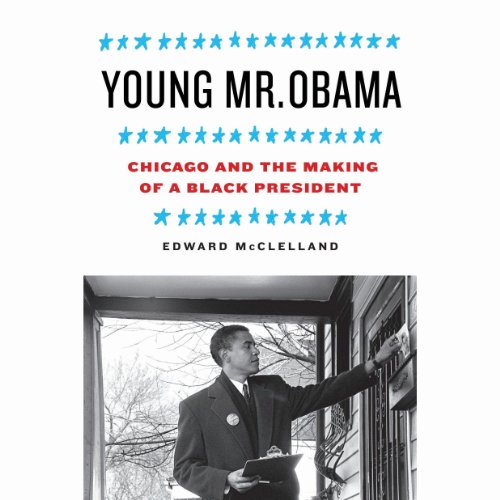
Young Mr. Obama
Summary
Barack Obama’s inspirational politics and personal mythology have overshadowed his fascinating history. Young Mr. Obama gives us the missing chapter: the portrait of the politician as a young leader, often too ambitious for his own good, but still equipped with a rare ability to inspire change. The route to the White House began on the streets of Chicago’s South Side. Edward McClelland, a veteran Chicago journalist, tells the real story of the first black president’s political education in the capital of the African American political community. Obama’s touch wasn’t always golden, and the unflappable and charismatic campaigner we know today nearly derailed his political career with a disastrous run for Congress in 2000. Obama learned from his mistakes, and rebuilt his public persona. Young Mr. Obama is a masterpiece of political reporting, peeling away the audacity, the T-shirts, and the inspiring speeches to craft a compelling and surpassingly listenable account of how local politics shaped a national leader.
©2010 Edward McClelland (P)2013 Audible, Inc.

Real Relationships
Summary
In this updated edition of their best-selling book, Relationships, Drs. Les and Leslie Parrott dig below the surface to the depths of human interactions, offering expert advice and practical tools for improving the most important aspect of human life: relationships. Designed for college students, young adults, singles, and dating couples, this cutting-edge book teaches the basics of healthy relationships, including friendship, dating, sexuality, and relating to God. Newly updated and expanded to include the latest research on relationship building and vital information on social networking, it provides listeners with proven tools for making bad relationships better and good relationships great.
©1998, 2011 Les and Leslie Parrott (P)2011 Zondervan

Kabir: A Poetic Glimpse of His Life and Work
Summary
The MSAC Philosophy Group is pleased to issue a new edition of Rabindranath Tagore's classic translation of the timeless poet-mystic Kabir. Includes a deeply insightful introduction by Evelyn Underhill.
©2016 MSAC Philosophy Group (P)2016 David Christopher Lane

Man vs. Markets
Summary
Man vs. Markets by Paddy Hirsch of NPR's "Marketplace" is economics explained, pure and simple, for the layperson who wouldn't know a "bond" from an "option," and who believes that a "future" is when we'll all have flying cars. Here is an illuminating, insightful, and wonderfully witty journey of discovery through the often confusing financial markets, offering clear, relatable explanations and definitions of the system's various instruments, yet less simplistically than the popular...for Dummies series. Man vs. Markets is a must-listen handbook for everyday investors, serious students of finance and economics, and everyone who wants to understand what they're reading when they open their newspapers to the business section.
©2012 Paddy Hirsch (P)2013 Audible Inc.

The Ultimate Dividend Playbook
Summary
Many people believe that the key to success in the stock market is buying low and selling high. But how many investors have the time, talent, and luck to earn consistent returns this way? In The Ultimate Dividend Playbook: Income, Insight, and Independence for Today's Investor, Josh Peters, editor of the monthly Morningstar Dividend Investor newsletter, shows you why you don't have to try to beat the market and how you can use dividends to capture the income and growth you seek. PLEASE NOTE: When you purchase this title, the accompanying PDF will be available in your Audible Library along with the audio.
©2008 Morningstar, Inc. (P)2012 Gildan Media