The Great Courses has 635 audiobooks on Listento.it, narrated by 479 narrators, with an average listener rating of 4.5★ across 19,831 ratings. The most-rated is A Column of Fire.

The Science of Mindfulness
Summary
Ever noticed that trying to calm down often produces more agitation? That trying to change bad habits can seem impossible? Or that real fulfillment can be elusive, despite living a successful life? Often, such difficulties stem from the human brain's hardwired tendency to seek pleasure and avoid pain. Modern science demonstrates that this survival mechanism served the needs of our earliest ancestors, but is at the root of many problems that we face today, such as depression, compulsive and addictive behaviors, chronic pain, and stress and anxiety. For thousands of years, people have used mindfulness practices to deal effectively with a wide range of life challenges. But how exactly does mindfulness work, in scientific terms? How can the human brain, which gives rise to so many of our problems, actually provide a solution? We are now in the midst of an explosion of scientific research demonstrating that mindfulness practice changes both the function and the structure of the brain. Numerous studies show which parts of the brain are affected by mindfulness practice, and how these neurobiological changes benefit our minds and bodies. Now, in the 24 fascinating lectures of The Science of Mindfulness, Professor Siegel, a clinical psychologist at Harvard Medical School, reveals the science behind mindfulness in compelling detail and demonstrates its application to a wide range of issues - psychological, social, and medical. You'll examine the neurobiology underlying ancient practices that are now profoundly influencing the contemporary world. And you'll learn many practical ways you can use mindfulness techniques in your own life. This playful, caring course demonstrates the effectiveness of mindfulness in responding to many of humanity's fundamental existential problems. In addition, this audiobook has complementary soundtracks, which are included in the audiobook from chapters 25 to 29. PLEASE NOTE: When you purchase this title, the accompanying reference material will be available in your Library section along with the audio.
©2013 The Great Courses (P)2013 The Teaching Company, LLC

Dante's Divine Comedy
Summary
Professors Cook and Herzman provide you with an illuminating introduction to one of the greatest works ever written. One of the most profound and satisfying of all poems, The Divine Comedy (or Commedia) of Dante Alighieri is a book for life. In a brilliantly constructed narrative of his imaginary guided pilgrimage through the three realms of the Christian afterlife, Dante accomplished a literary task of astonishing complexity. But the full achievement of the Commedia goes beyond anything merely literary. In these twenty-four lectures, as you follow Dante on his journey, you'll learn how medieval literature offers insights into fundamental questions: What is the quality of our moral actions? How does spiritual transformation come about? What is the nature of good and evil, virtue and vice, sin and sanctity? Why is the world so full of strife? How do we go on when we lose the things we love? You'll discover why, in the centuries since the Commedia was written, not one of these questions has lost its force. Moreover, you'll hear Dante address them in a demanding and innovative Italian verse form (terza rima) that makes the Commedia one of the great virtuoso pieces of world literature. With the guidance of these two master professors, you'll learn invaluable background information on Dante's life and times; why Dante wrote the Commedia; how to approach the various English editions available; and how each part of the poem is connected to what has come before. But above all, you'll understand why the Commedia is not a puzzle to be solved or a book to be read and put aside-but a mystery whose beauty and richness is to be constantly savored. PLEASE NOTE: When you purchase this title, the accompanying reference material will be available in your Library section along with the audio.
©2001 The Teaching Company, LLC (P)2001 The Great Courses

Foundations of Eastern Civilization
Summary
China. Korea. Japan. Southeast Asia. How did Eastern civilization develop? What do we know about the history, politics, governments, art, science, and technology of these countries? And how does the story of Eastern civilization play out in today's world of business, politics, and international exchange? Over the course of 48 ambitious lectures, take a grand journey through Eastern civilization to study everything from the material economy of day-to-day life to the political and religious philosophies that would bind these cultures together for thousands of years. While China is home to some of the great moments in world history and a major focal point for this course, you'll also take several extended forays into Central and Southeast Asia to build a comprehensive picture of Eastern civilization. "To truly understand the modern world, it is essential to know something about the many extraordinary contributions Eastern civilization has made," Professor Benjamin says. "Simply put, it is not enough to know just the 'Western' half of the story any more-both Eastern and Western are critical to understanding our present and our future." Now is your chance to fill in the other half of the story. You may be surprised to realize that all of us have been students of Eastern civilization, even if we have not been aware of it. Filled with captivating stories and surprising details, this course will open up an entirely new world for you as it unfolds the story of Eastern civilization. PLEASE NOTE: When you purchase this title, the accompanying reference material will be available in your Library section along with the audio.
©2013 The Great Courses (P)2013 The Teaching Company, LLC

Rome and the Barbarians
Summary
The history of the Romans as they advanced the frontiers of Classical civilization is often told as a story of warfare and conquest - the mighty legions encountering the "barbarians." But this only tells one side of the story. Who were the Celts, Goths, Huns, and Persians met by the Romans as they marched north and east? What were the political, military, and social institutions that made Rome so stable, allowing its power to be wielded against these different cultures for nearly three centuries? What role did those institutions themselves play in assimilating barbarian peoples? These 36 engaging lectures tell the story of the complex relationship between each of these native peoples and their Roman conquerors as they intermarried, exchanged ideas and mores, and, in the ensuing provincial Roman cultures, formed the basis of Western European civilization. You'll study the institutions that made Rome so extraordinary, as well as the extraordinary figures - both Roman and barbarian - whose names have been familiar to us for so long. You'll learn about Augustus, Constantine I, Diocletian, Gaius Julius Caesar, Nero, Attila the Hun, as well as a myriad of figures whose names are less familiar to us. But these lectures deliver far more than personal snapshots, as compelling as those may be. Professor Harl brings to life the institutions that shaped both Rome and her relationship with, and assimilation of, the barbarians at her constantly expanding frontiers. You'll come away with a new appreciation of how our Western world came to be and detailed knowledge about the individuals from royalty to "barbarian" who played key roles in that process. PLEASE NOTE: When you purchase this title, the accompanying reference material will be available in your Library section along with the audio.
©2004 The Teaching Company, LLC (P)2004 The Great Courses
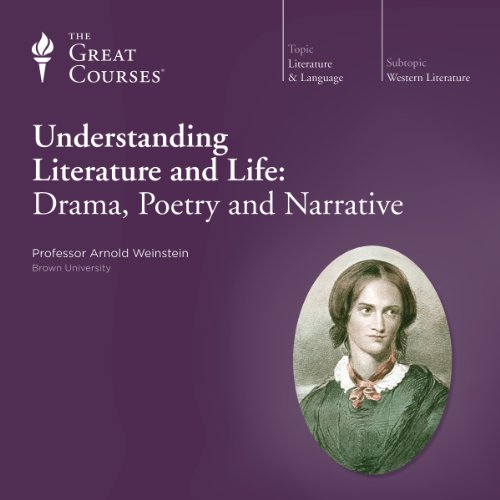
Understanding Literature and Life: Drama, Poetry and Narrative
Summary
The major texts of Western culture are a gateway to wisdom that can widen your views on self and society in enduring ways. The extraordinary body of literature given us by writers from antiquity to the present day, as Professor Weinstein notes, "is potent stuff, serving not only as transcription of history but also as a verbal Pandora's box, capable of shedding light on those transactions which remain in the dark for many of us: love, death, fear, desire. We are talking about more than artful language; we are talking about the life of the past and the life of the world." It is truly a monumental legacy. And now you can examine its most important works - whether drama, poetry, or narrative - in this series of 64 penetrating lectures that reveal astonishing common ground. You'll see how this award-winning teacher uses several different analytical perspectives, including Feminism, Marxism, Freudianism, Deconstruction, Postmodernism, and New Historicism, to give us fresh insight into persisting human themes like rites of passage; the "fit" or "misfit" between self and society; the creation of an identity; and the play, weight, and presence of the past in understanding our present. You learn how drama makes visible the conflicts and wars of culture in ways other forms cannot manage. How poetry can go to the heart of human existence with a purity and power akin to surgery, bidding us to challenge and change the way we usually do business. And how narrative can tell life stories in ways that enable a possession of that life that is hardly imaginable any other way. PLEASE NOTE: When you purchase this title, the accompanying reference material will be available in your Library section along with the audio.
©1995 The Teaching Company, LLC (P)1995 The Great Courses

The Roman Empire: From Augustus to the Fall of Rome
Summary
When Octavian, who took the title of Augustus as the first emperor of Rome, defeated Mark Antony to become the sole ruler of the Roman world, it was a major turning point in Western civilization. Not only did his decades-long rule completely transform the old Roman Republic into the Roman Empire, but it also profoundly shaped the culture and history of our world today. The Roman Empire: From Augustus to the Fall of Rome traces this breathtaking history from the empire’s foundation by Augustus to its Golden Age in the 2nd century CE through a series of ever-worsening crises until its ultimate disintegration. Taught by acclaimed Professor Gregory S. Aldrete of the University of Wisconsin-Green Bay, these 24 captivating lectures offer you the chance to experience this story like never before, incorporating the latest historical insights that challenge our previous notions of Rome’s decline. You’ll examine the major events and familiar figures of the Roman Empire, including: The political innovations of Augustus The mental instability and cruel acts of Caligula and Nero Writers such as Ovid, Horace, and Virgil The stoic philosophy of Marcus Aurelius Constantine’s startling conversion to Christianity You’ll also look beyond the famous figures and delve deeply into the lives of ordinary Roman citizens. You’ll hear the messages they left on tombstones or scribbled on walls as graffiti; examine what life was really like for average city-dwellers and the hazards they faced every day; spend a day at Rome’s spectacular public entertainments, such as gladiator games and chariot races; and explore some of the city’s marvelous architectural and engineering works, including the Pantheon and the aqueducts. We cannot truly understand ourselves unless we comprehend the vital influences of Rome on the modern world - and the lessons the empire can still teach us. The Roman Empire: From Augustus to the Fall of Rome is an excellent guide to one of the most important periods in world history. PLEASE NOTE: When you purchase this title, the accompanying PDF will be available in your Audible Library along with the audio.
©2019 The Great Courses (P)2019 The Teaching Company, LLC

The Terror of History: Mystics, Heretics, and Witches in the Western Tradition
Summary
Western civilization is closely associated with reason and science, and with exceptional accomplishments in art, architecture, music, and literature.Yet it has also been characterized by widespread belief in the supernatural and the irrational - with mystics who have visions of the divine and entire movements of people who wait in fervent anticipation of the apocalypse. Moreover, Western culture has also been the setting for repeated acts of barbaric reaction to those beliefs, including persecutions of certain groups, such as Jews, or of people accused as heretics and witches. This series of 24 intriguing lectures explores the concept of what has been called the "terror of history," a deeply held ancient belief that human beings live constantly on the edge of doom- a doom against which we must protect ourselves, sometimes by scapegoating an "other" whom we blame for this catastrophic plight. The lectures explore this belief through a study of mysticism, heresy, apocalyptic movements, and the witch-hunting craze that bloomed in Europe from 1000 to 1700. You'll examine sources you may be unfamiliar with, learn to think in new ways, and gain a fresh perspective on how social, economic, political, and religious climates - especially during times of change and stress - exert tremendous influence on the prevalence of irrational attitudes and persecutions. PLEASE NOTE: When you purchase this title, the accompanying reference material will be available in your Library section along with the audio.
©2002 The Teaching Company, LLC (P)2002 The Great Courses

Late Antiquity: Crisis and Transformation
Summary
Edward Gibbon's Decline and Fall of the Roman Empire painted a portrait of the Roman Empire in a long, debilitating slide to oblivion, but now historians have reevaluated this picture to create a radically different understanding of the period now known as "late antiquity." Far from being a period of decline and fall, late antiquity marked one of history's great turning points. These 36 half-hour lectures take you through five momentous centuries that link the classical world with the modern, beginning with Rome near its pinnacle of power and geographical extent and ending with the Byzantine Empire, the rise of Islam, and a succession of barbarian Christian kingdoms. You'll explore key features of late antiquity including how this tripartite division occurred; the memorable rulers and religious leaders who led the way; and the architecture, visual arts, and literature of the period. You also study what it was like to live in the late antique world: How did people earn their livings? What was the role of women in society? What distinguished the great cities of the era? Nothing in Rome's previous experience compared with the ferment of late antiquity, which saw the unpredictable growth of new institutions, states, religions, and arts. After taking this course you will never think of the barbarians and the "fall" of Rome in quite the same way again. Your imagination will be alive with the incidents, innovations, and peoples of an exciting era that gave birth to us all: late antiquity.
©2008 The Teaching Company, LLC (P)2008 The Great Courses

Behavioral Economics
Summary
Behavioral economics is the study of decision making, and of the related themes of valuation, exchange, and interpersonal interactions. Using methods from psychology, sociology, neurology, and economics, behavioral economics sheds light one of the most fundamental activities of human life:the decision process. In 24 insightful lectures, you'll learn how behavioral economists look at decision making and explore a set of key principles that offer deep insight into how we evaluate information and integrate different factors to make decisions. Most important, using real-life illustrations and case studies, each lecture offers practical tools, so that you can understand the patterns of decision making, the purposes they serve, and how to use your knowledge to make better and more satisfying decisions. In grasping the underlying factors in decision making, you'll explore key topics such as decisions regarding probability, time-related decisions, managing risk, high-stakes medical decisions, and group decision making. Professor Huettel illustrates each concept with meaningful examples, analogies, and case studies, relating the material directly to the decisions all of us make as a central part of living. This unique course gives you essential knowledge and insights for one of life's most important skills. PLEASE NOTE: When you purchase this title, the accompanying reference material will be available in your Library section along with the audio.
©2014 The Great Courses (P)2014 The Teaching Company, LLC

The Fall of the Pagans and the Origins of Medieval Christianity
Summary
Explore the dramatic interaction between Judaism, Christianity, and paganism in Rome from the 1st to the 6th centuries. Why did pagan Rome clash with the early Christians? What was it like to be a Jew or a Christian under Roman law? And how did Christianity ultimately achieve dominance in the Roman Empire? Over the course of 24 lectures, Professor Harl enables you to grasp the full historical sweep of this critically important era and its key figures. You'll examine why Christianity was able to emerge and endure and, in turn, spark a critical transition for religion, culture, and politics that underpins much of how today's Western world - both Christian and non-Christian alike - thinks about ethics, sin, redemption, forgiveness, progress, and so much more. While the Judeo-Christian values that have shaped society's ideas are ones we might today take for granted, their emergence from an ancient era dominated by loyalties to a vast array of gods would once have seemed the most unlikely of narratives. Even after the Roman emperor Constantine converted to Christianity in A.D. 312, it would not be until the 6th-century reign of Justinian that medieval Christianity would emerge and this new historical pathway confirmed. In this magnificent course, Professor Harl brings to life some of the most important and fascinating episodes of the era, taking you on a vibrant trek through the past - one that will lead you to a deeper understanding of the bedrock beliefs of Western culture. PLEASE NOTE: When you purchase this title, the accompanying reference material will be available in your Library section along with the audio.
©2011 The Teaching Company, LLC (P)2011 The Great Courses

Turning Points in Middle Eastern History
Summary
The Middle East is a critically important area of our world. And, with its current prominence in international affairs, media images of the Middle East reach us on a daily basis. Much media coverage, however, is incomplete at best, failing to take account of either the complexities or the historical background of this pivotal region. For most of us, the real story of the Middle East remains untold. What made this crucial geopolitical area what it is today? In coming to terms with the present and future of the Middle East, an understanding of its history is not only highly valuable but essential. Now, the 36 lectures of Turning Points in Middle Eastern History unfurl a breathtaking panorama of history, exploring a 1,300-year window from the rise of the warrior prophet Muhammad to the fall of the Ottoman Empire after World War I. Each lecture focuses on a specific moment that changed the direction of events or the narrative of history. You'll witness the Battle of Karbala, where Muhammad's heirs - the Sunni and Shia - split once and for all. You'll discover the wonders of the Islamic Golden Age and marvel at the superlative advances in astronomy, mathematics, medicine, and literature - and the preservation of classical Greek and Roman wisdom - that unfolded in global centers of learning such as Baghdad, Cairo, and Cordoba. You'll follow the empire building of the Persian Safavids, the Egyptian Mamluks, and the Ottomans, among others. The breakup of the Ottoman Empire yielded most of the modern states of the Middle East. The far-reaching impacts of its rise and fall, plus the long-lasting influence of the 18th-century Saud-Wahhab Pact between a desert ruler and a religious reformer, creating today's Kingdom of Saudi Arabia, are two more expressions of how the past suffuses the present. The stories you'll discover here are as dazzling as anything in the Arabian Nights and are all the more astonishing for being true. PLEASE NOTE: When you purchase this title, the accompanying reference material will be available in your My Library section along with the audio.
©2016 The Great Courses (P)2016 The Teaching Company, LLC

Medieval Myths & Mysteries
Summary
Was King Arthur a real person? What about Robin Hood? Is the Holy Grail a cup, or something else, altogether? Did Europeans really burn millions of people at the stake for witchcraft, in the past? These are just a few of the questions you will explore with the help of medieval scholar Dorsey Armstrong as she reveals the truth about the stories we continue to tell about the medieval period. Some contain nuggets of truth, others are wholly fabricated, but all of them can tell us something about the past. From films like Braveheart and Excalibur to literature such as Ivanhoe and Morte d’Arthur, the years between 500 and 1500 have generated amazing stories of knights and damsels, superstitions and magic; some of these stories even made it into our grade school history curriculum. But what were those years really like? Known, somewhat inaccurately, as the “Middle Ages,” this period was not merely a transition from Roman antiquity to the Renaissance, but a vibrant time full of people just as curious, innovative, malicious, joyful, confused, ambitious, complex - in other words, just as human - as in any other period of history. The 10 enlightening (and often humorous) lectures of Medieval Myths and Mysteries will show you how far from the “dark” times of legend these centuries were. Uncover the facts about the Knights Templar. Reveal the truth behind the tales of legendary creatures like the Questing Beast and the unicorn. Trace the events of the Black Death and the ways it altered the world in its wake, and much more. With Professor Armstrong, you will dig deep into the ways that later generations reshaped the narrative of the medieval years and perpetuated the myths of a simpler and less civilized age, which was, in fact, much richer and more complex than many of us have been led to believe.
©2019 Audible Originals, LLC (P)2019 Audible Originals, LLC.

The 30 Greatest Orchestral Works
Summary
Over the centuries, orchestral music has given us a category of works that stand apart as transcendent expressions of the human spirit. What are these "greatest of the greats"? Find out in these 32 richly detailed lectures that take you on a sumptuous grand tour of the symphonic pieces that continue to live at the center of our musical culture. These thirty masterworks form an essential foundation for any music collection and a focal point for understanding the orchestral medium and deepening your insight into the communicative power of music. While seasoned music lovers will find the lectures a revealing journey through the repertoire, the course welcomes newcomers to orchestral music, offering a very accessible point of entry to this magnificent repertoire. You'll encounter symphonies, concertos, tone poems, symphonic poems, and suites, delving into the works through extensive musical excerpts. The course covers the major eras and stylistic periods in Western music from the early 18th- to the mid-20th centuries and highlights a wide range of European and American works. Among these: Haydn's Symphony no. 104, Beethoven's Ninth Symphony, Stravinsky's The Rite of Spring, and Shostakovich's Symphony no. 5. Throughout these lectures, you'll learn about the major musical forms found in orchestral writing and how they're used in conveying expressive meanings. Knowing how these forms work allows you to grasp the structure of the music as you hear it, and also to appreciate how the greatest composers used them, extended them, and finally departed from them in sublimely original ways. PLEASE NOTE: When you purchase this title, the accompanying reference material will be available in your Library section along with the audio.
©2011 The Teaching Company, LLC (P)2011 The Great Courses

Music as a Mirror of History
Summary
In the worlds of painting and literature, it's easy to see where history and art intersect. In Picasso's Guernica or Tolstoy's War and Peace, it's evident how works of art mirror and participate in the life of their times, sometimes even playing roles in historical events. But what about music? In Music as a Mirror of History, Great Courses favorite Professor Greenberg of San Francisco Performances returns with a fascinating and provocative premise: Despite the abstractness and the universality of music - and our habit of listening to it divorced from any historical context - music is a mirror of the historical setting in which it was created. Music carries a rich spectrum of social, cultural, historical, and philosophical information, all grounded in the life and experience of the composer - if you're aware of what you're listening to. In these 24 lectures, you'll explore how composers convey such explicit information, evoking specific states of mind and giving voice to communal emotions, all colored by their own personal experiences. Music lovers and history enthusiasts alike will be enthralled by this exploration of how momentous compositions have responded to - and inspired - pivotal events. Ranging widely across the 18th, 19th, and 20th centuries, you witness historical moments such as the French Revolution, the Napoleonic Wars, the Austrian-Ottoman conflict, the Hungarian nationalist movement, the movement for Italian unification, the economic ascent of the US, the Stalinist regime in the USSR, and World Wars I and II. Across the arc of the course, you'll see how these events were felt and expressed in the music of Mozart, Beethoven, Berlioz, Brahms, Verdi, Wagner, and many others, including modern masters such as Janácek, Górecki, and Crumb, and you'll hear superlative musical excerpts in each lecture. Join us for an unparalleled look into the power and scope of musical art. PLEASE NOTE: When you purchase this title, the accompanying reference material will be available in your My Library section along with the audio.
©2016 The Teaching Company, LLC (P)2016 The Great Courses

Particle Physics for Non-Physicists: A Tour of the Microcosmos
Summary
Would you like to know how the universe works? Scientists have been asking that question for a long time and have found that many of the answers can be found in the study of particle physics, the field that focuses on those impossibly tiny particles with unbelievably strange names - the hadrons and leptons, baryons and mesons, muons and gluons - so mystifying to the rest of us. And now, in a fascinating and accessible series of 24 lectures, you can take the mystery out of the remarkable field that in only 100 years has unlocked the secrets of the basic forces of nature. Professor Pollock will make you familiar with the fundamental particles that make up all matter, from the tiniest microbe to the sun and stars. And you'll also learn the "rules of the game" - the forces that drive those particles and the ways in which they interact - that underlie the workings of the universe. The lectures have been designed to be enriching for everyone, regardless of scientific background or mathematical ability. Virtually all you'll need as you enter this fascinating world are your curiosity, common sense, and, as Professor Pollock notes, "an open mind for the occasional quantum weirdness." As you move through the lectures, you'll also gain a knowledge of how those particles fit into perhaps the greatest scientific theory of all time: the Standard Model of particle physics; a grasp of key terms like "gauge symmetry," "quantum chromodynamics," and "unified quantum field Theory;" and an appreciation of how particle physics fits in with other branches of physics - including cosmology and quantum mechanics - to create our overall understanding of nature. PLEASE NOTE: When you purchase this title, the accompanying reference material will be available in your Library section along with the audio.
©2003 The Teaching Company, LLC (P)2003 The Great Courses

Great Ancient Civilizations of Asia Minor
Summary
Embark on an unforgettable trip into the historical glories of the past with these 24 lectures that immerse you in the history of an often overlooked region of the ancient world. With Professor Harl as your guide, you'll plunge into the history of Asia Minor's great ancient civilizations and come face to face with eye-opening historical milestones. Among these: the rise of the Hittites, the legendary Trojan War, the birth of Western philosophy, the fiery Greek and Persian Wars, the victories of Alexander the Great, the dawn of the Hellenistic Age, the spread of early Christianity, the golden age of Byzantium, the birth of the Ottoman Empire, and much more. Cultural change and continuity are the main themes of these lectures. You'll come to see how each successive civilization inherited and modified the political, social, religious, and economic institutions of its predecessor. In fact, the scope of Anatolian history can be best understood as a series of major cultural and religious rewrites: first by the Hittite emperors; then by the elites of Hellenic cities; next by their Hellenized descendants in the Roman age; then by Christian emperors and bishops in the Byzantine age; and, finally, by Turkish rulers and Muslim mystics. To give you a stronger sense of that continuity (and the various changes that are a part of it), these lectures are organized into five cultural components: Early Anatolia (from 6000 to 500 B.C.), Hellenized Anatolia (from 750 to 31 B.C.), Roman Asia Minor (from 200 B.C. to 395 A.D.), Byzantium (from 395 to 1453), and Islamic Turkey (since 1071).
©2001 The Teaching Company, LLC (P)2001 The Great Courses
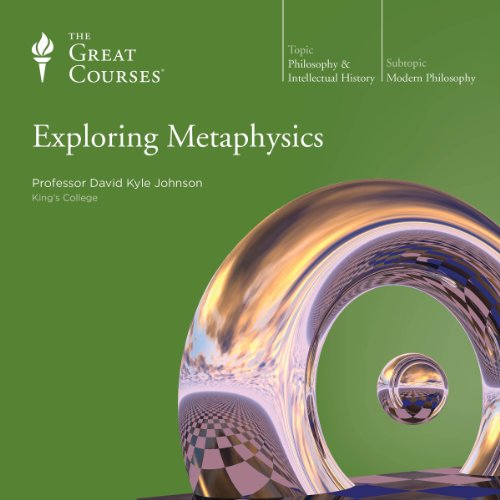
Exploring Metaphysics
Summary
This mind-bending tour of metaphysics applies philosophy to the forefront of today's knowledge. Over the course of 24 fascinating lectures, Professor Johnson thinks through the big questions about humans and the universe: The relationship between the mind and the brain, how consciousness emerges from neurochemical processes, the existence of God, human free will, the possibility of time travel, and whether we live in a multiverse or even a computer simulation. Drawing from the realms of psychology, neuroscience, artificial intelligence, and philosophy, the first half of the course examines the defining traits of being human. You'll explore the connection between brains and minds, as well as the nature of the self, time, and human free will. The second half of the course shifts from the nature of the individual to the nature of the universe. Here metaphysics, science, and theology all intersect as you consider the existence of God, the science behind relativity, and the bizarre-even spooky-world of quantum mechanics. Although the subject has ancient roots, the metaphysics you study in this course is far from an esoteric system of thought. Indeed, this material is very much alive today-at the forefront of philosophy, physics, and medical technology. When you complete this course, you will have a much richer perspective on the world around you. Virtually every lecture will challenge some of your bedrock beliefs about yourself and the universe. PLEASE NOTE: When you purchase this title, the accompanying reference material will be available in your Library section along with the audio.
©2013 The Great Courses (P)2013 The Teaching Company, LLC

Understanding the Old Testament
Summary
The Old Testament is one of the foundational texts of Western civilization, and is among the most impactful and widely read books in world history. In 24 enthralling lectures, Professor Miller guides you through a core selection of the major books of the Old Testament, inviting you to probe their meaning and relevance in incisive and thought-provoking commentary. Among the books of the Old Testament, you’ll explore: Genesis: Uncover fascinating features of the Old Testament’s opening, such as how the events of the first week of creation form an elaborate pattern, expressing the complex order of the universe; and how the text does not lay primary blame for “the fall” on the woman, Eve; Deuteronomistic History: Study the epic history of the people of Israel in the Promised Land; follow the story of the Israelites’ disobedience to God, and its tragic consequences; The Prophets: Through the dramatic stories of the prophets, take account of the challenges faced by those who sought to actualize God’s plan for humanity; The Books of Ruth and Esther: Among notable women in the Old Testament, explore two stories of women who are doubly at risk, and who prevail through loyalty, resourcefulness, and integrity; and Daniel and the Apocalyptic: In the Book of Daniel, encounter the genre of apocalyptic literature - revelation initiated by God - and contemplate the figure of “the Son of Man,” a promised redeemer. Throughout the lectures, Professor Miller offers a wealth of perspectives on how to approach the texts. You’ll assess the role of translation in the understanding of the texts, studying the meanings of key Hebrew words; you’ll also look in depth at the history, dating, and writing of the texts, and you’ll study their literary and linguistic features, noting how they achieve their impact on the reader. In Understanding the Old Testament, you’ll take a revelatory look at this epically impactful document, finding its deeper historical and religious meanings, as well as its sublime literary treasures. PLEASE NOTE: When you purchase this title, the accompanying PDF will be available in your Audible Library along with the audio.
©2019 The Teaching Company, LLC (P)2019 The Great Courses

Death, Dying, and the Afterlife: Lessons from World Cultures
Summary
After thousands of years of pondering it, we still find death one of life's most perplexing mysteries. Many cultures view death as a window into the true meaning of life. These 24 lectures looking at this often feared subject are an uplifting, meaningful, and multidisciplinary exploration of life's only certainty. Bringing together theology, philosophy, biology, anthropology, literature, psychology, sociology, and other fields, they are a brilliant compendium of how human beings have struggled to come to terms with mortality. You'll encounter everything from ancient burial practices, traditional views of the afterlife, and the five stages of grief to the question of killing during wartime, the phenomenon of near-death experiences, and even 21st-century theories about transcending death itself. With personal and cultural enlightenment as the overarching goal, Professor Berkson provides you with eye-opening answers to several major questions surrounding death, including: How do we think about death? How do religions approach death? When (if ever) is it justified to take a life? You'll also hear a chorus of voices from multiple disciplines, cultures, and ages as they offer sometimes shocking and sometimes refreshing perspectives on death. These voices include the Buddha, St. Paul, Albert Camus, Dylan Thomas, and Elizabeth Kübler-Ross. "Many religious traditions teach that a form of regular death reflection can deepen one's appreciation for life," Professor Berkson notes. "And in some traditions, it can actually lead to spiritual transformation or awakening. As the poet Rainer Maria Rilke wrote, 'Whoever rightly understands and celebrates death at the same time magnifies life.'"
©2016 The Great Courses (P)2016 The Teaching Company, LLC

The History of Christian Theology
Summary
In this 36-lecture course, you'll find an engaging way to explore profound religious questions and the many responses believers, scholars, and theologians have developed over more than 2,000 years. Through this series, Professor Cary reveals the enduring power of the Christian tradition - as both an intellectual discipline and a spiritual path. These lectures begin at the very dawn of Christianity, as you examine some of the earliest examples of scripture recorded by the first communities of the faithful. You'll see how, over the centuries, these teachings developed into the orthodox teachings of the mainstream church as well as the divergent doctrines taught by splinter groups branded as "heretics." You'll explore the causes and outcomes of the split between the Roman Catholic Church and the Eastern Orthodox Church during the Middle Ages and examine the explosion of the many Protestant groups that resulted from the Reformation in the 16th century. And finally, you'll come to the modern era, with a survey of the evolution of Christian thought in today's society - the ongoing story of how faith persists in an increasingly secularized world. Each lecture illuminates the conceptual structure of Christian theology as it connects to spiritual practices such as prayer, worship, the use of sacraments, and the contemplation of religious icons. Through lucid and engaging explanations, they provide intriguing analyses of theological ideas in their unique historical, social, and biographical contexts to help you understand the power of each tradition within its particular time and place. The result is a sweeping survey that probes some of the most common questions about Christian faith over the centuries. PLEASE NOTE: When you purchase this title, the accompanying reference material will be available in your Library section along with the audio.
©2008 The Teaching Company, LLC (P)2008 The Great Courses