The Great Courses has 635 audiobooks on Listento.it, narrated by 479 narrators, with an average listener rating of 4.5★ across 19,831 ratings. The most-rated is A Column of Fire.

The Italians before Italy: Conflict and Competition in the Mediterranean
Summary
Take a riveting tour of the Italian peninsula, from the glittering canals of Venice to the lavish papal apartments and ancient ruins of Rome. In these 24 lectures, Professor Bartlett traces the development of the Italian city-states of the Middle Ages and the Renaissance, showing how the modern nation of Italy was forged out of the rivalries, allegiances, and traditions of a vibrant and diverse people. This comprehensive portrait of Italian history opens an exciting new world-a grand mosaic of lustrous and storied cultures as distinctive as the people who helped build them. As you come to know these many "Italys," you'll see how the Italian states defined themselves against the others, competing for territory, trade, and artistic supremacy - and how the vestiges of these interactions are visible even today. Among other things, you'll consider the rivalry between the Genoese and the Pisans, which stems from a nearly 800-year-old grudge; examine how the crusades influenced the development of Genoa, Pisa, and Venice; and explore Italy's troubled relationship with the Holy Roman Empire and the Catholic Church during the Middle Ages and the Renaissance. You'll also get a glimpse into the lives of the powerful and influential, including Pope Paul IV, who championed the Roman Inquisition, and Luigi Gonzaga, who cut out the hearts of his enemies and nailed them to the doors of their palaces as a warning to others who might challenge his power. As you get to know the distinctive personalities and events that define the peninsula, you'll gain fresh insights into the Italy of today. Surprising, enriching, always engaging, this course offers a unique perspective on one of the most dynamic and creative cultures of the modern world. PLEASE NOTE: When you purchase this title, the accompanying reference material will be available in your Library section along with the audio.
©2007 The Teaching Company, LLC (P)2007 The Great Courses

The Passions: Philosophy and the Intelligence of Emotions
Summary
Conventional wisdom suggests there is a sharp distinction between emotion and reason. Emotions are seen as inferior, disruptive, primitive, and even bestial forces. These 24 remarkable lectures suggest otherwise-that emotions have intelligence and provide personal strategies that are vitally important to our everyday lives of perceiving, evaluating, appraising, understanding, and acting in the world. Take a tour of Professor Solomon's more than three-decade-long intellectual struggle to reach an understanding of emotions, which he argues are, "the key to the meaning of life." A distinguished philosopher himself, Professor Solomon's lectures unfold as a rich dialogue with other philosophers, including Plato, Aristotle, Descartes, Adam Smith, Nietzsche, William James, Freud, Heidegger, and Sartre. In your exploration, you'll address such questions as: how do we distinguish emotions from feelings, such as heartache? What is the meaning of our emotions, and how do they serve to enrich and guide our lives? Are there a determinable number of basic emotions that serve as building blocks for the range of emotions we experience? Is an emotion such as jealousy a genetic trait shared by all humans - or is it something learned? As you listen to these lectures, prepare to think: Think about your own emotions; think about what you observe in others; think about the enormous body of research and conjecture on this fascinating topic as Professor Solomon takes you on a challenging and stimulating journey. The more we puzzle over the nature of emotions, the deeper the mystery becomes. It is a mystery that is by no means solved, but one that repays in careful, philosophical analysis. PLEASE NOTE: When you purchase this title, the accompanying reference material will be available in your Library section along with the audio.
©2006 The Teaching Company, LLC (P)2006 The Great Courses

The Economics of Uncertainty
Summary
Economies are deeply complex systems. The marketplace involves many economic actors behaving in rational and irrational ways, sustaining a dizzying array of interconnected activity. Because of the number of participants involved, the unpredictability of their actions, and the sheer variety of possible actions, some degree of economic uncertainty is inevitable. In one of the most dramatic displays of economic uncertainty in our times, a wave of toxic loans almost brought down the American financial system in 2008-2009, and with it jobs and savings. Few experts forecast this catastrophe, which stands as a lesson in the power of economic forces to defy our predictions. This event may have been exceptional, but every day we are all at the mercy of economic uncertainty in matters such as the stock market, insurance, and career and retirement planning. Uncertainty also plagues us in smaller ways. For example, everyone is familiar with rising prices, but the Internet now makes it possible for online shoppers to be charged more based on their buying history, adding a new level of unpredictability to pricing. And anytime you hire someone for a service - from roofing to dentistry - you face the principal-agent problem, in which the person hired may take unethical advantage of your lack of expertise. Indeed, these large and small risks are so pervasive that it is all too easy to conclude that nothing can be done. But economic uncertainty is like the weather: You can't stop storms from happening, but understanding how and why they happen allows you to be prepared. In the same way, economic uncertainty is beyond our control, but we're in a much better position to respond if we know what's happening and why. In 24 practical and empowering half-hour lectures, The Economics of Uncertainty takes the mystery and dread out of uncertainty, giving you the tools to deal with risk in every phase of your life.
©2015 The Great Courses (P)2015 The Teaching Company, LLC

Destroyer of Worlds
Summary
200 Years before the Discovery of Ringworld The newly liberated humans of the Fleet of Worlds and Sigmund Ausfaller, who had been transported by the Puppeteers from Earth to the Fleet, must contend not only with the sly Puppeteers but also the threat of the Pak, a very smart and utterly ruthless species who are fleeing the exploding galactic core in an armada of ships at near light speed. The Pak are headed towards the Fleet of Worlds, having destroyed entire planets in their wake. Sigmund and his human allies are sent by the Puppeteers to reconnoiter and divert the Pak. A Pak is captured, but even a well-guarded Pak prisoner can be lethal. Sigmund and the human colonists must cope with many unpleasant surprises, between the manipulative Puppeteers, the brilliant, violent Pak and a new species called the Gw'oth who, while seeming to be allies, have own agenda.
©2009 Larry Niven and Edward M. Lerner (P)2009 Blackstone Audio, Inc.

Writing Creative Nonfiction
Summary
Bringing together the imaginative strategies of fiction storytelling and new ways of narrating true, real-life events, creative nonfiction is the fastest-growing part of the creative writing world. It's a cutting-edge genre that's reshaping how we write (and read) everything from biographies and memoirs to blogs and public speaking scripts to personal essays and magazine articles. Whether you're looking to launch into a new professional career as a creative nonfiction writer, dabble in the genre as a pastime, start a personal blog, or simply get inside the mind of a creative nonfiction writer at work, these dynamic 24 lectures are a chance for you to explore the entire process of writing creative nonfiction, from brainstorming for the perfect idea to getting your final product noticed by literary agents and publishers. Filled with helpful tips and techniques, memorable examples from well-known writers, and engaging exercises, it's a learning experience that proves that - with the right instructor - writing creative nonfiction can be mastered, practiced, and enjoyed by anyone with a desire to share his or her personal story. Professor Mazzeo guides you through the fundamental concepts such as narrative arcs, captivating beginnings, sentence variation, perspective, characterization, dialogue, and metaphor; each stage of writing creative nonfiction, from researching your topic to revising your first draft; and the publishing process, from finding an agent to writing a successful book proposal. You'll come away with the knowledge, tools, and, most important, inspiration you need to discover your stories and finally start telling them the right way. PLEASE NOTE: When you purchase this title, the accompanying reference material will be available in your Library section along with the audio.
©2012 The Teaching Company, LLC (P)2012 The Great Courses

Great World Religions: Hinduism
Summary
In this 12-lecture series, you'll encounter a religion that is perhaps the most diverse of all; one that worships more gods and goddesses than any other, and one that rejects the notion that there is only one path to the divine. These lectures provide a window into the roots of, perhaps, all religions. You'll explore over the course of Hinduism's 5,000-year journey: the Indus Valley civilization; the sizable variety of Hindu gods and goddess; the sacred writings in the Vedas, Bhagavad Gita, and Upanishads; Hindu ritual purity rites; the Aryan language of Sanskrit, whose roots can be seen in English words such as "divine," "video," and "ignite"; and much more. The story of Hinduism, you'll come to see, is the story of very non-Western traditions (such as arranged marriages and the caste system) that have survived and thrived for thousands of years. It's also home to a wealth of gods, terms, and practices (such as karma, Krishna, yoga, and guru) that have found a home in Western lives and language. Along the way, Dr. Muesse discusses salient aspects of Hindu life and places them in historical and theological context. He also explains that Hinduism honors all seekers of truth, that it contains multiple paths to divine reality (the way of action, the way of wisdom, and the way of devotion), and that it can be both a monotheistic and a polytheistic faith. PLEASE NOTE: When you purchase this title, the accompanying reference material will be available in your Library section along with the audio.
©2003 The Teaching Company, LLC (P)2003 The Great Courses

Origins of Great Ancient Civilizations
Summary
Locales like Mesopotamia or the Indus Valley, peoples like the Hittites or Assyrians, or rulers like Sargon, Hammurabi, and Darius are part of a long-dead antiquity, so shrouded with dust that we might be tempted to skip over them entirely, preferring to race forward along history's timeline in search of the riches we know will be found in our studies of Greece and Rome. But, according to Professor Harl, these civilizations, "act as the cultural basis for many of the civilizations that will emerge on the Eurasian landmass and will dictate the destinies of many of the people living today on the globe." These remote, ancient civilizations stand behind the traditions of Greece, so it is critical to understand these great societies in order to better understand those that would come later - including our own. These 12 fast-paced lectures cover many civilizations that may only receive a few lines of cursory discussion in the average Western civilization textbook. Beginning in the Bronze Age and the emergence of urban-based literate civilizations, the story continues through the demise of Persia's great empire at the hands of the Greeks. Along the way, you'll examine advances such as the invention and evolution of writing, the development of vast empires dependent not only on military might but on laws and administration, the growth of trade, and the contributions of the Hebrews to the religious and ethical future of Western civilization. History lovers will appreciate this course for its deep insights and its rock-solid foundation for deeper exploration. PLEASE NOTE: When you purchase this title, the accompanying reference material will be available in your Library section along with the audio.
©2005 The Teaching Company, LLC (P)2005 The Great Courses

Machiavelli in Context
Summary
Mention the name Niccolò Machiavelli and you might unleash a powerful response - even among people who have never read a word of his writing. The word "Machiavellian" conjures up images of an indistinct figure quietly making his way through the darkest corridors of power; a cold-blooded political liar; or a coolly practical leader - amoral at best - willing to do whatever is necessary in a world governed not by ideas of right or wrong, but by solutions dictated by realpolitik. But do these images bear any actual resemblance to the Machiavelli who lived, pondered, and wrote? In these 24 enlightening lectures, Professor Cook offers the opportunity to meet an extraordinarily thoughtful and sincere student of history and its lessons. You'll look beyond the sinister interpretations or caricatures of his writings and beliefs and get at the truth of this important Renaissance figure. You'll discover, perhaps surprisingly, that Machiavelli believed in the superiority of a republican form of government; he wanted to live in a free and equal participatory society and influenced the development of institutions and values both in Europe and in America. With a focus on The Prince, Discourses on the First Ten Books of Livy, and, more briefly, his Florentine Histories, Professor Cook moves easily among the different disciplines so pertinent to an understanding of Machiavelli's ideas, including history, philosophy, government, and the elements of leadership. The result is a thorough grounding in the information one needs to understand and appreciate this stunningly original thinker.
©2006 The Teaching Company, LLC (P)2006 The Great Courses

Explaining Social Deviance
Summary
How do deviants reconcile their behavior with society's norms? This set of 10 lectures examines the complex topic of deviance and how major sociological theories have attempted to define it and understand its role in both historical and modern society. Professor Wolpe introduces deviance as "a complex, often ambiguous, social phenomenon that raises numerous questions about how a varied and often arbitrary set of characteristics can be used to name the same idea." Intended for those with some understanding of sociology, these lectures trace Western theories of deviance from classical demonism to constructionism. Along the way, you'll get a chance to investigate a range of fascinating, thought-provoking, and sometimes even frightening topics and issues. You'll discover the relationship between deviance and criminology, and come to terms with three major sociological perspectives on deviance in human society. You'll explore the concept of demonism, with divides the world into good and evil, and see how it's often been used to explain and categorize bad behavior when no other explanations are available. You'll learn about the influence of science on sociological thought as proposed by a range of important thinkers, as well as the impact of this science on everything from the IQ controversy to the eugenics movement to Social Darwinism. Professor Wolpe has crafted an engaging series of discussions that are sure to have you looking at the world around you (and the people in them) in a new way.
©1995 The Teaching Company, LLC (P)1995 The Great Courses

Being Human: Life Lessons from the Frontiers of Science
Summary
Understanding our humanity - the essence of who we are - is one of the deepest mysteries and biggest challenges in modern science. Why do we have bad moods? Why are we capable of having such strange dreams? How can metaphors in our language hold such sway on our actions? As we learn more about the mechanisms of human behavior through evolutionary biology, neuroscience, anthropology, and other related fields, we're discovering just how intriguing the human species is. And while scientists are continually uncovering similarities between our behavior and that of other animals, they're also finding insights into everything that makes us unique from any other species. Join an acclaimed neurobiologist, award-winning teacher, and MacArthur Foundation "genius grant" recipient in a series of 12 invigorating lectures that offer a surprising and undeniably fascinating study of what makes you you, journeying to the front lines of scientific research to gain a new perspective on the quirky nature of being ourselves. Professor Sapolsky explores our humanity by investigating mysterious and sometimes even mundane aspects of human behavior, including bad moods, nostalgia, and dreams, packing the lectures with stories of bold experiments and case studies that illuminate the intricacies of our behavior. Thought-provoking, witty, and sometimes myth-shattering, this course is sure to have you thinking about and appreciating your life in novel ways. PLEASE NOTE: When you purchase this title, the accompanying reference material will be available in your Library section along with the audio.
©2012 The Teaching Company, LLC (P)2012 The Great Courses

The History of the Bible: The Making of the New Testament Canon
Summary
What different kinds of books are in the New Testament? When, how, and why were they written? And why did some books, and not others, come to be collected into what Christians came to consider the canon of scripture that would define their belief for all time? With these 12 lectures, get a fast-moving yet thorough introduction to these and other key issues in the development of Christianity. Designed to deepen the understanding of both Christians and non-Christians alike, this lecture series takes as its perspective the historical, rather than the theological, issues behind the development of the Bible. And it's an illuminating perspective, indeed, ranging across issues of language, oral history, the physical limitations of spreading the written word at a time when the printing press lay far in the future, and, of course, the theological forces that were shaping Christianity, molding a commonly accepted canon from the various expressions of the faith spreading across the ancient world. Professor Ehrman recreates the context of the times in which the canon was being assembled so that you can understand what the message of each written work would have meant to ancient Christians. You'll come to see how the diverse books of the New Testament were gathered together into the form we now know, whether it's the four canonical Gospels (whose authorship was only attributed by later Christians), the book of Acts, the 21 Epistles, or the book of Revelation (sometimes called the Apocalypse of John). These lectures are a compelling introduction not only to the development of the Christian canon, but to all of the forces that would play a role in early Christian history. PLEASE NOTE: When you purchase this title, the accompanying reference material will be available in your Library section along with the audio.
©2005 The Teaching Company, LLC (P)2005 The Great Courses

Le Meurtre du Commandeur 2
Summary
Alors que jusque-là je marchais normalement sur ce que je pensais être mon propre chemin, voilà que soudain celui-ci a disparu sous mes pas, et c'est comme si j'avançais simplement dans un espace vide sans connaître de direction, sans plus aucune sensation. Une jeune fille a disparu. Une jeune fille dont le narrateur avait entrepris de faire le portrait. Une jeune fille aux yeux comme une flamme gelée. Une jeune fille qui l'intrigue et qui pourrait être liée à Menshiki. Il va rendre visite au vieux peintre Tomohiko Amada. Là, dans la chambre d'hôpital, apparaît le Commandeur. Le Commandeur est prêt à offrir sa vie pour que la jeune fille soit retrouvée. Il faut faire revivre la scène du tableau, le Commandeur doit être poignardé. Le narrateur lui plante un couteau dans le cœur. Une trappe s'ouvre dans un coin de la chambre. Un personnage étrange en surgit, qui l'invite à entrer dans le passage souterrain. Le début d'un périple qui va conduire le narrateur au-devant des forces du mal... Deuxième livre d'une œuvre exceptionnelle, dans la lignée du monumental 1Q84, un roman somme, ambitieux, profond. Deux tomes pour une odyssée initiatique étrange, inquiétante, envoûtante, où le maître Murakami dévoile ses obsessions les plus intimes.
©2017/2018 Titre original : KISHIDANCHÔ GOROSHI (KILLING COMMENDATORE). Utsurou metaphor (Moving metaphor) publié par Shinchosha, Tokyo / Haruki Murakami. Tous droits réservés / Belfond, un département Place des Éditeurs, pour la traduction française. (P)2018 Lizzie, un département d'Univers Poche. Traduit par Hélène Morita
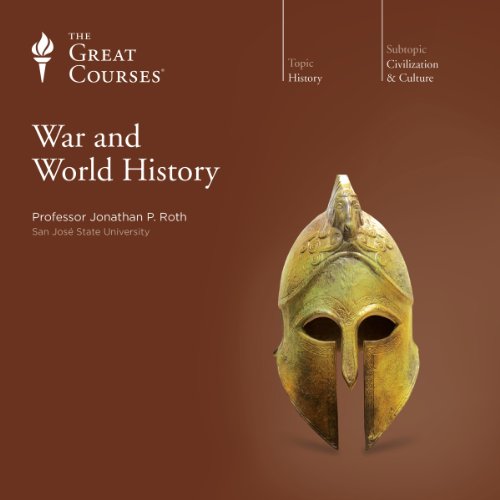
War and World History
Summary
This fresh and challenging inquiry into human societies takes a deep look at the effects and roles of war. As the most complex of all human endeavors, warfare - from ancient to modern - has spurred the growth of essential new technologies; demanded the adoption of complex economic systems; shaped the ideology and culture of nations; promoted developments in art and literature; and spread faith across the globe. Over the course of 48 highly provocative lectures, Professor Roth explores armed conflict across five continents. Far from a traditional approach to military events, this panoramic series is not the history of battles or military campaigns, but the story of the intimate interconnections of war with human cultures and societies and how these connections have shaped history. You'll study the complex effects of culture, economics, politics, and religion on war - and war's influences on them. In this context, you chart the colorful history of the practice and methodology of warfare. Among many other things, you'll learn about the development and evolution of history-making military weapons such as bows, horses, swords, and gunpowder; the interface of warfare with religion, which has bred some of the most unusual and poignant conflicts in history; the 17th-century European nation-state, where militaries were "nationalized" into central governments and military service was imbued with ideology of citizenship and loyalty to state; the crucial military underpinnings of nationalism, Communism, Fascism, and other political movements from the modern era. Probe these pivotal and revealing features of history and deepen your understanding of our extraordinary, evolving world. PLEASE NOTE: When you purchase this title, the accompanying reference material will be available in your Library section along with the audio.
©2009 The Teaching Company, LLC (P)2009 The Great Courses

Victorian Britain
Summary
This series of 36 fascinating lectures is a chronological journey into the story of Victorian Britain, from the unexpected ascension to the throne of teenaged Princess Victoria in 1837 to her death in 1901 as the Boer War neared its end. Presented with all of Victoria's strengths and foibles left intact by an award-winning teacher and author, the lectures invite you to reflect on both the positive and negative aspects of her reign. You'll discover the lives of Victorian women; the situation facing working people and the rise of trade unionism; Victorian achievements in art, literature, architecture, and music; and what Leonard Woolf called "the seriousness of games," and of leisure-time activities as windows on Victorian life. You'll discuss the important role played by Christianity as a force for both principled adherence to tradition and principled pursuit of change; and the influence of science and the debates over its impact that animated the Victorians. And you'll learn what the Victorians believed about education; the questions raised by Britain's rule over its empire, the problems of poverty and crime; the discoveries of Victorian explorers in Africa; and much more in this remarkable rendering of a remarkable age. PLEASE NOTE: When you purchase this title, the accompanying reference material will be available in your Library section along with the audio.
©2002 The Teaching Company, LLC (P)2002 The Great Courses

The Office
Summary
Listen and see if ASMR triggers your autonomous sensory meridian response, a tingling sensation that typically begins on the scalp and moves down the back of the neck and upper spine. With its emphasis on creating a heightened sensory experience, ASMR can bring you fully into the present moment—a powerful way to achieve the kind of total relaxation you need to achieve deep sleep. In this piece from Whisperlodge, a pioneering New York-based company that performs live ASMR experiences, an ASMRtist plays with various office supplies while gently whispering about the history of ASMR and how it became a source of pleasure and relaxation for so many. With its accessible educational component, it's the perfect introductory piece to ASMR. This title is part of a collection of audio experiences created to deliver your best sleep during this difficult time.
©2020 Audible Originals, LLC (P)2020 Audible Originals, LLC

The One-in-a-Million Boy
Summary
For years, guitarist Quinn Porter has been on the road, chasing gig after gig, largely absent to his twice-ex-wife Belle and their odd, Guinness records-obsessed son. When the boy dies suddenly, Quinn seeks forgiveness for his paternal shortcomings by completing the requirements for one of his son's unfinished Boy Scout badges. For seven Saturdays Quinn does yardwork for Ona Vitkus, the spry 104-year-old Lithuanian immigrant the boy had visited weekly. Quinn soon discovers that the boy had talked Ona into gunning for the world record for oldest licensed driver. Despite himself, Quinn picks up where the boy left off, forging a friendship with Ona that allows him to know the son he never understood.
©2016 Monica Wood (P)2016 Dreamscape Media, LLC

Philosophy and Religion in the West
Summary
Professor Cary explores thousands of years of deep reflection and brilliant debate over the nature of God, the human self, and the world in these 32 lectures. It's a debate that serves as a vivid introduction to the rich and complex history shared by the West's central religious and philosophical traditions. Whether you're a believer, a seeker, or both, you'll find much to spark your deepest ponderings in these talks on the long and rich interplay between faith and reason. You'll join Professor Cary on the fascinating search for answers about the similar questions philosophy and faith ask: What is the ultimate reality? What can we know, or what should we believe about it? To learn how these crucial issues have been discussed over the past three millennia is to enter the core of our intellectual heritage - to find the origin of some of our deepest perplexities and most cherished aspirations. It is a comprehensive journey - intellectually, philosophically, and spiritually - but one which requires no special background. By the end of these lectures, you'll gain a new or sharpened fluency in issues that include the historical interaction between philosophical traditions (such as Platonism) and religious traditions (such as Judaism and Christianity); the synthesis of philosophy and religion that characterized the "classical theism" of the medieval period; the most prominent philosophical criticisms of religion; and the reasons why many religious thinkers of the 20th century are suspicious of the alliances between philosophy and religion.
©1999 The Teaching Company, LLC (P)1999 The Great Courses

Classics of British Literature
Summary
For more than 1,500 years, the literature of Great Britain has taught, nurtured, thrilled, outraged, and humbled readers both inside and outside its borders. Chaucer, Shakespeare, Dickens, Austen, Swift, Conrad, Wilde - the roster of powerful British writers is remarkable. More important, Britain's writers have long challenged readers with new ways of understanding an ever-changing world. This series of 48 fascinating lectures by an award-winning professor provides you with a rare opportunity to step beyond the surface of Britain's grand literary masterpieces and experience the times and conditions they came from and the diverse issues with which their writers grappled. The unique insights Professor Sutherland shares about how and why these works succeed as both literature and documents of Britain's social and political history can forever alter the way you experience a novel, poem, or play. More than just a survey, these lectures reveal how Britain's cultural landscape acted upon its literature and how, in turn, literature affected the cultural landscape. Professor Sutherland takes a historical approach to the wealth of works explored in these lectures, grounding them in specific contexts and often connecting them with one another. All the great writers that come to mind when you think of British literature are here, along with unique looks at their most popular and powerful works. You also enjoy the company of less-familiar voices and contemporary authors who continue to take literature into new territories. PLEASE NOTE: When you purchase this title, the accompanying reference material will be available in your Library section along with the audio.
©2008 The Teaching Company, LLC (P)2008 The Great Courses
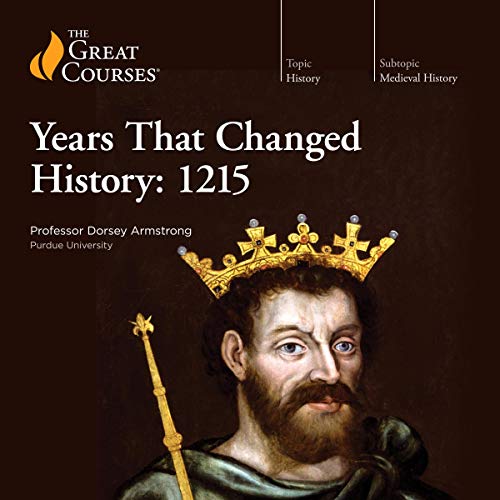
Years That Changed History: 1215
Summary
What is so important about the year 1215? There are some history buffs who may be able to tell you that 1215 is the year the Magna Carta was signed, but there are even fewer who know that King John of England’s acceptance of this charter was only one of four major, world-changing events of this significant year. In fact, the social, cultural, political, geographical, and religious shifts that occurred in this year alone had such a huge impact on the entire world, it warrants an entire course of study for anyone truly interested in the pivotal points of history that brought us to where we are now. As it turns out, the year 1215 was a major turning point in world history. Although the drafting of the Magna Carta is perhaps the most well-known event of 1215, anyone in Europe at the time would have told you the meeting of the Church’s Fourth Lateran Council was much more significant. Meanwhile, in Asia, a Mongol ruffian named Genghis Khan was embarking on a mission for world domination, beginning with his success at the Battle of Beijing, while Islam was experiencing a Golden Age centered around Baghdad’s House of Wisdom. Other cultures and societies around the globe were also experiencing pivotal moments in their development - from the Americas to Africa and Asia and beyond. These seismic events were only possible thanks to a confluence of global conditions, starting with the climate. Although we might not be familiar with the specifics, the ripple effect from these events can still be felt all over the world today. Years That Changed History: 1215 is a unique course, offering you the chance to delve into one of the most interesting periods in world history. Over 24 fast-paced lectures, Professor Dorsey Armstrong of Purdue University gives you the Big History of this surprisingly impactful year, introducing you to the people, events, and wide-ranging influences of the year 1215. Among other fascinating discoveries, you will investigate how climate changes affected the population of Europe; explore the circumstances for the Magna Carta (which originally had nothing to do with human rights and liberty for everyday people); find out why the Fourth Lateran Council mattered so much; and tour the world beyond Europe to gain a true sense of global history. This last point about “global history” is an important one. Most history courses have to select a theme, which by its nature limits the scope of the curriculum. In choosing a year as her theme, Professor Armstrong is able to take you around the world, from the ancient Maya to the House of Baghdad to Shogun Japan. Professor Armstrong takes the world as her theme - and what a truly captivating world it is! PLEASE NOTE: When you purchase this title, the accompanying PDF will be available in your Audible Library along with the audio.
©2019 The Great Courses (P)2019 The Teaching Company, LLC
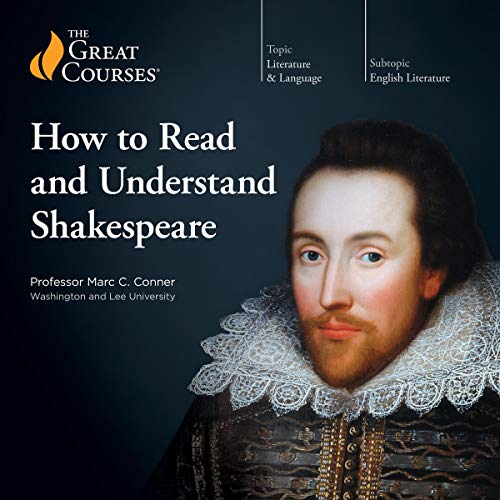
How to Read and Understand Shakespeare
Summary
Shakespeare's works are among the greatest of humanity's cultural expressions and, as such, demand to be experienced and understood. But, simply put, Shakespeare is difficult. His language and culture - those of Elizabethan England - are greatly different from our own, and his poetry, thick with metaphorical imagery and double meanings, can be hard to penetrate. Yet the keys to understanding Shakespeare are written into the plays themselves. If you can learn to recognize the playwright's own clues, you'll become able to engage meaningfully with his language, to follow the plot structures and themes that drive his plays, and to track the development of his characters. Over the course of 24 lectures, this innovative and penetrating exploration of Shakespeare's plays reveals how to enter Shakespeare's dramatic world, how to grasp what's happening in any of his plays, and how to enjoy them fully both on the page and the stage. Under Professor Conner's expert guidance, shaped by decades of studying and performing Shakespeare, you learn more than 40 interpretive tools, drawn from the texts themselves, that give you direct insight into the plays. These guiding principles allow you to follow the narratives of the plays as they unfold, with a clear understanding of how the plays function and fit together. The professor also reveals fascinating details of Shakespeare's era, which shed further light on the plays and the way his contemporary audiences perceived them. This course builds the skills that allow you to reach your own understanding of the plays - to deeply comprehend Shakespeare's transcendent poetic language, the spellbinding world of his great characters and stories, and his revelatory reflections on human experience. PLEASE NOTE: When you purchase this title, the accompanying reference material will be available in your Library section along with the audio.
©2013 The Teaching Company, LLC (P)2013 The Great Courses