The Great Courses has 635 audiobooks on Listento.it, narrated by 479 narrators, with an average listener rating of 4.5★ across 19,831 ratings. The most-rated is A Column of Fire.
Representing Justice: Stories of Law and Literature
Summary
What is the dynamic relationship between our culture's written and unwritten laws and its literature? How is that relationship evolving? How do law and literature influence or reflect one other? And what lessons might we draw from their symbiotic relationship? This 24-lecture series from a much-honored teacher approaches these questions with provocation and passion as it explores the rhetorical and philosophical connections that link these two disciplines, moving through ancient Greece, the Middle Ages, England's experience of the Renaissance and the Enlightenment, and the 19th and 20th centuries. Focusing on individual works of literature where law - implicit or explicit - is a central theme, as well as on the overall relationship between law and literature in society, Professor Heinzelman shows how that relationship gradually transformed, from the astoundingly intricate cross-connections between law and literature still present during the time of Shakespeare, to a point in the mid-18th century when the two disciplines separated more clearly into the distinct realms we recognize today. The crucial period from the late 17th to the 19th century - during which that separation evolved and solidified - draws her sharpest focus, with the literature of the time, including some of the most famous and influential works ever put to paper, offering a profound perspective on that era's structures and values as well as an enduring impact we still feel today.
©2006 The Teaching Company, LLC (P)2006 The Great Courses

Cycles of American Political Thought
Summary
American history is often presented as a tale of dynamic movers and shakers who subdued an untamed wilderness on the way to forging a great nation - all the while leaving philosophy for their European counterparts. But this history neglects the philosophical underpinnings of America. As these 36 lectures demonstrate, America has borne the imprint of influential thinkers from its earliest days, from the Reformation theology of John Calvin to the Enlightenment philosophy of John Locke. Throughout this epic historical journey, you'll explore the many ways this nation has answered the question: What is an American? Professor Kobylka traces the many answers that have been offered showing how the idea of "We the People" has changed and expanded far beyond the Founding Fathers' original conception. You'll navigate America's ever-shifting political landscape and see how the great political trends in American history can be understood as variations on a single theme: the philosophy of liberalism, this conception that government is the source of some of our most deeply valued political notions. You'll also meet the great men and women who, over the course of American history, have molded political thought and policy. This is your opportunity to gain a deep understanding both of the nation's past and how this rich political history continues to influence the current day. Even if you've studied American history before, you'll encounter something new: a unique synthesis of viewpoints, ideas, and events that's enlightening and compelling.
©2006 The Teaching Company, LLC (P)2006 The Great Courses
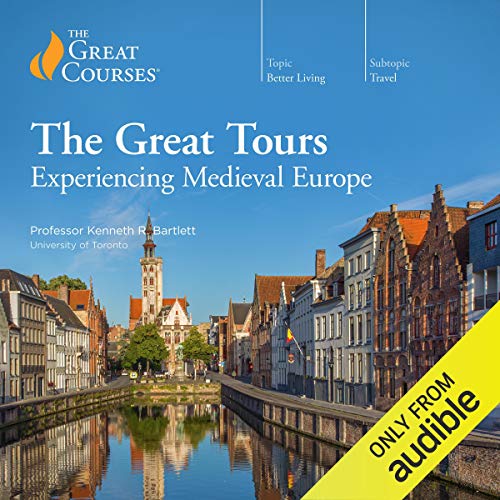
The Great Tours: Experiencing Medieval Europe
Summary
Tucked away within the romantic landscapes of Europe, a remarkable range of beautifully preserved medieval cities and towns invites discovery - time capsules of history where you can stroll the cobbled streets of another time; savor the treasures of palaces, stately mansions, soaring cathedrals, and grand civic centers; and walk the mighty bastions and ramparts that once defended them. Now, in The Great Tours: Experiencing Medieval Europe, award-winning Professor Kenneth R. Bartlett of the University of Toronto invites you to travel through time to the golden ages of 12 of Europe’s most beautiful medieval cities. In 24 lectures, you’ll discover the sights, sounds, and smells of teeming markets and mercantile centers, royal feasts and ritual, dramatic military engagements, magnificent religious pageantry, and the many colorful layers of daily medieval life. PLEASE NOTE: When you purchase this title, the accompanying PDF will be available in your Audible Library along with the audio.
©2013 The Great Courses (P)2013 The Teaching Company, LLC

Rise of the Novel
Summary
Thousands of novels are published around the world every year. There are so many readily available, it would take multiple lifetimes for a single person to even read a fraction of them. But it hasn’t always been that way. While humans have always been storytellers, the novel as we recognize it today is a relatively new art form in the timeline of human culture. Of all the ways we tell stories, why has the novel become such a perennial favorite? How did the novel go from a narrative experiment with a low-brow reputation to a cultural touchstone and focal point of modern literature? In the 24 lectures of Rise of the Novel, you will take a journey from the birth of the novel to the height of the form in the mid-19th century - and better understand what this literary form can tell us about human nature and our unquenchable thirst for great stories. With Professor Emeritus Leo Damrosch of Harvard University as your guide, you will dive into some of the most notable works that helped create and shape the novel over the course of more than three centuries, looking at the social and historical influences that coincided with shifts in literary taste along the way. Beginning with Don Quixote - held up by many scholars as the foundational text from which the novel form would spring - Professor Damrosch will lead you through works both tragic and comic, brief and diffuse, epic and domestic. From early works like La Princesse de Clèves and Robinson Crusoe to pinnacles of the form in the 19th century such as Emma and Middlemarch - along with a few novels that are less familiar today but well worth knowing - you will dive into works with different perspectives and intentions that have all impacted our culture in their own way. PLEASE NOTE: When you purchase this title, the accompanying PDF will be available in your Audible Library along with the audio.
©2020 The Great Courses (P)2020 The Teaching Company, LLC
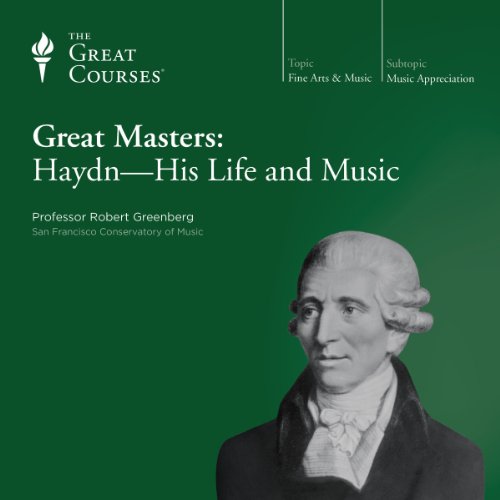
Great Masters: Haydn - His Life and Music
Summary
Almost from the moment it was first set to paper, the music of Franz Joseph Haydn (1732-1809) - technically superb, rich in quality, and widely imitated - has exemplified the Classical style, creating not only the Classical-era symphony but setting the standard, through his own 68 string quartets, against which that form has ever after been judged. And yet Haydn, despite the influence left by more than 1,000 works, seems to no longer get his due, often thought of as an aged figure surpassed and overshadowed by Beethoven and Mozart, who actually credited Haydn, the only contemporary he admired, and with whom he formed a lasting and artistically fruitful friendship, with teaching him how to write string quartets. Even Beethoven, whose relationship with his compositional teacher was troubled and stormy, would never have been able to write his triumphant Ninth Symphony without the influence of Haydn's crowning achievement, the towering 1798 oratorio, Creation. Now, in a series of eight vivid lectures, you can learn to understand and appreciate the music of one of the most original and influential composers of all time as you explore his origins, influence, and greatest works.
©2000 The Teaching Company, LLC (P)2000 The Great Courses

Falling in Love with Romance Movies
Summary
Why have viewers always had a love affair with romance movies? From tragic love stories, like Romeo + Juliet, to feel-good rom-coms, like Sleepless in Seattle, people simply cannot get enough of these movies. Join Professor Eric R. Williams to analyze dozens of titles that fall under the scope of "romance films"—inviting students to see old favorites in a new light and introduce them to elements of romance in movies one might not consider to be part of the genre. Explore traditional romantic titles, such as When Harry Met Sally, West Side Story, and Casablanca; controversial spins on the traditional genre, including Her, Harold and Maude, and Lars and the Real Girl; less conventional "romances," such as Blade Runner, Eternal Sunshine of the Spotless Mind, She’s Gotta Have It, and yes—even Fight Club. Throughout, Professor Williams draws on a wealth of examples, revealing the DNA of these films. Listeners will understand the difference between a love story and a romance; see how directors manipulate audiences’ emotions from opening credits to the final scene—keeping everyone on the edge of their seat; and be able to decode the underlying storytelling techniques. Students will see cinematic romances from a different point of view, deepening their understanding of the genre.
©2019 Audible Originals, LLC (P)2019 Audible Originals, LLC.

Books That Matter: The Federalist Papers
Summary
It would be difficult to overstate the influence of The Federalist Papers. Despite their lack of official or legal status, these 85 brilliant essays have served as the single most important guide to the interpretation and application of the US Constitution for more than 230 years. Authored by Alexander Hamilton, James Madison, and John Jay, The Federalist Papers offer a detailed blueprint for building a successful democratic republic. Books That Matter: The Federalist Papers gives you the chance to delve into this magisterial blueprint for yourself. Taught by acclaimed professor and legal scholar Joseph L. Hoffmann of the Indiana University Maurer School of Law, these 12 thought-provoking lectures take you back to the hot summer weather of Philadelphia in 1787, when the delegates from the several states gathered to revise the Articles of Confederation. As you will learn, the Framers were rightly concerned about whether the 13 largely autonomous states would accept a strong centralized federal government and whether such a system could include safeguards to protect against the tyranny they’d just fought a war to overcome. To answer these concerns, the authors laid out a bold vision for the new nation, drafting what became essentially the Bible of American government - perhaps America’s most significant contribution to the way that human beings choose to organize their lives, and their societies, in order to fulfill their hopes and pursue their dreams together. PLEASE NOTE: When you purchase this title, the accompanying PDF will be available in your Audible Library along with the audio.
©2020 The Great Courses (P)2020 The Teaching Company, LLC

American Ideals: Founding a 'Republic of Virtue'
Summary
What is the significance of the phrase "the pursuit of happiness" in the Declaration of Independence? Why does it read "We the people" in the preamble to the Constitution? What were the philosophies and social forces that made this country unique - that enabled it to become the first successfully self-governing republic? Answer these questions and more with this insightful 12-lecture course, which explores the principles that guided the founding of the United States, the conditions that led to the break with Great Britain, and the creation of such founding documents as the Declaration of Independence and the Constitution. You'll deepen your understanding of fundamental ideas that inspired American independence and that continue to have a profound influence on American thought. You'll also receive insight into what historians call "the long conversation" in American society - questions that have been the focus of debate and controversy since the nation was born. As the world's oldest democracy, the United States stands as the "test case" for those who regard self-government as inherently unstable, inherently self-destructive. Examining the founding documents, such as the Articles of Confederation, the Declaration of Independence, and the U.S. Constitution, Professor Robinson considers the principles under which the United States evolved.
©2004 The Teaching Company, LLC (P)2004 The Great Courses

Great Masters: Brahms-His Life and Music
Summary
Johannes Brahms was a man of contrasts. His serious Teutonic music was balanced by joyful dance music. His miserliness with himself by exceeding generosity with family and associates. His kindness to working people with a biting, malicious wit reserved for those he encountered in artistic and aristocratic circles. He was not an easy man to know, destroying a good deal of his own work and almost all of his lifetime's correspondence, in later years even collecting his letters from friends so that he could consign them to the flames. Yet you can know this enigmatic genius through this 8-lecture series, which uses biographical information and musical commentary to link the complexities of Brahms the man with the electrifying music of Brahms the composer.You'll learn how Brahms found unique ways of combining the rigor and formal complexity of older Classical and even Baroque genres and forms with the melodic inventiveness, harmonic sophistication, and expressive richness so prized in the Romantic age. And how his fanatical perfectionism led him to write, rewrite, and ultimately destroy more than 20 string quartets before publishing a pair of exceptionally exquisite pieces at the age of 40, breathing new life into the old bones of this exacting chamber music form. "His legacy," notes Professor Greenberg, "is a lifetime of extraordinary craft and artistic beauty without an inferior piece in the collection."
©2002 The Teaching Company, LLC (P)2002 The Great Courses
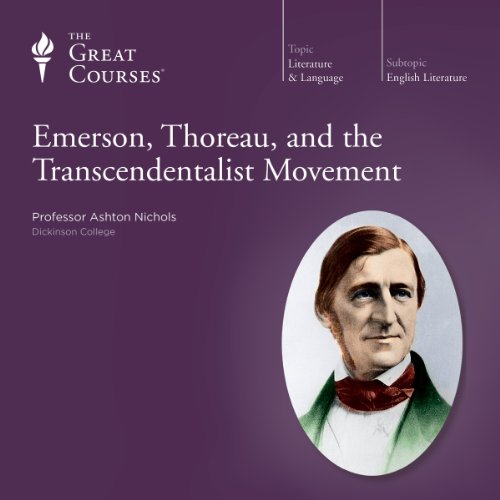
Emerson, Thoreau, and the Transcendentalist Movement
Summary
The America we know today is so different in its fundamental views about almost every aspect of life as to be unrecognizable to our countrymen of two centuries ago. On issues as divergent as slavery, women's rights, education, the environment, and many others, we are simply no longer the country we were. What is the source of not only these changes, but of our distinctly American way of experiencing ourselves-confident in our value as individuals, certain of our ability to discover truths, self-reliant in the face of uncertainty and change? Answers to questions like these and so many more are found in and around Boston and Concord, Massachusetts, which became, little more than five decades after the American Revolution, the epicenter of a profoundly influential movement that would make possible the America we know today. That movement was Transcendentalism-the subject of an extraordinary 24-lecture series by an award-winning teacher, scholar, and journalist. You'll learn how Transcendentalism-drawing on an array of influences from Europe and the non-Western world-also offered uniquely American perspectives of thought: an emphasis on the divine in nature, on the value of the individual and intuition, and on belief in a spirituality that might "transcend" one's own experienceto provide a guide for daily living. And you'll learn how Transcendentalism's impact was rooted in the intellectual energy of two remarkable individuals: Ralph Waldo Emerson, the most important figure behind Transcendentalism in America, and Henry David Thoreau, his most influential disciple. Along with a diverse group of intellectual activists, literary figures, and social reformers, their ideas would remake America. PLEASE NOTE: When you purchase this title, the accompanying reference material will be available in your Library section along with the audio.
©2006 The Teaching Company, LLC (P)2006 The Great Courses

Abraham Lincoln: In His Own Words
Summary
Abraham Lincoln was one of America's greatest public orators. The cadence, argument and power he brought to his speeches, like those of the Gettysburg address almost every American learns in school, still stir the hearts of not only Americans, but countless millions around the world. This series of 24 lectures examines Lincoln's rhetoric - the public messages in which he evolved his views on slavery and the preservation of the Union and by which he sought to persuade others. By tracing significant moments in Lincoln's career from the fresh perspective of his use of public persuasion, you'll learn how Lincoln was able to navigate the constraints imposed by both audiences and situations, and you'll understand exactly how he was able to take advantage of creative opportunities. You also see the extent to which Lincoln's public career developed through his public speeches and writings, and gain valuable insight into the importance of both thinking rhetorically and reasoning with specific audiences and situations in mind.
©1999 The Teaching Company, LLC (P)1999 The Great Courses

Great Presidents
Summary
The creation of the executive branch of government was one of the most audacious decisions in American history. The story of our greatest presidents create a narrative as compelling as an historical novel, and these 48 compelling lectures look at the lives, the achievements, and the legacies of those generally considered our 12 greatest presidents: George Washington, Thomas Jefferson, Andrew Jackson, James K. Polk, Abraham Lincoln, Theodore Roosevelt, Woodrow Wilson, Franklin D. Roosevelt, Harry S. Truman, John F. Kennedy, Lyndon B. Johnson, and Ronald Reagan. Drawing on a wealth of revealing anecdotes and inside stories, Professor Lichtman sheds new light on how the individual characters and historic decisions of each president made a major contribution to shaping our developing nation. You'll study the critical role these men played in America's founding years, Westward expansion, the struggle over slavery and the Civil War, the Great Depression, World War II, the perils of the atomic age, and more. These 12 leaders can be seen as giants of the most powerful elective office in the world. But through Professor Lichtman's eyes we see them as they really were, contradictions and paradoxes included. These lectures give the "inside stories" from our highest office, and they reveal 12 leaders with varying styles, personalities, and beliefs, but they all had in common an unsinkable ambition, a deep affinity with the American people, and a strong inner core of guiding values and principles. PLEASE NOTE: When you purchase this title, the accompanying reference material will be available in your Library section along with the audio.
©2000 The Teaching Company, LLC (P)2000 The Great Courses

Shakespeare's Tragedies
Summary
Shakespeare's contributions to stage and language are unequaled, audiences left breathless for the past four centuries, his artistry as evident in moments of insensate rage as it is in moments of heartbreaking tenderness. But beyond his astonishing feats of language and dramatic impact, Shakespeare also left us a legacy in the explorations of suffering and transgression offered in the six great mature tragedies—Hamlet, Othello, King Lear, Macbeth, Antony and Cleopatra, and Coriolanus—that make up the astonishing body of work he produced from 1600 to 1608. This series of 24 exciting lectures from an award-winning teacher takes you deep within each play to observe Shakespeare's protagonists struggling to make choices in the face of competing social, moral, and psychological pressures and "clawing [from] their pain and horror," as Professor Kinney puts it, " [to] a kind of insight." Whether you're a veteran lover of Shakespeare, someone new to his work, or an old lover returning after too long away, you'll find this course a delight, as Professor Kinney offers insights that give you a nuanced understanding of each play's meaning. It's a gift that will increase the dramatic impact of every Shakespearean tragedy you see on the stage or screen, or visualize as you read them, as well as enhance your ability to form insights on your own with each reading or performance.
©2007 The Teaching Company, LLC (P)2007 The Great Courses

Understanding the Brain
Summary
Considering everything the brain does, how can it possibly be the source of our personalities, dreams, thoughts, sensations, utterances, and movements? Understanding the Brain, a 36-lecture course by award-winning Professor Jeanette Norden of Vanderbilt University, takes you inside this astonishingly complex organ and shows you how it works. With its combination of neurology, biology, and psychology, this course helps you understand how we perceive the world through our senses, how we move, how we learn and remember, and how emotions affect our thoughts and actions. Your tour starts with the organization of the central nervous system at the gross, cellular, and molecular levels, then investigates in detail how the brain accomplishes a host of tasks - from seeing and sleeping to performing music and constructing a personal identity. You explore a broad range of exciting topics in neuroscience and come away with a deeper knowledge of how the brain is organized - and a feeling of wonder and appreciation for all that it accomplishes. PLEASE NOTE: When you purchase this title, the accompanying PDF will be available in your Audible Library along with the audio.
©2007 The Great Courses (P)2007 The Teaching Company, LLC

European Thought and Culture in the 19th Century
Summary
In the 19th century, Europe was the crucible for most of the ideas, institutions, and "isms" that now shape the life of our entire planet- nationalism, capitalism, democracy, socialism, feminism, and the list goes on and on. But where did these ideas come from? How did the particular conditions of Europe between the French Revolution and the First World War shape these thinkers' ideas, the thoughts of their critics, the progress of the debates that went on between them, and the wider hearing that all received? Over the course of 24 sweeping lectures, Professor Kramer invites you to view intellectual history as a series of overlapping, interconnected dialogues, which will help you deepen your understanding of the ideas of influential 19th-century European intellectuals; reflect on the interactions between ideas and social experience; and think critically and creatively about how the ideas of 19th-century Europe's leading thinkers and writers still raise a host of cogent questions for our own time. You will examine not only famous thinkers like Marx, Darwin, and Nietzsche, but a number of important, though less well-remembered, figures including the romantic author Germaine de Staël, the positivist Auguste Comte, the novelist and feminist George Sand, the political theorist Benjamin Constant, and many others-each placed in a context and linked both to other creative thinkers and the major issues of the time. Beginning the legacy of the 18th-century Enlightenment and its connection to the French Revolution and ending with the philosophy of Nietzsche, this ambitious course is rich with great-and lasting-ideas.
©2001 The Teaching Company, LLC (P)2001 The Great Courses

Literary Modernism: The Struggle for Modern History
Summary
Professor Perl invites you in these eight lectures to abandon your preconceptions and consider some of the most controversial authors of the 20th century: the Modernists.Who were they? How did "classical" Modernists like Ezra Pound, T.S. Eliot, and James Joyce differ from "neo-Modernists" like Gertrude Stein and William Carlos Williams? What made them believe and write as they did? Why were political extremism, war, and self-destructive behavior such defining forces in their writing (and their personal demons)? What do they have to say to us today in the 21st century? These lectures place literary Modernism within the wide-ranging context of the philosophy, literature, politics, and morality of its time. In doing so, they allow you to look more clearly at the writers and works who have contributed to the definition of human culture. You'll see Eliot, Joyce, Pound, Yeats, James, Lawrence, and others spring to life with their radical beliefs about art and their unforgettable novels and stories. These lectures do not shrink from the challenges imposed by exploring Modernism, or from challenging the answers that scholars have routinely accepted. Nor do they shy away from the difficulties of literary Modernism itself; a literary genre that intimidates many. But despite all this, these lectures are brilliantly organized, crystal clear, and an invaluable tool for finally wrapping your brain around a dramatic roster of authors and an enduring canon of literature.
©1991 The Teaching Company, LLC (P)1991 The Great Courses

Great Masters: Stravinsky - His Life and Music
Summary
Stravinsky composed what is arguably one of the two most important musical compositions of the twentieth century, The Rite of Spring. He forged a new "musical language" to portray the sense of the ballet's primitive and earthy theme. More than a dozen excerpts of Stravinsky's works are examined. PLEASE NOTE: When you purchase this title, the accompanying reference material will be available in your Library section along with the audio.
©2000 The Teaching Company, LLC (P)2000 The Great Courses

Understanding the Science for Tomorrow: Myth and Reality
Summary
Science and technology are, without a doubt, two forces that will change the way you live your life in the coming months, years, and decades. And in recent decades, these forces have evolved and developed at a lightning-fast pace. Explore the many possibilities of what your future may look like with these 24 lectures: a scientifically accurate and enlightening survey of today's most advanced research in fields such as engineering, biology, chemistry, and theoretical physics. You'll see firsthand how recent developments in science and technology can potentially fulfill this need in a range of modern-day, real-world areas like transportation, computing, medicine, and energy. The lectures are filled with intriguing sneak peeks at the latest developments and technologies in a range of scientific fields, including nanorobots that could identify and destroy cancer cells, personalized medicine that could be customized to an individual’s specific genome, and biofuels that could be created from food industry waste. In discussing these and other eye-opening topics, Professor Grossman always makes a point to emphasize fact and truth over fiction and hype. By the final lecture, you'll have a stronger sense of some important fundamental scientific principles being used right this moment to innovate your life. You'll also find yourself filled with a sense of excitement and wonder for both how, and how quickly, science and technology are working to make your world a better place. PLEASE NOTE: When you purchase this title, the accompanying PDF will be available in your Audible Library along with the audio.
©2012 The Great Courses (P)2012 The Teaching Company, LLC

Between Cross and Crescent: Jewish Civilization from Mohammed to Spinoza
Summary
Experience the evolution of all of Jewish life during the 10 critical centuries from its rabbinic foundations in late antiquity until the dawn of modernity in the 17th century. During this time, Judaism was forever affected by its encounters with the surrounding social, economic, political, and intellectual environments of both medieval Islam and Christendom. As a result of those encounters, new pathways of philosophical inquiry and religious spirituality would be formed. The Hebrew language would find new ways of artistic expression. And the role of Jews in the life of the surrounding community would be changed forever, sometimes even increased, as was the paradoxical case in Italy, by the very ghettoization meant to keep them isolated. These 24 insightful lectures give you a unique perspective from which to examine the three major Western religions as they interact over time, and noting especially their ability or inability to tolerate and even appreciate the "other", as viewed from the vantage point of the Jewish minority. They also feature the emergence of two distinct intellectual threads: the rise of medieval Jewish philosophy and the appearance of Jewish mysticism and piety as the faith's primary expressions of religiosity. These lectures span an enormous disciplinary range, moving back and forth among history, philosophy, religion, and art. No previous familiarity with Jewish, Islamic, or Christian history is necessary to enjoy this broad and detailed examination of the leading Jewish communities of the period, their political and economic structures, the social relations between Jews and non-Jews, and Jewish cultural and intellectual achievements in a premodern world dominated by two other faiths.
©2005 The Teaching Company, LLC (P)2005 The Great Courses

Biblical Wisdom Literature
Summary
In 36 thought-provoking lectures, you'll explore enlightening teachings that have inspired the world and that continue to speak to life's most important questions. Throughout, you'll benefit from Father Koterski's ecumenical perspective, as he presents these teachings within the Jewish and Christian traditions and compares the varying versions of these texts. What do these writings have to say about the great philosophical problems people seek to understand? You'll find out as you contend with the literal and figurative meanings behind some of the Bible's most essential books and parts (as well as some that many of us overlook). Among them: the book of Job, which contends with some of the most enduring philosophical and theological questions; the book of Proverbs, with its moral exhortation to live according to God's covenant; the book of Sirach, which contains advice on friendship and fidelity to God's law; the Song of Songs, a sublime piece of biblical poetry; and the Wisdom of Solomon, with its stirring contemplation of wisdom in civic and private life. Each of these and the other books in these lectures is placed in its historical and cultural context, but is also examines in the context of today's world. Father Koterski takes care to describe how these ancient teachings can be applied to everyday dilemmas we all face. The result is an enriching journey that is as rewarding for members of the Jewish and Christian faiths as it is to those
©2009 The Teaching Company, LLC (P)2009 The Great Courses