The Ancient History category has 310 audiobooks on Listento.it, with an average listener rating of 4.5★ across 2,807 ratings. The most-rated is Magicians of the Gods.
![Cover art for La historia azteca [Aztec History]](https://m.media-amazon.com/images/I/51VEN10ibGL._SL500_.jpg)
La historia azteca [Aztec History]
Summary
¿Sabía usted que los aztecas sacrificaban entre 500 y 700 personas cada año para satisfacer a los dioses? Durante muchos años, los aztecas han capturado nuestra imaginación. Las historias de los invasores europeos originales combinadas con ruinas y leyendas únicas e impresionantes que hablan de palacios de oro crean una imagen de la sociedad azteca definida por la grandeza, la riqueza y el esplendor. Pero, ¿quiénes eran exactamente los aztecas? ¿De dónde vienen? ¿Cómo ascendieron para controlar una extensión tan amplia de tierra? Y si fueron tan poderosos, ¿cómo era posible que cayeran del poder y la dominación solo tres años después del primer contacto con los españoles? Estas son solo algunas de las preguntas que este nuevo audiolibro de historia fascinante pretende responder. En La historia azteca: Una guía fascinante sobre el imperio azteca, la mitología y la civilización descubrirá temas como: ¿Dónde vivían los aztecas? La verdad sobre quiénes eran realmente los aztecas Revelaciones importantes sobre el gobierno, ciudades-estado y la expansión La llegada de los españoles y la decadencia del imperio Un día en la vida de un ciudadano azteca El Soberano, los Dignatarios y los Nobles La agricultura y la dieta La religión Descubrimientos impactantes sobre el sacrificio humano ¡Y mucho, mucho más! ¡Obtenga este libro ahora para aprender más acerca de la historia azteca! Please note: This audiobook is in Spanish.
©2019 Captivating History (P)2019 Captivating History

The Jurassic Period
Summary
The early history of our planet covers such vast stretches of time that years, centuries, and even millennia become virtually meaningless. Instead, paleontologists and scientists who study geochronology divide time into periods and eras. The current view of science is that planet Earth is around 4.6 billion years old. The first four billion years of its development are known as the Precambrian period. For the first billion years or so, there was no life in Earth. Then, the first single-celled life-forms, early bacteria and algae, began to emerge. We don’t know where they came from or even if they originated on this planet, at all. This gradual development continued until around four billion years ago, when suddenly (in geological terms) more complex forms of life began to emerge. Scientists call this time of an explosion of new forms of life the Paleozoic Era, and it stretched from around 541 to 250 million years ago (Mya). First of all, in the oceans and then on land, new creatures and plants began to appear in bewildering variety. By the end of this period, life on Earth had exploded into a myriad of complex forms that filled virtually every habitat and niche available in the seas and on the planet’s only continent Pangea. Then, a mysterious event that became known to early paleontologists as “The Great Dying” wiped out more than 95 percent of all life on Earth. No one is entirely certain what caused this, but the effect of this cataclysm was as if someone had pressed a great cosmic “reset” button and it took 30 million years for the development of life on Earth to start again. The next period of Earth’s history is known as the Mesozoic Era, from about 252 to 66 Mya. This era is further divided into three periods - the Triassic, Jurassic and Cretaceous. During this era, one type of life came to dominate the planet more completely and for a longer period than had been seen before or since; this was the Age of Reptiles. Beginning in the Triassic, but especially in the Jurassic period, reptiles came to dominate the oceans, land and even the skies. There has never been anything else quite like this period in terms of the success of a particular type of creature. For almost 200 million years, reptiles were the only significant creatures on Earth. They were so successful and so diverse that they evolved to take advantage of every available habitat and no other type of large creature had a chance to develop. To put the 200 million years of reptile dominance in perspective, the entire span of recorded human history - the time since people advanced from tribes of primitive, nomadic hunter-gatherers into recognizable societies - covers less than 6,000 years. To put this in context, if the entire history of the planet were to be laid out on the length of a football field, the period of dominance of the age of reptiles would not begin until the five-yard line and would stretch for twelve feet. All of human history would occupy a tiny strip at the end of the field, less than the width of a human hair. It was during the Jurassic period that reptiles began rule the Earth and some of the best-known prehistoric creatures first emerged. The Jurassic Period: The History and Legacy of the Geologic Era Most Associated with Dinosaurs looks at the development of the era, the extinction events that preceded it, and how life began to evolve during it. You will learn about the Jurassic Period like never before.
©2020 Charles River Editors (P)2020 Charles River Editors

The Life of Pelopidas
Summary
Pelopidas started out a hero to the people, being born under a noble family and making a name for himself as an athlete. But as Plutarch describes in Pelopidas’ chapter of Parallel Lives, there was a lot more to this man than could be seen. Being very generous with his wealth to the less fortunate of the town, Pelopidas also went on to lead the army. By the end of his life, his patriotism did not go unnoticed - and was ultimately what led to his untimely demise.
Public Domain (P)2018 Audio Sommelier

The Empires of Ancient Persia
Summary
Lying in the middle of a plain in modern day Iran is a forgotten ancient city: Persepolis. Built two and a half thousand years ago, it was known in its day as the richest city under the sun. Persepolis was the capital of Achaemenid Persian Empire, the largest empire the world had ever seen, but after its destruction, it was largely forgotten for nearly 2,000 years, and the lives and achievements of those who built it were almost entirely erased from history. Alexander the Great’s troops razed the city to the ground in a drunken riot to celebrate the conquest of the capital, after which time and sand buried it for centuries. It was not until the excavations of the 1930s that many of the relics, reliefs, and clay tablets that offer so much information about Persian life could be studied for the first time. Through archaeological remains, ancient texts, and work by a new generation of historians, a picture can today be built of this remarkable civilization and their capital city. Although the city had been destroyed, the legacy of the Persians survived, even as they mostly remain an enigma to the West and are not nearly as well understood as the Greeks, Romans, or Egyptians. In a sense, the Achaemenid Persian Empire holds some of the most enduring mysteries of ancient civilization. The Parthian people created an empire that lasted almost 500 years, from the mid-3rd century BCE until 224 CE, and it stretched from the Euphrates River in the west to Central Asia and the borders of Bactria in the east (Brosius 2010, 83). In fact, the expansive empire challenged the Romans on numerous occasions for supremacy in the Near East, created the first sustainable link between the peoples of Europe and East Asia, and followed a religion that many consider to be the oldest form of monotheism in the world; but despite these accomplishments the Parthians are often overlooked in favor of the Achaemenid and Sassanid Persians who came before and after them respectively, not to mention the Romans themselves. Although the Parthians may not get top billing in most popular histories of the period, they left an indelible mark on the world that cannot be overstated. During the first half of the 1st millennium CE, an empire arose in Persia that extended its power and influence to Mesopotamia in the east, Arabia in the south, the Caucasus Mountains in the north, and as far east as India. This empire, known alternatively as the Sasanian Empire or Sassanid Empire, was the last of three great dynasties in Persia—the Achaemenid and the Parthian being the first two dynasties—before the rise of Islam. In fact, many scholars consider the Sasanian Empire to be the last great empire of the ancient Near East because once it had been obliterated, Islam became the standard religion of the region, ushering in the Middle Ages.
©2017 Charles River Editors (P)2017 Charles River Editors
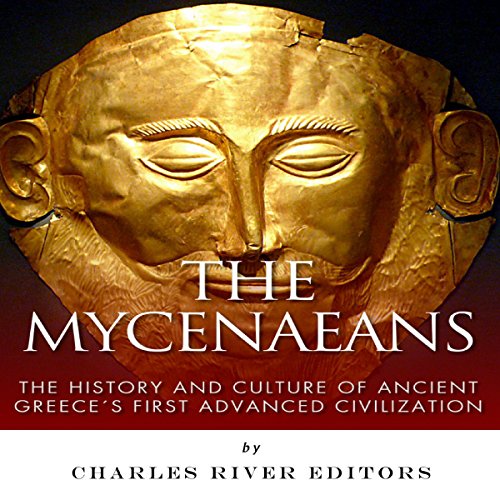
The Mycenaeans: The History and Culture of Ancient Greece's First Advanced Civilization
Summary
When people think of ancient Greece, images of philosophers such as Plato or Socrates often come to mind, as do great warriors like Pericles and Alexander the Great. But hundreds of years before Athens became a city, a Greek culture flourished and spread its tentacles throughout the Western Mediterranean region via trade and warfare. Scholars have termed this preclassical Greek culture the Mycenaean culture. It existed from about 2000 to 1200 BCE, when Greece, along with much of the Eastern Mediterranean, was thrust into a centuries-long dark age. Before the Mycenaean culture collapsed, it was a vital part of the late Bronze Age Mediterranean system and stood on equal footing with some of the great powers of the region, such as the Egyptians and Hittites. Despite being ethnic Greeks and speaking a language that was the direct predecessor of classical Greek, the Mycenaeans had more in common with their neighbors from the island of Crete, who are known today as the Minoans. Due to their cultural affinities with the Minoans and the fact that they conquered Crete yet still carried on many Minoan traditions, the Mycenaeans are viewed by some scholars as the later torchbearers of a greater Aegean civilization. This is similar to the way the Romans carried on Hellenic civilization after the Greeks. Given that the Mycenaeans played such a vital role in history in the late Bronze Age, it would be natural to assume there are countless studies and accurate chronologies on the subject, but the opposite is true. Although the Mycenaeans were literate, the corpus of written texts from the period is minimal, so modern scholars are left to use a variety of methods in order to reconstruct a proper history of Mycenaean culture.
©2012 Charles River Editors (P)2015 Charles River Editors

Viking Sagas
Summary
Explore captivating Viking Sagas. The period between the end of the eighth century CE and the middle of the 11th is often called the “Viking Age” because this is the period in which Scandinavian people expanded their contacts with the outside world through trade, raiding, exploration, and colonization. This volume presents a version of Ragnar’s saga compiled from different modern sources, along with information providing additional historical and documentary context, followed by a discussion of some aspects of modern appropriations and representations of ancient Norse culture. The first section of the book provides historical context for Ragnar’s saga through an exploration of daily life in ninth century Scandinavia and of contemporary Viking culture and history. The text of the saga itself forms the second part of the book, along with notes giving further information about how this version of the saga is presented and about elements within the story that might not be familiar to modern listeners. The third section of the book deals with representations of ancient Norse cultures in modern popular media. Within this book, you'll find the following the Viking Sagas and topics covered: The world of Ragnar Lothbrok The saga of Ragnar Lothbrok and his sons Representations of Norse myths and history in modern media The clash of history and drama in the History Channel television series Vikings And much more! Get the audiobook now and learn more about Viking Sagas!
©2020 Matt Clayton (P)2020 Matt Clayton
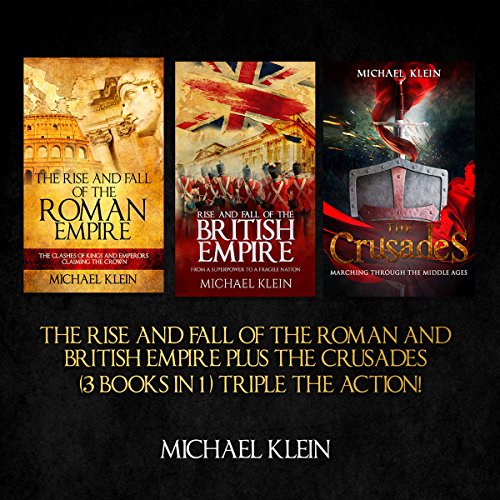
The Rise and Fall of the Roman and British Empire plus the Crusades
Summary
How did we get here, to this time and place in history? Are we repeating history's mistakes because we did not learn about the pivotal events that shaped the modern world? This three-book history course helps you quickly understand the nuances and the impact of three crucial periods portrayed in countless films: the Crusades and of the rise and fall of two great empires, the Roman and British. The culture, technology, law, and military organization of the Roman Empire shaped western civilization. Determined to spread their rule, the Romans succeeded magnificently until human nature and other factors led to the empire's collapse. Were current relationships between Christians and Muslims determined when the knights of the Crusades rode off on their grand quest? By the beginning of the 20th century, the British Empire and its superior navy claimed territory larger than that of any other empire in history, but its overreach foretold its downfall. This insightful and critically acclaimed history of the British Empire spans from the 17th century to contemporary time and combines comprehensive scholarship with popular history.
©2016 Michael Klein (P)2016 Michael Klein

Maya Civilization: A History from Beginning to End
Summary
Discover the remarkable history of the Maya Civilization... For more than one thousand years, the Maya people dominated areas of Central America and modern-day Mexico and made important advances in architecture, astronomy, mathematics, and medicine. Then, after the Spanish occupation in the 16th century, Maya culture and thinking were deliberately suppressed. Only in the 20th century did scientists appreciate just how advanced these people had been and how important they were in the history of Mesoamerica. The excavation and investigation of several large Maya cities in the second half of the 20th century completely changed how we view these people. We now know that the Maya were capable of building vary large stone structures that were precisely aligned with astronomical features, though we do not know how this was done. We are still learning about Maya cities - as recently as 2018, the use of new technology uncovered more than 60,000 previously undiscovered Maya ruins in the jungles of Guatemala. Many scholars now believe that the Maya were one of the most important of all the ancient Mesoamerican cultures. There are still many mysteries about the Maya. At one point in their history, several major Maya cities were abandoned and left to the encroaching jungle while their people relocated to more inhospitable areas in the Yucatán. There are many theories, but no one is entirely certain why this happened. We also don’t know why the Maya made important advances in the fields of mathematics and medicine and yet failed to develop, for example, the wheel or metalworking. What we do know is that these people created a sophisticated culture which they recorded via one of the first complex writing systems. Unlike other contemporary Mesoamerican peoples, the Maya survived the Spanish occupation, and Maya language, religion, and culture continue to survive today in parts of Central America and Mexico. This is the story of the mysterious and frequently misunderstood Maya civilization. Discover a plethora of topics such as: Origins Maya Religion and Medicine The Classic Period Weapons and Warfare The Spanish Conquest Maya Writing And much more! So if you want a concise and informative audiobook on the Maya Civilization, simply get this audiobook now!
©2020 Hourly History (P)2020 Hourly History

Uncovering Greek Mythology: A Beginner's Guide into the World of Greek Gods and Goddesses
Summary
Get to know the Greek gods and goddesses, from the mighty Zeus, to the temperamental Poseidon, the beautiful Aphrodite, and every character from A to Z. Who wouldn’t want to hear about Zeus and his command of lightning, Hades and how he found his bride, the wisdom of Athena, and so many other stories that capture the imagination. These stories can do more than just entertain; they can also inspire and teach us lessons that were penned by the Greeks themselves. Starting with the creation myth, this audiobook will take you through the stories of the Titans, introduce the Olympians, bring in the demigods, and sneak a peek at the monsters that made up the mythology. You’ll learn who all the gods and goddesses were in relation to one another, mythological explanations for natural events, and why any of this still matters today. In addition, you’ll discover: The names, powers, and significance of all the major Greek gods and goddesses Rich stories based around the Greek pantheon Moral lessons and cultural values important to the Greeks, preserved in their mythology A brief history of Greek civilization and how they worshipped their gods and goddesses Creatures of Greek mythology that still feature in modern tales today And so much more Greek history! Up on Mount Olympus, along the shores of the Mediterranean, and deep in the Underworld, gods, goddesses, demigods, and creatures linger in the mind and stories of an ancient culture. This culture gave us science, philosophy, and a rich mythology that never stops enticing us. To appreciate the power of their stories for yourself and become absorbed in a world so like and yet unlike our own, buy this audiobook now.
©2020 Lucas Russo (P)2021 Lucas Russo

The Cushite
Summary
Rufus L. Perry was an educator and Baptist minister from Brooklyn, New York. He was a member of the African Civilization Society and was a co-founder of the Howard Colored Orphan Asylum. The Cushite is a short work that investigates the history of the ancient peoples.
Public Domain (P)2020 Museum Audiobooks

The Decline and Fall of the Roman Empire
Summary
This is the complete and unabridged collection of all six volumes from The Decline and Fall of the Roman Empire. The Decline and Fall of the Roman Empire by Edward Gibbon (an English historian) is a six-volume collection that examines the fate of one of the most renowned civilizations in history, the Roman Empire. This historical account by Gibbon is widely considered by many as one of the greatest works of history ever written. In this masterpiece, Gibbon covers the time periods from the second century A.D. to the 15th century, and takes a look at the history of early Christianity along with the Roman State church, the history of Europe and the Middle East along with the rise of Islam, and the events that lead to the collapse of the Roman Empire among many other historical events.
©2020 Goffin Media (P)2020 Goffin Media

Life in Ancient Rome
Summary
Lionel Casson paints a vivid portrait of life in ancient Rome - for slaves and emperors, soldiers and commanders alike - during the empire's greatest period, the first and second centuries AD.
©2015 American Heritage (P)2017 HighBridge, a Division of Recorded Books

The Pleistocene Era
Summary
The Pleistocene spans a period from around 2.5 million years ago (mya) to just over 12,000 years ago, and it was an epoch of enormous change on Earth, mainly characterized by climate changes involving fluctuations between periods of extreme heat and long periods of glaciation. This period is commonly known as the Ice Age, despite the fact there were actually a number of separate periods of cold. Along with the climate challenges, this was also the period that saw the development of modern humans. The origin of our ancient ancestors is still a matter of debate among paleontologists, and classification systems for early hominoids are constantly being updated as new discoveries are made. What is generally agreed upon is the species Homo sapiens belong to the order primates and the suborder anthropoids. Within the anthropoids suborder, humans belong to the family hominids, which also includes other animals such as the orangutan and the great apes. Drilling down even further, humans belong to a subgroup of hominids known as hominin. The subgroup hominin includes humans as well as chimpanzees and gorillas. Discoveries have revealed more than 20 species of the genus Homo, all of which appeared during the Pleistocene Epoch, and all but Homo sapiens became extinct during the same period. The challenge is in understanding which of these groups are predecessors to Homo sapiens and which are separate groups that died out leaving no current representation. Not knowing this information makes it difficult to determine neat classification and establish precisely when hominins separated from the rest of the non-hominin primates. It is generally accepted that hominoids and the first hominins evolved in what is now Africa. Somewhere around seven mya, the common hominoid lineage split into two distinct evolutionary lines: the ancestors of modern chimpanzees and those of modern humans. Around 2.5 mya, a new genus of hominin appeared. Homo had larger brains than their predecessors as well as smaller jaws and teeth. The very first stone tools date to this period, when there were a number of different hominin species. The very first true humans, Homo erectus, appeared around two mya. These new creatures could hardly have chosen a more difficult time to appear. In addition to facing the challenges of simply surviving in a generally hostile environment, the world was about to enter a period of convulsive climatic change. The new humans would face drought and extreme heat, as well as long periods of cooling where glaciers spread across the surface of the planet, but they survived, and by the time the Pleistocene Epoch ended around 12,000 years ago, Homo sapiens had become one of the most significant species on the planet. The Pleistocene Era: The History of the Ice Age and the Dawn of Modern Humans looks at the development of the era, what life on Earth was like, and the origins of archaic humans.
©2020 Charles River Editors (P)2020 Charles River Editors

Ancient African Kingdoms
Summary
If you want to discover the captivating history of ancient Africa and the Kingdom of Kush, then pay attention.... Two captivating manuscripts in one audiobook: Ancient Africa: A Captivating Guide to Ancient African Civilizations, Such as the Kingdom of Kush, the Land of Punt, Carthage, the Kingdom of Aksum, and the Mali Empire with Its Timbuktu The Kingdom of Kush: A Captivating Guide to an Ancient African Kingdom in Nubia That Once Ruled Egypt Africa is the continent where the first humans were born. They explored the vast land and produced the first tools. And although we migrated from that continent, we never completely abandoned it. From the beginning of time, humans lived and worked in Africa, leaving evidence of their existence in the sands of the Sahara Desert and the valleys of the great rivers such as the Nile and the Niger. Some of the earliest great civilizations were born there, and they give us an insight into the smaller kingdoms of ancient Africa. Some of the topics covered in part one of this audiobook include: The Kingdom of Kush The Land of Punt Carthage The Kingdom of Aksum The Ghana Empire The Mali Empire And much, much more! Some of the topics covered in part two of this audiobook include: Nubia and the emergence of the Kingdom of Kush From Alara to the Twenty-Fifth Dynasty The rulers of the Twenty-Fifth Dynasty Relations between Kush and Egypt continue Kush between the sixth and third centuries The Meroitic Dynasty The last centuries of the Kingdom of Kush The society of Kush And much, much more! So, if you want to learn more about ancient Africa and the Kingdom of Kush, then get this audiobook now!
©2020 Captivating History (P)2020 Captivating History

Roman Britain: A History from Beginning to End
Summary
This audiobook takes a holistic look at Roman Britain, from the events leading up to its official inception in AD 43 until the Romans left the Isle entirely around AD 409. The timeline is straightforward, and each chapter delves into some aspect of Romano-British life: dealing with the concept of the Celts; when Britannia actually became Roman; how the two peoples attempted to blend their culture through religion; and lastly, why the Romans had to leave. Inside you will read about.... "The Timeline" "Ancient Celtic Ethnicity, a Modern Invention" "The Beginnings of Roman Britain" "Religion and Blending Culture in Roman Britain" "The Bitter End" It can be difficult to explain everything from a neutral, unbiased perspective as most of the records from the time are Roman in nature, but drawing on a variety of perspectives from archaeologists and historians alike has made for a thought-provoking assessment of the era. Rome's power bestowed cities like London and York to Britannia, and their lasting influence is still visible today in places like Bath and at Hadrian's Wall to the north. Roman Britain lingers on still.
©2016 Henry Freeman (P)2017 Henry Freeman

Catiline's War
Summary
Catiline's War, by Sallust, who was better known as Gaius Sallustius Crispus, (86-c. 35 BC), tells of the conspiracy in 63 BCE led by L. Sergius Catilina, who plotted to assassinate numerous senators and take control of the Roman government but was thwarted by Cicero. Sallust describes Catiline as the enemy of law, order, and morality. Cataline fled Rome, and his much-reduced army first tried to reach Gaul but was blocked. Eventually it engaged the army of Gaius Antonius near Pistoia where Cataline died in battle. Sallust wrote in a distinctive Latin style that is quite different from other historians of the era.
Public Domain (P)2020 Museum Audiobooks

Greek Mythology
Summary
Greek Mythology Have you ever wondered about the legendary Olympian Gods that have been documented and portrayed across different medias? Do you know what mythology says about them and who they were, really? The mysterious Olympian Gods and Ancient Greek Heroes have been explained clearly and completely in this book. For the lovers of ancient mythology, this book brings valuable insights into Greek mythology, ancient culture and much more. The book provides valuable insight into the polytheistic religion of the Ancient Greece and gives an in-depth knowledge about Greek culture. This book has connected all the pieces of the puzzle and presents a unique tapestry interwoven with multiple threads from the different sides of Greek mythology that contains all the answers about the legendary Olympian Gods and Heroes. Greek Mythology provides: A detailed account of the Greek gods and heroes An insight into the Greek polytheistic religion The most important myths of Greek mythology Fanciful tales about all the Greek mythological creatures and deities
©2020 Josh Drake (P)2021 Josh Drake

Qatna
Summary
The Early Bronze Age in the Near East (c. 3300 - 2100 BCE) was an era of significant cultural, political, and scientific development. At the same time, city-states became empires, gaining hegemony over the region, and then collapsed, sending Mesopotamia and the Levant into political chaos. The Sumerians were the dominant ethnic group during the first part of the Early Bronze Age Mesopotamia, and the Semitic Akkadians followed them, with the language of the latter became the lingua franca of the Near East for more than a millennium. However, as the Early Bronze Age transitioned into the Middle Bronze Age (c. 2100-1550 BCE), new ethnic groups came to prominence that would once more change the region’s political composition. These groups ushered in a new era where the Near East’s cultural and economic focus shifted from southern Mesopotamia to central and northern Mesopotamia and the Levant. The primary ethnic group that led this transition was the Amorites, who were originally a collection of nomadic Semitic tribes from the deserts of Arabia. When the Amorites began steadily infiltrating the cities and states of Mesopotamia and Syria around 2000 BCE, they brought a new way of conducting geopolitics in the region while adopting many centuries-old Mesopotamian and Levantine traditions regarding religion literacy and other aspects of culture. The legendary Hammurabi (r. circa 1792 - 1750 BCE) descended from the Amorites and most famously established the First Dynasty of Babylon, but other rulers named Hammurabi also reigned in Mari, Assyria, Yamhad, and Qatna. The Kingdom of Qatna, named for the primary city in the kingdom, was located on the other Amorite states’ geographical periphery in the northern Levant but was still a significant participant in the Near East’s geopolitical system during the Middle Bronze Age. Although researchers know little about the chronological details of the Qatna kings, a combination of sources from Mari, Egypt, and Qatna itself provide an image of the kingdom’s place in the world at the time, and it seems Qatna was every bit as powerful as its brother states in Mesopotamia. Thanks to its location, it was able to withstand the aggression of the more powerful states of Assyria and Babylon. The textual and archaeological evidence shows that Qatna was able to grow and prosper throughout the Middle Bronze Age. As the other Amorite powers collapsed at the onset of the Late Bronze Age (c. 1550 - 1200 BCE), it was able to stay politically relevant longer by playing the new powers against one another. Eventually, though, Qatna could not stop the march of history, or the armies of Egypt, Mitanni, and Hatti, and Qatna was ultimately leveled, only to be rediscovered over 3,000 years later in the 20th century. Qatna: The History and Legacy of the Ancient Syrian City During the Bronze Age chronicles the dramatic rise and fall of the Syrian city, and what life was like there; You will learn about Qatna like never before."
©2021 Charles River Editors (P)2021 Charles River Editors

The Dynastic Tablets and Chronicles of the Babylonians
Summary
Sound interesting? The historians thinks so too! Listen to The Dynastic Tablets and Chronicles of the Babylonians and learn about ancient history. Museum Audiobooks strives to present audiobook versions of authentic, unabridged historical texts from prior eras which contain a variety of points of view. The texts do not represent the views or opinions of Museum Audiobooks, and in certain cases may contain perspectives or language that is objectionable to the modern listener.
Public Domain (P)2019 Museum Audiobooks

Sumerian Mythology
Summary
Sumerian history and mythology have been shrouded in mystery for thousands of years. These tales of the world's very first civilization is now being exposed to the light of day, fascinating men and women around the world. The stories of Enlil, Enkidu, and Gilgamesh are finding new audiences. People are interested in learning about a world where the people felt and experienced thoughts very differently from how we do today. Sumerian mythology was so powerful that some of their gods found their way into different cultures. The most famous example of this being Aphrodite who began life as the Sumerian goddess Inanna. In Sumerian Mythology: Fascinating Sumerian History and Mesopotamian Empire and Myths, you will be exposed to the riveting tales of gods and heroes who formed the canon of the Sumerian religion. Sumerian civilization has become an intrinsic part of how we live today, even if most of us are unaware of it. The way that we measure time, observe the stars, and even plant and grow crops has a lot to do with the advancements made by the Sumerians, more than 6000 years ago. And heroes like Gilgamesh have helped define what it means to be a hero today. They were men who became gods, earning their place in immortality in more ways than one. The Sumerians used their stories as a way to instruct others about how they lived and even to help themselves understand their world. In this audiobook, you will learn the formative tales of gods and heroes to help you understand who the Sumerians were and why they were important. Sumerian Mythology: Fascinating Sumerian History and Mesopotamian Empire and Myths explores the tales of gods and heroes in a concise, easy-to-listen fashion. These tales of heroes and gods were deeply important to the Mesopotamian people and learning about them is the only way to understand the kind of world they lived in and how it was different from our own. It was a world of birds with the faces of lions, gods with the wings of birds, and seductive goddesses who symbolically married the kings of the various city-states. The Sumerians told many tales of gods like Inanna, An, Ashur, and Enlil, tales that helped the civilizations of Mesopotamia endure for nearly 4000 years. Indeed, European travelers to the Orient in the 18th century discovered that there were still districts where the goddess Inanna (more than 5000 years old then) was still worshiped in secret. The world of the Sumerians was unlike our own. The people at the heart of Sumerian civilization - living in modern-day Iraq, Kuwait, Turkey, and other places - were part of a culture so far removed from the way that we think and perceive today as to be almost unrecognizable. Sumerian Mythology: Fascinating Sumerian History and Mesopotamian Empire and Myths gives you the binoculars to view their world. It was a world of great empires: the Akkadian, Hurrian, Assyrian, and Babylonian. It was a world of legendary wealth and beauty. You will understand this world by gaining a summary of the major historical events and an in-depth exposure to the gods. In Sumerian Mythology: Fascinating Sumerian History and Mesopotamian Empire and Myths, you will learn all there is to know about Sumerian myth and history. You will learn about the Gilgamesh and Enkidu, the Anzu bird, who the major gods and goddesses were, who the important heroes were, and how Sumerian society left a legacy that continues with us today. Poets and historians recorded Mesopotamian tales on cuneiform tablets, but we have made the deciphering work easy for you. Buy now to embark on an exciting journey through the world of Sumerian myth and history!
©2019 Neil Matt Hamilton (P)2019 Neil Matt Hamilton