The Ancient History category has 310 audiobooks on Listento.it, with an average listener rating of 4.5★ across 2,807 ratings. The most-rated is Magicians of the Gods.

The Fall of Rome
Summary
Was the fall of Rome a great catastrophe that cast the West into darkness for centuries to come? Or, as scholars argue today, was there no crisis at all, but simply a peaceful blending of barbarians into Roman culture, an essentially positive transformation? In The Fall of Rome, eminent historian Bryan Ward-Perkins argues that the "peaceful" theory of Rome's "transformation" is badly in error. Indeed, he sees the fall of Rome as a time of horror and dislocation that destroyed a great civilization, throwing the inhabitants of the West back to a standard of living typical of prehistoric times. Attacking contemporary theories with relish and making use of modern archaeological evidence, he looks at both the wider explanations for the disintegration of the Roman world and also the consequences for the lives of everyday Romans. The book recaptures the drama and violence of the last days of the Roman world and reminds us of the very real terrors of barbarian occupation. Equally important, Ward-Perkins contends that a key problem with the new way of looking at the end of the ancient world is that all difficulty and awkwardness is smoothed out into a steady and positive transformation of society. Nothing ever goes badly wrong in this vision of the past. The evidence shows otherwise.
©2005 Bryan Ward-Perkins (P)2019 Tantor

Ancient Rome: A Concise Overview of the Roman History and Mythology Including the Rise and Fall of the Roman Empire
Summary
Explore the history and mythology of the Roman Empire! Few societies and historical periods capture our fascination as much as ancient Rome. With a founding steeped in legend, along with the rise and fall of a monarchy, a republic, and an empire filled with colorful, and often even bizarre, leaders and popular figures, it is no wonder that it has been the source of inspiration for a multitude of novels, movies, and television shows. While this entertainment fare has had varying degrees of historical accuracy, a great deal of artistic license does not need to be taken to make the story of ancient Rome intriguing and scintillating. It was a society and a people rich with a drama that still captures our interest even today, more than 1,500 years since the fall of the great Roman Empire. In this audiobook you are going to find out about: The founding and rise of the Roman Republic The era of an empire The Christianization of the empire and its impact The masterpiece of Rome How it becomes a melting pot of theism And more... Don’t wait another moment to enjoy from this information - buy your copy of Ancient Rome right away!
©2018 Eric Brown (P)2018 Eric Brown

When Life Nearly Died
Summary
Today it is common knowledge that the dinosaurs were wiped out by a meteorite impact 65 million years ago that killed half of all species then living. It is far less widely understood that a much greater catastrophe took place at the end of the Permian period 251 million years ago: at least 90 percent of life on earth was destroyed. When Life Nearly Died documents not only what happened during this gigantic mass extinction, but also the recent renewal of the idea of catastrophism: the theory that changes in the earth's crust were brought about suddenly in the past by phenomena that cannot be observed today. Was the end-Permian event caused by the impact of a huge meteorite or comet or by prolonged volcanic eruption in Siberia? The evidence has been accumulating, and Michael J. Benton gives his verdict at the end of the volume. The new edition brings the study of the greatest mass extinction of all time thoroughly up-to-date. In the years since the book was originally published, hundreds of geologists and paleontologists have been investigating all aspects of how life could be driven to the brink of annihilation, and especially how life recovered afterward, providing the foundations of modern ecosystems.
©2003, 2008, 2015 Thames & Hudson Ltd (P)2020 Tantor

The History of Rome, Volume 5: Books 33 - 39
Summary
Livy's purpose in writing his famous history was to show how Rome had started out as a city state full of brave, idealistic and virtuous citizens, but had then descended into the voracious, debauched, and immoral empire it had become by his own time in the late 1st century B.C. And the evidence was compelling. In volume five, Rome begins to confront the corrupt tyrannies and monarchies of Greece and the eastern Mediterranean. At first, her intention is simply to free the Greek cities from the yoke of bondage put in place by Philip of Macedon, Antiochus, and others. The task was all the more rewarding in that Philip and Antiochus had aided and abetted the Carthaginians earlier. But the thrill of liberation turns into the burden of empire as Rome assumes a role it cannot easily back away from. Soon, the protector of Greece becomes its jailor. And the corruption in the east moves west. Livy's The History of Rome continues in one additional volume. Translation: Roberts
Public Domain (P)2011 Audio Connoisseur

Science Education in the Early Roman Empire
Summary
Throughout the Roman Empire cities held public speeches and lectures, had libraries, and teachers and professors in the sciences and the humanities, some subsidized by the state. There even existed something equivalent to universities, and medical and engineering schools. What were they like? What did they teach? Who got to attend them? In the first treatment of this subject ever published, Dr. Richard Carrier answers all these questions and more, describing the entire education system of the early Roman Empire, with a unique emphasis on the quality and quantity of its science content. He also compares pagan attitudes toward the Roman system of education with the very different attitudes of ancient Jews and Christians, finding stark contrasts that would set the stage for the coming Dark Ages.
©2016 Richard Carrier (P)2016 Pitchstone Publishing

The Roman Republic: A Captivating Guide to the Rise and Fall of the Roman Republic, SPQR and Roman Politicians Such as Julius Caesar and Cicero
Summary
Explore the captivating history of the Roman republic When we think of ancient Rome, the first notion that comes to mind is the one of the empire, followed by the image of a mighty emperor, his legions, colossal buildings, and the Gladiators (or the rhetoric and poetry, depending on your preferences). Some may recall the image of a “unified” Europe under a single sovereign - the emperor of Rome. However, Rome did not become remarkable at this considerably late phase. In fact, many historians see the history of Rome under the Emperors as a long, gradual decline. It was during the republic that Rome gained an empire. Most of the achievements that the first emperor of Rome, Octavian Augustus, claimed to have completed were, in fact, earned during the Roman republic. In this audiobook, we’ll have a close look at the beginning of Roman civilization, the foundation of the city and the Senate, the expansion of the Roman republic, its glory, and its end. Some of the topics covered in this audiobook include: The past that made it possible: The foundation of Rome between myth and history Down with the kings: The past that made it happen Early tepublic Military achievements of early republic: Taking Italy Middle republic: The Punic Wars and Mediterranean dominance The military vs. cultural dominance: The Roman civilization meets the Greek world Limitless power and the beginning of the end: The late republic The age of the generals: Pompeius, Crassus, and Caesar Senatus Populus-Que Romanus (SPQR) and its downfall The rise and fall of Julius Caesar and the end of the Roman republic And more! Get the audiobook now to learn more about the Roman republic.
©2018 Captivating History (P)2018 Captivating History

The Roman Empire
Summary
Explore the captivating history of the Roman Empire. The Roman Empire was one of the most powerful forces the world has ever seen. But this isn’t just the story of conquest or the incredible system of institutions that made it possible. The Roman Empire is not yet another boring historical topic. On the contrary, it wakes our imagination, scares us, and entertains us. This is the story of the fascinating men and women - the emperors, their wives, parents, brothers, sisters, and children - who gave the empire its characteristic charm. Some of them, like Marcus Aurelius and Antoninus Pius, were virtuous and wise; others - like Caligula, Commodus, and Caracalla - were monstrous, insane predators whose thirst for blood and sexual habits were beyond believable. This is the story of the most important people and events between the two crucial events - the rise of Augustus in the first century BC and the final sack of Rome in the late fifth century AD. Some of the topics covered in this audiobook include: From the Republic to the Empire: The rise of Octavian The age of Augustus The Julio-Claudian dynasty after Augustus: From Tiberius to Nero Civil war and the year of the four emperors (AD 68-69) The Flavians The Nerva-Antonine dynasty: The five good emperors (and a couple of not-so-good ones) Some new emperors Crises, civil wars, and divisions: The long and painful decline Two Empires: East and West And a great deal more you don't want to miss out on! Get the audiobook now to learn more about the Roman Empire!
©2018 Captivating History (P)2018 Captivating History

The Joy of Ancient History
Summary
For years, The Great Courses has taken lifelong learners on stirring explorations of our ancient roots; ones that bring you face to face with what history means, and how we use it to understand both the past and the present. So where's the best place to start? Right here with this eclectic and insightful collection of 36 lectures curated from our most popular ancient history courses. Guided by some of our most highly rated and award-winning professors - including archaeologists, classicists, military historians, and religion scholars - you'll hopscotch around the world and across time to experience the fascinating variety of what ancient history has to offer. Because the subject itself spans roughly five millennia, this "best of" collection does all the legwork for you, selecting captivating lectures that offer both introductions to and deep dives into some of the most prominent ancient civilizations, including the ancient Greeks, Romans, and Egyptians. This collection also takes you far afield into the dramatic stories of cultures in Europe, the Middle East, South America, India, China, and other parts of the world. Listening to some of our brightest academic minds talk about the ancient world, you'll truly understand why we're still captivated by people and events from thousands of years ago, and why they still have much to tell us about where we are. And where we're headed.
©2014 The Great Courses (P)2014 The Teaching Company, LLC

Mesopotamia: A Captivating Guide to Ancient Mesopotamian History and Civilizations, Including the Sumerians and Sumerian Mythology, Gilgamesh, Ur, Assyrians, Babylon, Hammurabi and the Persian Empire
Summary
If you want to discover the remarkable history of Mesopotamia, then pay attention... Seven captivating manuscripts in one audiobook: Sumerians: A Captivating Guide to Ancient Sumerian History, Sumerian Mythology and the Mesopotamian Empire of the Sumer Civilization Gilgamesh: A Captivating Guide to Gilgamesh the King and the Epic of Gilgamesh Ur: A Captivating Guide to One of the Most Important Sumerian City-States in Ancient Mesopotamia Assyrian History: A Captivating Guide to the Assyrians and Their Powerful Empire in Ancient Mesopotamia Babylon: A Captivating Guide to the Kingdom in Ancient Mesopotamia, Starting from the Akkadian Empire to the Battle of Opis Against Persia, Including Babylonian Mythology and the Legacy of Babylonia Hammurabi: A Captivating Guide to the Sixth King of the First Babylonian Dynasty, Including the Code of Hammurabi The Persian Empire: A Captivating Guide to the History of Persia, Starting from the Ancient Achaemenid, Parthian, and Sassanian Empires to the Safavid, Afsharid, and Qajar Dynasties Taken together, the civilizations of Sumer, Assyria, and Persia have helped form the modern makeup of Mesopotamia, western Asia, and the world. However, to really understand why things are the way they are, it’s important to break up this historical timeline and spend some time learning about each society. Only by doing this will you be able to fully appreciate the powerful impact these ancient peoples had on our modern world. So if you want to learn more about Mesopotamia, scroll up and click the "add to cart" button! PLEASE NOTE: When you purchase this title, the accompanying PDF will be available in your Audible Library along with the audio.
©2019 Captivating History (P)2019 Captivating History

Incas: A Captivating Guide to the History of the Inca Empire and Civilization
Summary
Explore the captivating history of the Incas! One of the most notable ancient cultures of South America is undoubtedly the Inca civilization. They once ruled over the largest empire in South America. Not only that - their empire was also the largest in the world at the time. There are many mysteries surrounding the Incas. Where did the Incas originate? And how did they come to rule over their vast empire that incorporated mountaintops, tropical jungles, and coastal lands? What were the most notable achievements of their great kings? What did their temples and monuments look like, especially the capital city of Cuzco and their breathtaking mountaintop settlement at Machu Picchu in modern-day Peru? Some of the topics and questions covered in this audiobook include: How the Incas recorded their history The Inca creation myth The founding of the great city of Cuzco The first dynasty of Inca rulers and their greatest deeds The second dynasty of Inca rulers and their greatest deeds The rise of the Inca empire: a cosmological event? Social order in the Inca society The different roles of women in the Inca society Inca religious order and ideology Tour of the greatest Inca sights From Pachacuti to the arrival of the Spanish The Spanish Conquest The aftermath and the Inca legacy And a great deal more that you don't want to miss out on! Get the audiobook now and learn more about the Incas.
©2018 Captivating History (P)2018 Captivating History

The Histories
Summary
Herodotus is not only the father of the art and the science of historical writing, but also one of the Western tradition's most compelling storytellers. In tales such as that of Gyges, who murders Candaules, the king of Lydia, and usurps his throne and his marriage bed, thereby bringing on, generations later, war with the Persians, Herodotus laid bare the intricate human entanglements at the core of great historical events. In his love for the stranger, more marvelous facts of the world, he infused his magnificent history with a continuous awareness of the mythic and the wonderful. For more than a hundred generations, his supple, lucid prose has drawn readers into his panoramic vision of the war between the Greek city-states and the great empire to the east. And in the generosity of his spirit, in the instinctive empiricism that took him searching over much of the known world for information, in the care he took with sources and historical evidence, in his freedom from intolerance and prejudice, he virtually defined the rational, humane spirit that is the enduring legacy of Greek civilization.
(P) Blackstone Audiobooks

The Greek Dark Ages
Summary
When people think of ancient Greece, images of philosophers such as Plato or Socrates often come to mind, as do great warriors like Pericles and Alexander the Great. But hundreds of years before Athens became a city, a Greek culture flourished and spread its tentacles throughout the Western Mediterranean region via trade and warfare. Scholars have termed this pre-Classical Greek culture the Mycenaean culture, which existed from about 2000 to 1200 BCE, when Greece, along with much of the Eastern Mediterranean, was thrust into a centuries-long Dark Ages. Before the Mycenaean culture collapsed, it was a vital part of the late Bronze Age Mediterranean system and stood on equal footing with some of the great powers of the region, such as the Egyptians and Hittites. Despite being ethnic Greeks and speaking a language that was the direct predecessor of classical Greek, the Mycenaeans had more in common with their neighbors from the island of Crete, who are known today as the Minoans. Due to their cultural affinities with the Minoans and the fact that they conquered Crete yet still carried on many Minoan traditions, the Mycenaeans are viewed by some scholars as the later torchbearers of a greater Aegean civilization, much the way the Romans carried on Hellenic civilization after the Greeks. Given that the Mycenaeans played such a vital role on the history in the late Bronze Age, it would be natural to assume there are countless studies and accurate chronologies on the subject, but the opposite is true. Although the Mycenaeans were literate, the corpus of written texts from the period is minimal, so modern scholars are left to use a variety of methods in order to reconstruct a proper history of Mycenaean culture, and what came after. The Greek Dark Ages, sometimes referred to as the Homeric Age or the Geometric Period, spans the era of Greek history from the end of the Mycenaean civilization around 1100 BCE and the emergence of the Greek poleis in the ninth century BCE. It is an era that has provided little in terms of extant archaeological evidence, which in part explains the name “Dark Ages”, but this lack of evidence has led some archaeologists and historians to make the very great assumption that little of any real significance occurred during these 200 years. Instead, they view it as a sort of hiatus between the collapse of the Mycenaean culture and the emergence of Archaic Greece. As with other so-called “Dark Ages”, this assessment is simplified, and an absence of evidence should never be assumed as evidence of absence. While these two centuries were, indeed, a period of transition, they included events and developments that were specific to the time, most notably the development of iron for weaponry, and many of these developments were highly significant in the subsequent evolution of Archaic Greece. After all, it’s crucial to keep in mind that places like Athens and Sparta were inhabited throughout this time, and the impact of the Minoans, Mycenaeans, and others shaped their futures. The Greek Dark Ages: The History and Legacy of the Era Between the Fall of the Mycenaeans and the Rise of the City-States examines the overlooked time period, what life was like during it, and how it facilitated the rise of the famous poleis.
©2020 Charles River Editors (P)2020 Charles River Editors

The Monarchy of England
Summary
This is the first of three volumes, which, taken together under the over-arching title of Monarchy, will form a new, ground-breaking history of England as told through the lives of its Kings and Queens. Volume one is an in-depth examination of how the English monarchy came into being, and how England became a nation state. It begins with Rome, the 'fount' from which all modern western European countries spring. The importance of the contrasting cultural and intellectual heritage of the Anglo-Saxons is underlined. Wessex, round which England coalesced in the ninth and tenth centuries, was a participatory society which balanced an effective monarchy at the centre with institutions of local governement which required - and got - the active involvement of most free men. It was this combination which enabled Wessex to survive and absorb the Viking invasions, and finally to thrive. Then came the crisis of the Norman invasion when, as one contemporary put it, 'God ordered that the English should cease to be people'. But - as David Starkey demonstrates - the English proved resilient, and within forty years of the battle of Hastings had conquered Normandy. The values and practices of Anglo-Saxon politics had triumphed and the English nation state had been reborn. This is popular history of the most exciting and challenging kind.
©2004 David Starkey (P)2004 Harper Collins UK

What If Carthage Won the Punic Wars?
Summary
Rome and Carthage rarely could maintain peace after the end of the fourth century BCE. As the two most powerful civilizations in the western Mediterranean region, they were destined to clash, curse or not. Roman historians placed the foundation of Carthage at approximately 814 BCE, several decades before Rome. The settlers of Carthage were of Phoenician descent, tracing their ancestry back to the great city of Tyre on the southern coast of Lebanon, but Carthage soon transformed from a minor Phoenician colony into the capital of its own growing civilization. The city itself was well positioned for shipping, and it soon dominated maritime trade. Along with that, the Carthaginians built a powerful and well-trained navy, whose protection, combined with its strategic location, made the city of Carthage a formidable prospect to attack. At its height, Carthage housed several hundred thousand inhabitants, living under a republican governmental system operated by the Carthaginian Senate. As Carthage grew, it began to expand, conquering by sea and establishing new colonies to improve trade networks. One of the Carthaginians’ key objectives was Sicily. Certain foreign policy decisions led to continuing enmity between Carthage and the burgeoning power of Rome, and what followed was a series of wars which turned from a battle for Mediterranean hegemony into an all-out struggle for survival. Although the Romans gained the upper hand in the wake of the First Punic War, Hannibal brought the Romans to their knees for over a decade during the Second Punic War. While military historians are still amazed that he was able to maintain his army in Italy near Rome for nearly 15 years, scholars are still puzzled over some of his decisions, including why he never attempted to march on Rome in the first place. After the serious threat Hannibal posed during the Second Punic War, the Romans didn’t wait much longer to take the fight to the Carthaginians in the Third Punic War, which ended with Roman legions smashing Carthage to rubble. As legend has it, the Romans literally salted the ground upon which Carthage stood to ensure its destruction, once and for all. Despite having a major influence on the Mediterranean for nearly five centuries, little evidence of Carthage’s past might survives. The city itself was reduced to nothing by the Romans, who sought to erase all physical evidence of its existence, and though its ruins have been excavated, they have not provided anywhere near the wealth of archaeological items or evidence as ancient locations like Rome, Athens, Syracuse, or even Troy. Today, Carthage is a largely unremarkable suburb of the city of Tunis, and though there are some impressive ancient monuments there for tourists to explore, the large majority of these are the result of later Roman settlement. The Punic Wars spanned more than a century, brought the loss of approximately 400,000 lives, and eventually led to the utter defeat and destruction of Carthage, but it was no easy victory for Rome, and on several occasions, the young Roman Republic was close to annihilation. Given what happened in the wake of the Punic Wars, historians have long been left to ponder what might have happened had the Carthaginians won, especially given how close Hannibal came to accomplishing such a victory against Rome during the Second Punic War. What If Carthage Won the Punic Wars?: An Alternative History of the Conflict Between Rome and Carthage profiles the conflict and examines how events may have gone quite differently for Europe if Rome had been defeated.
©2020 Charles River Editors (P)2020 Charles River Editors

Les Vikings
Summary
À la fin du VIIIe siècle, l'Europe est en émoi. Des barbares envahissent les campagnes. On les appelle Normands. Plus tard, on les nommera Vikings. Ils sont partout, ravagent l'Europe, sillonnent les mers, conquièrent l'Angleterre, s'installent en Normandie, colonisent l'Islande puis le Groenland, fondent la Russie, encerclent Byzance et débarquent, dit-on, sur le continent américain. Trois siècles plus tard, après tant de conquêtes et de colonisations, les Vikings sortent de l'Histoire médiévale. Ils entrent dans la légende. Leur aventure est une formidable épopée.Michel Datcharry est un auteur atypique, qui n'est venu à l'histoire que tardivement. Elle s'est imposée à lui naturellement au gré de ses voyages et de ses marches comme étant le meilleur moyen de comprendre le monde et les peuples qui le composent. Il y voue depuis plus de 30 ans une infatigable énergie. Basco-béarnais, il a effectué des recherches fouillées sur l'histoire des Basques et de façon plus générale sur sa région, l'Aquitaine.
©2012 Datcharry / Detroit Publishing Co., publisher library of congress (P)2012 Voolume
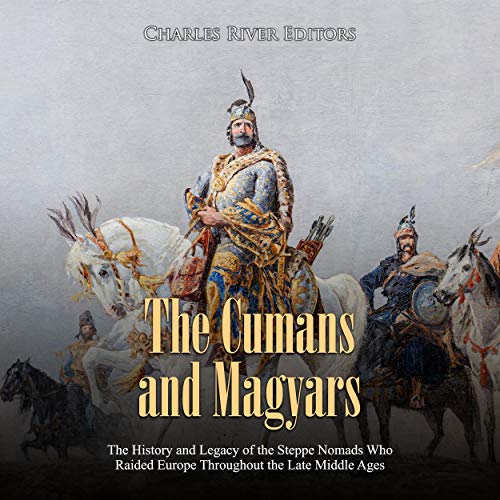
The Cumans and Magyars
Summary
Of all the steppe peoples in the medieval period, perhaps none were more important to European history than the Magyars. Like the Huns and Avars before them and the Cumans and Mongols after them, the Magyars burst into Europe as a destructive, unstoppable horde, taking whatever they wanted and leaving a steady stream of misery in their wake. They used much of the same tactics as the other steppe peoples and lived a similar, nomadic lifestyle. The Magyars also had many early cultural affinities with other steppe peoples, following a similar religion and ideas of kingship and nobility, among other things. That said, as similar as the Magyars may have been to other steppe nomads before and after them, they were noticeably different in one way: The Magyars settled down and became a part of Europe and Western Civilization in the Middle Ages. The Magyars exploded onto the European cultural scene in the late ninth century as foreign marauders, but they made alliances with many important kingdoms in less than a century and established their own dynasty in the area, roughly equivalent to the modern nation-state of Hungary. After establishing themselves as a legitimate dynasty among their European peers, the Magyars formed a sort of cultural bridge between the Roman Catholic kingdoms of Western Europe and the Orthodox Christian kingdoms of Eastern Europe. Ultimately, the Magyars chose the Roman Catholic Church, thereby becoming a part of the West and tying their fate to it for the remainder of the Middle Ages.
©2020 Charles River Editors (P)2020 Charles River Editors

Cyrus the Great: A Life from Beginning to End
Summary
Cyrus II of Persia was one of the greatest leaders that the world had ever known, he was the one in whose footsteps other empire builders would follow. From Alexander the Great to countless Roman emperors and Ottoman sultans - it was the mighty shoes of Cyrus that they all attempted to fill. Inside you will read about: Early life and legend The Persian Empire is born Love and marriage Cyrus’ last stand Aftermath and succession And much more! More than merely a successful conqueror, Cyrus the Great is known just as much for being a great liberator as he is known for his conquests. He was even credited in the Bible as the one who freed the Jews from their long-held Babylonian exile. By the time of his death, Cyrus controlled more land and people than anyone before him. Under his dominion were countless principalities, nationalities, ethnicities, and religions of all kinds. In contrast to many other powerful rulers, Cyrus did not seek to oppress his subjects or interfere with their way of life, religions, or local customs. It is for this reason that, as great as his temporal conquests may have been, the benevolence of Cyrus the Great’s leadership stands as his greatest attribute of all. The life of Cyrus the Great remains as an unparalleled testament in the annals of history.
©2019 Hourly History (P)2019 Hourly History
![Cover art for Historia de las civilizaciones [The History of Civilization]](https://m.media-amazon.com/images/I/51gv7YZxOfL._SL500_.jpg)
Historia de las civilizaciones [The History of Civilization]
Summary
El nacimiento de civilizaciones e imperios tan importantes como el Persa, el Romano o de la ciudad de Grecia; así como de conflictos bélicos que marcaron la historia de la humanidad como la segunda guerra mundial y la postguerra, son contados por la historiadora que revolucionó la forma de narrar los hechos del pasado. De la mano de Diana Uribe, usted podrá conocer todos los detalles, lugares y situaciones más significativas en el desarrollo del hombre. Con un enfoque muy particular, este audiolibro es un artículo infaltable en la "biblioteca" de cualquiera que esté interesado en conocer un poco más de la Historia Universal. En este audio libro Diana Uribe lo llevará por: El mundo de la Antigüedad y el origen de las civilizaciones. Los desarrollos de Persia, Grecia, Roma y otros pueblos europeos. El Renacimiento y el encuentro de dos mundos. Las revoluciones de los siglos XIX y XX. La Segunda Guerra Mundial y la posguerra. Las grandes transformaciones de los siglos XX y XXI. Please note: This audiobook is in Spanish.
©2008 Diana Uribe (P)2015 Penguin Random House Grupo Editorial, S. A. U.

The Amber Road
Summary
“Pytheas says that the Gutones, a people of Germany, inhabit the shores of an estuary of the Ocean called Mentonomon, their territory extending a distance of six thousand stadia; that, at one day's sail from this territory, is the Isle of Abalus, upon the shores of which, amber is thrown up by the waves in spring, it being an excretion of the sea in a concrete form; as, also, that the inhabitants use this amber by way of fuel, and sell it to their neighbors, the Teutones...” (Pliny the Elder)
The story of the Silk Road has been a popular topic among tourists, academics, economists, state parties, and daydreaming children for many centuries. In many ways the Silk Road can be seen everywhere, and it has existed for as long as people have traveled across Eurasia. Its impact is widely felt among the diverse peoples that live on the continent, through the unique regional art and architectural styles, as well as in countless films, books, academic studies, and organized tours devoted to the ancient trade routes.
At the same time, however, the Silk Road is an entirely abstract invention, first coined by the 19th century German geographer Ferdinand von Richthofen. There has never existed a single route - let alone a road - that was used to transfer goods, nor was silk the primary commodity traded across Eurasia. Instead, the Silk Road is more a multi-layered narrative about the rise and fall of nomadic confederations and sedentary societies, the consolidation and dissolution of kingdoms and empires, the exchange of commodities and fine crafts, and the transfer and mixture of ideas, religions, technology, science, art, architecture, myths, and legends. It is a story that is relevant for the present-day countries through which this exchange once took place, as they lay claim to the artifacts, heritage sites, and symbolic meaning of the Silk Road for political and economic purposes and to build their national identity.
In fact, international trade in the ancient world was a more intricate and far-reaching system than many have been led to believe. The Silk Road and the Incense Trade Route have been heavily investigated in recent decades, but the Amber Road trade network dominating northern Europe has been given far less attention. Amber, the hardened sap of prehistoric trees, has washed up on Baltic shores for generations, and though it had little value to the locals beyond religious symbolism and aesthetic beauty, they learned that foreign civilizations would pay massive sums for the beautiful substance.
Though written sources are scattered and tend to come and go depending on the civilization involved, much has been written by ancient authors, particularly of Greek and Roman origins. More importantly, archeologists have traced the spread of amber through the discovery of pieces with specific chemical construction, linking it back to the Baltic region. Once thought to have mainly been exported to Rome, Baltic amber has also been found in Mycenaean Greece, Egypt and Syria, though perhaps not surprisingly, it was Roman demand that formed the height of the amber exchange.
Perhaps even more interesting than the movement of the amber is regarding shifting trade operations from government controlled systems to private merchant enterprises to monopolies of guilds and orders, a return to government control, and finally, the selling of the trade to individual countries. It is a fascinating microcosm of changing political and governmental landscapes through millennia of change and development in northern Europe and the wider ancient Mediterranean world.
The Amber Road: The History and Legacy of the Ancient Trade Network that Moved Amber across Europe looks at the development of this crucial trade, and its impact on antiquity.
©2019 Charles River Editors (P)2019 Charles River Editors

The Influence of Pythagoras on Freemasonry
Summary
Renowned Masonic scholar Albert G. Mackey examines the role Pythagoras has played in our fraternity. He begins by examining old records and the potential origin of how the Masonic name "Peter Gower" became a synonym for Pythagoras. He points to an early Masonic reference of Pythagoras and Hermes, dating to 1450, while at the same time pointing out that many of the much later documents are devoid of his name altogether. From there, Mackey explores the history of Pythagoras and what he may have symbolized to some early masons, which would have encouraged them to adopt aspects of the famed initiate Pythagoras into the overall Masonic lore.
©2018 Lamp of Trismegistus (P)2018 Lamp of Trismegistus