The History category has 4,114 audiobooks on Listento.it, with an average listener rating of 4.4★ across 16,411 ratings. The most-rated is A Short History of Nearly Everything.

Late Antiquity: Crisis and Transformation
Summary
Edward Gibbon's Decline and Fall of the Roman Empire painted a portrait of the Roman Empire in a long, debilitating slide to oblivion, but now historians have reevaluated this picture to create a radically different understanding of the period now known as "late antiquity." Far from being a period of decline and fall, late antiquity marked one of history's great turning points. These 36 half-hour lectures take you through five momentous centuries that link the classical world with the modern, beginning with Rome near its pinnacle of power and geographical extent and ending with the Byzantine Empire, the rise of Islam, and a succession of barbarian Christian kingdoms. You'll explore key features of late antiquity including how this tripartite division occurred; the memorable rulers and religious leaders who led the way; and the architecture, visual arts, and literature of the period. You also study what it was like to live in the late antique world: How did people earn their livings? What was the role of women in society? What distinguished the great cities of the era? Nothing in Rome's previous experience compared with the ferment of late antiquity, which saw the unpredictable growth of new institutions, states, religions, and arts. After taking this course you will never think of the barbarians and the "fall" of Rome in quite the same way again. Your imagination will be alive with the incidents, innovations, and peoples of an exciting era that gave birth to us all: late antiquity.
©2008 The Teaching Company, LLC (P)2008 The Great Courses

Against the Grain
Summary
An account of all the new and surprising evidence now available for the beginnings of the earliest civilizations that contradict the standard narrative Why did humans abandon hunting and gathering for sedentary communities dependent on livestock and cereal grains and governed by precursors of today's states? Most people believe that plant and animal domestication allowed humans, finally, to settle down and form agricultural villages, towns, and states, which made possible civilization, law, public order, and a presumably secure way of living. But archaeological and historical evidence challenges this narrative. The first agrarian states, says James C. Scott, were born of accumulations of domestications: first fire, then plants, livestock, subjects of the state, captives, and finally women in the patriarchal family - all of which can be viewed as a way of gaining control over reproduction. Scott explores why we avoided sedentism and plow agriculture, the advantages of mobile subsistence, the unforeseeable disease epidemics arising from crowding plants, animals, and grain, and why all early states are based on millets and cereal grains and unfree labor. He also discusses the "barbarians" who long evaded state control, as a way of understanding continuing tension between states and nonsubject peoples.
©2017 Yale University (P)2017 Audible, Inc.

River of Darkness
Summary
From the acclaimed author of Conquistador comes this thrilling account of one of history's greatest adventures of discovery. With cinematic immediacy and meticulous attention to historical detail, here is the true story of a legendary 16th-century explorer and his death-defying navigation of the Amazon - river of darkness, pathway to gold. In 1541, the brutal conquistador Gonzalo Pizarro and his well-born lieutenant Francisco Orellana set off from Quito in search of La Canela, South America's rumored Land of Cinnamon, and the fabled El Dorado, "the golden man". Driving an enormous retinue of mercenaries, enslaved natives, horses, hunting dogs, and other animals across the Andes, they watched their proud expedition begin to disintegrate even before they descended into the nightmarish jungle, following the course of a powerful river. Soon hopelessly lost in the swampy labyrinth, their numbers diminishing daily through disease, starvation, and Indian attacks, Pizarro and Orellana made a fateful decision to separate. While Pizarro eventually returned home barefoot and in rags, Orellana and 57 men, in a few fragile craft, continued downriver into the unknown reaches of the mighty Amazon, serenaded by native war drums and the eerie cries of exotic predators. Theirs would be the greater glory.
©2011 Buddy Levy (P)2017 Tantor

The Fall of the Pagans and the Origins of Medieval Christianity
Summary
Explore the dramatic interaction between Judaism, Christianity, and paganism in Rome from the 1st to the 6th centuries. Why did pagan Rome clash with the early Christians? What was it like to be a Jew or a Christian under Roman law? And how did Christianity ultimately achieve dominance in the Roman Empire? Over the course of 24 lectures, Professor Harl enables you to grasp the full historical sweep of this critically important era and its key figures. You'll examine why Christianity was able to emerge and endure and, in turn, spark a critical transition for religion, culture, and politics that underpins much of how today's Western world - both Christian and non-Christian alike - thinks about ethics, sin, redemption, forgiveness, progress, and so much more. While the Judeo-Christian values that have shaped society's ideas are ones we might today take for granted, their emergence from an ancient era dominated by loyalties to a vast array of gods would once have seemed the most unlikely of narratives. Even after the Roman emperor Constantine converted to Christianity in A.D. 312, it would not be until the 6th-century reign of Justinian that medieval Christianity would emerge and this new historical pathway confirmed. In this magnificent course, Professor Harl brings to life some of the most important and fascinating episodes of the era, taking you on a vibrant trek through the past - one that will lead you to a deeper understanding of the bedrock beliefs of Western culture. PLEASE NOTE: When you purchase this title, the accompanying reference material will be available in your Library section along with the audio.
©2011 The Teaching Company, LLC (P)2011 The Great Courses

Turning Points in Middle Eastern History
Summary
The Middle East is a critically important area of our world. And, with its current prominence in international affairs, media images of the Middle East reach us on a daily basis. Much media coverage, however, is incomplete at best, failing to take account of either the complexities or the historical background of this pivotal region. For most of us, the real story of the Middle East remains untold. What made this crucial geopolitical area what it is today? In coming to terms with the present and future of the Middle East, an understanding of its history is not only highly valuable but essential. Now, the 36 lectures of Turning Points in Middle Eastern History unfurl a breathtaking panorama of history, exploring a 1,300-year window from the rise of the warrior prophet Muhammad to the fall of the Ottoman Empire after World War I. Each lecture focuses on a specific moment that changed the direction of events or the narrative of history. You'll witness the Battle of Karbala, where Muhammad's heirs - the Sunni and Shia - split once and for all. You'll discover the wonders of the Islamic Golden Age and marvel at the superlative advances in astronomy, mathematics, medicine, and literature - and the preservation of classical Greek and Roman wisdom - that unfolded in global centers of learning such as Baghdad, Cairo, and Cordoba. You'll follow the empire building of the Persian Safavids, the Egyptian Mamluks, and the Ottomans, among others. The breakup of the Ottoman Empire yielded most of the modern states of the Middle East. The far-reaching impacts of its rise and fall, plus the long-lasting influence of the 18th-century Saud-Wahhab Pact between a desert ruler and a religious reformer, creating today's Kingdom of Saudi Arabia, are two more expressions of how the past suffuses the present. The stories you'll discover here are as dazzling as anything in the Arabian Nights and are all the more astonishing for being true. PLEASE NOTE: When you purchase this title, the accompanying reference material will be available in your My Library section along with the audio.
©2016 The Great Courses (P)2016 The Teaching Company, LLC

The Conquering Tide
Summary
The devastation of Pearl Harbor and the American victory at Midway were prelude to a greater challenge: rolling back the vast Japanese Pacific empire island by island. This masterful history encompasses the heart of the Pacific War - the period between mid-1942 and mid-1944 - when parallel Allied counteroffensives north and south of the equator washed over Japan's far-flung island empire like a "conquering tide", concluding with Japan's irreversible strategic defeat in the Marianas. It was the largest, bloodiest, most costly, most technically innovative and logistically complicated amphibious war in history, and it fostered bitter interservice rivalries, leaving wounds that even victory could not heal. Often overlooked, these are the years and fights that decided the Pacific War. Ian W. Toll's battle scenes - in the air, at sea, and in the jungles - are simply riveting. He also takes the listener into the wartime councils in Washington and Tokyo, where politics and strategy often collided, and into the struggle to mobilize wartime production, which was the secret of Allied victory. Brilliantly researched, the narrative is propelled and colored by firsthand accounts - letters, diaries, debriefings, and memoirs - that are the raw material of the telling details, shrewd judgment, and penetrating insight of this magisterial history.
©2015 Ian W. Toll (P)2015 Recorded Books
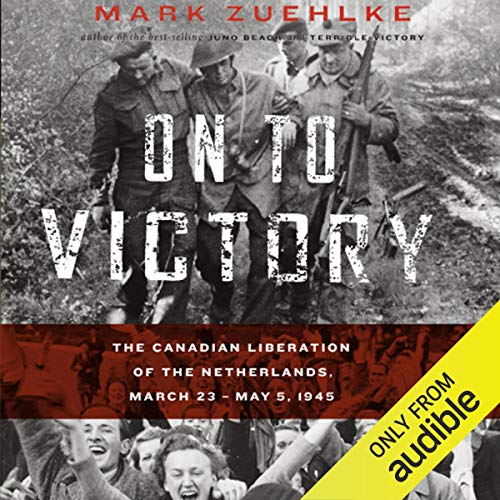
On to Victory
Summary
It is remembered in the Netherlands as "the sweetest of springs", the one that saw the country's liberation from German occupation. But for the soldiers of First Canadian army, who fought their way across the Rhine River and then through Holland and northwest Germany, that spring of 1945 was bittersweet. While the Dutch were being liberated from the grinding boot heel of the Nazis, their freedom was being paid for in Canadian lives lost. On to Victory is the story of those final cruel days of the war. From the brutal battlefields of Holland and northwest Germany where a collapsing enemy army still fought with fierce determination, to the unique truce in which the Germans and Allies provided food to millions of Dutch citizens starved almost to death, to those heady moments when each town and city was finally liberated, this is the little-told story of First Canadian Army's last campaign of World War II. With his trademark "you are there" style that draws upon official records, veteran memories, and a keen understanding of the experience of combat, Mark Zuehlke brings to life this final chapter in the story of Canada in World War II.
©2011 Mark Zuehlke (P)2011 Audible, Inc.

Shattered Sword
Summary
Many consider the Battle of Midway to have turned the tide of the Pacific War. It is without question one of the most famous battles in history. Now, for the first time since Gordon W. Prange's best-selling Miracle at Midway, Jonathan Parshall and Anthony Tully offer a new interpretation of this great naval engagement. Unlike previous accounts, Shattered Sword makes extensive use of Japanese primary sources. It also corrects the many errors of Mitsuo Fuchida's Midway: The Battle That Doomed Japan, an uncritical reliance upon which has tainted every previous Western account. It thus forces a major, potentially controversial reevaluation of the great battle. Parshall and Tully examine the battle in detail and effortlessly place it within the context of the Imperial Navy's doctrine and technology. With a foreword by leading World War II naval historian John Lundstrom, Shattered Sword is an indispensable part of any military buff's library. Shattered Sword is the winner of the 2005 John Lyman Book Award for the "Best Book in U.S. Naval History" and was cited by Proceedings as one of its "Notable Naval Books" for 2005.
©2005 Jonathan Parshall and Anthony Tully (P)2019 Tantor

Apollo 8
Summary
This program includes a bonus conversation with Commander Frank Borman plus archival audio from Apollo 8's lunar orbit and from the cockpit during the mission. The untold story of the historic voyage to the moon that closed out one of our blackest, bloodiest years with a nearly unimaginable triumph In August 1968 NASA made a bold decision: In just 16 weeks, the United States would launch humankind's first flight to the moon. Only the year before, three astronauts had burned to death in their spacecraft, and since then the Apollo program had suffered one setback after another. Meanwhile, the Russians were winning the space race, the Cold War was getting hotter by the month, and President Kennedy's promise to put a man on the moon by the end of the decade seemed sure to be broken. But when Frank Borman, Jim Lovell, and Bill Anders were summoned to a secret meeting and told of the dangerous mission, they instantly signed on. Written with all the color and verve of the best narrative nonfiction, Apollo 8 takes us from Mission Control to the astronauts' homes, from the test labs to the launchpad. The race to prepare an untested rocket for an unprecedented journey paves the way for the hair-raising trip to the moon. Then, on Christmas Day, a nation that has suffered a horrendous year of assassinations and war is heartened by an inspiring message from the trio of astronauts in lunar orbit. And when the mission is over - after the first view of the far side of the moon, the first Earth-rise, and the first reentry through the Earth's atmosphere following a flight to deep space - the impossible dream of walking on the moon suddenly seems within reach. The full story of Apollo 8 has never been told, and only Jeffrey Kluger - Jim Lovell's coauthor on their best-selling book about Apollo 13 - can do it justice. Here is the tale of a mission that was both a calculated risk and a wild crapshoot, a stirring account of how three American heroes forever changed our view of the home planet.
©2017 Jeffrey Kluger (P)2017 Macmillan Audio

The Second World War: Triumph and Tragedy
Summary
This volume of Churchill's history ofWorld Ward 2 recounts the dramatic months as the war drew to a close - the normandy landings, the liberation of western Europe, the bombing of hiroshima and Nagaski, and the surrender of Germany and Japan.
©1990 The Estate of Winston Churchill (P)2014 Audible, Inc.

Kelly
Summary
Clarence L. "Kelly" Johnson led the design of such crucial aircraft as the P-38 and Constellation, but he will be more remembered for the U-2 and SR-71 spy planes. His extraordinary leadership of the Lockheed "Skunk Works" cemented his reputation as a legendary figure in American aerospace management.
©1985 Smithsonian Institution (P)2019 Tantor

Children of Ash and Elm
Summary
The definitive history of the Vikings - from arts and culture to politics and cosmology - by a distinguished archaeologist with decades of expertise The Viking Age - from 750 to 1050 saw an unprecedented expansion of the Scandinavian peoples into the wider world. As traders and raiders, explorers and colonists, they ranged from eastern North America to the Asian steppe. But for centuries, the Vikings have been seen through the eyes of others, distorted to suit the tastes of medieval clerics and Elizabethan playwrights, Victorian imperialists, Nazis, and more. None of these appropriations capture the real Vikings, or the richness and sophistication of their culture. Based on the latest archaeological and textual evidence, Children of Ash and Elm tells the story of the Vikings on their own terms: their politics, their cosmology and religion, their material world. Known today for a stereotype of maritime violence, the Vikings exported new ideas, technologies, beliefs, and practices to the lands they discovered and the peoples they encountered, and in the process were themselves changed. From Eirík Bloodaxe, who fought his way to a kingdom, to Gudrid Thorbjarnardóttir, the most traveled woman in the world, Children of Ash and Elm is the definitive history of the Vikings and their time.
©2020 Neil Price (P)2020 Recorded Books

Twelve Years a Slave
Summary
Twelve Years a Slave is an account of actual events that took place in the life of Solomon Northup, during the pre-Civil War era of the 1840s. It follows the trials and tribulations of an educated African American man that was born into freedom and later kidnapped, taken away from his family, and forced into slavery. His story brings to life a shockingly common practice that took place during those times. In his journey, Northup, who is a native of Saratoga, New York, and has a wife with three kids, gets lured into leaving his home town by two circus promoters who ask him to accompany them to Washington, D.C., while getting paid to perform at a musical gig. This trip, which he thought would only take a few days turned in to an unimaginable voyage of deceit and great misfortune. Those few days turned into 12 long years, in which Northup was placed back into slavery in the isolated plantation country of Louisiana's Bayou Boeuf where he quickly learned that the mere mention of his past freedom would result in severe punishments or possibly his own death. His story takes a drastic turn when a heroic friend risks his own life to help deliver the news of Northup's whereabouts to his wife, in order to help him regain his freedom. This heroic act could ultimately get Northup killed or help return him back home, to his family and freedom.
©2014 A.R.N. Publications (P)2014 A.R.N. Publications

Killing the Rising Sun
Summary
The powerful and riveting new audiobook in the multimillion-selling Killing series by Bill O'Reilly and Martin Dugard. Autumn 1944. World War II is nearly over in Europe but is escalating in the Pacific, where American soldiers face an opponent who will go to any length to avoid defeat. The Japanese army follows the samurai code of Bushido, stipulating that surrender is a form of dishonor. Killing the Rising Sun takes listeners to the bloody tropical-island battlefields of Peleliu and Iwo Jima and to the embattled Philippines, where General Douglas MacArthur has made a triumphant return and is plotting a full-scale invasion of Japan. Across the globe in Los Alamos, New Mexico, Dr. J. Robert Oppenheimer and his team of scientists are preparing to test the deadliest weapon known to mankind. In Washington, DC, FDR dies in office, and Harry Truman ascends to the presidency only to face the most important political decision in history: whether to use that weapon. And in Tokyo, Emperor Hirohito, who is considered a deity by his subjects, refuses to surrender despite a massive and mounting death toll. Told in the same pause-resistant style of Killing Lincoln, Killing Kennedy, Killing Jesus, Killing Patton, and Killing Reagan, this epic saga details the final moments of World War II like never before.
©2016 Bill O'Reilly & Martin Dugard (P)2016 Macmillan Audio

Great Ancient Civilizations of Asia Minor
Summary
Embark on an unforgettable trip into the historical glories of the past with these 24 lectures that immerse you in the history of an often overlooked region of the ancient world. With Professor Harl as your guide, you'll plunge into the history of Asia Minor's great ancient civilizations and come face to face with eye-opening historical milestones. Among these: the rise of the Hittites, the legendary Trojan War, the birth of Western philosophy, the fiery Greek and Persian Wars, the victories of Alexander the Great, the dawn of the Hellenistic Age, the spread of early Christianity, the golden age of Byzantium, the birth of the Ottoman Empire, and much more. Cultural change and continuity are the main themes of these lectures. You'll come to see how each successive civilization inherited and modified the political, social, religious, and economic institutions of its predecessor. In fact, the scope of Anatolian history can be best understood as a series of major cultural and religious rewrites: first by the Hittite emperors; then by the elites of Hellenic cities; next by their Hellenized descendants in the Roman age; then by Christian emperors and bishops in the Byzantine age; and, finally, by Turkish rulers and Muslim mystics. To give you a stronger sense of that continuity (and the various changes that are a part of it), these lectures are organized into five cultural components: Early Anatolia (from 6000 to 500 B.C.), Hellenized Anatolia (from 750 to 31 B.C.), Roman Asia Minor (from 200 B.C. to 395 A.D.), Byzantium (from 395 to 1453), and Islamic Turkey (since 1071).
©2001 The Teaching Company, LLC (P)2001 The Great Courses

The Birth of Britain
Summary
The English-speaking peoples comprise perhaps the greatest number of human beings sharing a common language in the world today. These people also share a common heritage. For his four-volume work, Sir Winston Churchill took as his subject these great elements in world history. Volume 1 commences in 55 BC, when Julius Caesar famously "turned his gaze upon Britain" and concludes with the Battle of Bosworth in 1485.
©2014 Audible, Inc. (P)2014 Audible, Inc.

Stalingrad
Summary
Tantor Audio presents the complete audio version of the long-awaited one-volume campaign history from the leading experts of the decisive clash of Nazi and Soviet forces at Stalingrad. Stalingrad is an abridged edition of the five-volume Stalingrad Trilogy.
©2017 The University Press of Kansas (P)2017 Tantor

The Sleepwalkers
Summary
The Sleepwalkers is historian Christopher Clark's riveting account of the explosive beginnings of World War I. Drawing on new scholarship, Clark offers a fresh look at World War I, focusing not on the battles and atrocities of the war itself but on the complex events and relationships that led a group of well-meaning leaders into brutal conflict. Clark traces the paths to war in a minute-by-minute, action-packed narrative that cuts between the key decision centers in Vienna, Berlin, St. Petersburg, Paris, London, and Belgrade, and he examines the decades of history that informed the events of 1914 and details the mutual misunderstandings and unintended signals that drove the crisis forward in a few short weeks. Meticulously researched and masterfully written, The Sleepwalkers is a dramatic and authoritative chronicle of Europe's descent into a war that tore the world apart.
©2012 Christopher Clark (P)2014 Tantor

How to Be a Victorian
Summary
Penguin presents the audiobook edition of How to Be a Victorian by Ruth Goodman, read by Patience Tomlinson. How to be a Victorian - a time traveller's guide to Victorian Britain by the BBC's Ruth Goodman. We know what life was like for Victoria and Albert. But what was it like for a commoner like you or me? How did it feel to cook with coal and wash with tea leaves? Drink beer for breakfast and clean your teeth with cuttlefish? Dress in whalebone and feed opium to the baby? Surviving everyday life came down to the gritty details, the small necessities and tricks of living. Drawing on Ruth's unique first-hand experience, gained from living on a Victorian farm for a year, this book will teach you everything you need to know about 19th-century living. If you liked A Time Traveller's Guide to Medieval England or If Walls Could Talk, you will love this book.
©2018 Ruth Goodman (P)2018 Penguin Books Ltd

Energy
Summary
Pulitzer Prize- and National Book Award-winning author Richard Rhodes reveals the fascinating history behind energy transitions over time - wood to coal to oil to electricity and beyond. People have lived and died, businesses have prospered and failed, and nations have risen to world power and declined, all over energy challenges. Ultimately, the history of these challenges tells the story of humanity itself. Through an unforgettable cast of characters, Pulitzer Prize-winning author Richard Rhodes explains how wood gave way to coal and coal made room for oil, as we now turn to natural gas, nuclear power, and renewable energy. Rhodes looks back on five centuries of progress, through such influential figures as Queen Elizabeth I, King James I, Benjamin Franklin, Herman Melville, John D. Rockefeller, and Henry Ford. In Energy, Rhodes highlights the successes and failures that led to each breakthrough in energy production, from animal and water power to the steam engine, from internal combustion to the electric motor. He addresses how we learned from such challenges, mastered their transitions, and capitalized on their opportunities. Rhodes also looks at the current energy landscape, with a focus on how wind energy is competing for dominance with cast supplies of coal and natural gas. He also addresses the specter of global warming and a population hurtling toward 10 billion by 2100. Human beings have confronted the problem of how to draw life from raw material since the beginning of time. Each invention, each discovery, each adaptation brought further challenges, and through such transformations we arrived at where we are today. In Rhodes’ singular style, Energy details how this knowledge of our history can inform our way tomorrow.
©2018 Richard Rhodes (P)2018 Simon & Schuster Audio