The History category has 4,114 audiobooks on Listento.it, with an average listener rating of 4.4★ across 16,411 ratings. The most-rated is A Short History of Nearly Everything.

Empires of the Sea
Summary
Empires of the Sea tells the story of the 50-year world war between Islam and Christianity for the Mediterranean: one of the fiercest and most influential contests in European history. It traces events from the appearance on the world stage of Suleiman the Magnificent - the legendary ruler of the Ottoman Empire - through "the years of devastation" when it seemed possible that Islam might master the whole sea, to the final brief flourishing of a united Christendom in 1571. The core of the story is the six years of bitter and bloody conflict between 1565 and 1571 that witnessed a fight to the finish. It was a tipping point in world civilization, a fast-paced struggle of spiraling intensity that led from the siege of Malta and the battle for Cyprus to the pope's last-gasp attempt to rekindle the spirit of the Crusades and the apocalypse at Lepanto. It features a rich cast of characters: Suleiman the Magnificent, greatest of Ottoman sultans; Hayrettin Barbarossa, the pirate who terrified Europe; the Knights of St. John, last survivors of the medieval crusading spirit; the aged visionary Pope Pius V; and the meteoric, brilliant Christian general, Don John of Austria. It is also a narrative about places: the shores of the Bosphorus, the palaces and shipyards of the Venetian lagoon, the barren rocks of Malta, the islands of Greece, the slave markets of Algiers - and the character of the sea itself, with its complex pattern of winds and weather, which provided the conditions and the field of battle. It involves all the peoples who border the Great Sea: Italians, Turks, Greeks, Spaniards, the French and the people of North Africa. This story is one of extraordinary color and incident, rich in detail, full of surprises, and backed by a wealth of eyewitness accounts. Its denouement, the battle of Lepanto, is a single action of quite shocking impact - considered at the time in Christian Europe to be "a day to end all days".
©2008 Roger Crowley (P)2008 Tantor

Churchill's Secret Warriors
Summary
In the bleak moments after defeat on mainland Europe in winter 1939, Winston Churchill knew that Britain had to strike back hard. So Britain's wartime leader called for the lightning development of a completely new kind of warfare, recruiting a band of eccentric free-thinking warriors to become the first 'deniable' secret operatives to strike behind enemy lines, offering these volunteers nothing but the potential for glory and all-but-certain death. Churchill's Secret Warriors tells the story of the daring victories for this small force of 'freelance pirates', undertaking devastatingly effective missions against the Nazis, often dressed in enemy uniforms and with enemy kit, breaking all previously held rules of warfare. Master storyteller Damien Lewis brings the adventures of the secret unit to life, weaving together the stories of the soldiers' brotherhood in this compelling narrative, from the unit's earliest missions to the death of their leader just weeks before the end of the war.
©2014 Damien Lewis (P)2014 WF Howes Ltd

The Liri Valley
Summary
For the Allied armies fighting their way up the Italian boot in early 1944, Rome was the prize that could only be won through a massive offensive. Military historian Mark Zuehlke returns to the Mediterranean theater of World War II with this gripping tribute to the Canadians who opened the way for the Allies to take Rome. The book is a fitting testament to the bravery of soldiers like the badly wounded Captain Pierre Potvin, who survived more than 30 hours alone on the battlefield.
©2004 Mark Zuehlke (P)2011 Audible, Inc.

Dynasty
Summary
Dynasty tells the story of Rome's first dynasty of emperors, from its establishment by Augustus Caesar in the last decades of the first century BC to its final, florid extinction less than a century later. The line of autocrats known to historians as the 'Julio-Claudians' remains to this day a byword for depravity. The brilliance of its allure and the blood-steeped shadows cast by its crimes still haunt the public imagination. When people think of imperial Rome, it is the cities of Tiberius and Caligula, of Claudius and Nero that are most likely to come into their minds. Dynasty Tom Holland provides not only a compelling history of this fascinating family but a portrait of the entire Roman world.
©2015 Tom Holland (P)2015 Hachette Audio

The Heart of Everything That Is
Summary
The acclaimed New York Times best-selling biography of the legendary Sioux warrior Red Cloud: “a page-turner with remarkable immediacy...and the narrative sweep of a great Western” (The Boston Globe). Red Cloud was the only American Indian in history to defeat the United States Army in a war, forcing the government to sue for peace on his terms. At the peak of Red Cloud’s powers the Sioux could claim control of one-fifth of the contiguous United States and the loyalty of thousands of fierce fighters. But the fog of history has left Red Cloud strangely obscured. Now, thanks to the rediscovery of a lost autobiography, and painstaking research by two award-winning authors, the story of the 19th century’s most powerful and successful Indian warrior can finally be told. In The Heart of Everything That Is, Bob Drury and Tom Clavin restore Red Cloud to his rightful place in American history in a sweeping and dramatic narrative based on years of primary research. As they trace the events leading to Red Cloud’s War, they provide intimate portraits of the many lives Red Cloud touched - mountain men such as Jim Bridger; US generals like William Tecumseh Sherman, who were charged with annihilating the Sioux; fearless explorers, such as the dashing John Bozeman; and the memorable warriors whom Red Cloud groomed, like the legendary Crazy Horse. And at the center of the story is Red Cloud, fighting for the very existence of the Indian way of life. “Unabashed, unbiased, and disturbingly honest, leaving no razor-sharp arrowhead unturned, no rifle trigger unpulled....a compelling and fiery narrative” (USA Today), this is the definitive chronicle of the conflict between an expanding white civilization and the Plains Indians who stood in its way.
©2013 Bob Drury and Tom Clavin (P)2013 Simon & Schuster Audio

The Dead Hand
Summary
Pulitzer Prize, General Nonfiction, 2010This riveting narrative history of the end of the arms race sheds new light on the frightening last chapters of the Cold War and the legacy of the nuclear, chemical, and biological weapons that remain a threat today. During the Cold War, world superpowers amassed nuclear arsenals containing the explosive power of one million Hiroshimas. The Soviet Union secretly plotted to create the "Dead Hand," a system designed to launch an automatic retaliatory nuclear strike on the United States, and developed a fearsome biological warfare machine. President Ronald Reagan, hoping to awe the Soviets into submission, pushed hard for the creation of space-based missile defenses. In the first full account of how the arms race finally ended, The Dead Hand provides an unprecedented look at the inner motives and secret decisions of each side. Drawing on top-secret documents from deep inside the Kremlin, memoirs, and interviews in both Russia and the United States, David Hoffman introduces the scientists, soldiers, diplomats, and spies who saw the world sliding toward disaster and tells the gripping story of how Reagan, Gorbachev, and many others struggled to bring the madness to an end. When the Soviet Union dissolved, the danger continued, and the United States began a race against time to keep nuclear and biological weapons out of the hands of terrorists and and rogue states.
©2009 David Hoffman (P)2009 Random House

The Fight for History
Summary
National best seller A masterful telling of the way World War Two has been remembered, forgotten, and remade by Canada over 75 years. The Second World War shaped modern Canada. It led to the country's emergence as a middle power on the world stage; the rise of the welfare state; industrialization, urbanization, and population growth. After the war, Canada increasingly turned toward the United States in matters of trade, security, and popular culture, which then sparked a desire to strengthen Canadian nationalism from the threat of American hegemony. The Fight for History examines how Canadians framed and reframed the war experience over time. Just as the importance of the battle of Vimy Ridge to Canadians rose, fell, and rose again over a 100-year period, the meaning of Canada's Second World War followed a similar pattern. But the Second World War's relevance to Canada led to conflict between veterans and others in society - more so than in the previous war - as well as a more rapid diminishment of its significance. By the end of the 20th century, Canada's experiences in the war were largely framed as a series of disasters. Canadians seemed to want to talk only of the defeats at Hong Kong and Dieppe or the racially driven policy of the forced relocation of Japanese-Canadians. In the history books and media, there was little discussion of Canada's crucial role in the Battle of the Atlantic, the success of its armies in Italy and other parts of Europe, or the massive contribution of war materials made on the home front. No other victorious nation underwent this bizarre reframing of the war, remaking victories into defeats. The Fight for History is about the efforts to restore a more balanced portrait of Canada's contribution in the global conflict. This is the story of how Canada has talked about the war in the past, how we tried to bury it, and how it was restored. This is the history of a constellation of changing ideas, with many historical twists and turns, and a series of fascinating actors and events.
©2020 Tim Cook (P)2020 Penguin Random House Canada

The Age of Napoleon
Summary
An engrossing volume on European civilization by Pulitzer Prize-winning historians Will and Ariel Durant. The Age of Napoleon, the 11th and final volume of the Story of Civilization, surveys the amazing chain of events that wrenched Europe out of the Enlightenment and into the age of democracy. In this masterful work, listeners will encounter the French Revolution from the storming of the Bastille to the guillotining of the king; the revolution's leaders - Danton, Desmoulins, Robespierre, and Saint-Just - all cut down by the reign of terror they inaugurated; Napoleon's meteoric rise from provincial Corsican military student to emperor and commander of the largest army in history; Napoleon's fall - his army's destruction in the snows of Russia, his exile to Elba, his escape and reconquest of the throne, and his ultimate defeat at Waterloo by the combined forces of Europe; and the birth of Romanticism and the dawning of a new age of active democracy and a rising middle class, laying the foundation for a new era.
©1975 Will and Ariel Durant (P)2015 Blackstone Audio, Inc.

The Chosen Few
Summary
The story of one of the Afghanistan war's most decorated units and their 15-month ordeal, culminating in the Battle of Wanat, the deadliest battle of the war. A single company of US paratroopers - calling themselves the "Chosen Few" - arrived in eastern Afghanistan in late 2007 hoping to win the hearts and minds of the remote mountain people and extend the Afghan government's reach into this wilderness. Instead, they spent the next 15 months in a desperate struggle, living under almost continuous attack, forced into a slow and grinding withdrawal, and always outnumbered by Taliban fighters descending on them from all sides. Month after month, rocket-propelled grenades, rockets, and machine-gun fire poured down on the isolated and exposed paratroopers as America's focus and military resources shifted to Iraq. Just weeks before the paratroopers were to go home, they faced their last - and toughest - fight. Near the village of Wanat in Nuristan province, an estimated 300 enemy fighters surrounded about 50 of the Chosen Few and others defending a partially finished combat base. Nine died and more than two dozen were wounded that day in July 2008, making it arguably the bloodiest battle of the war in Afghanistan. The Chosen Few would return home tempered by war. Two among them would receive the Medal of Honor. All of them would be forever changed. PLEASE NOTE: When you purchase this title, the accompanying reference material will be available in your Library section along with the audio.
©2017 Gregg Zoroya (P)2018 Hachette Audio

Turning Points in Medieval History
Summary
For an accurate picture of how the political, social, and religious structure of present-day Europe came to be - and even why we're speaking English today - studying the key events between the years 500 and 1500 is of critical import. These 24 gripping lectures deliver an unparalleled look at these moments that profoundly changed the arc of history, and they weave the era's vast array of disparate events into an interconnected tapestry that illuminates why nothing exists in a vacuum. Among the events you'll experience: the moment in 711 A.D. when Tariq ibn Zayid conquered Spain and created the unusually tolerant society of Al-Andalus; the 1152 marriage between Eleanor of Aquitaine and Henry Plantagenet, which led to the Hundred Years' War and the War of the Roses; and the composition of Fibonacci's Liber Abaci in 1202, which transformed the medieval world of business, banking, and commerce. These are just three of the many turning points in the history of medieval Europe that prove the Middle Ages were far from "dark." Throughout these lectures, you'll investigate events, such as the Norman conquest of England in 1066, where the impact was immediate and tangible. In others, like the Great Schism between the Eastern and Western churches, the importance was not recognized for years; some developments had effects so gradual that their significance can only be recognized from the vantage point of history. Methodical and meticulous in its approach to a labyrinthine age, these lectures will help you understand why the West's transition from the classical to the early modern was a fluid, ongoing process rather than the result of a single pivotal moment. PLEASE NOTE: When you purchase this title, the accompanying reference material will be available in your Library section along with the audio.
©2012 The Teaching Company, LLC (P)2012 The Great Courses

Histories
Summary
In this, the first prose history in European civilization, Herodotus describes the growth of the Persian Empire with force, authority, and style. Perhaps most famously, the book tells the heroic tale of the Greeks' resistance to the vast invading force assembled by Xerxes, king of Persia. Here are not only the great battles - Marathon, Thermopylae, and Salamis - but also penetrating human insight and a powerful sense of epic destiny at work. PLEASE NOTE: When you purchase this title, the accompanying reference material will be available in your Library section along with the audio.
Public Domain (P)2016 Naxos AudioBooks

Armor and Blood
Summary
While the Battle of Kursk has long captivated World War II aficionados, it has been unjustly overlooked by historians. Drawing on the masses of new information made available by the opening of the Russian military archives, Dennis E. Showalter at last corrects that error. This battle was the critical turning point on World War II's Eastern Front. In the aftermath of the Red Army's brutal repulse of the Germans at Stalingrad, the stakes could not have been higher. More than 3,000,000 men and 8,000 tanks met in the heart of the Soviet Union, some 400 miles south of Moscow, in an encounter that both sides knew would reshape the war. The adversaries were at the peak of their respective powers. On both sides, the generals and the dictators they served were in agreement on where, why, and how to fight. The result was a furious death grapple between two of history's most formidable fighting forces - a battle that might possibly have been the greatest of all time. In Armor and Blood, Showalter recreates every aspect of this dramatic struggle. He offers expert perspective on strategy and tactics at the highest levels, from the halls of power in Moscow and Berlin to the battlefield command posts on both sides. But it is the author's exploration of the human dimension of armored combat that truly distinguishes this book. In the classic tradition of John Keegan's The Face of Battle, Showalter's narrative crackles with insight into the unique dynamics of tank warfare - its effect on men's minds as well as their bodies. Scrupulously researched, exhaustively documented, and vividly illustrated, this book is a chilling testament to man's ability to build and to destroy. When the dust settled, the field at Kursk was nothing more than a wasteland of steel carcasses, dead soldiers, and smoking debris. The Soviet victory ended German hopes of restoring their position on the Eastern Front, and put the Red Army on the road to Berlin. Armor and Blood presents listeners with what will likely be the authoritative study of Kursk for decades to come.
©2013 Dennis Showalter (P)2013 Tantor
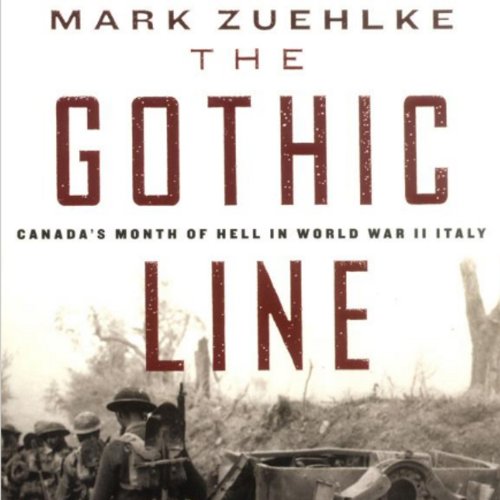
The Gothic Line
Summary
Stretching like an armor-toothed belt across Italy's upper thigh, the Gothic Line was the most fortified position the German army had yet thrown into the Allied forces' path. On August 25, 1944, it fell to Canadian troops to spearhead a major offensive: to rip through that fiercely defended line. This gripping chronicle tells, through the eyes of the soldiers who fought there, of the 28-day clash that ultimately ended in glory for the Canadians.
©2003 Mark Zuehlke 2003 (P)2013 Audible, Inc.

The Unwomanly Face of War
Summary
A long-awaited English translation of the groundbreaking oral history of women in World War II across Europe and Russia - from the winner of the Nobel Prize in Literature “A landmark.” (Timothy Snyder, author of On Tyranny: Twenty Lessons from the Twentieth Century) For more than three decades, Svetlana Alexievich has been the memory and conscience of the twentieth century. When the Swedish Academy awarded her the Nobel Prize, it cited her invention of “a new kind of literary genre,” describing her work as “a history of emotions...a history of the soul.” In The Unwomanly Face of War, Alexievich chronicles the experiences of the Soviet women who fought on the front lines, on the home front, and in the occupied territories. These women - more than a million in total - were nurses and doctors, pilots, tank drivers, machine-gunners, and snipers. They battled alongside men, and yet, after the victory, their efforts and sacrifices were forgotten. Alexievich traveled thousands of miles and visited more than a hundred towns to record these women’s stories. Together, this symphony of voices reveals a different aspect of the war - the everyday details of life in combat left out of the official histories. Translated by the renowned Richard Pevear and Larissa Volokhonsky, The Unwomanly Face of War is a powerful and poignant account of the central conflict of the 20th century, a kaleidoscopic portrait of the human side of war. “But why? I asked myself more than once. Why, having stood up for and held their own place in a once absolutely male world, have women not stood up for their history? Their words and feelings? They did not believe themselves. A whole world is hidden from us. Their war remains unknown...I want to write the history of that war. A women’s history.” (Svetlana Alexievich) Read by Julia Emelin, Yelena Shmulenson, Allen Lewis Rickman, and Alan Winter THE WINNER OF THE NOBEL PRIZE IN LITERATURE “[F]or her polyphonic writings, a monument to suffering and courage in our time.” “A mighty documentarian and a mighty artist... Her books are woven from hundreds of interviews, in a hybrid form of reportage and oral history that has the quality of a documentary film on paper. But Alexievich is anything but a simple recorder and transcriber of found voices; she has a writerly voice of her own which emerges from the chorus she assembles, with great style and authority, and she shapes her investigations of Soviet and post-Soviet life and death into epic dramatic chronicles as universally essential as Greek tragedies.” (The New Yorker)
©2017 Svetlana Alexievich (P)2017 Random House Audio

Murdered Midas
Summary
A gold mine. A millionaire. An island paradise. An unsolved murder. A missing fortune. The story of the infamous Sir Harry Oakes as only Charlotte Gray can tell it. On an island paradise in 1943, Sir Harry Oakes, gold-mining tycoon, philanthropist, and "richest man in the Empire", was murdered. The news of his death surged across the English-speaking world, from London, the Imperial center, to the remote Canadian mining town of Kirkland Lake, in the Northern Ontario bush. The murder became celebrated as "the crime of the century". The layers of mystery deepened as the involvement of Oakes' son-in-law, Count Alfred de Marigny, came quickly to be questioned, as did the odd machinations of the governor of the Bahamas, the former King Edward VIII. Despite a sensational trial, no murderer was ever convicted. Rumors were unrelenting about Oakes' missing fortune, and fascination with the Oakes story has persisted for decades. Award-winning biographer and popular historian Charlotte Gray explores, for the first time, the life of the man behind the scandal, a man who was both reviled and admired - from his early, hardscrabble days of mining exploration, to his explosion of wealth, to his grandiose gestures of philanthropy. And Gray brings fresh eyes to the bungled investigation and shocking trial in the remote colonial island streets, proposing an overlooked suspect in this long-cold case. Murdered Midas is the story of the man behind the newspaper headlines, who despite his wealth and position was never able to have justice. PLEASE NOTE: When you purchase this title, the accompanying PDF will be available in your Audible Library along with the audio.
©2019 Charlotte Gray (P)2019 HarperCollins Publishers

The Last Battle
Summary
The classic account of the final offensive against Hitler’s Third Reich. The Battle for Berlin was the culminating struggle of World War II in the European theater. The last offensive against Hitler’s Third Reich, it devastated one of Europe’s historic capitals and marked the final defeat of Nazi Germany. It was also one of the war’s bloodiest and most pivotal battles, whose outcome would shape international politics for decades to come. The Last Battle is Cornelius Ryan’s compelling account of this final battle, a story of brutal extremes, of stunning military triumph alongside the stark conditions that the civilians of Berlin experienced in the face of the Allied assault. As always, Ryan delves beneath the military and political forces that were dictating events to explore the more immediate imperatives of survival, where, as the author describes it, “to eat had become more important than to love, to burrow more dignified than to fight, to endure more militarily correct than to win.” The Last Battle is the story of ordinary people, both soldiers and civilians, caught up in the despair, frustration, and terror of defeat. It is history at its best, a masterful illumination of the effects of war on the lives of individuals, and one of the enduring works on World War II.
©1966 Cornelius Ryan; 1994 by Victoria Ryan Bida and Geoffrey J. M. Ryan (P)2012 Blackstone Audio, Inc.

Holding Juno
Summary
At D-Day's end, the Canadians, who had landed on Juno Beach, were six miles inland - the deepest penetration achieved by Allied forces on this infamous day. But every soldier on this front line knew worse was yet to come. For in the darkness the Germans were massing, intent on throwing them back to sea. With dramatic intensity, Holding Juno re-creates the ensuing battle and ultimate Canadian triumph and includes fascinating first-person soldier accounts as well as photos and maps.
©2005 Mark Zuehlke (P)2013 Audible, Inc.

Hue 1968
Summary
Not since his New York Times best seller Black Hawk Down has Mark Bowden written a book about a battle. His most ambitious work yet, Hu? 1968, is the story of the centerpiece of the Tet Offensive and a turning point in the American War in Vietnam. By January 1968, despite an influx of half a million American troops, the fighting in Vietnam seemed to be at a stalemate. Yet General William Westmoreland, commander of American forces, announced a new phase of the war in which "the end begins to come into view". The North Vietnamese had different ideas. In mid-1967, the leadership in Hanoi had started planning an offensive intended to win the war in a single stroke. Part military action and part popular uprising, the Tet Offensive included attacks across South Vietnam, but the most dramatic and successful would be the capture of Hu?, the country's cultural capital. At 2:30 a.m. on January 31, 10,000 National Liberation Front troops descended from hidden camps and surged across the city of 140,000. By morning, all of Hu? was in Front hands save for two small military outposts. The commanders in country and politicians in Washington refused to believe the size and scope of the Front's presence. Captain Chuck Meadows was ordered to lead his 160-marine Golf Company against thousands of enemy troops in the first attempt to reenter Hu? later that day. After several futile and deadly days, Lieutenant Colonel Ernie Cheatham would finally come up with a strategy to retake the city, block by block and building by building, in some of the most intense urban combat since World War II. With unprecedented access to war archives in the US and Vietnam and interviews with participants from both sides, Bowden narrates each stage of this crucial battle through multiple points of view. Played out over 24 days of terrible fighting and ultimately costing 10,000 combatant and civilian lives, the Battle of Hu? was by far the bloodiest of the entire war. When it ended, the American debate was never again about winning, only about how to leave. In Hu? 1968, Bowden masterfully reconstructs this pivotal moment in the American War in Vietnam.
©2017 Mark Bowden (P)2017 Audible, Inc.

Amazing Grace
Summary
Amazing Grace tells the story of the remarkable life of the British abolitionist William Wilberforce (1759-1833). This accessible biography chronicles Wilberforce's extraordinary role as a human rights activist, cultural reformer, and member of Parliament. At the center of this heroic life was a passionate 20-year fight to abolish the British slave trade, a battle Wilberforce won in 1807, as well as efforts to abolish slavery itself in the British colonies, a victory achieved just three days before his death in 1833. Metaxas discovers in this unsung hero a man of whom it can truly be said, "He changed the world." Before Wilberforce, few thought slavery was wrong. After Wilberforce, most societies in the world came to see it as a great moral wrong. This account of Wilberforce's life will help many to become acquainted with an exceptional man who was a hero to Abraham Lincoln and an inspiration to the anti-slavery movement in America.
©2007 Eric Metaxas (P)2007 Tantor Media Inc.

A History of the World
Summary
From the earliest civilizations to the 21st century: a global journey through human history, published alongside a landmark BBC One television series. Our understanding of world history is changing, as new discoveries are made on all the continents and old prejudices are being challenged. In this truly global journey, Andrew Marr revisits some of the traditional epic stories, from classical Greece and Rome to the rise of Napoleon, but surrounds them with less familiar material, from Peru to the Ukraine, China to the Caribbean. He looks at cultures that have failed and vanished, as well as the origins of today’s superpowers, and finds surprising echoes and parallels across vast distances and epochs. This is a book about the great change-makers of history and their times, people such as Cleopatra, Genghis Khan, Galileo, and Mao, but it is also a book about us. For 'The better we understand how rulers lose touch with reality, or why revolutions produce dictators more often than they produce happiness, or why some parts of the world are richer than others, the easier it is to understand our own times.' Fresh, exciting and vividly listenable, this is popular history at its very best.
©2012 Andrew Marr (P)2012 Macmillan Digital Audio