The History category has 4,114 audiobooks on Listento.it, with an average listener rating of 4.4★ across 16,411 ratings. The most-rated is A Short History of Nearly Everything.

Understanding Imperial China: Dynasties, Life, and Culture
Summary
A knowledge of China's imperial history is vital for any understanding of its present, as modern China is linked in many ways to the extraordinary culture of its empire. These 24 lectures take you to the heart of life during China's imperial era, through the lives of individual subjects of all social ranks. Across the arc of the course, you'll witness what daily life was like for government bureaucrats, for scholars, for women of the court, for soldiers, merchants, craftspeople, courtesans, imperial cooks, and many others - all against the backdrop of the diversity, the genius, and the majesty of imperial China. You'll hear about such memorable sights as the grand boulevards; splendorous palaces; imposing temples of Chang'an, the medieval world's greatest city; and the Qingming Shanghetu, a 17-foot painted scroll that gloriously portrays Song Dynasty life. And you'll meet unforgettable human beings, whose lives vividly reveal the world around them, such as Ban Zhao, Han-era woman of letters, poet, scholar, and teacher; Tao Yuanming, Daoist luminary and the empire's first great poet; Zhu Yuanzhang, powerful warlord and founder of the Ming Dynasty; and Hong Xiuquan, visionary reformer and architect of the religiously inspired Taiping Rebellion. Understanding Imperial China: Dynasties, Life, and Culture is your passport to this incredible, historic world. PLEASE NOTE: When you purchase this title, the accompanying reference material will be available in your Library section along with the audio.
©2017 The Teaching Company, LLC (P)2017 The Great Courses

The Vietnam War
Summary
From the award-winning historian and filmmakers of The Civil War, Baseball, The War, The Roosevelts, and others: a vivid, uniquely powerful history of the conflict that tore America apart - the companion volume to the major multipart PBS film to be aired in September 2017. More than 40 years after it ended, the Vietnam War continues to haunt our country. We still argue over why we were there, whether we could have won, and who was right and wrong in their response to the conflict. When the war divided the country, it created deep political fault lines that continue to divide us today. Now, continuing in the tradition of their critically acclaimed collaborations, the authors draw on dozens and dozens of interviews in America and Vietnam to give us the perspectives of people involved at all levels of the war: US and Vietnamese soldiers and their families, high-level officials in America and Vietnam, antiwar protestors, POWs, and many more. The book plunges us into the chaos and intensity of combat, even as it explains the rationale that got us into Vietnam and kept us there for so many years. Rather than taking sides, the book seeks to understand why the war happened the way it did and to clarify its complicated legacy. Beautifully written, this is a tour de force that is certain to launch a new national conversation.
©2017 Geoffrey C. Ward and Ken Burns (P)2017 Random House Audio

Ice Ghosts
Summary
The spellbinding story of the greatest cold case in Arctic history - and how the rare mix of marine science and Inuit knowledge finally led to the recent discovery of the shipwrecks. Spanning nearly 200 years, Ice Ghosts is a fast-paced detective story about Western science, indigenous beliefs, and the irrepressible spirit of exploration and discovery. It weaves together an epic account of the legendary Franklin Expedition of 1845 - whose two ships, the HMS Erebus and the HMS Terror, and their crew of 129 were lost to the Arctic ice - with the modern tale of the scientists, researchers, divers, and local Inuit behind the recent discoveries of the two ships, which made news around the world. The journalist Paul Watson was on the icebreaker that led the expedition that discovered the HMS Erebus in 2014, and he broke the news of the discovery of the HMS Terror in 2016. In a masterful work of history and contemporary reporting, he tells the full story of the Franklin Expedition: Sir John Franklin and his crew setting off from England in search of the fabled Northwest Passage; the hazards they encountered and the reasons they were forced to abandon ship after getting stuck in the ice hundreds of miles from the nearest outpost of Western civilization; and the dozens of search expeditions over more than 160 years, which collectively have been called "the most extensive, expensive, perverse, and ill-starred...manhunt in history". All that searching turned up a legendary trail of sailors' relics, a fabled note, a lifeboat with skeletons lying next to loaded rifles, and rumors of cannibalism...but no sign of the ships until, finally, the discoveries in our own time. As Watson reveals, the epic hunt for the lost Franklin Expedition found success only when searchers combined the latest marine science with faith in Inuit lore that had been passed down orally for generations. Ice Ghosts is narrative nonfiction of the highest order, full of drama and rich in characters: Lady Jane Franklin, who almost single-handedly kept the search alive for decades; an Inuit historian who worked for decades gathering elders' accounts; an American software billionaire who launched his own hunt; and underwater archaeologists honing their skills to help find the ships. Watson also shows how the hunt for the Franklin Expedition was connected to such technological advances as scuba gear and sonar technology and how it ignited debates over how to preserve the relics discovered with the ships. A modern adventure story that arcs back through history, Ice Ghosts tells the complete and incredible story of the Franklin Expedition - the greatest of Arctic mysteries - for the ages.
©2017 Paul Watson (P)2017 Penguin Random House Canada

World War I: The Great War
Summary
Touched off by a terrorist act in Bosnia and spreading all too quickly beyond the expectations of those who were involved, World War I was an unprecedented catastrophe with a ghastly cost. After this first "total war" - the first conflict involving entire societies mobilized to wage unrestrained war, devoting all their wealth, industries, institutions, and the lives of their citizens to win victory at any price - the world itself would never be the same. These 36 riveting half-hour lectures cut through the tangle of historical data to uncover the patterns that make sense of complex events. Whereas most World War I narratives focus on the Western Front in France and Flanders, with its mazelike trenches, gas attacks, constant shelling, assaults "over the top" into withering machine gun fire, and duels of dog-fighting aviators in the sky, Professor Liulevicius also devotes great attention to other important arenas, including the Eastern Front, the Southern Fronts, the War at Sea, the Arab Revolt, the Communist Revolution, the Armenian Massacre, the Spanish Influenza, and more. Professor Liulevicius combines chronological and thematic approaches for a sweeping survey of World War I's many dimensions. He explores themes such as the surprising eagerness of all parties to plunge into mutual slaughter, the unexpected endurance of societies undergoing total war, the radically different hopes and hatreds that the war evoked, with remarkable contrasts between western and eastern Europe, the meanings that the different sides ascribed to the war, and the role of various ideologies in the war's course and conduct. PLEASE NOTE: When you purchase this title, the accompanying reference material will be available in your Library section along with the audio.
©2006 The Teaching Company, LLC (P)2006 The Great Courses

Inglorious Empire
Summary
In the 18th century, India's share of the world economy was as large as Europe's. By 1947, after two centuries of British rule, it had decreased six-fold. Beyond conquest and deception, the Empire blew rebels from cannons, massacred unarmed protesters, entrenched institutionalized racism, and caused millions to die from starvation. British imperialism justified itself as enlightened despotism for the benefit of the governed, but Shashi Tharoor takes on and demolishes this position, demonstrating how every supposed imperial "gift" - from the railways to the rule of law - was designed in Britain's interests alone. He goes on to show how Britain's Industrial Revolution was founded on India's deindustrialization and the destruction of its textile industry. In this bold and incisive reassessment of colonialism, Tharoor exposes to devastating effect the inglorious reality of Britain's stained Indian legacy.
©2016 Shashi Tharoor (P)2018 Tantor

Blood Red Snow
Summary
Gunter Koschorrek wrote his illicit diary on any scraps of paper he could lay his hands on. As keeping a diary was strictly forbidden, he sewed the pages into the lining of his thick winter coat and deposited them with his mother on infrequent trips home on leave. The diary went missing, and it was when he was reunited with his daughter in America some 40 years later that it came to light and became Blood Red Snow. The author was a keen recruit at initial training, and his excitement at the first encounter with the enemy in the Russian Steppe is obvious. The horror and confusion of fighting in the streets of Stalingrad are brought to life by his descriptions of the others in his unit; their differing manners and techniques for dealing with the squalor and death. He is also posted to Romania and Italy, assignments he remembers fondly compared to his time on the Eastern Front. This book stands as a memorial to the huge numbers on both sides who did not survive and is, over five decades later, the fulfillment of a responsibility he feels to honor the memory of those who perished. Gunter K. Koschorrek was a machine-gunner on the Russian front in WWII. He lives in Germany, having retired from his job as managing director of a sales company.
©2002 Greenhill Books (P)2018 Tantor
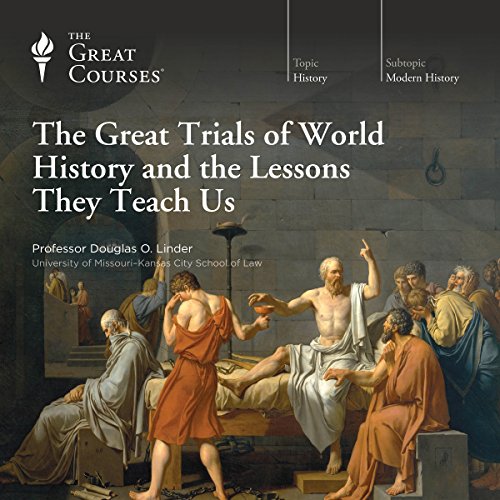
The Great Trials of World History and the Lessons They Teach Us
Summary
No understanding of the past is complete without an understanding of the legal battles and struggles that have done so much to shape it. Inside a survey of world history's greatest trials are the key insights to critical issues we still talk about today, including freedom of speech, the death penalty, religious freedom, and the meaning of equality. Join Professor Linder for these 24 lectures that investigate important legal cases from around the world and across the centuries. From the trials of Socrates in ancient Athens and Thomas More in Henry VIII's England to the Nuremburg Trials in the wake of World War II and the media frenzy of the O. J. Simpson murder case, you'll discover what each of these trials has to teach us about ourselves and our civilization. Professor Linder takes you back in time to revisit some of history's most famous trials from fresh perspectives that ground them in the evolution of human ideas of law and justice, including the Salem Witch Trials, and the Scopes "Monkey" Trial. You'll also encounter less familiar (but equally important) legal battles, including medieval trials by ordeal and the Trial of Giordano Bruno, which would impact the later trial of Galileo. For years, Professor Linder has studied the fascinating intersection between history and jurisprudence. Now he's crafted these lectures to share that fascination with you. PLEASE NOTE: When you purchase this title, the accompanying reference material will be available in your Library section along with the audio.
©2017 The Teaching Company, LLC; 2017 The Great Courses (P)2017 The Great Courses

Chernobyl 01:23:40
Summary
At 01:23:40 on April 26th 1986, Alexander Akimov pressed the emergency shutdown button at Chernobyl's fourth nuclear reactor. It was an act that forced the permanent evacuation of a city, killed thousands, and crippled the Soviet Union. The event spawned decades of conflicting, exaggerated, and inaccurate stories. This book, the result of five years of research, presents an accessible but comprehensive account of what really happened - from the desperate fight to prevent a burning reactor core from irradiating eastern Europe, to the self-sacrifice of the heroic men who entered fields of radiation so strong that machines wouldn't work, to the surprising truth about the legendary "Chernobyl diver", all the way through to the USSR's final show-trial. The historical narrative is interwoven with a story of the author's own spontaneous journey to Ukraine's still-abandoned city of Pripyat and the wider Chernobyl Zone.
©2016 Andrew Leatherbarrow (P)2016 Tantor

La grande histoire du monde
Summary
L'histoire du monde de la préhistoire à nos jours expliquée avec le talent d'un conteur qui nous invite à sortir du point de vue strictement européen. Des grands empires de l'Antiquité à la chute de l'URSS, de l'Europe de Charlemagne au Japon du XIXe siècle, de l'Asie des Mongols à l'Afrique de la décolonisation, cet ouvrage nous convie à un voyage extraordinaire au fil des siècles. Procédant par étapes chronologiques, il suit l'évolution des grandes civilisations les unes par rapport aux autres. Il réussit en même temps à nous faire comprendre la façon dont chaque peuple considère son passé. Nous avons tous en tête aujourd'hui l'importance nouvelle de la Chine, de l'Iran, de l'Inde. Nous percevons le rôle essentiel que vont jouer l'Afrique et l'Amérique latine. Nous voyons à quelle vitesse la montée de nouvelles puissances reconfigure le monde. C'est pourquoi il paraît urgent de mieux connaître son histoire. Introduction Prologue : Brève histoire de la préhistoire ; Prologue : Survol de la haute Antiquité ; Première partie : Un monde éclaté Les fondements des trois grandes civilisations : Chapitre 1 : L'Occident, Athènes et Jérusalem ; Chapitre 2 : La Chine, Laozi et Confucius ; Chapitre 3 : L'Inde, Hindouisme et bouddhisme. Quatre empires de l'Antiquité : Chapitre 4 : Un millénaire d'empires perses, des Achéménides aux Sassanides ; Chapitre 5 : L'Empire chinois, du premier empereur à la dynastie Han ; Chapitre 6 : Le premier empire indien et l'âge classique de l'Inde ; Chapitre 7 : L'Empire romain en cinq idées-forces, VIIIe siècle av. J.C-Ve siècle ap. J.C. Le monde au temps d'Haroun al-Rachid : Chapitre 8 : Naissance de l'islam, l'âge d'or arabe, VIIe-XIe siècle ; Chapitre 9 : La Chine des grandes inventions à l'époque de Tang-Song ; Chapitre 10 : Charlemagne et la formation de l'Europe ; Chapitre 11 : Les Vikings ; Chapitre 12 : Un tour du monde de 600 à l'an mil. Le monde au temps des invasions mongoles : Chapitre 13 : Beau et sombre Moyen Âge, XIIe-XIVe siècle ; Chapitre 14 : Le siècle des Mongols ; Chapitre 15 : Les grands empires africains du Moyen Âge ; Chapitre 16 : Un tour du monde au XVe siècle ; Deuxième partie : Un monde reconfiguré Le XVIe siècle : Chapitre 17 : L'Europe décolle ; Chapitre 18 : L'Empire espagnol 1492-1810 ; Chapitre 19 : L'Empire portugais XVIe-XVIIe siècle ; Chapitre 20 : L'Europe au XVIe siècle ; Chapitre 21 : Quatre empires musulmans, XVIe-XVIIe siècle ; Chapitre 22 : Le Japon s'ouvre et se referme, XVIe-début XIXe siècle. Le XVIIe siècle : Chapitre 23 : La guerre de Trente Ans et l'Europe du XVIIe siècle ; Chapitre 24 : La colonisation en Amérique du Nord ; Chapitre 25 : Les traites négrières et le martyre de l'Afrique. Le XVIIIe siècle : Chapitre 26 : La science, les Lumières, le libéralisme ; Chapitre 27 : L'émergence de la Prusse et de la Russie ; Chapitre 28 : La conquête anglaise de l'Inde, XVIIe-XIXe siècle ; Chapitre 29 : L'exploration du Pacifique ; Chapitre 30 : La Chine au XVIIIe siècle ; Chapitre 31 : Le temps des révolutions. Troisième partie : Un monde dominé Le siècle de l'Europe : Chapitre 32 : L'Europe domine le monde, 1815-1914 ; Chapitre 33 : L'Europe au temps des nations, de 1815 au tournant du XIXe siècle ; Chapitre 34 : Les États-Unis en cinq idées-forces ; Chapitre 35 : L'Amérique latine de Bolivar à Zapata ; Chapitre 36 : La Chine humiliée ; Chapitre 37 : Le Japon dans le club des puissances, 1853-1914 ; Chapitre 38 : La ruée vers l'Afrique ; Chapitre 39 : Le déclin de l'Empire ottoman. Le XXe siècle : Chapitre 40 : Une vision mondiale de la Première Guerre ; Chapitre 41 : La reconstitution du monde au sortir de la guerre ; Chapitre 42 : Les débuts de l'URSS et les tentatives d'expansion mondiale du communisme, 1917-1941 ; Chapitre 43 : Le Royaume-Uni, la France, les États-Unis entre les deux guerres ; Chapitre 44 : Les régimes autoritaires et la montée à la guerre, Italie, Allemagne, Japon ; Chapitre 45 : La Seconde Guerre mondiale en quatre temps forts, 1937-1945 ; Chapitre 46 : Le monde en deux blocs, 1947-1991 ; Chapitre 47 : Les moments-clés de la décolonisation ; Chapitre 48 : Le Moyen-Orient depuis 1945 ; Chapitre 49 : La Chine, de Mao à Deng Xiaoping ; Épilogue ; Remerciements.
©2016 Librairie Arthème Fayard (P)2020 Audiolib

The Second World War: Milestones to Disaster
Summary
Churchill's history of the Second World War is, and will remain, the definitive work. Lucid, dramatic, remarkable for its breadth and sweep and for its sense of personal involvement, it is universally acknowledged as a magnificent reconstruction. Please note: This book was originally published in six volumes: 1.The Gathering Storm 2. Their Finest Hour 3. The Grand Alliance 4. The Hinge of Fate5. Closing the Ring 6. Triumph and Tragedy Churchill then condensed these into four volumes, which have since been released as one, rather hefty, publication. Audible has published the unabridged recordings of Churchill's condensed volume, divided into four parts, as follows: 1.Milestone to Disaster 2.Alone 3.The Grand Alliance 4.Triumph and Tragedy
©1959 Cassell and Co. Ltd; 1990 the Esate of Winston Churchill (P)2014 Audible, Inc.

History's Greatest Voyages of Exploration
Summary
Mutiny. Disease. Starvation. Cannibals. From the ancient wayfarers to modern astronauts, world explorers have blazed trails fraught with danger. Yet, as History's Greatest Voyages of Exploration vividly demonstrates, exploration continues to be one of humanity's deepest impulses. Across 24 lectures that unveil the process by which we came to know the far reaches of our planet, you'll witness the awe-inspiring and surprisingly interconnected tale of global exploration. An award-winning history professor from the University of Tennessee, Knoxville, revolutionizes how you view the world as he introduces you to some of the greatest and most influential explorers ever known-successful as well as unsuccessful, admirable as well as flawed. You'll be spellbound as you learn of the treacherous, at times fatal, expeditions into the unknown these adventurers embarked upon, whether to the frozen Poles, Asia, Europe, the Americas, Africa, the ocean's depths, or the final frontier of space. Through it all, you consider what drove these intrepid individuals, from proselytizing and pilgrimage to the lure of wealth, conquest, fame, and new lands, as evidenced by the Vikings' arrival in North America; Marco Polo's journey along the Silk Road to China; Christopher Columbus' "Enterprise of the Indies"; the conquistadors' ravages in Latin America; and the tiny kingdom of Portugal's triumphant circumnavigation of Africa to seize control of trade in the Indian Ocean. In every lesson, you'll follow these fascinating figures - including several remarkable women - as they venture into uncharted territory and put themselves, and often their crews, in dire peril. With Professor Liulevicius' uniquely global approach, you also get a meaningful portrait of the travels of non-Westerners, as well as the perspectives of discovered people. PLEASE NOTE: When you purchase this title, the accompanying reference material will be available in your Library section along with the audio.
©2015 The Teaching Company, LLC (P)2015 The Great Courses

Operation Medusa
Summary
From the Canadian in charge of the joint military command in Kandahar Province in Afghanistan, this is the real on-the-ground story of one of NATO's bloodiest, most decisive and misunderstood operations: the battle of Panjwayi, the defining moment of Operation Medusa. In the summer of 2006, David Fraser was the Canadian general in charge of NATO's Regional Command South, a territory spanning six Afghan provinces surrounding the Arghandab Valley. Birthplace of the Taliban decades earlier, this fertile region had since become Afghanistan's most deadly turf. It would soon turn deadlier still. Advised in the night by his intelligence officers that the Taliban had secretly amassed for a full-scale military assault, Fraser knew it would fall to him, his Canadians, and their allies to avoid the wholesale slaughter of NATO troops, keep the Taliban from laying siege to Kandahar, and restore control of the south of the country to a newly formed, democratic Afghan government. The odds were solidy against Fraser's forces. The Taliban knew every millimeter of their own terrain. During the months of secret manoeuvers they had stocked every farmhouse, school, grape hut, and tunnel with weapons and ammunition. They had drilled Soviet-era landmines into all of the marijuana and poppy fields and dug IEDs into every roadway. Protected from detection by corrupt officials, their sophisticated warfare schools had successfully readied an army of zealous fighters to attack and fight to the death. And now their top commanders were poised to launch decisive military operations against freshly arrived troops who had never seen combat. The bloodiest battle in NATO's history was about to begin. PLEASE NOTE: When you purchase this title, the accompanying PDF will be available in your Audible Library along with the audio.
©2018 Major General David Fraser, Brian Hanington (P)2018 McClelland & Stewart
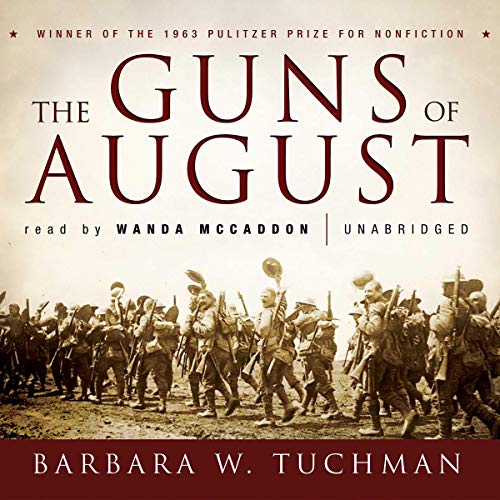
The Guns of August
Summary
In this Pulitzer Prize-winning classic, historian Barbara Tuchman brings to life the people and events that led up to World War I. This was the last gasp of the Gilded Age, of Kings and Kaisers and Czars, of pointed or plumed hats, colored uniforms, and all the pomp and romance that went along with war. How quickly it all changed...and how horrible it became. Tuchman masterfully portrays this transition from 19th to 20th Century, focusing on the turning point in the year 1914: the month leading up to the war and the first month of the war. With fine attention to detail, she reveals how and why the war started, and why it could have been stopped but wasn't, managing to make the story utterly suspenseful even when we already know the outcome.
©1990 Dr. Lester Tuchman (P)2005 Blackstone Audio, Inc.

Thunder Below!
Summary
The thunderous roar of exploding depth charges was a familiar and comforting sound to the crew members of the USS Barb, who frequently found themselves somewhere between enemy fire and Davy Jones's locker. Under the leadership of her fearless skipper, Captain Gene Fluckey, the Barb sank the greatest tonnage of any American sub in World War II. At the same time, the Barb did far more than merely sink ships-she changed forever the way submarines stalk and kill their prey. This is a gripping adventure chock-full of "you-are-there" moments. Fluckey has drawn on logs, reports, letters, interviews, and a recently discovered illegal diary kept by one of his torpedomen. And in a fascinating twist, he uses archival documents from the Japanese Navy to give its version of events. The unique story of the Barb begins with its men, who had the confidence to become unbeatable. Each team helped develop innovative ideas, new tactics, and new strategies. All strove for personal excellence, and success became contagious. Instead of lying in wait under the waves, the USS Barb pursued enemy ships on the surface, attacking in the swift and precise style of torpedo boats. She was the first sub to use rocket missiles and to creep up on enemy convoys at night, joining the flank escort line from astern, darting in and out as she sank ships up the column. Surface-cruising, diving only to escape, "Luckey Fluckey" relentlessly patrolled the Pacific, driving his boat and crew to their limits. There can be no greater contrast to modern warfare's long-distance, video game style of battle than the exploits of the captain and crew of the USS Barb, where the sub, out of ammunition, actually rammed an enemy ship until it sank. Thunder Below! is a first-rate, true-life, inspirational story of the courage and heroism of ordinary men under fire.
©1992 The Board of Trustees of the University of Illinois (P)2013 Tantor
The Perfectionists
Summary
The revered New York Times best-selling author traces the development of technology from the Industrial Age to the Digital Age to explore the single component crucial to advancement - precision - in a superb history that is both an homage and a warning for our future. The rise of manufacturing could not have happened without an attention to precision. At the dawn of the Industrial Revolution in 18th-century England, standards of measurement were established, giving way to the development of machine tools - machines that make machines. Eventually, the application of precision tools and methods resulted in the creation and mass production of items from guns and glass to mirrors, lenses, and cameras - and eventually gave way to further breakthroughs, including gene splicing, microchips, and the Hadron Collider. Simon Winchester takes us back to origins of the Industrial Age, to England where he introduces the scientific minds that helped usher in modern production: John Wilkinson, Henry Maudslay, Joseph Bramah, Jesse Ramsden, and Joseph Whitworth. It was Thomas Jefferson who later exported their discoveries to the fledgling United States, setting the nation on its course to become a manufacturing titan. Winchester moves forward through time, to today’s cutting-edge developments occurring around the world, from America to Western Europe to Asia. As he introduces the minds and methods that have changed the modern world, Winchester explores fundamental questions. Why is precision important? What are the different tools we use to measure it? Who has invented and perfected it? Has the pursuit of the ultra-precise in so many facets of human life blinded us to other things of equal value, such as an appreciation for the age-old traditions of craftsmanship, art, and high culture? Are we missing something that reflects the world as it is, rather than the world as we think we would wish it to be? And can the precise and the natural co-exist in society?
©2018 Simon Winchester (P)2018 HarperCollins Publishers

From Yao to Mao: 5000 Years of Chinese History
Summary
For most of its 5,000-year existence, China has been the largest, most populous, wealthiest, and mightiest nation on Earth. And for us as Westerners, it is essential to understand where China has been in order to anticipate its future. These 36 eye-opening lectures deliver a comprehensive political and historical overview of one of the most fascinating and complex countries in world history. You'll learn about the powerful dynasties that ruled China for centuries; the philosophical and religious foundations-particularly Confucianism, Daoism, and Buddhism-that have influenced every iteration of Chinese thought, and the larger-than-life personalities, from both inside and outside its borders, of those who have shaped China's history. As you listen to these lectures, you'll see how China's politics, economics, and art reflect the forces of its past. From the "Mandate of Heaven," a theory of social contract in place by 1500 B.C.E., 3,000 years before Western philosophers such as Thomas Hobbes and John Locke, to the development of agriculture and writing independent of outside influence to the technologically - advanced Han Dynasty during the time of the Roman Empire, this course takes you on a journey across ground that has been largely unexplored in the history courses most of us in the West have taken. In guiding you through the five millennia of China's history, Professor Hammond tells a fascinating story with an immense scope, a welcome reminder that China is no stranger to that stage and, indeed, has more often than not been the most extraordinary player on it. PLEASE NOTE: When you purchase this title, the accompanying reference material will be available in your Library section along with the audio.
©2004 The Teaching Company, LLC (P)2004 The Great Courses
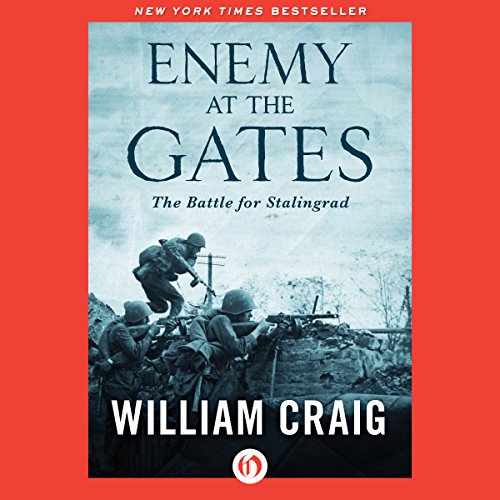
Enemy at the Gates
Summary
A classic work of World War II history that brings to vivid, dramatic life one of the bloodiest battles ever fought - and the beginning of the end for the Third Reich. On August 5, 1942, giant pillars of dust rose over the Russian steppe, marking the advance of the 6th Army, an elite German combat unit dispatched by Hitler to capture the industrial city of Stalingrad and press on to the oil fields of Azerbaijan. The Germans were supremely confident; in three years, they had not suffered a single defeat. The Luftwaffe had already bombed the city into ruins. German soldiers hoped to complete their mission and be home in time for Christmas. The siege of Stalingrad lasted five months, one week, and three days. Nearly two million men and women died, and the 6th Army was completely destroyed. Considered by many historians to be the turning point of World War II in Europe, the Soviet Army's victory foreshadowed Hitler's downfall and the rise of a communist superpower. Best-selling author William Craig spent five years researching this epic clash of military titans, traveling to three continents in order to review documents and interview hundreds of survivors. Enemy at the Gates is the enthralling result: the definitive account of one of the most important battles in world history. The book was the inspiration for the 2001 film of the same name, starring Joseph Fiennes and Jude Law.
©1973 William Craig; This edition published in 2015 by Open Road Integrated Media, Inc. (P)2015 Audible, Inc.

The Lost City of Z
Summary
A grand mystery reaching back centuries. A sensational disappearance that made headlines around the world. A quest for truth that leads to death, madness or disappearance for those who seek to solve it. The Lost City of Z is a blockbuster adventure narrative about what lies beneath the impenetrable jungle canopy of the Amazon. After stumbling upon a hidden trove of diaries, acclaimed New Yorker writer David Grann set out to solve "the greatest exploration mystery of the 20th century": What happened to the British explorer Percy Fawcett and his quest for the Lost City of Z? In 1925 Fawcett ventured into the Amazon to find an ancient civilization, hoping to make one of the most important discoveries in history. For centuries Europeans believed the world's largest jungle concealed the glittering kingdom of El Dorado. Thousands had died looking for it, leaving many scientists convinced that the Amazon was truly inimical to humankind. But Fawcett, whose daring expeditions helped inspire Conan Doyle's The Lost World, had spent years building his scientific case. Captivating the imagination of millions, Fawcett embarked with his 21-year-old son, determined to prove that this ancient civilization, which he dubbed "Z", existed. Then he and his expedition vanished. Fawcett's fate, and the tantalizing clues he left behind about "Z", became an obsession for hundreds who followed him into the uncharted wilderness. For decades scientists and adventurers have searched for evidence of Fawcett's party and the lost City of Z. As David Grann delved ever deeper into the mystery surrounding Fawcett's quest, and the greater mystery of what lies within the Amazon, he found himself, like the generations who preceded him, being irresistibly drawn into the jungle's "green hell". His quest for the truth and his stunning discoveries about Fawcett's fate and "Z" form the heart of this complex, enthralling narrative.
©2009 David Grann (P)2009 Random House
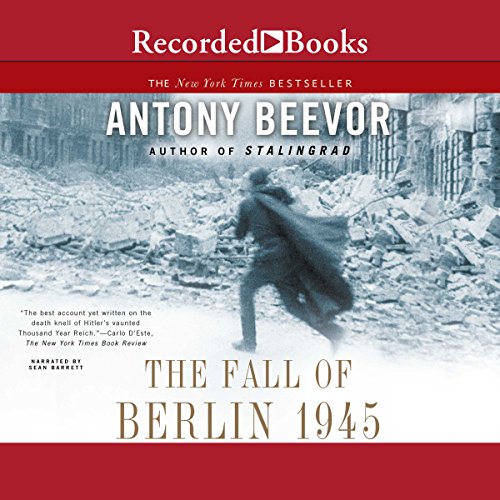
The Fall of Berlin 1945
Summary
The Red Army had much to avenge when it finally reached the frontiers of the Third Reich in January 1945. Frenzied by their terrible experiences with Wehrmacht and SS brutality, they wreaked havoc - tanks crushing refugee columns, mass rape, pillage, and unimaginable destruction. Hundreds of thousands of women and children froze to death or were massacred; more than seven million fled westward from the fury of the Red Army. It was the most terrifying example of fire and sword ever known. Antony Beevor has reconstructed the experiences of those millions caught up in the nightmare of the Third Reich's final collapse. The Fall of Berlin is a terrible story of pride, stupidity, fanaticism, revenge, and savagery, yet it is also one of astonishing endurance, self-sacrifice, and survival against all odds.
©2002 Antony Beevor and Artemis Cooper (P)2002 Isis Audio Books

A Man on the Moon: The Voyages of the Apollo Astronauts
Summary
Audie Award, History/Biography, 2016 This acclaimed portrait of heroism and ingenuity captures a watershed moment in human history. The astronauts themselves have called it the definitive account of their missions. On the night of July 20, 1969, our world changed forever when Neil Armstrong and Buzz Aldrin walked on the moon. Based on in-depth interviews with 23 of the 24 moon voyagers, as well as those who struggled to get the program moving, A Man on the Moon conveys every aspect of the Apollo missions with breathtaking immediacy and stunning detail.
©2007 Andrew Chaikin (P)2015 Audiobooks.com