The History category has 4,114 audiobooks on Listento.it, with an average listener rating of 4.4★ across 16,411 ratings. The most-rated is A Short History of Nearly Everything.

The Italian Renaissance
Summary
The effects of the Italian Renaissance are still with us today, from the incomparable paintings of Leonardo da Vinci to the immortal writings of Petrarch and Machiavelli. But why was there such an artistic, cultural, and intellectual explosion in Italy at the start of the 14th century? Why did it occur in Italy? And why in certain Italian city-states such as Florence? Professor Bartlett probes these questions and more in 36 dynamic lectures. This is your opportunity to appreciate the results of the Italian Renaissance and gain an understanding of the underlying social, political, and economic forces that made such exceptional art and culture possible. At the heart of Renaissance Italy were the city-states, home to the money, intellect, and talent needed for the growth of Renaissance culture. You'll look at the Republic of Florence, as well as other city-states that, thanks to geographical and historical circumstances, had much different political and social structures. This course contains a wealth of details that will give you a feel and appreciation for the Italian Renaissance - its contributions to history, the ways it was similar and dissimilar to our times, and how the people of the time, both famous and ordinary, experienced it. You'll come away surprised by how much of our modern life was made possible by the Renaissance. Our concept of participatory government, our belief in the value of competition, our philosophy of the content and purpose of education, even our notions of love all have roots in the Renaissance period. Its loftiest ideals - the importance of the individual, the value of human dignity and potential, and the promotion of freedom - are ones we embrace as our own. PLEASE NOTE: When you purchase this title, the accompanying reference material will be available in your Library section along with the audio.
©2005 The Teaching Company, LLC (P)2005 The Great Courses

Canada: Canadian History: From Aboriginals to Modern Society
Summary
Canada is known all over the world due to its undying commitment to multiculturalism and its social and ethnic diversity. In a time when these values were unspoken of, Canada was the first country to embrace an official multiculturalism policy. Nevertheless, the path that Canada followed to become the powerful nation it is today was like a labyrinth, filled with challenges and obstacles. Starting from Canada's first inhabitants and explorers, this brief book will offer you a comprehensive overview of Canada's history, as it presents the key events that altered the course of this nation irrevocably. The following aspects are included in the book: The coming of the Aboriginal peoples to Canada The first Viking expedition to Canada led by Leif Eriksson The initial European explorations that took place during the 15th-16th centuries and how these laid the grounds for the colonization movement that followed afterward Canada's role and place in the world today The primary elements that shape the Canadian culture and what makes it so distinctive Main places to visit in Canada: some sights and attractions that you shouldn't miss from your itinerary if you want to understand Canada's culture and uniqueness Only when you aim at learning about a country's history could you fully grasp its culture and evolution. That's what makes this book the perfect resource for those who want to enlarge their knowledge of Canada. Canada is a country that seems to relish unlimited space. It is dynamic, unique, and complex, being much more than a multicultural society; it is also a multinational one. The details pointed to in this book link Canada's past and present to its potential future. I challenge you to broaden your comprehension of Canada and get this book today! This beautiful country is unexpectedly intriguing once you get to learn more about it.
©2017 Lean Stone Publishing (P)2017 Lean Stone Publishing

Conquistador
Summary
It was a moment unique in human history: the face-to-face meeting between two men from civilizations a world apart. In 1519 Hernán Cortés arrived on the shores of Mexico, determined not only to expand the Spanish empire but to convert the natives to Catholicism and carry off a fortune in gold. That he saw nothing paradoxical in his intentions is one of the most remarkable and tragic aspects of this unforgettable story. In Tenochtitlán, Cortés met his Aztec counterpart, Montezuma: king, divinity, and commander of the most powerful military in the Americas. Yet in less than two years, Cortés defeated the entire Aztec nation in one of the most astounding battles ever waged. The story of a lost kingdom, a relentless conqueror, and a doomed warrior, Conquistador is history at its most riveting.
©2008 Buddy Levy (P)2008 Tantor

The Beginning of Infinity
Summary
A bold and all-embracing exploration of the nature and progress of knowledge from one of today's great thinkers. Throughout history, mankind has struggled to understand life's mysteries, from the mundane to the seemingly miraculous. In this important new book, David Deutsch, an award-winning pioneer in the field of quantum computation, argues that explanations have a fundamental place in the universe. They have unlimited scope and power to cause change, and the quest to improve them is the basic regulating principle not only of science but of all successful human endeavor. This stream of ever improving explanations has infinite reach, according to Deutsch: we are subject only to the laws of physics, and they impose no upper boundary to what we can eventually understand, control, and achieve. In his previous book, The Fabric of Reality, Deutsch describe the four deepest strands of existing knowledge-the theories of evolution, quantum physics, knowledge, and computation-arguing jointly they reveal a unified fabric of reality. In this new book, he applies that worldview to a wide range of issues and unsolved problems, from creativity and free will to the origin and future of the human species. Filled with startling new conclusions about human choice, optimism, scientific explanation, and the evolution of culture, The Beginning of Infinity is a groundbreaking audio book that will become a classic of its kind.
©2011 David Deutsch (P)2011 Gildan Media Corp
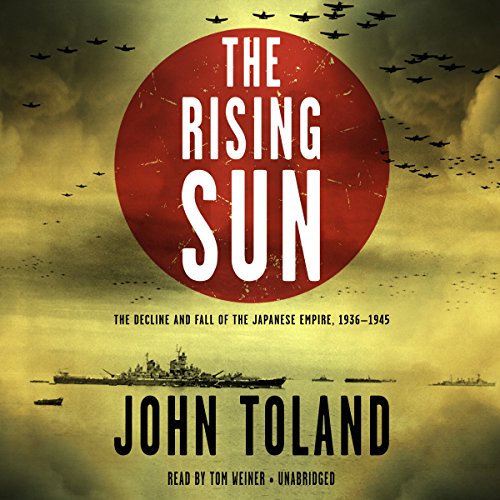
The Rising Sun
Summary
This Pulitzer Prize-winning history of World War II chronicles the dramatic rise and fall of the Japanese empire, from the invasion of Manchuria and China to the atomic bombing of Hiroshima and Nagasaki. Told from the Japanese perspective, The Rising Sun is, in the author’s words, "a factual saga of people caught up in the flood of the most overwhelming war of mankind, told as it happened - muddled, ennobling, disgraceful, frustrating, full of paradox." In weaving together the historical facts and human drama leading up to and culminating in the war in the Pacific, Toland crafts a riveting and unbiased narrative history.
©1970 John Toland (P)2014 Blackstone Audio, Inc.

Masters of War: History's Greatest Strategic Thinkers
Summary
From Napoleon's revolutionary campaigns to the way insurgency, terrorism, and nuclear weaponry have defined the nature of warfare in the 21st century, the results of military strategy have changed the course of history. These 24 thought-provoking lectures give you an inside look at both the content and historical context of the world's greatest war strategists. From the triremes and hoplites of ancient Greece to the Special Forces in 21st-century Afghanistan, strategy is the process by which political objectives are translated into military action - using the means at a nation's disposal to compel an enemy to bend to its political will. In this concise and rigorous survey, Professor Wilson introduces: Thucydides' History of the Peloponnesian War; Sun Tzu's famous The Art of War; Machiavelli's strategy for a republic with a citizen-army; Jomini, Clausewitz, and the Napoleonic revolution in warfare; the development of naval strategy and the rise of airpower; Mao Tse-tung, David Galula, and Roger Trinquier's reflections on insurgency and counterinsurgency and their influence on the U.S. Army's Field Manual 3-24; Just-war theory, from Thucydides' Melian Dialogue to Operation Iraqi Freedom; nuclear war, terrorism, and other strategic challenges for the 21st century. You'll come away from this course with new insight that will allow you to take an informed, active interest in political and military debates - which ultimately will determine the course of our nation. Disclaimer: The views expressed in this course are those of the professor and do not necessarily reflect the position or policy of the U.S. Navy, the U.S. Department of Defense, or the U.S. government. PLEASE NOTE: When you purchase this title, the accompanying reference material will be available in your Library section along with the audio.
©2012 The Teaching Company, LLC (P)2012 The Great Courses

A Man Called Intrepid
Summary
The classic real-life story of the superspy whose vast intelligence network helped defeat the Nazis in World War II. A Man Called Intrepid is the account of the world’s first integrated intelligence operation and of its master, William Stephenson. Codenamed INTREPID by Winston Churchill, Stephenson was charged with establishing and running a vast, worldwide intelligence network to challenge the terrifying force of Nazi Germany. Nothing less than the fate of Britain and the free world hung in the balance as INTREPID covertly set about stalling the Nazis by any means necessary. First published in 1976, A Man Called Intrepid was an immediate bestseller. With over thirty black-and-white photographs and countless World War II secrets, this book revealed startling information that had remained buried for decades. Detailing the infamous Camp X training center in Ontario, Canada; the miraculous breaking of the Ultra Code used by the Enigma Machine; and dozens of other stories of clandestine missions, A Man Called Intrepid is an undisputed modern classic. PLEASE NOTE: When you purchase this title, the accompanying reference material will be available in your Library section along with the audio.
©1982, 2000, 2009, 2014 William Stevenson (P)2014 Audible, Inc.

Lost to the West
Summary
In AD 476 the Roman Empire fell - or rather, its western half did. Its eastern half, which would come to be known as the Byzantine Empire, would endure and often flourish for another 11 centuries. Though its capital would move to Constantinople, its citizens referred to themselves as Roman for the entire duration of the empire's existence. Indeed, so did its neighbors, allies, and enemies: When the Turkish Sultan Mehmet II conquered Constantinople in 1453, he took the title Caesar of Rome, placing himself in a direct line that led back to Augustus. For far too many otherwise historically savvy people today, the story of the Byzantine civilization is something of a void. Yet for more than a millennium, Byzantium reigned as the glittering seat of Christian civilization. When Europe fell into the Dark Ages, Byzantium held fast against Muslim expansion, keeping Christianity alive. When literacy all but vanished in the West, Byzantium made primary education available to both sexes. Students debated the merits of Plato and Aristotle and commonly committed the entirety of Homer's Iliad to memory. Streams of wealth flowed into Constantinople, making possible unprecedented wonders of art and architecture, from fabulous jeweled mosaics and other iconography to the great church known as the Hagia Sophia that was a vision of heaven on earth. The dome of the Great Palace stood nearly two hundred feet high and stretched over four acres, and the city's population was more than twenty times that of London's. From Constantine, who founded his eponymous city in the year 330, to Constantine XI, who valiantly fought the empire's final battle more than a thousand years later, the emperors who ruled Byzantium enacted a saga of political intrigue and conquest as astonishing as anything in recorded history. Lost to the West is replete with stories of assassination, mass mutilation and execution, sexual scheming, ruthless grasping for power, and clashing armies that soaked ...
©2009 Lars Brownworth (P)2009 Random House

Operation Husky
Summary
On July 10, 1943, two great Allied armadas of over 2,000 ships readied to invade Sicily. This was Operation Husky, the first step toward winning a toehold in fascist-occupied Europe. Among the invaders were 20,000 Canadian troops serving in the First Canadian Infantry Division and First Canadian Tank Brigade - in their first combat experience. Over the next 28 days, the Allied troops carved a path through the rugged land, despite fierce German opposition. Drawing on firsthand accounts of veterans and official military records, Operation Husky offers a gripping, meticulous account of this seminal operation and the young men who fought, died, and survived it.
©2008 Mark Zuehlke (P)2013 Audible, Inc.

Bury My Heart at Wounded Knee
Summary
Dee Brown's eloquent, meticulously documented account of the systematic destruction of the American Indian during the second half of the 19th century uses council records, autobiographies, and firsthand descriptions. Brown allows great chiefs and warriors of the Dakota, Ute, Sioux, Cheyenne, and other tribes to tell us in their own words of the battles, massacres, and broken treaties that finally left them demoralized and defeated. A unique and disturbing narrative told with force and clarity, Bury My Heart at Wounded Knee changed forever our vision of how the West was really won - and lost.
©1970 Dee Brown; Preface 2000 by Dee Brown (P)2009 Blackstone Audio, Inc.

Stalin, Volume I
Summary
A magnificent new biography that revolutionizes our understanding of Stalin and his world. It has the quality of myth: A poor cobbler's son, a seminarian from an oppressed outer province of the Russian Empire, reinvents himself as a revolutionary and finds a leadership role within a small group of marginal zealots. When the old world is unexpectedly brought down in a total war, the band seizes control of the country, and the new regime it founds as the vanguard of a new world order is ruthlessly dominated from within by the former seminarian until he stands as the absolute ruler of a vast and terrible state apparatus, with dominion over Eurasia. We think we know the story well. Remarkably, Stephen Kotkin's epic new biography shows us how much we still have to learn. Volume One of Stalin begins and ends in January 1928 as Stalin boards a train bound for Siberia, about to embark upon the greatest gamble of his political life. He is now the ruler of the largest country in the world, but a poor and backward one, far behind the great capitalist countries in industrial and military power, encircled on all sides. In Siberia, Stalin conceives of the largest program of social reengineering ever attempted: the root-and-branch uprooting and collectivization of agriculture and industry across the entire Soviet Union. To stand up to the capitalists he will force into being an industrialized, militarized, collectivized great power is an act of will. Millions will die, and many more will suffer, but Stalin will push through to the end against all resistance and doubts. Where did such power come from? The product of a decade of scrupulous and intrepid research, Stalin contains a host of astonishing revelations. Kotkin gives an intimate first-ever view of the Bolshevik regime’s inner geography, bringing to the fore materials from Soviet military intelligence and the secret police.
©2014 Stephen Kotkin (P)2014 Recorded Books

Countdown to War
Summary
An audio dramatisation of July 1914 Countdown to War by Sean McMeekin. 'The story of the 37 days that led Europe to war after the assassination of the Archduke Franz Ferdinand in Sarajevo in June 1914.' This is an Audible Original Podcast. Free for members. You can download all 6 episodes to your Library now.
©2019 Audible, Ltd. (P)2019 Audible, Ltd.

The Hollow Crown
Summary
The 15th century saw the crown of England change hands seven times as the great families of England fought to the death for power, majesty and the right to rule. The Hollow Crown completes Dan Jones' epic history of medieval England, and describes how the Plantagenets tore themselves apart to be finally replaced by the Tudors. Some of the greatest heroes and villains in British history were thrown together in these turbulent times: Henry V, whose victory at Agincourt and prudent rule at home marked the high point of the medieval monarchy; Edward IV, who was handed his crown by the scheming soldier Warwick the Kingmaker, before their alliance collapsed into a fight to the death; and the last Plantagenet, Richard III, who stole the throne and murdered his own nephews, the Princes in the Tower. Finally, the Tudors arrived - but even their rule was only made certain in the 1520s, when Henry VIII ruthlessly hunted down his family's last remaining enemies. In the midst this tumult, chivalry was reborn, the printing press arrived and the Renaissance began to flourish. With vivid descriptions of the battle of Towton, where 28,000 men died in a single morning, and the Battle of Bosworth Field, at which Richard III was hacked down, this is the real story behind Shakespeare's famous history plays.
©2014 Dan Jones (P)2018 Audible, Ltd

Masters of the Air
Summary
This is the dramatic story of the American bomber boys in World War II who brought the war to Hitler’s doorstep. With the narrative power of fiction, this is a harrowing ride through the fire-filled skies over Berlin, Hanover, and Dresden. Fighting at 25,000 feet in thin, freezing air no warriors had encountered before, bomber crews battled new kinds of assaults on body and mind. Air combat was deadly but intermittent: periods of inactivity and anxiety were followed by short bursts of fire and fear. Unlike infantrymen, bomber boys slept on clean sheets, drank beer in local pubs, and danced to the music of Glenn Miller’s Air Force Band. But they had a much greater chance of dying than ground soldiers. In 1943 an American bomber crewman stood only a one-in-five chance of surviving his tour of duty. The Eighth Air Force lost more men in the war than the US Marine Corps. The bomber crews were an elite group of warriors. Actor Jimmy Stewart was a bomber boy, as was “King of Hollywood” Clark Gable. The air war was filmed by Oscar-winning director William Wyler and covered by reporters like Andy Rooney and Walter Cronkite, all of whom flew combat missions with the men. The Anglo-American bombing campaign against Nazi Germany was the longest military campaign of World War II, a war within a war. Until Allied soldiers crossed into Germany in the final months of the war, it was the only battle fought inside the German homeland. Strategic bombing did not win the war, but the war could not have been won without it. American airpower destroyed the rail facilities and oil refineries that supplied the German war machine. The bombing campaign was a shared enterprise: The British bombed at night while American bombers attacked by day - a technique that British commanders thought was suicidal. Drawn from interviews, oral histories, and American, British, German, and other archives, this is an authoritative, deeply moving account of the world’s first and only bomber war.
©2006 Donald L. Miller (P)2011 Blackstone Audio, Inc.

The New Tsar
Summary
The epic tale of the rise to power of Russia's current president - the only complete biography in English - that fully captures his emergence from shrouded obscurity and deprivation to become one of the most consequential and complicated leaders in modern history, by the former New York Times Moscow bureau chief. In a gripping narrative of Putin's rise to power as Russia's president, Steven Lee Myers recounts Putin's origins - from his childhood of abject poverty in Leningrad to his ascension through the ranks of the KGB and his eventual consolidation of rule. Along the way world events familiar to listeners, such as September 11th and Russia's war in Georgia in 2008, as well as the 2014 annexation of Crimea and the ongoing conflict in Ukraine, are presented from never-before-seen perspectives. This audiobook is a grand, staggering achievement and a breathtaking look at one man's rule. On one hand, Putin's many reforms - from tax cuts to an expansion of property rights - have helped reshape the potential of millions of Russians whose only experience of democracy had been crime, poverty, and instability after the fall of the Soviet Union. On the other hand, Putin has ushered in a new authoritarianism, unyielding in his brutal repression of revolts and squashing of dissent. Still, he retains widespread support from the Russian public. The New Tsar is a narrative tour de force, deeply researched and utterly necessary for anyone fascinated by the formidable and ambitious Vladimir Putin but also for those interested in the world and what a newly assertive Russia might mean for the future.
©2015 Steven Lee Myers (P)2015 Random House Audio

The Fall of Carthage
Summary
The struggle between Rome and Carthage in the Punic Wars was arguably the greatest and most desperate conflict of antiquity. The forces involved and the casualties suffered by both sides were far greater than in any wars fought before the modern era, while the eventual outcome had far-reaching consequences for the history of the Western World, namely the ascendancy of Rome. An epic of war and battle, this is also the story of famous generals and leaders: Hannibal, Fabius Maximus, Scipio Africanus, and his grandson Scipio Aemilianus, who would finally bring down the walls of Carthage.
©2000 Adrian Goldsworthy (P)2018 Tantor

The Late Middle Ages
Summary
The Late Middle Ages - the two centuries from c. 1300 to c. 1500 - might seem like a distant era, but students of history are still trying to reach a consensus about how it should be interpreted. Was it an era of calamity or rebirth? Was it still clearly medieval or the period in which humanity took its first decisive steps into modernity? These 24 provocative lectures introduce you to the age's major events, personalities, and developments, and arms you with the essentials you need to form your own ideas about this age of extremes - an age that, according to Professor Daileader, "experiences disasters and tragedies of such magnitude that those who survive them cannot remember the like, and doubt that subsequent generations will be capable of believing their descriptions. "You'll look at the Black Death, the carnage of frequent wars, and the religious turmoil we associate with the Middle Ages." But you'll also look at the beginning of the intellectual and cultural movement known as Humanism, which planted the seeds of modernity. Humanism's precepts, which hearkened back to the moral inspiration inherent in classical artistic values, humans have an enormous capacity for goodness, for creativity, even for the achievement of happiness. But these were hardly the only forces that tug modern-day historians in multiple directions. The Middle Ages was also a period when the persisting legacy of knights, serfs, and castles coexisted with the cannons and muskets newly made possible by gunpowder. With so many contradictions, it's no wonder that historians have differed widely on how to judge this era-debating even when it ended and modernity began. PLEASE NOTE: When you purchase this title, the accompanying reference material will be available in your Library section along with the audio.
©2007 The Teaching Company, LLC (P)2007 The Great Courses

The Long 19th Century: European History from 1789 to 1917
Summary
Few periods of history offer such captivating complexity as Europe in the long 19th century between 1789 and 1914. From the idealism of the French Revolution to the power of the Industrial Revolution to the chaos of World War I, this fascinating whirl of events, personalities, and forces formed the foundation for the modern world. Over the course of 36 engaging lectures Professor Weiner leads you on a spirited journey across an ever-changing European landscape, examining the forces and personalities that reshaped the continent's physical borders, diplomatic relationships, and balance of power. Assuming no prior knowledge of this era and no professional vocabulary, he explores this turbulent and important era with interest, curiosity, and passion. You'll look at what the transition to modernity meant for peasants, workers, the middle class, aristocrats, women, and minorities. And you'll consider the political and diplomatic moves of the great powers - Great Britain, France, Germany, Austria-Hungary, Russia, and Italy - in the context of the deeper economic, social, and cultural forces at work and how they reflect the impact of some of history's most significant names, including Napoleon Bonaparte, Otto von Bismarck, and Kaiser Wilhelm II. With this ambitious look at the evolution of the environment that ultimately made World War I possible, Professor Weiner explores more than factual history - the dates, battles, and treaties. He repeatedly steps back from on-the-ground events to clarify historical trends or patterns, providing a comprehensive look at this engaging era. PLEASE NOTE: When you purchase this title, the accompanying reference material will be available in your Library section along with the audio.
©2005 The Teaching Company, LLC (P)2005 The Great Courses

Soldiers of Science
Summary
It’s the height of the Vietnam war when a new generation of doctors, including a young Dr. Anthony Fauci, arrive at the National Institutes of Health as part of the doctor’s draft. What happens next is a hidden history of American medicine that could not be more revelatory or prescient. Alan Alda reveals how one of the darkest and divisive moments in the nation’s history also paved the way the for some of the greatest medical breakthroughs our country has ever seen. This one public health program would not only launch the careers of our top physician scientists, but build the country’s medical research system and also lead to nine Nobel-prize winning discoveries. So far. This is a story of faith in government and a belief in science. We meet patients who sacrifice everything, and doctors who still can’t believe their luck at being allowed to serve the country in this unique way. It reminds us of President Franklin Delano Roosevelt’s mission for the NIH in 1940 when he declared “to be a strong nation we must be a healthy nation.” As well as President John F. Kennedy’s hope-filled call to service. One can’t help but wonder how the story of the Soldiers of Science might help us shape a better and healthier future.
©2020 Audible Originals, LLC (P)2020 Audible Originals, LLC

King Arthur: History and Legend
Summary
The saga of King Arthur and his court is the most enduringly popular mythic tradition of Western civilization. For over 1,500 years, the Arthurian narrative has enthralled writers, artists, and a limitless audience spanning the Western world and beyond - and its appeal continues unabated in our time. No other heroic figure in literature compares with King Arthur in terms of global popularity and longevity; now, each year sees literally thousands of new versions of the story appear across diverse media, from fiction writing and visual arts to film and popular culture. Delve into the historical mystery behind the figure of Arthur, and discover the magnificent breadth of these epic tales. These 24 spellbinding lectures reveal the full scope of the Arthurian tradition, from its beginnings in post-Roman Britain to its extraordinary trajectory across the centuries and its latest incarnations in modern times. Your pathfinder in this world of mythic adventure and romance, Professor Armstrong, is one of the world's leading Arthurian scholars and the current editor-in-chief of the academic journal Arthuriana. Demonstrating both encyclopedic knowledge and an infectious passion for the subject, she leads you in tracing how the myth developed across time, clarifying many misunderstood aspects of the narrative, such as the origins of the Round Table and the figure of Merlin, the illicit love between Lancelot and Guenevere, and the varied manifestations of the magical Holy Grail. You'll discover how the legend was appropriated and assimilated by differing cultures, and how each writer and artist in the tradition reflected and commented, through the Arthurian narrative, on the concerns of their own time and place. The result is an illuminating look at one of the most engaging, entertaining, and influential legendary traditions the world has ever known. PLEASE NOTE: When you purchase this title, the accompanying reference material will be available in your Library section along with the audio.
©2015 The Great Courses (P)2015 The Teaching Company, LLC