Colin Fluxman has narrated 107 audiobooks on Listento.it by 7 authors, with an average listener rating of 3.9★ across 23 ratings. The most-rated is Yugoslavia: The History of the Eastern European Nation from Its Founding to Its Breakup.

The Colonization of South Africa
Summary
“The Boers were hostile toward indigenous African peoples, with whom they fought frequent range wars, and toward the government of the Cape, which was attempting to control Boer movements and commerce. They overtly compared their way of life to that of the Israel patriarchs of the Bible, developing independent patriarchal communities based upon a mobile pastoralist economy. Staunch Calvinists, they saw themselves as the children of God in the wilderness, a Christian elect divinely ordained to rule the land and the backward natives therein. By the end of the 18th century the cultural links between the Boers and their urban counterparts were diminishing, although both groups continued to speak a type of Flemish.” (Encyclopaedia Britannica) The Boer War was the defining conflict of South African history and one of the most important conflicts in the history of the British Empire. In fact, the European history of South Africa began with the 1652 arrival of a small Dutch flotilla in Table Bay, which made landfall with a view to establishing a victualing station to service passing Dutch East India Company (Vereenigde Oost-Indische Compagnie) ships. The Dutch at that point largely dominated the East Indian Trade, and it was their establishment of the settlement of Kaapstad, or Cape Town, that set in motion the lengthy and often turbulent history of South Africa. For over a century, the Cape remained a Dutch East India Company settlement, and in the interests of limiting expenses, strict parameters were established to avoid the development of a colony. As religious intolerance in Europe drove a steady trickle of outward emigration, however, Dutch settlers began to informally expand beyond the Cape, settling the sparsely inhabited hinterland to the north and east of Cape Town. In their wake, towards the end of the 17th century, followed a wave of French Huguenot immigrants, fleeing a renewal of anti-Protestantism in Europe. They were integrated over the succeeding generations, creating a hybridized language and culture that emerged in due course as the Cape Dutch, The Afrikaner or the Boer. The Napoleonic Wars radically altered the old, established European power dynamics, and in 1795, the British, now emerging as the globe’s naval superpower, assumed control of the Cape as part of the spoils of war. The British established their presence at the Cape, which they held until the unification of South Africa in 1910. However, it would only come after several rounds of conflicts. The Colonization of South Africa: The History and Legacy of the European Subjugation of South Africa looks at the controversial expeditions, fighting, and results...you will learn about the colonization of South Africa like never before.
©2019 Charles River Editors (P)2019 Charles River Editors

The Battle of Thermopylae
Summary
If you want to discover the captivating history of the Battle of Thermopylae, then pay attention.... The Battle of Thermopylae is one of the most famous battles in human history. It featured two of the ancient world’s most prominent cultures, the Achaemenid-led Persian Empire and the fragmented yet culturally advanced Greeks. It also included some of history’s most famous leaders, such as the Persian king Xerxes and the Spartan king and military general Leonidas. This glorification is apt only because the battle was indeed an important moment in the much larger conflict known as the Greco-Persian Wars. However, the Greeks lost this battle. In fact, it was a slaughter. Had it not been for some good fortune as well as an advantage in terms of equipment and fighting techniques, the Battle of Thermopylae could have gone down in history as the beginning of the end for one of the world’s great civilizations. That these soldiers were more willing to die than to surrender to the evil Persians is part of the reason why this battle has become so famous. It serves as a symbol of what people will do to protect their freedom and their homeland. Sure, much of our memory of the Battle of Thermopylae is glorified untruth, but no one can deny that the Greeks and the Persians, in late August or early September of 480 BCE, fought one of the most important battles in one of the most important wars of the ancient era. In this audiobook, you will discover topics such as Leading up to the Battle of Thermopylae The main characters of the Battle of Thermopylae Greece and Persia prepare for battle The Battle of Thermopylae: Seven days to last the test of time After the Battle of Thermopylae The Greek and Persian armies And much, much more! So if you want to learn more about the Battle of Thermopylae, buy this book now!
©2019 Captivating History (P)2019 Captivating History

Italy
Summary
Journey to the center of Italy! "In Italy, they add work and life on to food and wine." (Robin Leach) Italy is one of the most magical countries in the world - so what are you waiting for? Passport to European Travel Guides offers this comprehensive, yet quick and concise, top 10 guide to Italy - one of the most romanticized countries in the world! Top 10 best places to visit for unforgettable Italian travel Have no idea where to start? Or maybe you have some idea but could use a treasure trove of great insider tips? Well, read on! You see, we know your trip begins long before you even book the flight, so this guide is chock full of dynamite tips on everything you need to know BEFORE you go - and much, much more we know you'll thank us for! Passport to European Travel Guides features: Dynamite insider tips - for tourists! we give you the scoop on everything from local etiquette to saving money! Top 10 best places in italy - covers the 10 best places the country has to offer! Luxury sleeps, luxury eats - our best recommendations for ultimate Italian luxury Budget sleeps, budget eats - best spots for travelers on a budget Country snapshot - language, currency, airports, country code, and more! Before you go - there are some things you need to know! Getting in the mood - with a few great films and books to enjoy before you go! Local tourist information - where to find it once you're on the ground in italy Overview of Italy Italian phrases for emergencies - least you'll know how to holler "help!"
©2017 Passport to European Travel Guides (P)2017 Passport to European Travel Guides

The Life Cycles of Stars
Summary
When people look up into the night sky, the stars seem fixed and immutable, as unchanging as the darkness of space itself, but the truth is that stars are born, live, and die in a never-ending cycle of creation and annihilation. These cycles stretch over such vast spans of time that to short-lived humans, they seem to last forever. No one knows just how many stars there are, but their number is almost beyond comprehension. When people look up into the night sky, they can see further than they might guess: Up to 19 quadrillion miles, the distance to Deneb in Cygnus, a star that is visible from most inhabited parts of Earth. In total, around 5,000 stars are visible to the naked eye, though only around 2,000 are visible at any one time from a particular place on Earth. All the visible stars are bigger and brighter than the Sun. Of course, there are many more known stars than those that can be seen with the naked eye. Astronomers estimate that in the Milky Way alone, there may be more than 300 billion stars, and every other galaxy may have a similar number of stars. How many galaxies are there in the Universe? Again, no one is certain, but most astronomers agree that there must be many billions. Stars begin as vast clouds of dust and gas within galaxies and are known as nebulae. Due to Newton’s Law of Global Attraction, the densest areas in these nebulae pull in matter from the surrounding space. The more mass they gain, the more mass they attract. Over time, this accumulation can lead to the creation of a star. From that moment on, an eternal battle begins. Gravity tends to contract the star while its growing inner pressure tends to expand it. Nebulae are stellar nurseries, the places where stars are created and an essential part of the life cycle of the Universe. Stars do not last forever. Over time they gradually lose energy and finally die. This process of the creation of new stars and the gradual death of existing stars is part of a vast, cosmic process of recycling that continues all the time. However, that raises the question of how the very first stars were formed and that in turn leads to questions about the origin of the Universe itself. However, the life cycle of stars also has a direct relationship to life here on Earth. Singer Joni Mitchell famously included the line “We are stardust” in her hit song “Woodstock". Surprisingly, it seems that she was absolutely right. In the beginning, the Universe comprised hydrogen, small quantities of helium, minuscule amounts of lithium, and almost nothing else. Stars are the engines that provide the raw material from which life itself as well as stellar bodies are created. Each star is like a factory that uses nuclear fusion to convert hydrogen into helium, and that in turn is used to create carbon, nitrogen, oxygen, and many other elements. When a star dies, it ejects its outer layers, throwing these elements off as cosmic dust. The gravity of planets attracts and captures this dust which settles on the surface, introducing new elements. It is estimated that more than 40,000 tons of cosmic dust arrives on Earth every year, and this process has continued as long as there has been a planet Earth. Some of the tiny pieces of dust (most are smaller than 1/100th the width of a human hair) are very old indeed. Scientists have found what they call “original stardust” on meteorites and asteroids. Many of these have been drifting in space since before the Sun was created. The elements in this dust are the fundamental building blocks of life, and every living organism on Earth is created from elements that were originally produced in long-dead stars.
©2020 Charles River Editors (P)2021 Charles River Editors

King Philip's War
Summary
What was the bloodiest war in American history? Most people with at least a little knowledge of history would quickly say that it was the Civil War (1861-65), and they would certainly be correct overall. In recently-updated numbers, it is thought that over 750,000 Americans died in the Civil War from battle wounds, diseases, and other causes. In a single day at the battle of Antietam on September 17, 1862, almost 27,000 soldiers were killed, wounded and missing. However, when historians go farther back in time and include colonial wars and look at casualties per capita, the correct answer would be the much-lesser known conflict known as "King Philip's War" (1675-76). While a significant 2.5% of the US population perished in the Civil War, 5% of New England's white settler population died during King Philip's War, during which 13 towns were destroyed and 600 dwellings were burned by the natives.
©2016 Charles River Editors (P)2016 Charles River Editors

The Siege of Masada
Summary
Many westerners have never even heard of the Siege of Masada, and those who have may simply know it as an obscure reference to a minor battle fought in a remote location of the Roman world. By contrast, virtually all Israeli school children know the story of Masada as a premier example of nationalistic pride. The heroic story of a small band of fighters facing incalculable odds has many elements that are reminiscent of both the Battle of Thermopylae and the Battle of the Alamo. The refrain "Masada shall not fall again", coined in a poem on the subject by Yitzak Lamdan, became a cry of resolve in battle for Israeli soldiers in the 20th century, just as the cry of "Remember the Alamo" had galvanized Americans. For decades the Israelite military used the site of Masada as the location for swearing in their new recruits; the choice of the site was designed to evoke within the new soldiers a deep sense of connection with their national history. The Siege of Masada was the final battle in a long series of fights that constituted the First Jewish-Roman War. The Roman Empire had established control over the region in the first century BCE, when the Roman proconsul Pompey the Great took control of Jerusalem and ceremonially defiled their temple by entering it. This mix of political control and religious desecration was a contentious issue for the Judeans throughout the Roman period, and militant activists opposed to Roman rule, often espousing strongly held religious beliefs, frequently developed large followings to challenge the Roman authorities. This led to multiple violent clashes between the Judeans and the Romans, and the First Jewish-Roman War (66-73 CE) was one such clash (albeit on a larger scale than most). The Roman troops marched through and made their military might felt, first in the northern region of Galilee, then down the coast where they finally laid siege to the capital city of Jerusalem. This left three Roman fortress outposts, including Masada, that had been built by Herod the Great but had been taken over by various Judean factions. Masada was the last of these fortresses that the Romans attacked and proved the most difficult for them to seize, but seize it they did. However, what made this battle qualitatively different from most was not just the difficulty Rome had in retaking control of it with incredibly disproportional military equipment and numbers, but also the actions of the Judean defenders. In the final hours of the battle, just as the Romans were about to breach the walls of the city, the defenders gathered together and committed mass suicide, rather than being killed or taken captive by the Romans. Josephus, a contemporary historian of the era, vividly described the mass suicide.
©2016 Charles River Editors (P)2017 Charles River Editors

American Indian Wars
Summary
If you want to discover the captivating history of the American Indian Wars, then pay attention.... Today, the United States of America is one of the largest countries in the world. Comprised of 50 states, this huge nation is filled with diverse topography, as well as a variety of flora and fauna. Not only that, but the USA is also home to a huge population with diverse ethnic backgrounds, including Hispanic, African American, Chinese, Japanese, French, German, Polish, and many more. A vast number of the white population are the descendants of the European colonists and settlers who ultimately conquered the land, dominating the Native Americans who were the original inhabitants of the land. This was very similar to the way the British conquered the Indian subcontinent, except for the fact the British conquerors didn’t make the Indian subcontinent their permanent home while the early American colonists shed sweat and blood to make the untamed American wilderness their new homeland. But, in order to do so, the Americans waged wars against the Native Americans who had roamed the lands for thousands of years, driving them away from their homes in a brutal and horrific manner. Part of the blame lay on the Native Americans as well since their retaliation on the newcomers trespassing their lands were often brutal and horrific. If you want to learn more about the American Indian Wars, listen to this audiobook!
©2019 Captivating History (P)2019 Captivating History

Haile Selassie: The Life and Legacy of the Ethiopian Emperor Revered as the Messiah by Rastafarians
Summary
“By virtue of His Imperial Blood, as well as by anointing He has received, the person of the Emperor is sacred. His dignity is inviolable and His power indisputable.” - Article 4 of the revised Constitution of Ethiopia (1955)
The modern history of Africa was, until very recently, written on behalf of the indigenous races by the white man, who had forcefully entered the continent during a particularly hubristic and dynamic phase of European history. In 1884, Prince Otto von Bismarck, the German chancellor, brought the plenipotentiaries of all major powers of Europe together, to deal with Africa's colonization in such a manner as to avoid provocation of war. This event - known as the Berlin Conference of 1884-1885 - galvanized a phenomenon that came to be known as the Scramble for Africa. The conference established two fundamental rules for European seizure of Africa. The first of these was that no recognition of annexation would granted without evidence of a practical occupation, and the second, that a practical occupation would be deemed unlawful without a formal appeal for protection made on behalf of a territory by its leader, a plea that must be committed to paper in the form of a legal treaty.
Before World War II, few in the West had ever heard of Abyssinia, and fewer still could point to a map and tell precisely where it was. On the eve of that war, in the autumn of 1935, as the forces of imperial Italy prepared to invade the sovereign territory of Ethiopia, the leaders of the Allies brimmed with sympathy for the imperiled African kingdom but offered nothing in the way of practical assistance. Rallying his subjects against the invaders was Negus Negusti, the “King of Kings”, Emperor Haile Selassie, the last ruler of the great Solomonic Dynasty of Ethiopia. The Italians, led by Benito Mussolini, were practically unassailable at that point, and while a bold resistance was mounted to hold back their invasion, the effort was ultimately futile. On May 2, 1936, as the Italian army bore down on the capital at Addis Ababa, Emperor Haile Selassie boarded a train and fled east to the French territory of Djibouti. From there, he was granted asylum in Britain.
The Allies’ conquest of Ethiopia formed a cornerstone of the early phases of the North Africa Campaign during World War II, and the dramatic advance of Allied forces on Addis Ababa in the spring of 1941 placed Ethiopia very much at the forefront of Western affairs. In May of that year, Emperor Haile Selassie returned in triumph to the capital of his kingdom, the fanfare and hubris of which tended to project his personality to the forefront of the global political stage.
©2019 Charles River Editors (P)2019 Charles River Editors

The Indian Wars
Summary
If you want to discover the captivating history of the Indian Wars, then pay attention.... Three captivating manuscripts in one audiobook: American Indian Wars: A Captivating Guide to a Series of Conflicts That Occurred in North America and How They Impacted Native American Tribes, Including Events Such as the Sand Creek Massacre The Battle of the Little Bighorn: A Captivating Guide to One of the Most Significant Actions of the Great Sioux War and How Custer's Last Stand Impacted the Northern Cheyenne and Arapaho Tribes The Wounded Knee Massacre: A Captivating Guide to the Battle of Wounded Knee and Its Impact on the Native Americans after the Final Clash Between Federal Troops and the Sioux Some of the topics covered this audiobook include: The foreign colonization of America The American-Indian Wars during the Colonial Period (1609-1774) Beginning of the American Indian Wars in the east of the Mississippi: the American Revolutionary War (1775-1783) American-Indian Wars east of the Mississippi after the American Revolutionary War part 1: the Northwest Indian War American-Indian Wars east of the Mississippi after the American Revolutionary War part 2: the Cherokee-American Wars Underlying factors of Custer’s loss in the Battle of the Little Bighorn A short introduction of the Lakota tribe and the Ghost Dance Movement The military investigation of the Wounded Knee Massacre and the Medal of Honor Debacle And much, much more! So if you want to learn more about the Indian Wars, listen to this audiobook!
©2019 Captivating History (P)2019 Captivating History

Argentina
Summary
By the time Christopher Columbus started setting east from the New World, he had explored San Salvador in the Bahamas (which he thought was Japan), Cuba (which he thought was China), and Hispaniola, the source of gold. As the common story goes, Columbus, en route back to Spain from his first journey, called in at Lisbon as a courtesy to brief the Portuguese King John II of his discovery of the New World. King John subsequently protested that according to the 1479 Treaty of Alcáçovas, which divided the Atlantic Ocean between Spanish and Portuguese spheres of influence, the newly discovered lands rightly belonged to Portugal. To make clear the point, a Portuguese fleet was authorized and dispatched west from the Tagus to lay claim to the “Indies,” which prompted a flurry of diplomatic activity in the court of Ferdinand and Isabella. At the time, Spain lacked the naval power to prevent Portugal from acting on this threat, and the result was the hugely influential 1494 Treaty of Tordesillas. Perhaps inevitably, a regional rivalry had developed as the Portuguese began to establish a colony in Brazil and push its boundaries southwards. After the conquest of the Incas in the 1530s, the Portuguese threat prompted the authorization of a second expedition, commanded this time by Pedro de Mendoza with a force of some 1,500 men. The party arrived at the mouth of the Río de la Plata in 1536, and there Mendoza founded the settlement of Nuestra Señora Santa María del Buen Ayre. This was the basis of the future city of Buenos Aires, but its establishment was not without resistance from surrounding tribes, marking the kind of conflicts that would shape the history and independence movements of Argentina over the next 300 years.
©2020 Charles River Editors (P)2020 Charles River Editors

The Byzantine Army
Summary
It would be hard if not outright impossible to overstate the impact Roman Emperor Constantine I had on the history of Christianity, Ancient Rome, and Europe as a whole. Best known as Constantine the Great, the kind of moniker only earned by rulers who have distinguished themselves in battle and conquest, Constantine remains an influential and controversial figure to this day. He achieved enduring fame by being the first Roman emperor to personally convert to Christianity, and for his notorious Edict of Milan, the imperial decree which legalized the worship of Christ and promoted religious freedom throughout the Empire. More than 1500 years after Constantine’s death, Abdu'l-Bahá, the head of the Bahá'í Faith, wrote, “His blessed name shines out across the dawn of history like the morning star, and his rank and fame among the world's noblest and most highly civilized is still on the tongues of Christians of all denominations” The Byzantine Army: The History and Legacy of the Byzantine Empire’s Military during the Middle Ages examines the history of the Byzantine military machine, why it was so successful, and why, in the end, it failed to preserve a civilization that had lasted a thousand years.
©2019 Charles River Editors (P)2019 Charles River Editors

Anglo-Saxon England Before the Norman Conquest
Summary
The famous conqueror from the European continent came ashore with thousands of men, ready to set up a new kingdom in England. The Britons had resisted the amphibious invasion from the moment his forces landed, but he was able to push forward. In a large winter battle, the Britons’ large army attacked the invaders, but was eventually routed, and the conqueror was able to set up a new kingdom. Over 1,100 years before William the Conqueror became the king of England after the Battle of Hastings, Julius Caesar came, saw, and conquered part of “Britannia”, setting up a Roman province with a puppet king in 54 BCE. In the new province, the Romans eventually constructed a military outpost overlooking a bridge across the River Thames. The new outpost was named Londinium, and it covered just over two dozen acres. Shortly after Emperor Hadrian came to power in the early second century CE, he decided to seal off Scotland from Roman Britain with an ambitious wall stretching from sea to sea. To accomplish this, the wall had to be built from the mouth of the River Tyne - where Newcastle stands today - 80 Roman miles (76 miles or 122 kilometers) west to Bowness-on-Solway. The sheer scale of Hadrian’s Wall still impresses people today, but as the Western Roman Empire collapsed in the late fifth century, Hadrian’s Wall was abandoned and Roman control of the area broke down. Little is known of this period of British history, but soon the Anglo-Saxons - who had been harassing the Saxon Shore as pirates - showed up and began to settle the land, creating a patchwork of little kingdoms and starting a new era of British history. Several early medieval historians, writing well after the events, said the Anglo-Saxons were invited to Britain to defend the region from the northern tribes and ended up taking over. The Venerable Bede (AD 672 or AD 673-735) said in his Historia Ecclesiastica Gentis Anglorum (Ecclesiastical History of the English People) that in the year AD 449, “The British consulted what was to be done and where they should seek assistance to prevent or repel the cruel and frequent incursions of the northern nations. They all agreed with their King Vortigern to call over to their aid, from the parts beyond the sea, the Saxon nation. [T]he two first commanders are said to have been Hengist and Horsa.” However, they came to control most of England, the Anglo-Saxons became the dominant power in the region for nearly 500 years, and the strength of their cultural influence could be felt even after William the Conqueror won the Battle of Hastings and became the first Norman ruler on the island. In the generations leading up to William’s historic campaign, kingdoms fall, others rose, and the kingdom of England took shape under the guiding hand of kings like Alfred the Great and Æthelstan. This period of history was undoubtedly the most famous in Anglo-Saxon England, with countless video games, novels, and shows depicting the Great Heathen Army’s invasion of England in the 860s and King Alfred’s reign in the face of their incursion. At the same time, the Anglo-Saxons forged enough of a national culture that when William did conquer the island, the efforts to consolidate his rule in England were complicated from the start, both due to external enemies and those jockeying for his position while he was still alive. The Normans would manage just barely to cling to power over England, and William remains the last foreign conqueror of the island.
©2020 Charles River Editors (P)2020 Charles River Editors

Augustus
Summary
If you want to discover the captivating life of Augustus, then pay attention... The life of Augustus is historically important because his leadership marked out a new era in the story of the Roman world - an era that would see the expansion of the Roman Empire across the Mediterranean and beyond. However, the influence of the Roman Empire extended much farther than its territory and had a profound effect on the development of Western culture. Moreover, the stories and legends that emanate from the Roman world have become part of the cultural consciousness of the Western world today. Our fascination with the Roman world is boundless. There are thousands of movies, books, plays, and video games that are inspired by ancient Rome. The stories of the lives of great Romans have, in turn, become stories and ideas that have been taken up by everyone, from Shakespeare to the Star Wars franchise. What is absolutely fascinating about the story of Augustus is the way that he masterminded his ascent to power: by leading people to believe that power was the last thing he wanted, so that, as a leader, he was willingly accepted - and often demanded - by the people. At the same time, he also proved indispensable to the Senate, whose job it was to check his power. In Augustus: A Captivating Guide to the First Emperor of Rome and How He Ruled the Roman Empire, you will discover chapters such as: Rome The Early Years Early Career Caesar’s Son The Road to Actium Augustus The Birth of an Empire Imperator Death and Legacy And much, much more! So, if you want to learn more about Augustus, scroll up and click the "buy now" button!
©2019 Captivating History (P)2020 Captivating History
The Battle of Vienna (1683)
Summary
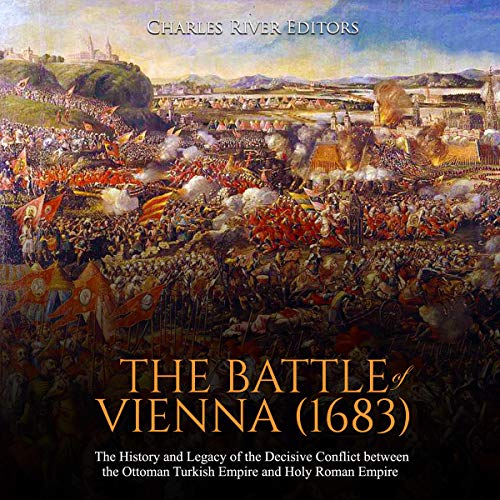
“Ours are treasures unheard of...tents, sheep, cattle and no small number of camels...it is victory as nobody ever knew before, the enemy now completely ruined, everything lost for them. They must run for their sheer lives....General Starhemberg hugged and kissed me and called me his saviour.” (Polish King John III Sobieski) There are certain events that are famous not so much in themselves, noteworthy as they might be, but on account of their role in the context of history. Seismic shifts pivot upon the outcome of such events, and many of them come from battles, for it is an unfortunate but irrefutable fact of history that humanity is shaped by the force of arms. Salamis, Hastings, Agincourt, Waterloo, Sedan, and Stalingrad all fit into this category, and the 1683 Battle of Vienna or Kahlenberg (named after a hill near the city) can also, with eminent justification, be placed in the list of era-changing conflicts. For nearly 1,000 years, there had been a clash for the souls, hearts, and bodies of societies across Europe, Africa, and Asia. The conflict between Christianity and Islam has been one of the defining factors in Europe and the Middle East, and while this dichotomy might be an excessively simple and incomplete explanation, there is no doubt that it has generated the world today. From Arabia, Islam surged forth onto the world stage in the 7th century as a religion carried by the force of arms. By the middle of the 8th century, the Islamic Caliphate had conquered the Levant, parts of North Africa, and even parts of Spain, all regions which had converted to Christianity in the previous three centuries. An Islamic invasion of France was turned away at the Battle of Poitiers in 732, and a Western counter-offensive known as the Reconquista lasted about 700 more years. Away from Europe, Christian and Muslim forces fought the Crusades around the Holy Land. Toward the end of the 17th century, the preeminent Islamic power in the world was the Ottoman Empire. From lowly beginnings as a vassal of the Anatolian Sultanate of Rum Osman I, from whom the empire was named, it expanded into the lands of the Christian Byzantine Empire, and by 1683, the year of the Battle of Vienna, the Ottomans ruled Asia Minor, the Middle East (with the exception of Iran), northern Africa to the borders of Morocco, the Balkan Peninsula up to the lands of modern Poland, as well as portions of Poland, Ukraine, Crimea, and Georgia. The sultan was styled “His Imperial Majesty the Padishah (Emperor), Commander of the Faithful and Successor to the Prophet of the Lord of the Universe.” The Battle of Vienna (1683): The History and Legacy of the Decisive Conflict Between the Ottoman Turkish Empire and Holy Roman Empire chronicles the dramatic siege, and how the Christian forces turned back the Ottomans. You will learn about the battle like never before.
©2019 Charles River Editors (P)2019 Charles River Editors

Japan and World War I
Summary
World War I, also known in its time as the “Great War” or the “War to End all Wars”, was an unprecedented holocaust in terms of its sheer scale. It saw millions of soldiers do battle in brutal assaults of attrition which dragged on for months with little to no respite. It demonstrated man’s capacity to kill each other on a heretofore unprecedented scale, and as always, such a war brought about technological innovation at a rate that made the boom of the Industrial Revolution seem stagnant. The First World War came at an unfortunate time for those who would fight in it, and while the role of Japan in World War II is widely known, Japan’s important role in the First World War is mostly overlooked. The Japanese contribution to the defeat of Germany and the Central Powers was important enough for Japan to be included among the Big Five Allied delegations at the 1919 peace negotiations, along with the British, French, Italians, and Americans, but it also served as a precursor of sorts for what would transpire a generation later. In the Second World War, Japanese forces ranged over an immense portion of the globe, but during World War I, Japanese naval forces spanned an even larger portion of the globe. Japanese warships escorted troopships carrying Australian and New Zealand Army Corps troops to the Middle East, cruisers hunted German commerce raiders in the Indian Ocean, the Bay of Bengal, and all over the Pacific, and destroyers plowed Mediterranean waters as they escorted British convoys from Egypt to Gibraltar and searched for German and Austrian submarines. Japanese troops besieged the German citadel of Qingdao in China, forcing that German colonial city and naval base to surrender, and through it all, Japanese naval forces stood guard off Mexico, Hawaii, and the American West Coast. All of this was accomplished with by far the fewest military losses of any of the major Allies. Indeed, the Japanese losses in World War I represented a small fraction of the losses incurred in the Russo-Japanese War of 1904-1905. Yet Japanese strategic gains were far greater that what was obtained in the previous war, as they took the German North Pacific islands, they had a relatively free hand to exploit China, and they gained an uneasy peace with the young Soviet Union. In short, World War 1 brought Japan recognition as one of the world’s primary military and economic powers. Japan and World War I: The History of the Japanese Empire’s Participation in the Great War analyzes the actions of the forgotten ally, and how Japan’s participation helped set the stage for its expansion across the Pacific. Along with pictures of important people, places, and events, you will learn about Japan and World War I like never before.
©2019 Charles River Editors (P)2019 Charles River Editors

Clausewitz and Jomini
Summary
Carl Philipp Gottfried von Clausewitz died almost 200 years ago, yet he remains one of the most important and influential of all military thinkers. His teachings combined strategy with military knowledge to produce a dialectic approach to the philosophy of warfare, and his work is still widely taught in military academies around the world. There are few senior military leaders anywhere who are not familiar with his seminal book, On War. In fact, with the exception of Napoleon Bonaparte, no man was more influential on the military tactics and strategy of 19th century warfare than Clausewitz, a Prussian soldier and military theorist who stressed the moral and political aspects of war. On War was mandatory for all military students and officers to read during the 19th century, and it was common practice for generals during the American Civil War to carry Clausewitz’s treatise and read it to assist them in strategy and tactics. On War covered every conceivable facet of warfare, using historical battles as examples of what to do and what not to do. The treatise discusses how opposite forces interact, and how unexpected new developments unfolding under the "fog of war" called for rapid decisions by alert commanders. In opposition to Antoine-Henri Jomini, he argued war could not be quantified or graphed or reduced to mapwork and graphs. Few men were more influential on the military tactics and strategy of 19th century warfare than Antoine-Henri Jomini, and yet the introduction for a 1947 English translation of Jomini’s Art of War noted, “The military world that today burns gun-powder at the altar of Clausewitzian doctrine has all but forgotten Antoine-Henri Jomini.” The author of that introduction, Lt. Col. J.D. Little of the US Marine Corps, was right then, and he remains correct today - while Clausewitz’s aphorisms are still used to support everything from military action to business management, the work of his contemporary writer Jomini has been all but forgotten. During the Napoleonic Era and throughout the 19th century, however, the situation was very different. Jomini was regarded as the preeminent strategist and writer of his generation, while Clausewitz was virtually unknown outside the General Staff of the Prussian Army. In the intervening period, Clausewitz has come to be regarded as the most important writer and strategic analyst of the period, whereas the writings of Jomini have been discarded and largely ignored. As a result, many military historians and strategists have only recently begun to understand how important Jomini was and how relevant his writings remain today. In lamenting what had happened to Jomini’s reputation, Little asserted, “No man in the history of war has exerted a greater influence on the development of modern warfare than Napoleon Bonaparte. No man has been more responsible for Napoleon’s influence as Antoine-Henri Jomini.” Again, Little had a point, because unlike Clausewitz, the writings of Jomini had a direct influence on the conduct of wars during the 19th century. While Clausewitz was not widely read outside Prussia (and later Germany) until the final years of the 19th century, few generals in Europe and America were unfamiliar with Jomini’s works, and many used his Summary of the Art of War as their main guide to strategy and tactics. Why is it that Jomini has been forgotten while Clausewitz’s name is now far more famous than it ever was during his lifetime? One of the reasons is that Clausewitz attempted to develop a philosophy of war that went well beyond the mechanics of combat. Such a philosophy is timeless precisely because it is not linked to the tactics or weapons of a particular period. This is made evident by the fact that as recently as the First Gulf War (1990–1991), senior military leaders in the coalition against Iraq were quoting Clausewitz.
©2019 Charles River Editors (P)2019 Charles River Editors

The Republic of Venice
Summary
“As in the Arsenal of the Venetians Boils in winter the tenacious pitch To smear their unsound vessels over again For sail they cannot; and instead thereof One makes his vessel new, and one recaulks The ribs of that which many a voyage has made One hammers at the prow, one at the stern This one makes oars and that one cordage twists Another mends the mainsail and the mizzen…” (Dante’s Inferno) To the first settlers of the unpromising, marshy islands of Venice in the 5th century BCE, it appeared as if any attempt at civilization was doomed to fail. Yet, even with the cards stacked against them, the artful inhabitants mastered the unlivable terrain and slowly pieced together a society that would put the small, unassuming city right on the map. In time, the city evolved into the most powerful maritime empire in all of Europe. Founded in the wake of the decline of the Roman Empire, the Republic of Venice lasted for more than a thousand years, from 697-1797, and in order to understand its singular position in world history, it is necessary to first note its geographical positioning and its topographical make-up: Located in northeastern Italy at the head of the Adriatic, the city is made up of 120 islands that are connected by 430 bridges that cross over 170 canals, referred to as a “rio” or plural “rii” (Italian for river). As a maritime power, the interests of Venice once reached all the way to Asia, which allowed it to form an important crossroads within the Eastern Mediterranean, in terms of trade. In Venice, a vast array of products (raw materials, spices, cloth) came all the way from North Africa, Russia, and India and were exchanged for the goods and wealth of Europe.” Venice, of course, earned its remarkable reputation on its own merit, but the reason for its current fame should be credited at least in part to its status as one of the most important tourist destinations of all time, attracting travelers interested in religion, art, culture, architecture, the seashore as well as shopping. As far back as the 16th century, pilgrims flocked there to take in its numerous holy sites, the remnants of the city’s medieval heritage, and in the 17th century, rich northern Europeans flocked to the city as part of their lengthy Grand Tour, hoping to feast their eyes on the unusual cityscape and its unique cultural heritage. Many of those famous writers penned unforgettable accounts of the city in English and in German, stories that only served to increase its fortunes over time. The Republic of Venice: The History of the Venetian Empire and Its Influence across the Mediterranean dives into the city's origin story, how it became one of the most important powers in Europe, and its inevitable undoing. Along with information about important people, places, and events, you will learn about the Venetian Republic like never before.
©2019 Charles River Editors (P)2019 Charles River Editors

Nimrud: The History and Legacy of the Ancient Assyrian City
Summary
When scholars study the history of the ancient Near East, several wars that had extremely brutal consequences (at least by modern standards) often stand out. Forced removal of entire populations, sieges that decimated entire cities, and wanton destruction of property were all tactics used by the various peoples of the ancient Near East against each other, but the Assyrians were the first people to make war a science. When the Assyrians are mentioned, images of war and brutality are among the first that come to mind, despite the fact that their culture prospered for nearly 2,000 years. Like a number of ancient individuals and empires in that region, the negative perception of ancient Assyrian culture was passed down through Biblical accounts, and regardless of the accuracy of the Bible’s depiction of certain events, the Assyrians clearly played the role of adversary for the Israelites. Indeed, Assyria (Biblical Shinar) and the Assyrian people played an important role in many books of the Old Testament and are first mentioned in the book of Genesis: “And the beginning of his kingdom was Babel and Erech, and Akkad, and Calneh, in the land of Shinar. Out of that land went forth Ashur and built Nineveh and the city Rehoboth and Kallah.” (Gen. 10:10-11). Although the Biblical accounts of the Assyrians are among the most interesting and are often corroborated with other historical sources, the Assyrians were much more than just the enemies of the Israelites and brutal thugs. A historical survey of ancient Assyrian culture reveals that although they were the supreme warriors of their time, they were also excellent merchants, diplomats, and highly literate people who recorded their history and religious rituals and ideology in great detail. The Assyrians, like their other neighbors in Mesopotamia, were literate and developed their own dialect of the Akkadian language that they used to write tens of thousands of documents in the cuneiform script (Kuhrt 2010, 1:84). Furthermore, the Assyrians prospered for so long that their culture is often broken down by historians into the “Old”, “Middle”, and “Neo” Assyrian periods, even though the Assyrians themselves viewed their history as a long succession of rulers from an archaic period until the collapse of the neo-Assyrian Empire in the 7th century BCE. In fact, the current divisions have been made by modern scholars based on linguistic changes, not on political dynasties (van de Mieroop 2007, 179). The city of Nimrud was one of the Assyrians’ most important cities, and it has been known by many different names throughout its history. In ancient Assyrian, the city was called Kal?u, a name first attested to in texts dating back to the 13th century BCE. In the Bible, it is known as Calah, and the city is now called Nimrud from an association with the Biblical figure Nimrod. Nimrud is located in northern Iraq on the east bank of the Tigris River, about 20 miles south of modern Mosul and ancient Nineveh. An ancient Assyrian capital during the Neo-Assyrian period, the city has produced many glorious artifacts and provided countless insights into this ancient civilization, but the history of the city after the fall of the Assyrians has proven just as turbulent and interesting. Nimrud: The History and Legacy of the Ancient Assyrian City chronicles the origins of the city, how it became a power center in antiquity, and its controversial fate.
©2019 Charles River Editors (P)2019 Charles River Editors

The First World War: A Captivating Guide to World War 1, the Battle of Verdun and the Battle of Somme
Summary
If you want to discover captivating stories of people and events of World War 1, then pay attention... Three captivating manuscripts in one audiobook: World War 1: A Captivating Guide to the First World War, Including Battle Stories from the Eastern and Western Front and How the Treaty of Versailles in 1919 Impacted the Rise of Nazi Germany The Battle of Verdun: A Captivating Guide to The Longest and Largest Battle of World War 1 That Took Place on The Western Front Between Germany and France The Battle of the Somme: A Captivating Guide to One of the Most Devastating Events of the First World War That Took Place on the Western Front Some of the topics covered in part one of this audiobook include: The fatal shots that set the stage for war The Western Front and the First Battle of Marne War in the Trenches The Eastern Front and the Battle of Tannenberg The Battle of Ypres and the Christmas Truce Second Battle of Ypres and the introduction of chemical warfare World leaders who played a pivotal role in the first world war And much, much more! Some of the topics covered in part 2 of this audiobook include: The Road to Verdun The Battle of Verdun Gets Bogged Down in the Trenches A Summer in Hell And much, much more! Some of the topics covered in part 3 of this audiobook include: The road to the Somme The significance of Verdun The Battle of the Somme Begins Z Day The Battles of the Somme And much, much more... So if you want to learn more about the First World War, scroll up and click the "Add to Cart" button!
©2019 Captivating History (P)2019 Captivating History

Kosmos 954 and Operation Morning Light
Summary
“We are just not good enough to tell New York City, for instance, that a satellite is coming and will knock King Kong off the Empire State Building at 2 P.M.” (Lieutenant Colonel Yanchek, Space Defense Center chief, 1978) In the predawn sky of northern Canada, on the morning of January 24th, 1978, a long streak of blue fire suddenly rushed across the starry vista northeast of the remote town of Yellowknife. Those out on the bitterly cold night, with a temperature many tens of degrees below zero Fahrenheit, saw a brilliant leading object sheathed in flames, blue or bluish red, and shining with incandescent intensity. Other smaller objects or fragments shed off it, arcing or tumbling earthward on their own trajectories. Even in this remote location, a number of individuals saw and reported the unusual phenomenon. Out under the starry dome of the distant north, where celestial objects appeared with burning clarity through the frigid, pure air, they watched the apparition until it vanished in the northeast, somewhere far over Great Slave Lake. One such observer, a native of the Dog Rib tribe named Jimmy Doctor, recounted what he saw: “That night I saw it, I was listening to the radio at home when I heard some noise behind the house. So, I got up to see what it was. It was a dog howling into the sky beside my skidoo. I looked up into the sky to see if the moon was still shining. That was when I seen the big flame going north east. I ran outside to see what it was. I thought it was a plane on fire. I didn’t know what it was. It sounded like air coming out of a tire. That was the way I saw the satellite.” (Heaps, 1978, 54). Of the relatively few people who witnessed it, most assumed they witnessed a burning passenger jet crashing. One thought that it might have something to do with lasers after seeing a program about them on television. Others, observing its speed and unusual appearance, recognized they had not seen a crashing aircraft but had no ready explanation for it at all. Conversely, Canadian and American officials knew precisely what the people of Yellowknife and the surrounding areas witnessed. Within a short time, teams of scientists and security experts boarded aircraft to converge on the deep wilderness where the Soviet spy satellite Kosmos 954 had just crashed into the atmosphere and burned up over Great Slave Lake, strewing radioactive debris over an area of approximately 48,000 square miles. Those efforts would kick off one of the most unique environmental operations in history. Kosmos 954 and Operation Morning Light: The History of Efforts to Contain Radioactive Debris Spread across Canada by a Soviet Satellite examines how the satellite malfunctioned, the disastrous results, and efforts to clean up the radioactivity.
©2019 Charles River Editors (P)2019 Charles River Editors