Ken Kliban has narrated 12 audiobooks on Listento.it by 15 authors, with an average listener rating of 4.6★ across 111 ratings. The most-rated is Separation of Power.

Separation of Power
Summary
Newly appointed CIA director Dr. Irene Kennedy is the target of an inside plot to destroy her and prematurely end the American President's term. To make matters worse, Saddam Hussein is close to entering the nuclear arms race - something Israel has vowed to stop. With the haunting specter of World War III looming, the president calls on his secret weapon: top counter-terrorism operative Mitch Rapp. But with only two weeks to take out the nukes, Rapp is up against a ticking clock - and impossible odds.
©2002 Vince Flynn (P)2011 Simon & Schuster
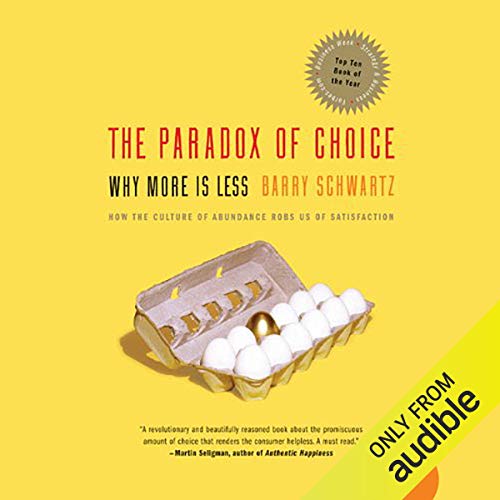
The Paradox of Choice
Summary
In the spirit of Alvin Tofflers' Future Shock, a social critique of our obsession with choice, and how it contributes to anxiety, dissatisfaction and regret. Whether were buying a pair of jeans, ordering a cup of coffee, selecting a long-distance carrier, applying to college, choosing a doctor, or setting up a 401(k), everyday decisions - both big and small - have become increasingly complex due to the overwhelming abundance of choice with which we are presented. We assume that more choice means better options and greater satisfaction. But beware of excessive choice: choice overload can make you question the decisions you make before you even make them, it can set you up for unrealistically high expectations, and it can make you blame yourself for any and all failures. In the long run, this can lead to decision-making paralysis, anxiety, and perpetual stress. And, in a culture that tells us that there is no excuse for falling short of perfection when your options are limitless, too much choice can lead to clinical depression. In The Paradox of Choice, Barry Schwartz explains at what point choice - the hallmark of individual freedom and self-determination that we so cherish - becomes detrimental to our psychological and emotional well-being. In accessible, engaging, and anecdotal prose, Schwartz shows how the dramatic explosion in choice--from the mundane to the profound challenges of balancing career, family, and individual needs--has paradoxically become a problem instead of a solution. Schwartz also shows how our obsession with choice encourages us to seek that which makes us feel worse.
©2004 Barry Schwartz (P)2010 Audible, Inc.

Anatomy of an Epidemic
Summary
In this astonishing and startling book, award-winning science and history writer Robert Whitaker investigates a medical mystery: Why has the number of disabled mentally ill in the United States tripled over the past two decades? Every day, 1,100 adults and children are added to the government disability rolls because they have become newly disabled by mental illness, with this epidemic spreading most rapidly among our nations children. What is going on? Anatomy of an Epidemic challenges listeners to think through that question themselves. First, Whitaker investigates what is known today about the biological causes of mental disorders. Do psychiatric medications fix chemical imbalances in the brain, or do they, in fact, create them? Researchers spent decades studying that question, and by the late 1980s, they had their answer. Listeners will be startled - and dismayed - to discover what was reported in the scientific journals. Then comes the scientific query at the heart of this book: During the past 50 years, when investigators looked at how psychiatric drugs affected long-term outcomes, what did they find? Did they discover that the drugs help people stay well? Function better? Enjoy good physical health? Or did they find that these medications, for some paradoxical reason, increase the likelihood that people will become chronically ill, less able to function well, more prone to physical illness? This is the first book to look at the merits of psychiatric medications through the prism of long-term results. By the end of this review of the outcomes literature, listeners are certain to have a haunting question of their own: Why have the results from these long-term studies - all of which point to the same startling conclusion - been kept from the public?
©2010 Robert Whitaker (P)2010 Audible, Inc.

The Auschwitz Volunteer
Summary
In 1940, the Polish Underground wanted to know what was happening inside the recently opened Auschwitz concentration camp. Polish army officer Witold Pilecki volunteered to be arrested by the Germans and report from inside the camp. His intelligence reports, smuggled out in 1941, were among the first eyewitness accounts of Auschwitz atrocities: the extermination of Soviet POWs, its function as a camp for Polish political prisoners, and the "final solution" for Jews. Pilecki received brutal treatment until he escaped in April 1943; soon after, he wrote a brief report. This book is the first English translation of a 1945 expanded version. In the foreword, Poland's chief rabbi states, "If heeded, Pilecki's early warnings might have changed the course of history." Pilecki's story was suppressed for half a century after his 1948 arrest by the Polish Communist regime as a "Western spy". He was executed and expunged from Polish history. Pilecki writes in staccato style but also interjects his observations on humankind's lack of progress: "We have strayed, my friends, we have strayed dreadfully.... We are a whole level of hell worse than animals!"
©2012 Jarsolaw Garlinski and Aquila Polonica (U.S.) Ltd. (P)2013 Audible, Inc.
Grab Your Audience's Attention
Summary
This Element is an excerpt from So What?: How to Communicate What Really Matters to Your Audience by Mark Magnacca, available in print and digital formats.Create an irresistible "Positioning Statement" that will make everyone want to know more about you! The cliche "You never get a second chance to make a first impression" is absolutely right. And the way you answer the question, "What do you do for a living?" usually determines whether or not people will want to listen to what you have to say. Here's how to get them engaged immediately.
©2010 Pearson Education, Inc. (P)2009 Audible, Inc.

Shadow Account
Summary
Investment banker Conner Ashby is doing all right for himself - until he receives a wayward e-mail...and is plunged into a terrifying nightmare. It's a communication not meant for Conner's eyes, about a company engaged in corporate fraud on a massive scale. With millions of dollars at stake and hell to pay if the truth comes out, whoever clicked the send button by mistake isn't about to take any chances. Following a trail of misdeeds that stretches nationwide, Conner slowly uncovers a shocking agenda. Surviving will mean struggling to expose the plot as relentlessly as his shadowy enemies seek to conceal it - and fighting for his life as ruthlessly as those determined to end it.
©2004 Stephen Frey (P)2008 BBC Audio

Stalin's Children
Summary
A transcendent history/memoir of one family’s always passionate, sometimes tragic connection to Russia. On a midsummer day in 1937, a black car pulled up to a house in Chernigov, in the heart of the Ukraine. Boris Bibikov - Owen Matthews’ grandfather - kissed his wife and two young daughters good-bye and disappeared inside the car. His family never saw him again. His wife would soon vanish as well, leaving Lyudmila and Lenina alone to drift across the vast Russian landscape during World War II. Separated as the Germans advanced in 1941, they were miraculously reunited against all odds at the war’s end. Some 25 years later, in the early 1960s, Mervyn Matthews - Owen’s father - followed a lifelong passion for Russia and moved to Moscow to work for the British embassy. He fell in and out with the KGB, and despite having fallen in love with Lyudmila, he was summarily deported. For the next six years, Mervyn worked day and night to get Lyudmila out of Russia, and when he finally succeeded, they married. Decades on from these events, Owen Matthews - then a young journalist himself in Russia - came upon his grandfather’s KGB file recording his “progress from life to death at the hands of Stalin’s secret police". Stimulated by its revelations, he has pieced together the tangled and dramatic threads of his family’s past and present, making sense of the magnetic pull that has drawn him back to his mother’s homeland. Stalin’s Children is an indelible portrait of Russia over seven decades and an unforgettable memoir about how we struggle to define ourselves in opposition to our ancestry only to find ourselves aligning with it. “I came to Russia to get away from my parents,” writes Matthews. “Instead I found them there, though for a long time I didn’t know it or refused to see it. This is a story about Russia and my family, about a place which made us and freed us and inspired us and very nearly broke us. And it’s ultimately a story about escape, about how we all escaped from Russia, even though all of us - even my father, a Welshman, who has no Russian blood, even me, who grew up in England - still carry something of Russia inside ourselves, infecting our blood like a fever.”
©2008 Owen Matthews (P)2013 Audible, Inc.

St. Petersburg Noir
Summary
Launched with the summer '04 award-winning best-seller Brooklyn Noir, Akashic Books continues its groundbreaking series of original noir anthologies. Each book is comprised of all-new stories, each one set in a distinct neighborhood or location within the geographical area of the book. Original stories by: Lena Eltang, Sergei Nosov, Alexander Kudriavstev, Andrei Kivinov, Julia Belomlinsky, Natalia Kurchatova, Ksenia Venglinskaya, Eugene Kogan, Anton Chizh, Vladimir Berezin, Andrei Rubanov, and others. St. Petersburg boasts to have the strongest spirit of all Russian cities, and indeed the dark metaphysics of this city captivate tourists and locals alike. When you think of St. Petersburg noir, some of the greatest literary names immediately spring to mind - Alexander Pushkin, Nikolay Gogol, and Fyodor Dostoevsky. Modern day St. Petersburg lavishly offers the scenery and conditions for true noir stories, and the writers in St. Petersburg Noir succeed in concocting their own worlds within this city with stories ranging from mystical to outwardly grotesque. Within this collection, you'll meet characters who populate the narrow streets and unlit inner yards in the vast historical center winking at ghosts from pages of Dostoevsky's novels (Nutcracker); you'll hear of criminal activities settled behind the locked doors of magnificent palaces and museums (The Witch Hour and The Last Skinhead); and you'll follow the path of a police officer on his first day of duty maddeningly chasing a doppelganger... of a corpse (The First Duty).
©2012 Akashic Books (P)2014 Audible Inc.

The Great Cat Massacre
Summary
The landmark history of France and French culture in the 18th century, a winner of the Los Angeles Times Book Prize. When the apprentices of a Paris printing shop in the 1730s held a series of mock trials and then hanged all the cats they could lay their hands on, why did they find it so hilariously funny that they choked with laughter when they reenacted it in pantomime some 20 times? Why in the 18th century version of Little Red Riding Hood did the wolf eat the child at the end? What did the anonymous townsman of Montpelier have in mind when he kept an exhaustive dossier on all the activities of his native city? These are some of the provocative questions the distinguished Harvard historian Robert Darnton answers in The Great Cat Massacre, a kaleidoscopic view of European culture during what we like to call "The Age of Enlightenment". A classic of European history, it is an essential starting point for understanding Enlightenment France.
©2009 Robert Darnton (P)2020 Hachette Audio

The Mystified Magistrate
Summary
The great virtue of this volume is that it reveals a lighter, comic side of Sade. He was a man obsessed, like many great writers, and his obsessions are still present here: his hatred of all things pretentious, his loathing of a corrupt judicial system, his damning of hypocrisy and false piety. One of the great anarchists of all time, he was nevertheless far from mad (as many pretended) and these works of fiction shed another light on this most feverish of minds. But however heavy the subject, The Mystified Magistrate is infused with a light touch; it is revealing but never offensive.
©2000, 2011, 2012 Richard Seaver (P)2012 Audible, Inc.

The Art of the Deal
Summary
Art today is defined by its relationship to money as never before. Prices of living artists' works have been driven to unprecedented heights, conventional boundaries within the art world have collapsed, and artists now think ever more strategically about how to advance their careers. Artists no longer simply make art, but package, sell, and brand it. Noah Horowitz exposes the inner workings of the contemporary art market, explaining how this unique economy came to be, how it works, and where it's headed. He takes a unique look at the globalization of the art world and the changing face of the business, offering the clearest analysis yet of how investors speculate in the market and how emerging art forms, such as video and installation, have been drawn into the commercial sphere. By carefully examining these developments against the backdrop of the deflation of the contemporary art bubble in 2008, Art of the Deal is a must-listen book that demystifies collecting and investing in today's art market.
©2011 Princeton University Press (P)2011 Audible, Inc.

Useful Enemies
Summary
John “Iwan” Demjanjuk was at the center of one of history’s most complex war crimes trials. But why did it take almost sixty years for the United States to bring him to justice as a Nazi collaborator?The answer lies in the annals of the Cold War, when fear and paranoia drove American politicians and the U.S. military to recruit “useful” Nazi war criminals to work for the United States in Europe as spies and saboteurs, and to slip them into America through loopholes in U.S. immigration policy. During and after the war, that same immigration policy was used to prevent thousands of Jewish refugees from reaching the shores of America.The long and twisted saga of John Demjanjuk, a postwar immigrant and auto mechanic living a quiet life in Cleveland until 1977, is the final piece in the puzzle of American government deceit. The White House, the Departments of War and State, the FBI, and the CIA supported policies that harbored Nazi war criminals and actively worked to hide and shelter them from those who dared to investigate and deport them.The heroes in this story are men and women such as Congresswoman Elizabeth Holtzman and Justice Department prosecutor Eli Rosenbaum, who worked for decades to hold hearings, find and investigate alleged Nazi war criminals, and successfully prosecute them for visa fraud. But it was not until the conviction of John Demjanjuk in Munich in 2011 as an SS camp guard serving at the Sobibor death camp that this story of deceit can be told for what it is: a shameful chapter in American history.Riveting and deeply researched, Useful Enemies is the account of one man’s criminal past and its devastating consequences, and the story of how America sacrificed its moral authority in the wake of history’s darkest moment.
©2013 Richard Rashke (P)2014 Audible, Inc.