Marc Cashman has narrated 92 audiobooks on Listento.it by 85 authors, with an average listener rating of 4.3★ across 1,105 ratings. The most-rated is How to Think Like a Roman Emperor.

How to Think Like a Roman Emperor
Summary
The life-changing principles of Stoicism taught through the story of its most famous proponent. Roman emperor Marcus Aurelius was the final famous Stoic philosopher of the ancient world. The Meditations, his personal journal, survives to this day as one of the most loved self-help and spiritual classics of all time. In How to Think Like a Roman Emperor, psychotherapist Donald Robertson weaves stories of Marcus’ life from the Roman histories together with explanations of Stoicism - its philosophy and its psychology - to enlighten today’s listeners. He discusses Stoic techniques for coping with everyday problems, from irrational fears and bad habits to anger, pain, and illness. How to Think Like a Roman Emperor takes listeners on a transformative journey along with Marcus, following his progress from a young noble at the court of Hadrian - taken under the wing of some of the finest philosophers of his day - through to his reign as emperor of Rome at the height of its power. Robertson shows how Marcus used philosophical doctrines and therapeutic practices to build emotional resilience and endure tremendous adversity, and guides listeners through applying the same methods to their own lives. Combining remarkable stories from Marcus’s life with insights from modern psychology and the enduring wisdom of his philosophy, How to Think Like a Roman Emperor puts a human face on Stoicism and offers a timeless and essential guide to handling the ethical and psychological challenges we face today.
©2019 Donald Robertson (P)2019 Macmillan Audio

The Book on Investing In Real Estate with No (and Low) Money Down
Summary
Is your lack of cash holding you back from your real estate dreams? Discover the creative real estate financing techniques that savvy investors are using to do more deals, more often. No matter how much money you have in your checking account, there is always real estate you can’t afford. Don't let the contents of your wallet define your future! This book provides numerous strategies for leveraging other people’s money for amazing returns on your initial investment. Active real estate investor and co-host of The BiggerPockets Podcast, Brandon Turner, dives into multiple financing methods that professional investors use to tap into current real estate markets. Not only will you be able to navigate the world of creative real estate finance, but you’ll get more mileage out of any real estate investment strategy. Financing deals just got easier — learn how to be a smart investor by using creativity, not cash! Inside, you'll discover: The truth about no-money-down investing ? Investing with little to no money down is possible, but it’s not about a step-by-step strategy. It’s about a mindset. How to get started investing in real estate ? Looking for your first deal, but you have no money or experience? Learn the best strategies for getting your feet wet without paying thousands! Numerous strategies to mix and match ? Creative investing requires a creative mind. How to attract private money, lenders, and partners ? There are millions of millionaires walking the streets. Discover the best way to attract them to you. The ugly side of creative investing ? Learn the downsides to all the strategies mentioned in this book, as well as tips for overcoming those problems. Strategies for wholesaling, flipping, rentals, and more ? Find success no matter what niche you plan to use to build your real estate empire.
©2014 BiggerPockets Publishing, LLC (P)2014 BiggerPockets Publishing, LLC

Rule #1
Summary
Before I became "Phil Town, teacher of investing principles to more than 500,000 people a year", I was a lot like you: someone who viewed individual stock investing as way too hard to do successfully. As a guy who barely made a living as a river guide, I considered the whole process pretty impenetrable, and I was convinced that to do it right you had to make it a full-time job. Me, I was more interested in having full-time fun. In this book I'll show you how I turned $1,000 into $1 million in only five years, and then proceeded to make many millions more. I came to investing as a person who wasn't great at math, possessed zero extra cash, and wanted a life, not an extra three hours of work to do every day. Fortunately, I was introduced to The Rule. Rule #1, as famed investor Warren Buffett will tell you, is don't lose money. Through an intriguing process that I'll clarify in this book, not losing money results in making more money than you ever imagined. What it comes down to is buying shares of companies only when the numbers, and the intangibles, are on your side. If that sounds too good to be true, it's because the mind-set I'll be introducing you to leads not to bets but to certainties. Believe me, if there were anything genius-level about this, I'd still be a river guide collecting unemployment much of the year. What I won't waste your time with is fluff: a lot of vague parables reminding you of what you already know and leaving you exactly where you started. This is the real deal, folks: a start-to-finish, one-baby-step-at-a-time approach that will allow you to retire 10 years sooner than you planned, with more creature comforts than you ever imagined.
©2006 Phil Town (P)2006 Books on Tape

What Got You Here Won't Get You There
Summary
What's holding you back? Your hard work is paying off. You are doing well in your field. But there is something standing between you and the next level of achievement. Perhaps one small flaw, a behavior you barely even recognize, is the only thing that's keeping you from where you want to be. Who can help? Marshall Goldsmith is an expert at helping global leaders overcome their (sometimes unconscious) annoying habits and attaining a higher level of success. His one-on-one coaching comes with a six-figure price tag. But with this audiobook, you'll get Marshall's great advice without the hefty fee! What is the solution? The Harvard Business Review asked Goldsmith, "What is the most common problem faced by the executives that you coach?" Inside, he answers this question by discussing not only the key beliefs of successful leaders, but also the behaviors that hold them back. He addresses the fundamental problems that often come with success and offers ways to attack them. Goldsmith outlines 20 habits commonly found in the corporate environment and provides a systematic approach to helping executives achieve a positive change in behavior.
©2007 Marshall Goldsmith (P)2007 Books on Tape

The Zombie Survival Guide
Summary
The Zombie Survival Guide is your key to survival against the hordes of undead who may be stalking you right now. Exhaustively comprehensive, this book covers everything you need to know, including how to understand zombie physiology and behavior, the most effective defense tactics and weaponry, ways to outfit your home for a long siege, and how to survive and adapt in any territory or terrain. Top 10 Lessons for Surviving a Zombie Attack: 1. Organize before they rise! 2. They feel no fear, why should you? 3. Use your head: cut off theirs. 4. Blades don't need reloading. 5. Ideal protection: tight clothes, short hair. 6. Get up the staircase, then destroy it. 7. Get out of the car, get onto the bike. 8. Keep moving, keep low, keep quiet, keep alert! 9. No place is safe, only safer. 10. The zombie may be gone, but the threat lives on. Don't be carefree and foolish with your most precious asset: life. The Zombie Survival Guide offers complete protection through trusted, proven tips for safeguarding yourself and your loved ones against the living dead. It is an audiobook that can save your life.
©2003 Max Brooks (P)2006 Random House, Inc.

The End of Alzheimer's
Summary
A groundbreaking plan to prevent and reverse Alzheimer's disease that fundamentally changes how we understand cognitive decline. Everyone knows someone who has survived cancer, but until now no one knows anyone who has survived Alzheimer's disease. In this paradigm shifting book, Dale Bredesen, MD, offers real hope to anyone looking to prevent and even reverse Alzheimer's disease and cognitive decline. Revealing that AD is not one condition, as it is currently treated, but three, The End of Alzheimer's outlines 36 metabolic factors (micronutrients, hormone levels, sleep) that can trigger "downsizing" in the brain. The protocol shows us how to rebalance these factors using lifestyle modifications like taking B12, eliminating gluten, or improving oral hygiene. The results are impressive. Of the first 10 patients on the protocol, nine displayed significant improvement with three to six months; since then the protocol has yielded similar results with hundreds more. Now, The End of Alzheimer's brings new hope to a broad audience of patients, caregivers, physicians, and treatment centers with a fascinating look inside the science and a complete step-by-step plan that fundamentally changes how we treat and even think about AD. For more information, including articles and diagrams, please visit Drbredesen.com or mpicognition.com.
©2017 Dale E. Bredesen MD (P)2017 Penguin Audio

Haunted
Summary
Haunted by Chuck Palahniuk is a novel made up of stories: 23 of them, to be precise. Twenty-three of the most horrifying, hilarious, mind-blowing, stomach-churning tales you'll ever encounter, sometimes all at once. They are told by people who have answered an ad headlined "Writers' Retreat: Abandon Your Life for Three Months", and who are led to believe that here they will leave behind all the distractions of "real life" that are keeping them from creating the masterpiece that is in them. But "here" turns out to be a cavernous and ornate old theater where they are utterly isolated from the outside world, and where heat and power and, most important, food are in increasingly short supply. And the more desperate the circumstances become, the more extreme the stories they tell, and the more devious their machinations become to make themselves the hero of the inevitable play/movie/nonfiction blockbuster that will surely be made from their plight. Haunted is on one level a satire of reality television: The Real World meets Alive. It draws from a great literary tradition, The Canterbury Tales, The Decameron, the English storytellers in the Villa Diodati who produced, among other works, Frankenstein, to tell an utterly contemporary tale of people desperate that their story be told at any cost. Appallingly entertaining, Haunted is Chuck Palahniuk at his finest, which means his most extreme and his most provocative.
©2005 Chuck Palahniuk (P)2005 Random House, Inc. Random House Audio, a division of Random House, Inc.

Payback Time
Summary
Phil Town's first book, the number-one New York Times best seller Rule #1, was a guide to stock trading for people who believe they lack the knowledge to trade. But because many people arent ready to go from mutual funds directly into trading without understanding investing for the long term, he created Payback Time. Too often, people see long-term investing as mutual-fund contributing - otherwise known as long-term hoping. But the sad truth is that mutual fund investors are, to a stunning degree, pinning their hopes on an institution that is hopeless. It turns out that only 4% of fund managers consistently beat the S&P 500 index over the long term, which means that 96% of fund investors see a smaller return on their nest egg than a chimpanzee who simply buys stocks in the 500 biggest companies in America and watches what happens. But its worse than that. The net effect of hitching your wagon to mutual funds is that over a lifetime theyll fritter away as much 60% of your nest egg in fees. Once you understand how funds engineer this, you'll rush to invest on your own. Payback Time's risk-free approach is called stockpiling and it's how billionaires get rich in bad markets. Its a set of rules for investing (not trading but investing) in the right businesses at the right time -- rules that will ensure you make the big money.
©2010 Phil Town (P)2010 Random House

Your Inner Fish
Summary
Why do we look the way we do? What does the human hand have in common with the wing of a fly? Are breasts, sweat glands, and scales connected in some way? To better understand the inner workings of our bodies and to trace the origins of many of today’s most common diseases, we have to turn to unexpected sources: worms, flies, and even fish. Neil Shubin, a leading paleontologist and professor of anatomy who discovered Tiktaalik - the “missing link” that made headlines around the world in April 2006 - tells the story of evolution by tracing the organs of the human body back millions of years, long before the first creatures walked the earth. By examining fossils and DNA, Shubin shows us that our hands actually resemble fish fins, our head is organized like that of a long-extinct jawless fish, and major parts of our genome look and function like those of worms and bacteria. Shubin makes us see ourselves and our world in a completely new light. Your Inner Fish is science writing at its finest - enlightening, accessible, and told with irresistible enthusiasm.
©2008 Neil Shubin (P)2008 Books on Tape

The Attention Merchants
Summary
From Tim Wu, author of the award-winning The Master Switch (a New Yorker and Fortune Book of the Year) and who coined the term "net neutrality” - a revelatory, ambitious, and urgent account of how the capture and resale of human attention became the defining industry of our time. Feeling attention challenged? Even assaulted? American business depends on it. Attention merchant: an industrial-scale harvester of human attention. A firm whose business model is the mass capture of attention for resale to advertisers. In nearly every moment of our waking lives, we face a barrage of messaging, advertising enticements, branding, sponsored social media, and other efforts to harvest our attention. Few moments or spaces of our day remain uncultivated by the "attention merchants", contributing to the distracted, unfocused tenor of our times. Tim Wu argues that this condition is not simply the byproduct of recent technological innovations but the result of more than a century's growth and expansion in the industries that feed on human attention. From the pre-Madison Avenue birth of advertising to the explosion of the mobile web; from AOL and the invention of email to the attention monopolies of Google and Facebook; from Ed Sullivan to celebrity power brands like Oprah Winfrey, Kim Kardashian, and Donald Trump, the basic business model of "attention merchants" has never changed: free diversion in exchange for a moment of your consideration, sold in turn to the highest-bidding advertiser. Wu describes the revolts that have risen against the relentless siege of our awareness, from the remote control to the creation of public broadcasting to Apple's ad-blocking OS. But he makes clear that attention merchants are always growing new heads, even as their means of getting inside our heads are changing our very nature - cognitive, social, political, and otherwise - in ways unimaginable even a generation ago. “A startling and sweeping examination of the increasingly ubiquitous commercial effort to capture and commodify our attention.... We’ve become the consumers, the producers, and the content. We are selling ourselves to ourselves.” (Tom Vanderbilt, The New Republic) “An erudite, energizing, outraging, funny and thorough history.... A devastating critique of ad tech as it stands today, transforming 'don't be evil' into the surveillance business model in just a few short years. It connects the dots between the sale of advertising inventory in schools to the bizarre ecosystem of trackers, analyzers and machine-learning models that allow the things you look at on the web to look back at you.... This stuff is my daily beat, and I learned a lot from Attention Merchants.” (Cory Doctorow, BoingBoing) “Illuminating.” (Jacob Weisberg, The New York Review of Books)
©2016 Tim Wu (P)2016 Random House Audio

Getting More
Summary
Negotiation is part of every human encounter, and most of us do it badly. Whether dealing with family, a business, or diplomacy, people often fail to meet their goals in every country and context. They focus on power and “win-win” instead of relationships and perceptions. They don’t find enough things to trade. They think others should be rational when they should be dealing with emotions. They get distracted from their goals. In this revolutionary book, leading negotiation practitioner and professor Stuart Diamond draws on the research and practice of 30,000 people he has taught and advised in 45 countries over two decades to outline specific, practical and better ways to deal with others. They range from country and corporate leaders to administrative assistants, lawyers, housewives, students, and laborers. To this he adds his 40-year experience as an executive, Harvard-trained attorney, and Pulitzer Prize-winning journalist. Getting More is based on Professor Diamond’s award-winning negotiations course at The Wharton Business School, where it has been the most sought-after course by students for 13 years. It contains a powerful toolkit that can be used in any situation: with kids and jobs, travel and shopping, business, politics, relationships, cultures, partners and competitors. The advice is addressed through the stories of hundreds of people who have used Diamond’s tools with great success. A 20% savings on an item already on sale. An extra $300 million profit in a business. A woman from India getting out of her own arranged marriage. A four-year-old willingly brushing his teeth and going to bed. Instead of “win-win”, it sometimes makes more sense to lose today to get more tomorrow. The use of power, Diamond cautions, too often causes retaliation, harms relationships, and costs credibility. Walking out is almost never as good as understanding the other person’s perceptions and fixing the problem.
©2010 Stuart Diamond (P)2010 Random House

As I Lay Dying
Summary
At the heart of this 1930 novel is the Bundren family's bizarre journey to Jefferson to bury Addie, their wife and mother. Faulkner lets each family member, including Addie, and others along the way tell their private responses to Addie's life.
(P)2005 Random House, Inc. Random House Audio, a division of Random House, Inc.

Eat Pray Love Made Me Do It
Summary
True stories inspired by one of the most iconic, beloved, best-selling books of our time. In the 10 years since its electrifying debut, Elizabeth Gilbert's Eat Pray Love has become a worldwide phenomenon, empowering millions of readers and listeners to set out on paths they never thought possible, in search of their own best selves. Here, in this candid and captivating collection, nearly 50 of those readers and listeners - people as diverse in their experiences as they are in age and background - share their stories. The journeys they recount are transformative - sometimes hilarious, sometimes heartbreaking, but always deeply inspiring. Eat Pray Love helped one writer to embrace motherhood, another to come to terms with the loss of her mother, and yet another to find peace with not wanting to become a mother at all. One writer, reeling from a difficult divorce, finds new love overseas; another, a lifelong caregiver, is inspired to take an annual road trip - solo. A man leaves seminary, embraces his sexual identity, and forges a new relationship with God. A woman goes to divinity school and grapples with doubt and belief. One writer's search for the perfect pizza leads her to New Zealand and off-the-grid homesteading while another, in overcoming an eating disorder, redefines her relationship not only with food but with herself. Some writers face down devastating illness and crippling fears and others step out of their old lives to fulfill long-held dreams of singing, acting, writing, teaching, and learning. Entertaining and enlightening, Eat Pray Love Made Me Do It is a celebration for fans old and new. What will Eat Pray Love make you do? Introduction written and read by Elizabeth Gilbert. Read by Cassandra Campbell, Marc Cashman, Robbie Daymond, Mark Deakins, Ariana Delawari, Jorjeana Marie, and Emily Rankin. Full author list includes: Alexandria Hodge, Amy B. Scher, Linsi Broom, Melissa Bergstrom, Kahla Kiker, Sandra Roussy, James Belmont, Annmarie Kostyk, Nosipho Kota, Nicole Massaro, Regan Spencer, Chelsey Everest, Theressa Real, Crystal Gasser, Lisann Valentin, Karstee Davis, Laurie Granieri, Leslie Patrick Moore, Sondra Imperati, Elizabeth Duffy, Amanda Whitten, Billy Rosa, Theresa Thornton, Cara Bradshaw, Robin Murphy, Kitty Taylor, Danielle Rhinehart, Elizabeth Veras Holland, Susan Krakoff, Tracie Cornell, Lettie Stratton, Jen Flick, Peggy Bresnick, Eran Sudds, Laurna Strikwerda, Aimee Halfpenny, Jan Haag, Shannon Sykes Westgate, Eduardo Martinez, Emily Shaules, Rebecca Asher, Victoria Russell, Mallory Kotzman, Lisa Becker, Peter Richmond, April Schmidt, and Tina Donvito.
©2016 Elizabeth Gilbert, et al (P)2016 Penguin Audio
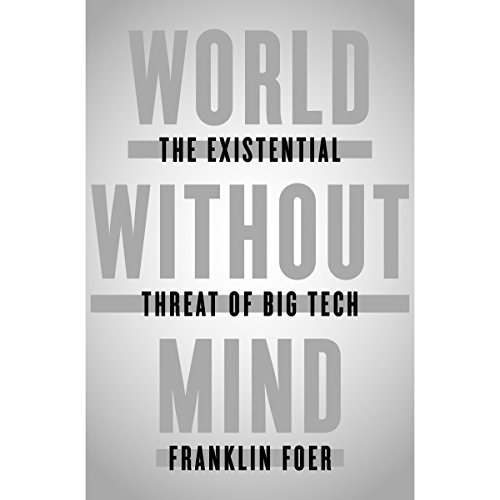
World Without Mind
Summary
A New York Times Book Review Notable Book of 2017 Franklin Foer reveals the existential threat posed by big tech, and in his brilliant polemic gives us the toolkit to fight their pervasive influence. Over the past few decades, there has been a revolution in terms of who controls knowledge and information. This rapid change has imperiled the way we think. Without pausing to consider the cost, the world has rushed to embrace the products and services of four titanic corporations. We shop with Amazon; socialize on Facebook; turn to Apple for entertainment; and rely on Google for information. These firms sell their efficiency and purport to make the world a better place, but what they have done instead is to enable an intoxicating level of daily convenience. As these companies have expanded, marketing themselves as champions of individuality and pluralism, their algorithms have pressed us into conformity and laid waste to privacy. They have produced an unstable and narrow culture of misinformation, and put us on a path to a world without private contemplation, autonomous thought, or solitary introspection - a world without mind. In order to restore our inner lives, we must avoid being coopted by these gigantic companies, and understand the ideas that underpin their success. Elegantly tracing the intellectual history of computer science - from Descartes and the enlightenment to Alan Turing to Stewart Brand and the hippie origins of today's Silicon Valley - Foer exposes the dark underpinnings of our most idealistic dreams for technology. The corporate ambitions of Google, Facebook, Apple, and Amazon, he argues, are trampling longstanding liberal values, especially intellectual property and privacy. This is a nascent stage in the total automation and homogenization of social, political, and intellectual life. By reclaiming our private authority over how we intellectually engage with the world, we have the power to stem the tide. At stake is nothing less than who we are, and what we will become. There have been monopolists in the past but today's corporate giants have far more nefarious aims. They’re monopolists who want access to every facet of our identities and influence over every corner of our decision-making. Until now, few have grasped the sheer scale of the threat. Foer explains not just the looming existential crisis but the imperative of resistance. Named One of the Best Books of the Year by: The New York Times Los Angeles Times NPR
©2017 Franklin Foer (P)2017 Penguin Audio

FDR
Summary
One of today's premier biographers, Jean Edward Smith, has written a modern, comprehensive, indeed ultimate book on the epic life of Franklin Delano Roosevelt. This is a portrait painted in broad strokes and fine details. We see how Roosevelt's restless energy, fierce intellect, personal magnetism, and ability to project effortless grace permitted him to master countless challenges throughout his life. Smith recounts FDR's personal battles and also tackles head-on and in depth the numerous failures and miscues of Roosevelt's political career. Summing up Roosevelt's legacy, Smith gives us the clearest picture yet of how this quintessential Knickerbocker aristocrat became the common man's president. The result is a powerful account that adds fresh perspectives and draws profound conclusions about a man whose story is widely known but far less understood. Written for the general public and scholars alike, FDR is a stunning biography in every way worthy of its subject.
©2007 Jean Edward Smith (P)2007 Books on Tape

The Curse of Bigness
Summary
From the man who coined the term "net neutrality", author of The Master Switch and The Attention Merchants, comes a warning about the dangers of excessive corporate and industrial concentration for our economic and political future. We live in an age of extreme corporate concentration, in which global industries are controlled by just a few giant firms - big banks, big pharma, and big tech, just to name a few. But concern over what Louis Brandeis called the "curse of bigness" can no longer remain the province of specialist lawyers and economists, for it has spilled over into policy and politics, even threatening democracy itself. History suggests that tolerance of inequality and failing to control excessive corporate power may prompt the rise of populism, nationalism, extremist politicians, and fascist regimes. In short, as Wu warns, we are in grave danger of repeating the signature errors of the 20th century. In The Curse of Bigness, Columbia Professor Tim Wu tells of how figures like Brandeis and Theodore Roosevelt first confronted the democratic threats posed by the great trusts of the Gilded Age - but the lessons of the Progressive Era were forgotten in the last 40 years. He calls for recovering the lost tenets of the trust-busting age as part of a broader revival of American progressive ideas as we confront the fallout of persistent and extreme economic inequality.
©2018 Tim Wu (P)2018 Random House Audio

Some Assembly Required
Summary
The author of the best-selling Your Inner Fish gives us a lively and accessible account of the great transformations in the history of life on Earth - a new view of the evolution of human and animal life that explains how the incredible diversity of life on our planet came to be. Over billions of years, ancient fish evolved to walk on land, reptiles transformed into birds that fly, and apelike primates evolved into humans that walk on two legs, talk, and write. For more than a century, paleontologists have traveled the globe to find fossils that show how such changes have happened. We have now arrived at a remarkable moment - prehistoric fossils coupled with new DNA technology have given us the tools to answer some of the basic questions of our existence: How do big changes in evolution happen? Is our presence on Earth the product of mere chance? This new science reveals a multibillion-year evolutionary history filled with twists and turns, trial and error, accident and invention. In Some Assembly Required, Neil Shubin takes listeners on a journey of discovery spanning centuries, as explorers and scientists seek to understand the origins of life's immense diversity.
©2020 Neil Shubin (P)2020 Random House Audio

The Good Gut
Summary
A groundbreaking guide to the surprising source of good health Genetics and lifestyle are thought to be the two most important determinants of good health. But that is not the whole story. We have a second genome, our gut bacteria, that sets the dial on our bodies. Unlike our DNA, we can influence the gut bacteria, or microbiota, to optimize all aspects of our health. In The Good Gut, noted Stanford researchers Justin and Erica Sonnenburg, who are doing cutting-edge research on the microbiota, investigate how the trillions of microbes that reside in our gastrointestinal tract help define us, affecting everything from our immune response to our weight, allergic reactions, aging and emotions; how they are under threat from the Western diet, our antibiotics, and our sterilized environment; and how we can nurture our individual microbiota. This is urgent news. The recent change in our gut microbiota is linked to the alarming increase in obesity and autoimmune diseases. Our intestinal microbiota play an important role in the prevalence of predominantly Western afflictions, such as cancer, diabetes, allergies, asthma, autism, and inflammatory bowel diseases. These gut bacteria are facing a mass extinction, and the health consequences are dire. How can we keep our microbiota off the endangered species list? How can we strengthen the community that inhabits our gut and thereby improve our own health? Your prescription for gut health is unique to you, and it changes as you age. The Good Gut offers a new plan for health that focuses on how to nourish your microbiota, including recipes and a menu plan. Drs. Sonnenburg look at safe alternatives to antibiotics; dietary and lifestyle choices to encourage microbial health; the management of the aging microbiota; and the nourishment of your own individual microbiome. Includes a bonus PDF with recipes. PLEASE NOTE: When you purchase this title, the accompanying PDF will be available in your Audible Library along with the audio.
©2015 Justin and Erica Sonnenburg (P)2015 Penguin Audio

Sea Power
Summary
From one of the most admired admirals of his generation - and the only admiral to serve as supreme allied commander at NATO - comes a remarkable voyage through all of the world's most important bodies of water, providing the story of naval power as a driver of human history and a crucial element in our current geopolitical path. From the time of the Greeks and the Persians clashing in the Mediterranean, sea power has determined world power. To an extent that is often underappreciated, it still does. No one understands this better than Admiral Jim Stavridis. In Sea Power, Admiral Stavridis takes us with him on a tour of the world's oceans from the admiral's chair, showing us how the geography of the oceans has shaped the destinies of nations and how naval power has in a real sense made the world we live in today and will shape the world we live in tomorrow. Not least, Sea Power is marvelous naval history, giving us fresh insight into great naval engagements from the battles of Salamis and Lepanto through to Trafalgar, the Battle of the Atlantic, and submarine conflicts of the Cold War. It is also a keen-eyed reckoning with the likely sites of our next major naval conflicts, particularly the Arctic Ocean, the Eastern Mediterranean, and the South China Sea. Finally, Sea Power steps back to take a holistic view of the plagues to our oceans that are best seen that way, from piracy to pollution. When most of us look at a globe, we focus on the shape of the seven continents. Admiral Stavridis sees the shapes of the seven seas. After listening to Sea Power, you will, too. Not since Alfred Thayer Mahan's legendary The Influence of Sea Power upon History have we had such a powerful reckoning with this vital subject.
©2017 James Stavridis (P)2017 Penguin Audio

Unfinished Business
Summary
Based on over 25 years of spirit communication and thousands of professional readings, world-famous medium James Van Praagh shares the personal regrets, misgivings, remorse, and, most important, the advice of the dead who have chosen him as a medium. These spirits have a great deal to say about what they have learned and discovered on the other side and how we, the living, can benefit from their experiences. Unfinished Business is filled with shocking and emotional stories of Van Praagh's communication with loved ones who cross over the barrier between the living and the dead to send messages to those whom they have left behind. Through these profound true stories, Van Praagh guides us on an adventure into the spirit world. The lessons for the living that he has learned from these experiences range from the dangers of emotional baggage caused by guilt, fear, and regret to the importance of karma, forgiveness, and taking responsibility for our actions. Van Praagh shares with us now the wisdom that, without him, we would only gain after death.
©2009 James Van Praagh (P)2009 HarperCollins Publishers