The Great Courses has 635 audiobooks on Listento.it, narrated by 479 narrators, with an average listener rating of 4.5★ across 19,831 ratings. The most-rated is A Column of Fire.

Great Masters: Shostakovich - His Life and Music
Summary
Dmitri Shostakovich is without a doubt one of the central composers of the 20th century. His symphonies and string quartets are mainstays of the repertoire. But Shostakovich is also a figure whose story raises challenging and exciting issues that go far beyond music: they touch on questions of conscience, the moral role of the artist, the plight of humanity in the face of total war and mass oppression, and the inner life of history's bloodiest century. And though he was not without flaws, he was a faithful witness to the survival of the human spirit under totalitarianism. And now you can discover the extraordinary life, times, and music of Shostakovich in a probing series of eight lectures from an acclaimed conductor, teacher, and music historian. Drawing on both the flood of declassified documents from the Soviet Union that began in 1991 and Shostakovich's own extraordinarily frank posthumous reminiscences, Professor Greenberg shows how Shostakovich, who, in the words of a friend, "did not want to rot in a prison or a graveyard" was still unwilling to become a docile instrument of the Soviet regime. You'll learn how what he would not say publicly in words, he instead said through his music - messages from a buried life of his experiences during the terror of Stalin, the Nazi destruction of his country, postwar reconstruction, and the arms race. In work after work, often composed under crushing difficulty and anxiety, you'll hear how he used a brilliant arsenal of ironic conceits, musical quotes from un-Soviet sources such as American jazz or Jewish klezmer tunes, and other techniques to assert the integrity of his art in the face of totalitarian oppression, and to pay, as he said, "homage to the dead." PLEASE NOTE: When you purchase this title, the accompanying reference material will be available in your Library section along with the audio.
©2002 The Teaching Company, LLC (P)2002 The Great Courses

The Operas of Mozart
Summary
When Wolfgang Amadeus Mozart died in 1791 at the age of just 35, he nonetheless left behind the defining composition in every available musical genre of his time: symphony, chamber music, masses, and above all - opera. Opera was the prestige genre of the era, and the thought of it, Mozart wrote, made him "beside myself at once." It was a form he loved dearly, depending on it heavily for personal, professional, artistic, and financial reasons of the greatest weight. Artistically, the world of the operatic stage spoke deeply to his primal instinct for play, his taste for fantasy, and his restless creative imagination. And in this rich series of eight entertaining lectures, you'll learn how his operas vied with one another for the acclaim reserved for the greatest achievements of human artistic striving: Idomeneo, The Abduction from the Harem, The Marriage of Figaro, Così fan tutte, Don Giovanni, and The Magic Flute, which premiered only ten weeks before his untimely death. In addition to summarizing Mozart's life and artistic development, the lectures focus on two of his greatest masterpieces, Così fan tutte and The Magic Flute, to help you understand more fully the height of Mozart's operatic achievement. PLEASE NOTE: When you purchase this title, the accompanying reference material will be available in your Library section along with the audio.
©2003 The Teaching Company, LLC (P)2003 The Great Courses
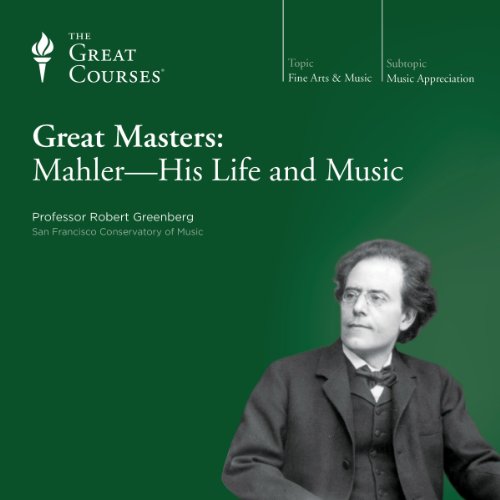
Great Masters: Mahler - His Life and Music
Summary
More than many other composers, Gustav Mahler's works are highly personal expressions of his inner world, a world of overwhelming alienation and loneliness - "thrice homeless," in his own words, "as a Bohemian in Austria, as an Austrian among Germans, as a Jew throughout the world - everywhere an intruder, never welcomed." Incredibly, Mahler was able to draw upon the diversity of this world that offered him no true home, as well as his often tortured inner world, to create rich and original music. It's a music whose power you will be able to appreciate fully after experiencing this eight-lecture exploration of the life and work of this titan of post-Romantic musical history, a complex, anxiety-bound visionary whose continual search for perfection and the answers to life's mysteries is profoundly reflected in his symphonies and songs. You'll learn, through both lectures and musical excerpts, how his symphonies are vast repositories of his intellectual, emotional, and spiritual expression that made him the first exponent of Expressionism, the early 20th-century art movement that celebrates inner reality as the only reality - but explored by Mahler using the musical language of the century just ended. And you'll learn how Mahler's music is, ultimately, about himself: the lonely, isolated individual.
©2001 The Teaching Company, LLC (P)2001 The Great Courses

Understanding Cultural and Human Geography
Summary
No one is an island. The community where you live, the food you eat, and the people you know are all part of a global chain of connections. Over the past 10,000 years, humans have transformed the planet - yet the planet has also influenced human life in myriad ways. In these 24 eye-opening lectures, take an interdisciplinary voyage across time and around the world to consider the dual nature of our relationship with "place". With insights drawn from ecology, anthropology, economics, geopolitics, and more, Professor Robbins reveals the underlying structures that explain why the world is the way it is. Understanding global trends and connections - from environmental changes such as deforestation to the way money and labor slosh around the globe - will give you new insights into the story of human civilization and current events. One key theme of this course is that "place" is a construct. People make (and constantly re-make) places in response to myriad circumstances, ranging from economic conditions to changes in the ecology around them. Indeed, humans have taken over the Earth so completely that some geologists now refer to our era as the Anthropocene - the "human era". While it is tempting to despair over humanity's takeover of the planet, you see how the picture is surprisingly complex, and that there is reason for optimism. Much of the human impact on the Earth, from deforestation to rapid urbanization, is not an inexorable march of destruction without any means of revitalization. In addition to the study of the environment, Professor Robbins examines the wide-ranging implications of a world economy. You'll explore the wellspring of culture and delve into the thorny issues of geography, ethnicity, and statehood. When you complete this course, you'll have all the tools you need to look beyond the headlines and analyze world events in a whole new way. PLEASE NOTE: When you purchase this title, the accompanying reference material will be available in your Library section along with the audio.
©2014 The Teaching Company, LLC (P)2014 The Great Courses
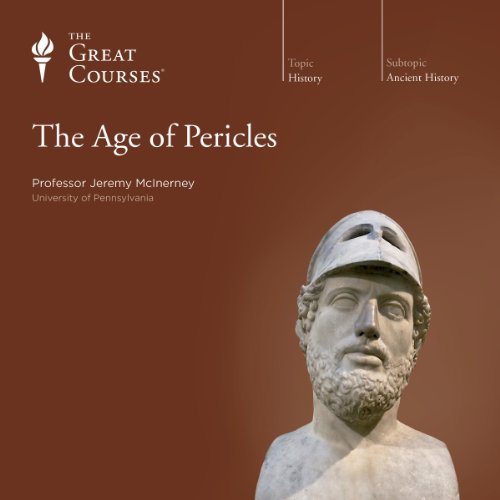
The Age of Pericles
Summary
The career of Pericles, the leading Athenian politician and general from c. 450 to 429 B.C., is a prism through which to view the "Golden Age" of Greece, a brief but remarkable era when Athens experienced a cultural flowering of extraordinary power and importance for Western culture. In the generation that followed Pericles' appearance on the public stage shortly after the Persian wars, Athens rapidly transformed the alliance of Greek states - an alliance first created as a defense against the Persians - into a true Aegean empire, dominated by the Athenians and their mighty navy. But this dramatic increase in military power, cultural influence, and prestige was also accompanied by something unique: the growth of full participatory democracy. But in examining the lives of Athenian men and women, one has to ask what freedom and autonomy really meant to a society that relied on slaves and was ruthless in its treatment of its subjects. These 24 stimulating lectures present a well-rounded portrait of almost every aspect of Athenian life during the Golden Age, including. the different ways Athens and Sparta raised their children; the fate of Athenian girls as mothers and managers of the household; young Pericles' role in bringing Aeschylus's masterpiece, The Persians; why the Spartans rejected the aid of Athens in putting down a slave revolt; and Thucydides' terrifying description of the plague's physical and social impact on Athens - including the death of Pericles - and its possible role in the ultimate defeat of Athens by Sparta.
©2004 The Teaching Company, LLC (P)2004 The Great Courses

Jesus and the Gospels
Summary
For most of the last 2,000 years, questions about the figure of Jesus have begun with the Gospels, but the Gospels themselves raise puzzling questions about both Jesus and the religious movement within which these narratives were produced. Is it possible to shape a single picture from the various accounts of his life given us by these Gospels? This far-ranging course examines not only the canonical Gospels of Matthew, Mark, Luke, and John familiar to us from the New Testament, but also the many other, apocryphal narratives and literary works that have contributed to our perceptions of Jesus, Mary, and Christianity - all of which are encompassed by the word "Gospel." In these 36 engaging lectures, you'll discover the human Jesus that underlies many portraits we have. After introducing you to the era's volatile mixture of Mediterranean culture, Greek ideals and realities, Roman governance, and the religion of Israel, Professor Johnson turns to the Gospels and provides close analyses of key lines of text, explanations of the significance of language and terminology, and overviews of important issues with which scholars have long grappled. You'll learn about the different issues of faith each Gospel emphasizes, as well as the real-world logistics of spreading that faith during the early Christian era. But it is the figure addressed by the Gospels who dominates these lectures, sometimes in ways less familiar than the portrayals of Jesus we most often encounter. Beyond the portrayal in the synoptic gospels, you'll study what the apocryphal narratives have to say about the childhood of Jesus. Among other things, you'll also learn about the source of Roman Catholicism's doctrine of Mary and examine the 2nd century faith of Gnosticism. PLEASE NOTE: When you purchase this title, the accompanying reference material will be available in your Library section along with the audio.
©2004 The Teaching Company, LLC (P)2004 The Great Courses

The Symphonies of Beethoven
Summary
Ludwig van Beethoven is justifiably acclaimed as one of the most revered composers in the history of Western music-a genius once characterized as a "Titan, wrestling with the gods." There is no better way for you to understand the full impact of that description than to not only listen to all nine of his magnificent symphonies, but to do so with a full understanding of what this great composer was saying and the circumstances that drove him up to and beyond what had once been considered the limits of musical expression. The 32 lectures that make up this detailed introduction to Beethoven explores each of his symphonies in depth, explaining the gifts of musical communication that made this composer unique. Even without any previous musical training, you'll be able to grasp the absolute directness that made his work so accessible, the sheer emotional power that could never be ignored, and the ways in which his ideas were revolutionary on every level. Beginning with an introduction to Beethoven the man and the musical and societal forces that shaped his development, you'll explore his breathtaking innovations: harmonic, melodic, rhythmic, formal, dramatic, self-expressive, and emotional. And you'll come to understand how and why this man was able to lead music into a totally new era as he dispensed with the restraint of 18th-century Classicism to usher in the era of romantic self-expression - even as his own ability to even hear what he was creating was progressively and tragically vanishing. PLEASE NOTE: When you purchase this title, the accompanying reference material will be available in your Library section along with the audio.
©1996 The Teaching Company, LLC (P)1996 The Great Courses

The United States and the Middle East: 1914 to 9/11
Summary
At the dawn of World War I, the United States was only a rising power. Our reputation was relatively benign among Middle Easterners, who saw no imperial ambitions in our presence and were grateful for the educational and philanthropic services Americans provided. Yet by September 11, 2001, everything had changed. The United States had now become the unquestioned target of those bent on attacking the West for its perceived offenses against Islam. How and why did this transformation come about? And how did each of the factors that make the Middle East so complex contribute to this transformation? This series of 24 lectures by an award-winning scholar is a narrative history of U.S. political involvement in the Middle East from World War I to the present day. Presented from a historian's balanced perspective, it will strengthen your ability to place today's headlines into historical context, evaluate what is most likely to happen next, and understand those oncoming events when they occur. Step by step, with attention to the viewpoints and motivations of each nation and leader involved, the lectures explore growing American involvement in the Middle East; the ongoing quest for political independence and self-mastery by Middle Easterners; the difficulty the United States has experienced in weighing diverse and conflicting objectives in the region, especially as the cold war against the Soviet Union intensified; and the increasing antagonism between Americans and Middle Easterners that came to such a shocking culmination on September 11, 2001. PLEASE NOTE: When you purchase this title, the accompanying reference material will be available in your Library section along with the audio.
©2003 The Teaching Company, LLC (P)2003 The Great Courses

Medical School for Everyone: Pediatrics Grand Rounds
Summary
Pediatrics, which focuses on the medical care of children from birth through adolescence, is one of the most fascinating areas of modern medicine. To step into the shoes of a trained pediatrician is to better understand how these medical heroes diagnose common and uncommon illnesses in their young patients, helping each child grow into his or her greatest potential. In these 24 lectures, don the doctor's white coat for an accessible journey into the world of pediatric medicine to solve medical mysteries. Each of these standalone lectures presents you with a case or series of cases that you tackle alongside Dr. Benaroch, from initial symptoms and workup to the diagnosis and resulting treatment. You'll quickly see just how multifaceted and nuanced the medical treatment of children is, whether dealing with minor diagnoses like runny noses and ear infections or life-changing ones like cerebral palsy and neonatal pneumonia. But sometimes children have concerns that extend beyond the traditional realm of medicine. In addition to the fascinating facts and compelling stories he shares, Dr. Benaroch has crafted the perfect tool for parents and caretakers who want a panic-free resource for their child's health and wellness, including issues surrounding sleep, discipline, and mental health. Whether he's dealing with a premature infant, complications arising with international adoption, or a homeless youth, Dr. Benaroch treats every case in this course with care and compassion. You'll quickly learn how the best pediatricians are also caretakers and counselors and why the experience of helping sick children is exciting and rewarding - especially when it transforms lives for the better. PLEASE NOTE: When you purchase this title, the accompanying reference material will be available in your My Library section along with the audio.
©2016 The Great Courses (P)2016 The Teaching Company, LLC

The Rise of Humans: Great Scientific Debates
Summary
Trying to understand our human origins has always been a fundamental part of who we are. Today, with the help of dramatic archaeological discoveries and groundbreaking advancements in technology and scientific understanding, we are closer than we've ever been to learning the true story. In recent decades, it has been the science of paleoanthropology that has led the investigation, helping us make sense of this controversial subject and providing us with a richer understanding of our origins. It's also sparked continued debate about key issues in human evolution. Did early humans evolve in Africa alone, or in regions throughout the world? Did Neandertals play an important role in our genetic heritage and, if so, how? Why did prehistoric humans form cooperative communities and create art? Now you can complete your own understanding of these issues in a fascinating 24-lecture series from an expert paleoanthropologist, who surveys both the questions that continue to rile the world's greatest minds in anthropology and the cutting-edge science responsible for them. The result is this expert guide to the wide-ranging debates over the most profound questions we can ask. Each lecture focuses on a single one of these questions and the sometimes surprising, sometimes fierce, and always illuminating debates surrounding them, including whether it was Africa or Asia that was more central to human origins, what prehistoric cultural groups were really like, and when humans actually reached the New World.
©2011 The Teaching Company, LLC (P)2011 The Great Courses

The Big History of Civilizations
Summary
The history of human civilization is an astonishing story of migration, innovation, and social development. Now, the exciting new field of "big history" allows us to explore human civilizations in ways unavailable to historians of previous generations. Big history scholars take a multidisciplinary approach to study great spans of time, unlocking important themes, trends, and developments across time and space. Unlike a traditional survey of history - with its focus on dates and events, kings and battles - The Big History of Civilizations is your chance to apply this cutting-edge historical approach to the epic story of humanity around the world. Taught by acclaimed Professor Craig G. Benjamin of Grand Valley State University, these 36 sweeping lectures trace the story of human civilizations from our emergence as a species, through the agricultural and industrial revolutions, and into the future. It only takes a few minutes of one lecture for you to discover that Big History is an amazing approach to history. Its grand vision will give you powerful new insights into human civilization, and it offers a profound analysis of some of our biggest questions: What makes us human? Where did we come from? And where are we going? There may be no easy answers, but Professor Benjamin takes you on a powerful journey to the limits of our understanding. What differentiates big history from any other field is the way it combines divergent fields, from archaeology and anthropology to ecology and philosophy, and ties them together, allowing you to see patterns of our past, present - and even future. From the just-right "Goldilocks factors" that allow civilizations to emerge to different ways civilizations have emerged across time and around the word, this riveting approach to history offers a multidisciplinary toolkit to tell the story about what makes us human. PLEASE NOTE: When you purchase this title, the accompanying reference material will be available in your Library section along with the audio.
©2016 The Great Courses (P)2016 The Teaching Company, LLC

Comparative Religion
Summary
Get a solid working knowledge of the spiritual beliefs that unite and divide us - as well as the perspective from the other side of these divisions. These 24 lectures offer you an opportunity to gain a solid grasp of the key ideas of religion itself - the issues that repeatedly surface when you look at any faith's beliefs, practices, and organization. Using five major religions - Judaism, Christianity, Islam, Buddhism, and Hinduism - as illustrations of how religions can address the same core issues in parallel and different ways, Professor Kimball leads you on an exploration of religion's complex and multidimensional nature. It's an exploration that can strengthen the interpersonal understanding that underlies your daily relationships, enhance your perception of events in a diverse world, and deepen your appreciation of your own beliefs and the traditions followed by others. Using the basics of these five major religions as a starting point - and explaining those basics so that no prior knowledge is needed - Professor Kimball plunges deeply into each to reveal and clarify the essential structural components shared by all faiths. Among the aspects of faith you compare and contrast are creation myths and sacred stories, concepts of the divine, sacred texts and spaces, and religion's ultimate goals - the reasons its adherents give them such importance. After completing these lectures, you'll be able to "see with a native eye", as Professor Kimball puts it, when you wonder why followers of a given religion believe or act as they do. PLEASE NOTE: When you purchase this title, the accompanying reference material will be available in your Library section along with the audio.
©2008 The Teaching Company, LLC (P)2008 The Great Courses

The Mysterious Etruscans
Summary
How much do you know about the Etruscans? Many people, even those who are fascinated by ancient history, are less familiar with this intriguing culture than with the history of Greece and Rome - but the story of the Etruscans is equally captivating and far more important than you may have known. This ancient civilization prospered in the region of modern-day Tuscany, maintaining extensive trade networks, building impressive fortified cities, making exquisite art, and creating a culture that, while deeply connected to the Greeks and Romans, had striking contrasts. The Etruscans were the original inhabitants of central Italy. Centuries before Rome's rise, they built cities such as Pompeii, Capua, and Orvieto along fortified hilltops. They developed a system of roads and invented what we call the Roman arch. While they had their own system of government, their own myths and legends, and their own cultural attributes, the Etruscans imported and repurposed much from the Greeks - and, in turn, gave much to the Romans. You might be surprised to find out how much of Roman civilization - from togas to bronze military armor to Rome itself - actually has Etruscan origins. The Etruscans are largely responsible for: transmitting the alphabet to the Romans and other ancient societies as far away as the Nordic regions granting Rome much of its celebrated architecture and infrastructure, from the Cloaca Maxima water-control system to the storied arch developing exquisite works of bronze and terra-cotta, as well as mesmerizing tomb paintings creating well-known symbols of republican government, imagery that still lives on in US government buildings like the Lincoln Memorial Without the Etruscans, much of what we associate with the Roman world, and thus the foundations of Western civilization, would largely disappear. PLEASE NOTE: When you purchase this title, the accompanying reference material will be available in your Library section along with the audio.
©2016 The Great Courses (P)2016 The Teaching Company, LLC

Moral Decision Making
Summary
Whether or not we're aware of them, we make important ethical decisions all the time - as professionals, consumers, citizens, parents, sons and daughters, and friends. These 24 thought-provoking lectures offer you the chance to reflect on some of the most powerful moral issues we face in our daily lives: Is it ever OK to lie? What are our moral obligations to others? What is the key to living the good life? From Plato to Kant to Bonhoeffer, you'll see how some of the world's greatest thinkers from across the ages have approached similar problems. Professor Martin provides a complete picture of various ethical schools and approaches and applies this rich philosophical overview to "case studies" relevant to our contemporary lives. You'll explore all the ins and outs of issues such as business ethics, love and marriage, privacy and technology, genetic engineering, animal rights, and much more. Engaging stories and thought experiments bring these issues to life, showing what different philosophical theories have to say about real-world ethical dilemmas. According to Professor Martin, the trick is to understand that the mind is like a parachute; it only works when it's open. Rather than take a side in any particular debate, this course provides a framework for thinking through a host of debates and dilemmas from all sides. Through it all, Professor Martin is a sympathetic guide, helping you think through some of our most complex decisions. PLEASE NOTE: When you purchase this title, the accompanying reference material will be available in your Library section along with the audio.
©2014 The Great Courses (P)2014 The Teaching Company, LLC

Introduction to the Study of Religion
Summary
The religious experience is an extraordinarily powerful force that can define and shape the communities it creates. Over the course of 24 lectures, Professor Jones takes a vibrant first look at the discipline known as religious studies and shows how other fields - sociology, psychology, anthropology, and phenomenology - have tried to explain the complex relationship between individuals, cultures, and faith. This relationship is as old as the first human quest for answers to fundamental questions of life, death, and what may lie beyond. Here you'll trace the idea of studying religion itself, drawing not only on the challenging and provocative collection of theories from the many disciplines that have influenced the development of religious studies, but also on revealing anecdotes and illuminating case studies that make this course a surprising delight. You'll explore the way "functional" anthropologists such as Malinowski and A. R. Radcliffe-Brown helped pull their discipline out of the drawing room and into the field to study a given culture. You'll also study Immanuel Kant's phenomenology, his theory that we can never make actual contact with the external world but can know it only from the internal images our minds construct from the raw data pulled in by our senses. By examining belief and what it means - for believers and nonbelievers alike - you'll come away with a solid grasp of the major thinkers and ideas that have contributed to this fascinating field of study, including their strengths and weaknesses, as well as insights into many aspects of religious life, belief, and practices - insights that may well have applications in your own life, whether or not you adhere to a religious faith.
©2007 The Teaching Company, LLC (P)2007 The Great Courses

Turning Points in American History
Summary
These 48 lectures are your chance to relive the most groundbreaking moments in the fascinating story of the United States. They offer you a different perspective on the sweeping narrative of U.S. history. Spanning the arrival of the first English colonists to the chaos of the Civil War to the birth of the computer age and beyond, this lecture series is a captivating and comprehensive tour of those particular moments in the story of America, after which the nation would never be the same again. Taking a chronological approach, Professor O'Donnell gives you new ways to understand American history and to appreciate it as a grand narrative pinpointed with key moments that changed things forever. Each lecture focuses on a single turning point, explaining the conditions that led up to it, immersing you in the experience of the event itself, and exploring its immediate and long-term ramifications. Among the great turning points you'll investigate in depth are the trial of John Peter Zenger (1735), which popularized the ideas that freedom of the press is essential to liberty; the battle of Antietam (1862), which eliminated the possibility of England and France intervening on behalf of the Confederacy; and the Watergate scandal (1974), which signaled a heightened level of public distrust toward elected officials. Along the way, Professor O'Donnell often dispels some intriguing myths and half-truths about American history and provides an honest, unabashed look at the subject matter. These lectures are packed with unfamiliar anecdotes, stories, and side notes that just may change your views on the grand narrative of American history. PLEASE NOTE: When you purchase this title, the accompanying reference material will be available in your Library section along with the audio.
©2011 The Teaching Company, LLC (P)2011 The Great Courses

Doctors: The History of Scientific Medicine Revealed Through Biography
Summary
Discover medical science's extraordinary journey from a time when even the slightest cut held the threat of infection and death to today's era of routine organ transplants and daily headlines about the mysteries of DNA and the human genome. What major discoveries made this transition possible? Who were the fascinating individuals responsible for those discoveries, and what qualities prepared each of them for their unique roles in medical history? These 12 compelling lectures draw on the lives of medicine's greatest contributors to tell the human story behind the development of Western scientific medicine. Professor Nuland reveals the human side of science - a story about strivings, disappointments, triumphs of human genius, and even greed. This course is a must-have for anyone interested in the fascinating story of medicine's evolution-and the brilliant men and women who made this journey possible. Topics include the rise of universities and how they influenced medical education; the appearance of scientific method and what we call "inductive reasoning"; the influence of individual personality on achievement along with the accompanying influence of national character and culture; the role of the church; and the part played by each discoverer's psychological makeup. Please note: This course contains some discussion about certain historical medical practices and experiments that, while common in their time, may seem barbaric and unusual to us today. The professor does not necessarily describe them in graphic detail, but due to the subject matter of this course, some descriptions of these practices do arise. This should be noted before selecting this course for a young or sensitive individual. PLEASE NOTE: When you purchase this title, the accompanying reference material will be available in your Library section along with the audio.
©2005 The Teaching Company, LLC (P)2005 The Great Courses

How Colors Affect You: What Science Reveals
Summary
There’s more to colors than just aesthetics. There’s an actual science behind how colors work on your eyes and your brain. And the secrets that scientists are uncovering offer astounding revelations about how colors influence the way you think, feel, and behave. And what’s truly surprising: The way our eyes perceive and our brains interpret reds, greens, blues, blacks, and other colors isn’t a subjective experience, but a hard-wired one. It’s a profound concept - one whose ramifications extend to everything from business and advertising to politics and entertainment. These lectures will open your eyes to why your favorite products practically jump off the shelf; why certain logos are more memorable than others; why particular scenes in nature evoke peace, joy, or fear; and so much more. Now you can learn how to tap into the power of color to create environments and achieve a range of visual goals in the six lectures of How Colors Affect You: What Science Reveals, taught by design expert and professor William Lidwell of the University of Houston. Central to this course is the expanse of information about how colors work on our brains to steer our thoughts and actions. You’ll go behind the scenes and examine the fascinating experiments and case studies that scientists have used to uncover what they know about color. And you’ll finally understand the (often hidden) significance behind the colors of your everyday life. A must-have course for corporate leaders, design professionals, marketers, and anyone else who communicates visually, How Colors Affect You tells you everything you need to know about the science of color and its impact on all aspects of human experience. These lectures will give you a beautiful new perspective on color - one rooted in credible scientific knowledge and not popular myth.
©2013 The Great Courses (P)2013 The Teaching Company, LLC

Voltaire and the Triumph of the Enlightenment
Summary
Discover why intellectuals and historians alike consider Voltaire to be one of the most intriguing, influential, and elusive thinkers of the modern world. Focusing on the deepest, most enduring aspects of Voltaire's work and thought, but never losing sight of the colorful, fascinating man himself, these 12 lectures sketch for you a vibrant, thought-provoking vision of Voltaire as "the father of the Enlightenment" and one of the great literary personalities of all time. You'll follow this Enlightenment thinker's 84 astoundingly productive years and go inside not only his masterpiece, Candide, but the hundreds of other works in almost all the literary, philosophical, and polemical genres current in his day, and the more than 20,000 letters this prolific writer and thinker left behind. What was Voltaire's world like? Who and what influenced him? What questions and dilemmas did he ponder? What evils did he struggle against? What reforms did he advocate? What made him laugh and cry, or write a book like Candide, which is at once so funny and so sad? And what is his place in the history of the Western mind? The answers to these and other questions can be found right here in this illuminating lecture series. If you're unfamiliar with Voltaire and his works, prepare to meet one of Western literature's defining writers. And if you already have some familiarity with the man, prepare to discover even more insights into why he still matters after all these years.
©2001 The Teaching Company, LLC (P)2001 The Great Courses

Myth in Human History
Summary
Myths provide the keys to truly grasping the ways that principles, rituals, codes, and taboos are woven into the fabric of a particular society or civilization. It's through myths that we can answer these and other fundamental questions: How was the universe created, and why? What is the purpose of evil? Why is society organized the way it is? How did natural features like rivers, mountains, and oceans emerge? This entertaining and illuminating course plunges you into the world's greatest myths. Taking you from ancient Greece and Japan to North America and Africa to New Zealand and Great Britain, these 36 lectures reveal mythology's profound importance in shaping nearly every aspect of culture. You'll also discover the hidden connections between them - a comparative approach that emphasizes the universality of myths across cultures. Along with the stories themselves, you'll encounter fascinating characters, including Herakles, the ancient Greek hero whose life illustrates the idea that all heroic stories have a similar structure; Loki, the shape-shifting trickster who introduces the concept of time into the Norse realm of Asgard; and King Arthur, the Celtic lord and founder of the Knights of the Round Table. Myths, according to Professor Voth, are "gifts from the ancestors to be cherished." His enchanting lectures are the perfect way for you to celebrate these cherished gifts, inviting you to develop your own interpretations of these age-old tales, as well as to ponder the role that myths - both ancient and everyday - play in your own life.
©2010 The Teaching Company, LLC (P)2010 The Great Courses