The Great Courses has 635 audiobooks on Listento.it, narrated by 479 narrators, with an average listener rating of 4.5★ across 19,831 ratings. The most-rated is A Column of Fire.

Customs of the World: Using Cultural Intelligence to Adapt, Wherever You Are
Summary
Taught by an international adviser to leaders of Fortune 500 companies, nonprofits, and governments, this eye-opening course reveals how you can actively improve your cultural intelligence in an increasingly globalized world. Based on groundbreaking research, these 24 lectures address dynamics and customs related to working, socializing, dining, marriage and family - all the areas necessary to help you function with a greater level of respect and effectiveness wherever you go. You'll also encounter practical tips and crucial context for greeting, interacting with, and even managing people from other parts of the world. In the first half, you'll analyze 10 cultural value dimensions that researchers have identified as helpful for comparing cultures; and you'll see how these "archetypes" play out in day-to-day lives. In the second half, you'll look at 10 cultural clusters around the world that - when combined with your understanding of the 10 cultural dimensions - provide strategic insight into how to be more effective as you live, work, and travel in our globalized world. Why do people from certain cultures have little regard for time? Why might working overtime reflect poorly on you in Scandinavia? Why should you avoid using your left hand when interacting with someone from the Arab world? You'll find out the answers to these and other intriguing questions in Customs of the World. PLEASE NOTE: When you purchase this title, the accompanying reference material will be available in your My Library section along with the audio.
©2013 The Teaching Company, LLC (P)2013 The Great Courses

Great Minds of the Medieval World
Summary
The Middle Ages was a time of major advances in many fields of knowledge, from theology and philosophy to science, medicine, art, literature, and education. Owing to the work of an astonishing range of visionary thinkers, this fascinating period was the era in which the foundations of the modern Western world were laid. In the medieval era’s great minds we find the roots of many aspects of today’s world - from the religious/philosophical thought of Augustine, Ambrose of Milan, and Thomas Aquinas to the scientific innovations of Avicenna and Alhacen, the enlightened statesmanship of Charlemagne and Lorenzo de Medici, and the literary creations of Dante and Chaucer. In these 24 lectures, Professor Armstrong leads you on an enthralling journey into the lives of the seminal thinkers of the Middle Ages. In this gallery of extraordinary minds, you'll encounter the leading lights of a world-shaping era, including figures such as Maimonides, Hildegard of Bingen, Bernard of Clairvaux, Peter Abelard, and Francesco Petrarch. Professor Armstrong goes to great lengths to bring these historic figures to life, revealing both the great intellectual contributions and the personal strivings, challenges, and triumphs of some of history's most remarkable human beings. These compelling lectures take you deeply into the heart of one of civilization’s most dynamic and impactful eras.
©2014 The Teaching Company, LLC (P)2014 The Great Courses

An Introduction to Greek Philosophy
Summary
More than 2,500 years later, the fundamental questions asked by the ancient Greeks continue to challenge, fascinate, and instruct us. Is reality stable and permanent or is it always changing? Are ethical values like justice and courage relative? What is justice? What is happiness? How shall we best live our lives? In this series of 24 lectures, Professor Roochnik invites you to join this eternal discussion. You'll study the development of Greek philosophy, meet its major thinkers, and explore the issues and ideas that concerned them, from the Pre-Socratic concerns with "Being" to the staggering contributions of Plato and Aristotle. Alfred North Whitehead, the great 20th-century British philosopher, said, "The safest general characterization of the European philosophical tradition is that it consists of a series of footnotes to Plato." In the Middle Ages, Aristotle was held in such high esteem that he was simply known as "the philosopher." In this course, you not only learn about Greek philosophy but, to some extent, how to do it. Professor Roochnik emphasizes that Greek philosophy is ultimately not about facts or answers but about the give-and-take of ideas. By joining the conversation, you will come away with a new appreciation for how Greek philosophy still heavily influences our view of life. PLEASE NOTE: When you purchase this title, the accompanying reference material will be available in your Library section along with the audio.
©2002 The Teaching Company, LLC (P)2002 The Great Courses

Earth's Changing Climate
Summary
In 2007 the Intergovernmental Panel on Climate Change-representing a global consensus of hundreds of scientists-concluded that "warming of the climate system is unequivocal," citing observations of increases in global average air and ocean temperatures, widespread melting of snow and ice, and rising global mean sea level. And they noted that human activity is "very likely" the cause. Whatever your views on climate change, it's important to understand how the current scientific consensus on global warming evolved out of basic physical principles and a broad range of observations. This lucid series of twelve lectures is designed to do exactly that-reviewing the most up-to-date research and explaining the concepts, tools, data, and analysis that have led an overwhelming number of climate scientists to conclude that Earth is indeed warming and that we humans are in great part responsible. In clear and accessible lectures designed for nonscientists, you'll learn about the "fingerprints" of global climate change-ranging from borehole temperatures to melting glaciers to the altered behavior of plant and animal species and other indicators-that convince scientists that our Earth has been warming at an unprecedented rate in recent decades. The lectures address only scientific issues and make no policy recommendations. Instead, they have been designed to serve as your personal scientific briefing to equip you to engage knowledgeably in one of the most important environmental issues of our time. PLEASE NOTE: When you purchase this title, the accompanying reference material will be available in your Library section along with the audio.
©2007 The Teaching Company, LLC (P)2007 The Great Courses

The History of World Literature
Summary
Whether around the campfire, between the covers of a great book, or in the theater, the desire to tell stories has been a common human impulse for thousands of years. These 48 lectures take you on a journey through time and around the world- from the enormous auditoriums of ancient Greece to a quiet study in the home of a 19th-century New England spinster- to introduce the history of world literature. In this course, you'll sample some of the greatest literary expressions the world has known and experience storytelling in its many forms, including poetry, drama, and narrative. You'll explore: the ancient world, where tribal bards created national myths and founded religious texts out of legends, history, philosophy, and local lore; the countryside and aristocratic courts of India and the Middle East, collecting stories and folklore of magical men, terrifying beasts, alluring women, and conniving tricksters that live on in today's fairy tales and bedtime stories; the Middle Ages, the Renaissance, and the Enlightenment to trace the evolution of storytelling from the poetic masterpiece of Dante's Inferno to the great drama pioneered by Shakespeare to sophisticated narratives such as Wu Ch'eng-en's Monkey and Voltaire's Candide; and the rise of Realism in the works of Flaubert, Dostoevsky, and Chekhov and the development of experimental modes by Brecht, Beckett, and Borges. Offering concise summaries and thought-provoking interpretations of some of the world's greatest literary masterpieces, this course gives you the tools you need to appreciate these great literary works and understand how authors, playwrights, and poets throughout the centuries have practiced their craft. PLEASE NOTE: When you purchase this title, the accompanying reference material will be available in your Library section along with the audio.
©2007 The Teaching Company, LLC (P)2007 The Great Courses
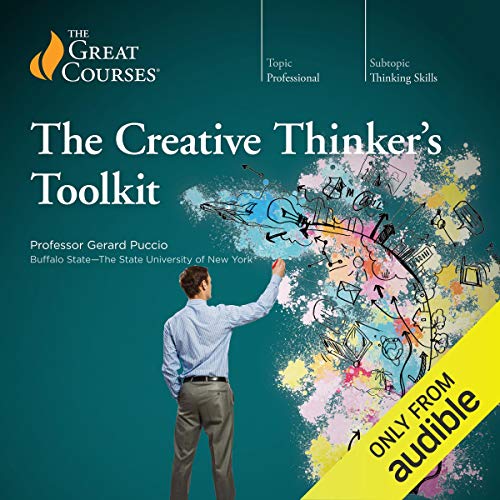
The Creative Thinker's Toolkit
Summary
According to the latest scientific research, anyone can be creative. You just have to know how to think creatively, which involves taking a more imaginative approach to the challenges we all face. Learn how to wield the same research-based tools that today's creative people use and tap into your inner creative thinker with Professor Puccio's engaging 24-lecture series that takes you step-by-step through the creative-thinking process. You'll get a solid introduction to the four major stages of creative problem solving, one of the most effective methods used in creativity training around the world. Just like today's creative geniuses, you'll learn how to approach professional and personal challenges by clarifying your obstacles, ideating potential solutions, developing the ones that are workable, and implementing them in the real world. You'll also learn how to wield the tools of the creative trade with the aid of simple exercises, in-studio demonstrations, hypothetical scenarios, and more. These powerful tools include everything from tapping into the power of brainwriting (an alternative take on brainstorming) to the effective use of How-How diagrams (which help you develop concrete action steps). Whether you want to overcome writer's block, solve a complex business problem, or figure out the best way to resolve a tense argument, this series will give you everything you need so that when other people are dodging challenges, you're uncovering the hidden opportunities they'll have missed. PLEASE NOTE: When you purchase this title, the accompanying reference material will be available in your Library section along with the audio.
©2014 The Great Courses (P)2014 The Teaching Company, LLC

The Science of Information: From Language to Black Holes
Summary
The science of information is the most influential, yet perhaps least appreciated field in science today. Never before in history have we been able to acquire, record, communicate, and use information in so many different forms. This revolution goes far beyond the limitless content that fills our lives, because information also underlies our understanding of ourselves, the natural world, and the universe. Little wonder that an entirely new science has arisen that is devoted to deepening our understanding of information and our ability to use it. The study and acquisition of information has been around a long time. In human terms, spoken language, writing, art, music, and mathematics are perfect examples; so are Morse code, Mendelian genetics, and radio signals - all understood and used before 1900. But a series of conceptual breakthroughs in the 20th century united what seemed like unrelated phenomena and led to a dramatic new way of looking at reality. Called information theory, this field has been responsible for path-breaking insights. The Science of Information: From Language to Black Holes covers the exciting concepts, history, and applications of information theory in 24 challenging and eye-opening half-hour lectures taught by Professor Benjamin Schumacher of Kenyon College. A prominent physicist and award-winning educator at one of the nation’s top liberal arts colleges, Professor Schumacher is also a pioneer in the field of quantum information, which is the latest exciting development in this dynamic scientific field. PLEASE NOTE: When you purchase this title, the accompanying PDF will be available in your Audible Library along with the audio.
©2016 The Great Courses (P)2016 The Teaching Company, LLC

Classical Archaeology of Ancient Greece and Rome
Summary
Over the years, Classical archaeology has evolved from a pastime of collectors and antiquarians to a mature science. Today, the field is a multidisciplinary effort that involves not only traditional diggers, but also geologists, geographers, anthropologists, and linguists.These 36 lectures introduce you to this fascinating field of study. Professor Hale guides you through dozens of ancient sites with the skill of a born storyteller. The riveting narrative unfolds like a series of detective stories and provides a new perspective from which to view the world of the Greeks and Romans, resurrecting them in all their glory and affording us a better grasp of cultures that have greatly influenced our own. A series of exciting archaeological sites that provides you with a detailed idea of what Classical archaeology entails, as well as insights into the details of ancient Greek and Roman life. These case studies - involving both famous sites and discoveries unknown outside the field - include the city of Troy, the Athenian Agora, and the Cape Gelidonya Shipwreck. Through an analysis of these and other riveting sites, you get a superb sampling of Classical archaeology and learn how it combines ancient history, anthropology, ethnography, comparative religion, art history, engineering, historical linguistics, paleobotany, and other pursuits with a dash of Indiana Jones-style adventure. Mysteries abound in this course, and in the end, you'll view the world of the Greeks and Romans not as a sequence of historical events but as an immense living organism; a system in which society, culture, and the natural environment interact in dynamic, creative, and sometimes destructive ways. PLEASE NOTE: When you purchase this title, the accompanying reference material will be available in your Library section along with the audio.
©2006 The Teaching Company, LLC (P)2006 The Great Courses

London: A Short History of the Greatest City in the Western World
Summary
No city has had as powerful and as enduring an impact on Western civilization as London. But what made the city the perfect environment for so many great developments? How did London endure the sweeping historical revolutions and disasters without crumbling? Find the answers to these questions and more in these 24 fascinating lectures. Professor Bucholz takes you through the history of this magnificent metropolis, from its birth as an ancient Roman outpost to its current status as a global village. You'll study the many epic chapters in British and world history - including the English Renaissance, the turmoil of the English civil war, and the epic conflicts of World Wars I and II - through the lens of this amazing capital. What makes the course unique is that it takes you deep into the streets of London during formative periods in its history. Professor Bucholz continuously emphasizes the importance of understanding and experiencing the sights and sounds of London as it was lived by its residents. You'll come to know what daily life was like in historical London, learning the secret histories behind places such as Westminster Abbey, Piccadilly Circus, and London Bridge. This unforgettable look at an unforgettable city will undoubtedly delight and surprise you. By the final lecture, you'll come to realize just what Samuel Johnson meant when he famously declared, "there is in London, all that life can afford." PLEASE NOTE: When you purchase this title, the accompanying reference material will be available in your Library section along with the audio.
©2009 The Teaching Company, LLC (P)2009 The Great Courses
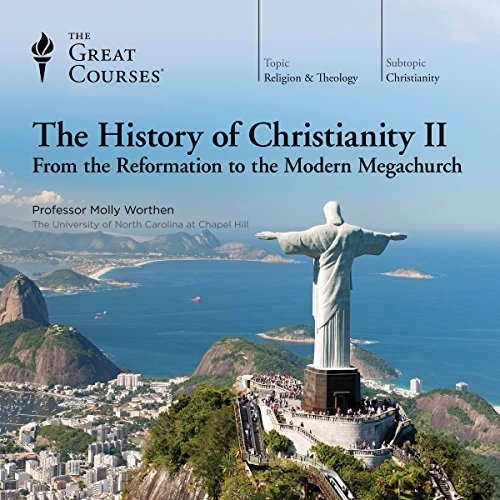
The History of Christianity II: From the Reformation to the Modern Megachurch
Summary
When you think about Christian history, you might think of the first thousand years - the events of Jesus' life, the acts of the apostles, the establishment of the church, and the various councils that established theological doctrine. But the history of Christianity from the Reformation to the present is equally dramatic and profoundly relevant. It's a story about people as much as theology - our cultures, our politics, our relationship to the world. The History of Christianity II: From the Reformation to the Modern Megachurch picks up where The Great Courses' first history of Christianity left off: with the Protestant Reformation. Over 36 fascinating lectures, Professor Molly Worthen of the University of North Carolina traces the story of Christianity as it transformed from a relatively homogenous entity at the end of the Middle Ages through the diverse global religion of today. While Professor Worthen gives you plenty of insight into theology, her primary focus is to place Christianity in its historical context. She personalizes history with stories of individual players and blends their narratives with larger trends give you the full history of momentous events, including the formation of myriad Protestant denominations, the Catholic Counter-Reformation, the Scientific Revolution and the Enlightenment, the Cold War, and the spread of Christianity to Latin America, China, and South Korea. As you'll discover, Christianity has been at the center of momentous transformations around the globe and is now the largest religion in the world. Professor Worthen is a marvelous storyteller, and brings history to life through the stories of people across history - scientists and theologians, revolutionaries and social justice warriors, commentators and ordinary people living out the great drama of Christian history. From Martin Luther's 95 Theses to Latin American liberation theology, this is a magisterial course, and a must-have for students. PLEASE NOTE: When you purchase this title, the accompanying reference material will be available in your Library section along with the audio.
©2017 The Teaching Company, LLC; 2017 The Great Courses

The String Quartets of Beethoven
Summary
In his 16 quartets for two violins, viola, and cello, Beethoven created a Mount Everest for string players and some of the most sublime, unforgettable music ever written. In this musically rich 24-lecture series, Professor Greenberg guides you in a deep encounter with these majestic works of art, offering you the rare opportunity to grasp the musical riches and spiritual greatness of the quartets in a clear and accessible way. You'll uncover the musical underpinnings of the luminous beauty, emotional depth, and dramatic scope that make these quartets legendary; examine the inner workings of one of history's most innovative minds; learn the "ritual template" of the Classical string quartet; and probe the seminal innovations of Haydn and Mozart within the template, as they set the stage for the explosive arrival of Beethoven. The heart of this series is a movement-by-movement exploration of the individual Beethoven quartets, revealing the arc of the composer's fierce independence and imagination as he brings to the string quartet an expressive, formal, and narrative range undreamed of by earlier musicians. You'll delve deeply into the musical innovations that underlie Beethoven's creativity in these works, including "motivic" development, originality, and contextual use of form. Each of these lectures is a rare and life-enriching opportunity to know the scope of Beethoven's genius, his most unforgettable music, and the profound humanity and beauty that live through them.
©2009 The Teaching Company, LLC (P)2009 The Great Courses

Theories of Human Development
Summary
In these 24 lectures, probe the field of "human development"; the science that studies how we learn and develop psychologically, from birth to the end of life. This very young science not only enables us to understand children and help them develop optimally, but also gives us profound insights into who we are as adults. Professor Watson introduces you to the six theories that have had perhaps the greatest influence on this field. Each of them has had a pervasive impact on the way we think about and see ourselves. Among the theories you'll encounter are Sigmund Freud's psychodynamic theory (including such concepts as the Oedipus Complex and the five stages of psycho-sexual development), Erik Erikson's psycho-social theory (which gave rise to the term "identity crisis"), and Albert Bandura's social learning theory (influential in such areas as the effect of media violence on children). You'll meet the people who formulated each theory, become familiar with their philosophical backgrounds and the historical contexts in which they worked, and study the specific processes of human development that each theory describes. Along the way, you'll evaluate the strength and weaknesses of each theory. How do these six theories complement or contradict one another? What do they tell us, as a whole, about human development? These lectures aren't simply about learning, behavior, and relationships in youth, but at any age. Taken as a whole, they provide our best answers to the questions of human nature-how we learn, adapt, and become who we are at every stage in life. PLEASE NOTE: When you purchase this title, the accompanying reference material will be available in your Library section along with the audio.
©2002 The Teaching Company, LLC (P)2002 The Great Courses

America's Founding Fathers
Summary
Today, the US Constitution is the oldest, continually-operating instrument of government in the world. But to think of the Constitution as a fully-formed, canonical document is to miss out on an honest, well-rounded grasp of American history. Now, more than ever, any well-informed citizen should understand how the Constitution lives, breathes, and endures. In collaboration with Smithsonian, these 36 lectures are a deep dive into the creation of the US Constitution as it actually happened - and the remarkable men who played their own unique role in the creation (and survival) of American democracy. Designed to be enjoyed in chronological order, they take you from the closing days of the American Revolution to the opening decades of the United States under the newly created US Constitution. Told like a dramatic story, each lecture uses a Founder as a doorway through which to examine the process involved in crafting the Constitution. You'll encounter fresh perspectives on familiar Founders including George Washington, Thomas Jefferson, James Madison, and Alexander Hamilton, as well as people not necessarily considered Founders, including James McHenry, Secretary of War under John Adams; and Alexis de Tocqueville, author of the insightful Democracy in America. While detailed, the lectures are highly accessible for all learners, high school students and history buffs alike. Less a biography of individuals, Professor Guelzo's lectures are instead a composite biography of one of the greatest political documents in history. PLEASE NOTE: When you purchase this title, the accompanying reference material will be available in your Library section along with the audio.
©2017 The Teaching Company, LLC (P)2017 The Great Courses

The Mongol Empire
Summary
The Mongol Empire was the largest empire the world has ever seen, forged by conquests across Eurasia in the 13th and 14th centuries. Yet despite the unparalleled brutality of the Mongols, they played a key role in launching civilization’s evolution into the modern world. In 24 half-hour lectures delivered by award-winning teacher and historian Craig Benjamin of Grand Valley State University, explore the paradox of the Mongols’ extreme barbarity combined with their enlightened religious attitudes and respect for high civilization, in The Mongol Empire. Professor Benjamin recounts the life of the most notorious Mongol of all, Chinggis Khan (also spelled Genghis Khan). He details the careers of other Great Khans, including Qubilai, Ogedai, Batu, and Hulagu, plus the saga of the last of the celebrated Mongol conquerors, Timur, also known as Tamerlane. You learn about the prehistoric origins of the Mongol nomads, the secret of Mongol military prowess, the Mongols’ remote capital of Karakorum, and the many great cities and empires they sacked in a virtually unbroken string of victories stretching from Hungary to China. Even today, the Mongol conquerors are almost as shrouded in mystery as they were for the victims of their sudden raids. Yet their empire was crucial to the fate of the religions of Islam and Orthodox Christianity and to the civilization of China. Plus, the long period of stability they brought to Central Asia opened the door to dependable commercial and cultural ties between Europe and East Asia. PLEASE NOTE: When you purchase this title, the accompanying PDF will be available in your Audible Library along with the audio.
©2020 The Great Courses (P)2020 The Teaching Company, LLC

Law School for Everyone: Corporate Law
Summary
Who is empowered to make and execute corporate decisions? Is it stockholders who have the final say, or a board of directors? What happens during a corporate merger or hostile takeover? What legal rules are in place to ensure corporations behave ethically? These 12 lectures answer these and other questions about a high-stakes, ever-evolving area of the American legal system. Recreating a traditional law school course in corporate law, Professor Geis guides you through the foundations of corporate law, the history of corporations, the problems that can plague corporations (including insider trading and bribery), and more. In clear, accessible language, Law School for Everyone: Corporate Law introduces you to the inner workings of corporate law, from the fundamental structure of a typical corporation to the high-stakes drama of battles over corporate control. They also explore fascinating, landmark court cases that have shaped the way corporate lawyers think about their field, transforming "legalese" into easily understandable stories that, woven together, create a grand narrative of the evolution of corporate law from its beginnings right up to the challenges of the present day. This lecture series is a fascinating look at how corporate law works, where it works well, and where it may still fall short of its goals. PLEASE NOTE: When you purchase this title, the accompanying PDF will be available in your Audible Library along with the audio.
©2019 The Great Courses (P)2019 The Teaching Company, LLC

The Apocryphal Jesus
Summary
The New Testament gives us 27 canonical texts - gospels, letters, and more - but these works are only a tiny fraction of the many volumes written about the life of Jesus, his family, and the apostles. This alternative body of literature falls under the category of "apocrypha", which means "hidden" or "secret", and it offers fascinating insights into the early Christian world. But these early Christian apocryphal works are more than historical curiosities. The canonical Bible is one of the most influential books in all of Western history, but you might be surprised to find out how many gaps and contradictions the New Testament contains. Much of what we know about Jesus today actually comes from these apocryphal sources, so The Apocryphal Jesus is your chance to learn the true breadth and depth of the early Christian world. Over the course of 24 revealing lectures, Professor David Brakke of The Ohio State University takes you on a tour of this world and surveys the major apocryphal works that have survived. From forged letters to newly discovered gospels, early Christian authors wrote reams of literature about Jesus, his family, and the apostles, drawing from an even larger oral tradition. Even though only a tiny portion of apocryphal works survive today, reviewing this literature gives us a host of new angles on well-known figures from the Bible, as well as insights that can't be found anywhere in the New Testament. Among other topics, you will examine the cult of the Virgin Mary through the Proto-Gospel of James, survey the Gnostic vision presented in the Gospel of Judas, encounter a radically different view of Jesus' teaching in the Gospel of Thomas, gain new insights into early Christian life, and much, much more. PLEASE NOTE: When you purchase this title, the accompanying reference material will be available in your Library section along with the audio.
©2017 The Teaching Company, LLC (P)2017 The Great Courses

Modern Economic Issues
Summary
Gross domestic product. Health insurance. Soaring energy prices. Major economic issues dominate today's news, but how do these issues impact the average citizen? This primer in 21st-century economics for the non-economist surveys today's most urgent economic issues that affect both global events and our everyday lives. You'll learn what economics has to say about making the decisions - big or small - that affect our daily lives: What factors come into play when you're deciding whether to buy this car or that one, or even commute by bus? Mow the lawn or take a nap? Grill a burger with a bubbling slice of cheese or eat a simple salad? And you'll see how this same kind of analysis applies to the major issues of public policy, where the needs and wants of a nation and its people - whether financial security, safety from terrorism, or even an available kidney for someone desperately waiting on a transplant list - involve tradeoffs, which are sometimes obvious and sometimes not. Whether dealing with the traditional sorts of topics most of us are used to seeing in an economics course - Social Security, inflation, unemployment, immigration, taxation, and the like - or issues perhaps surprising, such as gambling, major sports franchises, and even overeating, these 36 lectures offer a steady flow of insights about public policy and the American economy. By showing the full range of economic factors at work, this course can help you become an even more insightful judge of policy recommendations and of the leaders and policy makers who advocate them. And you may well learn to supplement your own analyses as you make the real-life economic choices each of us faces every day, becoming an even wiser consumer and manager of your own economic future.
©2007 The Teaching Company, LLC (P)2007 The Great Courses

The History of the English Language, 2nd Edition
Summary
This course offers an overview of the English language that is literary, historical, cultural, political, and scientific in its scope and designed to give you greater insight into the written and spoken word.The lectures provide a thorough understanding of the history of the English language - from its origins as a dialect of the Germanic-speaking peoples through the literary and cultural documents of its 1,500-year span to the state of American speech today. Professor Lerer defines concepts by illustrating them with copious examples. He often speaks in the dialect appropriate to each lecture - be it Old English, Chaucer’s Middle English, or the colloquial style of Mark Twain’s most unforgettable characters. PLEASE NOTE: When you purchase this title, the accompanying reference material will be available in your Library section along with the audio.
©1998 The Teaching Company, LLC (P)1998 The Great Courses

The Life and Death of Stars
Summary
Long ago, the magnificence of the star-filled sky and its clock-like motions inspired people to invent myths to explain this impressive feature of nature. Now we understand the stars at a much deeper level, not as legendary figures connected with constellations, but as engines of matter, energy, and the raw material of life itself. And thanks to powerful telescopes, our view of the stars is more stunning than ever. The Life and Death of Stars introduces you to this spectacular story in 24 half-hour lectures that lead you through the essential ideas of astrophysics - the science of stars. Your guide is Professor Stassun, an award-winning teacher and noted astrophysicist. He provides lively, eloquent, and authoritative explanations at a level suitable for science novices as well as for those who already know their way around the starry sky. The Life and Death of Stars takes you to some otherworldly destinations, including stellar nurseries, planetary nebulae, the core of the sun, and protoplanetary systems. You also become familiar with the periodic table of elements, discovering how fusion reactions inside stars forge successively heavier atoms, producing some in abundance, temporarily skipping others, and creating everything heavier than iron. PLEASE NOTE: When you purchase this title, the accompanying PDF will be available in your Audible Library along with the audio.
©2014 The Great Courses (P)2014 The Teaching Company, LLC

Lovely Madness: A Players Rockstar Romance
Summary
The fourth book in the Players rockstar romance series.
©2020 Jaine Diamond (P)2020 Jaine Diamond