The Great Courses has 635 audiobooks on Listento.it, narrated by 479 narrators, with an average listener rating of 4.5★ across 19,831 ratings. The most-rated is A Column of Fire.

International Economic Institutions
Summary
Since the end of World War II, groups such as the World Trade Organization, International Monetary Fund, World Bank, European Union, and G-20 have sprung up with a variety of missions, including promoting trade, ensuring financial stability, eradicating poverty, and advancing sustainable economic growth. Behind these worthy goals is the ultimate aim: preventing the kind of global economic instability that can easily lead to war. But while such organizations are trying to knit the world more tightly together, in many countries the voices of populism and nationalism are objecting that the price of lost sovereignty is too high and that traditions and customs are being lost. Furthermore, such organizations have the failings common to all human institutions. Do they really work? Have some saved us from disaster? Are we better off without others? What is the best route to prosperity, and do these groups help smooth the way or obstruct it? International Economic Institutions: Globalism vs. Nationalism uses these influential bodies as a lens to study today's globalized economy. In 24 eye-opening half-hour lectures, award-winning teacher and economist Professor Ramon P. DeGennaro of the University of Tennessee, Knoxville, conducts you through the dizzying array of institutions, their backgrounds, their goals, and the important roles they play in the economic life of the entire world. PLEASE NOTE: When you purchase this title, the accompanying reference material will be available in your Library section along with the audio.
©2017 The Great Courses (P)2017 The Teaching Company, LLC
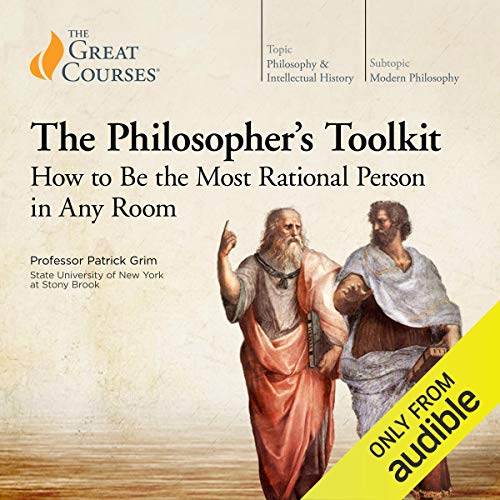
The Philosopher's Toolkit: How to Be the Most Rational Person in Any Room
Summary
Thinking is at the heart of our everyday lives, yet our thinking can go wrong in any number of ways. Bad arguments, fallacious reasoning, misleading language, and built-in cognitive biases are all traps that keep us from rational decision making. What can we do to avoid these traps and think better? Is it possible to think faster, more efficiently, and more systematically? The Philosopher’s Toolkit: How to Be the Most Rational Person in Any Room, taught by award-winning Professor Patrick Grim of the State University of New York at Stony Brook, arms you against the perils of bad thinking and supplies you with an arsenal of strategies to help you be more creative, logical, inventive, realistic, and rational in all aspects of your daily life. PLEASE NOTE: When you purchase this title, the accompanying PDF will be available in your Audible Library along with the audio.
©2013 The Great Courses (P)2013 The Teaching Company, LLC
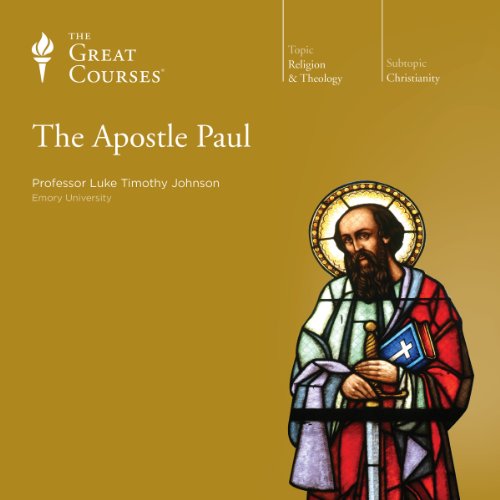
The Apostle Paul
Summary
Coming to grips with Christianity means coming to grips with Paul. There is no figure aside from Jesus himself who is more important to the history of this world religion, and no figure from the age of the early church about whom we know more or of whom we have a more rounded view. Historian Luke Timothy Johnson, the best-selling author of The Real Jesus, offers a fresh and historically grounded assessment of the life and letters of Christianity's "apostle to the Gentiles" in this 12-lecture series. "One of the most fascinating, important, and controversial figures in the religious history of the West, Paul the Apostle continues to find champions and detractors, sometimes in surprising places," says Professor Johnson. This course addresses many questions concerning Paul's embattled life and work: Is Paul the inventor of Christianity or part of a larger movement? Is he best understood from the Acts of the Apostles or from his letters? Why does he focus on the moral character of the community? How do his supporters and detractors depict him? You consider his letters to the Thessalonians, Corinthians, and Galatians. You explore his religious commitments as a member of the Pharisaic movement, his persecution of the Christian sect, the dramatic experience that changed him into an apostle, and his work as a missionary and church founder. PLEASE NOTE: When you purchase this title, the accompanying reference material will be available in your Library section along with the audio.
©2001 The Teaching Company, LLC (P)2001 The Great Courses
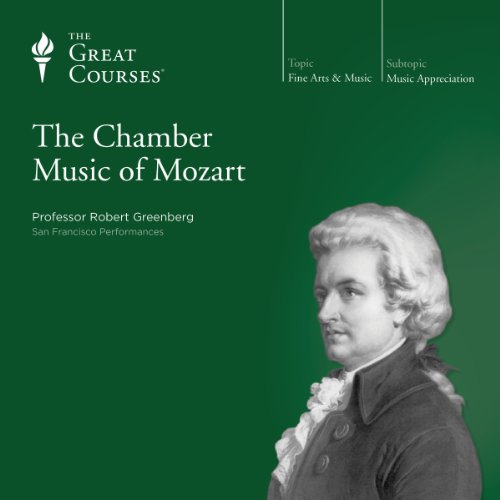
The Chamber Music of Mozart
Summary
Nowhere is Mozart's maturity and mastery more apparent than in the chamber music he wrote during the last 10 years of his life. These 16 lectures take you deep inside the structure of Mozart's chamber masterworks to reveal his hand at work. This is an amazing opportunity to hear, study, and enjoy a selection of immortal musical compositions that Professor Greenberg calls "a blessing of inconceivable richness". You will learn the basic "language" that all 18th-century composers used to write Classical music. You'll also explore the subtleties of Mozart's technique as a composer: his ability to make art "artless" - music that is enormously complex and sophisticated but which sounds simple and effortless - and to know how and when to bend or break the rules of composition. Professor Greenberg teaches you about the three different "generic types" of chamber music that Mozart composed: string quartets, works for piano and another instrument or instruments, and combinations that employ neither a string quartet nor a piano. The centerpiece of these works, drawn primarily from Mozart's "golden years" in Vienna, 1781-1791, is the set of six Haydn string quartets that Mozart dedicated to his friend Joseph Haydn. With a delightful blend of music analysis and appreciation and biographical narration, Professor Greenberg paints a detailed and compelling portrait of Mozart as man who commanded seemingly superhuman musical ability but could be all too human. You'll come away with a solid grasp of Mozart's profound impact as a composer and an improved understanding of what it takes to compose great music.
©2004 The Teaching Company, LLC (P)2004 The Great Courses

The Age of Henry VIII
Summary
Henry VIII, who ruled England for almost four decades, provokes questions. What is greatness? How should we judge character? Who or what can be said to "make" or cause history? England's most famous king ruled an island only about the size of Pennsylvania, inhabited by fewer than three million people nearly 500 years ago - yet he remains instantly recognizable to this day, his barrel-chested and bejeweled figure immortalized by the brush of Hans Holbein the Younger. In this series of 24 revealing lectures, an honored teacher offers an intimate portrait of the monarch who, in a recent biographer's words, "changed the heart, mind, and face of Britain more than anything between the coming of the Normans and the coming of the factory" - a despot who became an accidental great-grandfather of English-speaking democracy. You'll learn how Henry gave Protestantism its powerful purchase in the English-speaking world and how, given Britain's later significance in world history - made possible in part by Henry himself - he must be accounted a towering figure of history. The Henry VIII who emerges from these lectures is a man of both great charm and terrifying, self-pitying ferocity. He harbored ruthless ambitions and spun grand schemes, yet in the end was shadowed by the historical irony of expectations gone awry. At the same time, you'll grasp how his reign contributed an important legacy to British history and the modern world. The revolutionary effect of the Act of Appeals was to make law itself, or the king-in-Parliament, the supreme authority. Parliamentary law became the basis of the new constitutional monarchy, and Henry's navy was the first standing military force in his day. PLEASE NOTE: When you purchase this title, the accompanying reference material will be available in your Library section along with the audio.
©2003 The Teaching Company, LLC (P)2003 The Great Courses
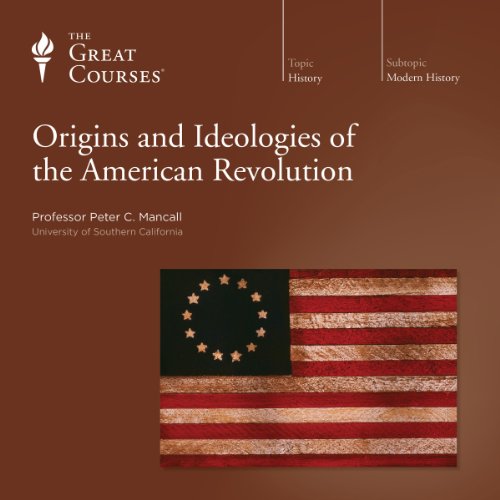
Origins and Ideologies of the American Revolution
Summary
The years between 1760 and 1800 rocked the Western world. These were the years when colonists on the eastern fringes of a continent converted the ideals of Enlightenment thought first into action, then into an actual form of government. Now you can learn why this happened and how the colonists did it - in a series of 48 insightful lectures from an award-winning teacher and author. Professor Mancall brings to life not only the famous but also the little-remembered colonists who were caught up in the debates over rights and power, liberties and empire. It is a story of immense importance and rich discoveries. And because he presents original source materials, including examples of how events were reported and interpreted, you'll more readily grasp the evolution of ideas, the competing pressures, and the misunderstandings - not only in the time leading up to the Revolution, and during the years it was being fought, but afterwards, as well. That's when the victorious colonists came to learn that in achieving freedom from Great Britain, they had simply traded one set of problems for another. They still had to cope with the extraordinarily difficult task of crafting a workable government - one that could support their ideals of how citizens and government should relate to each other - and achieving respect and success among other nations. PLEASE NOTE: When you purchase this title, the accompanying reference material will be available in your Library section along with the audio.
©2006 The Teaching Company, LLC (P)2006 The Great Courses

The Great Questions of Philosophy and Physics
Summary
Philosophers have long puzzled over the nature of space, time, and matter. These inquiries led to the flowering of physics with the Scientific Revolution in the 17th century. Since then, the spectacular success of modern physics might appear to have made philosophy irrelevant. But new theories have created a new range of philosophical concerns: What is the shape of space? Is time travel possible? Is there a grand unified theory that unites all of physics? Treating these and other puzzles with an entertaining and accessible approach, The Great Questions of Philosophy and Physics guides you through the concepts, theories, and speculations that underlie our understanding of reality. In 12 stimulating, half-hour lectures, award-winning teacher and philosopher Steven Gimbel of Gettysburg College covers the fundamental ideas of modern physics, highlighting the role of philosophy in setting ground rules, interpreting the results, and posing new questions. Professor Gimbel describes the grand synthesis that Isaac Newton achieved with his universal theory of gravitation and its picture of absolute space and time. Then, you see how Albert Einstein’s theory of relativity, combined with quantum theory, overthrew the Newtonian paradigm, posing a host of philosophical puzzles. Among them is Erwin Schrödinger’s famous thought experiment about a cat that is simultaneously dead and alive according to the standard interpretation of quantum mechanics. You survey philosophical attempts to escape from this and other paradoxes, and you also investigate the role of mathematics in physical theories. Does its extraordinary success imply that the world is a mathematical system? You close by exploring theological arguments that invoke the discoveries of physics to posit a creator God. As with other theories covered in the course, you carefully weigh both sides using scientific evidence and the tools of philosophy. PLEASE NOTE: When you purchase this title, the accompanying PDF will be available in your Audible Library along with the audio.
©2020 The Great Courses (P)2020 The Teaching Company, LLC

A History of Freedom
Summary
It can be argued that one simple idea - the concept of freedom - has been the driving force of Western civilization and may be the most influential intellectual force the world has ever known. But what is freedom, exactly? These 36 engaging lectures tell the dramatic story of freedom from ancient Greece to our own day, exploring a concept so close to us we may never have considered it with the thoroughness it deserves. In exploring what freedom meant to Abraham Lincoln, Robert E. Lee, Franklin Roosevelt, Winston Churchill, Martin Luther King, and other great historical figures, you'll probe a range of provocative issues related to a concept we in the 21st century sometimes take for granted. What does it take to be free, to have and to hold liberty? What role do the liberal arts and the world of the intellect play in the life of a free society or a free individual? How should we understand the relationship among freedom, religion, and morality? With Professor Fears guiding and informing your thinking, you explore the birth of the idea of freedom in Greece and the story of the world's first democracy; the status and meaning of freedom in both the Roman Republic and the Empire; the role of Christianity in that flowering of freedom, and the Christian view of the true meaning of human liberation; the debates about freedom that informed the framing and ratification of the United States Constitution; its awful testing on the battlefields of the Civil War; the struggles of free peoples against domestic injustices and foreign dictatorships during the 20th century; and the questions about freedom we still face today.
©2001 The Teaching Company, LLC (P)2001 The Great Courses

Peoples and Cultures of the World
Summary
As the "science of humanity," anthropology can help us understand virtually anything about ourselves, from our political and economic systems, to why we get married, to how we decide to buy a particular bottle of wine. This 24-lecture course reveals the extraordinary power of anthropology - and its subspecialty, cultural anthropology - as a tool to understand the world's varied human societies, including our own. Is there such a thing as progress? Are modern nations really happier and better off than "primitive" hunter-gatherer societies? How common is cannibalism today? What are the different types of cannibalism, and the beliefs associated with them? What's the difference between a "matriarchal" and a "matrilineal" society? Which is more common among world cultures? These lectures will immerse you in the world of the Trobriand Islanders of Melanesia; the Yanomamö of the Brazilian Amazon; the Dobe Ju'hoansi or Kung Bushmen of Botswana and Namibia; and other indigenous peoples. Professor Fischer leads an excursion through cultural practices that often seem, to us, quirky, exotic, and even repulsive - marriages that include as many as 20 husbands, matrilineal societies, magic spirits and witchcraft, cannibalism, and incest - practices that will make you question your assumptions about what is natural, or what is human nature. As you review these customs, the professor describes the issues that cultural anthropologists face in dealing with them. For example, what should anthropologists do in cases such as female circumcision or ritualized rape, in which customs seriously conflict with our own sense of morality and human rights? Professor Fischer also applies the lessons of cultural anthropology to our own culture by considering the U.S. economy and consumer behavior. Is our economy really based on rational decision making? If so, why do we eat cattle and pigs, but not horses? Why are we willing to shop around to save $10 on a clock radio, but not on a big-screen TV? You will grow to appreciate how valuable an understanding of cultural anthropology is in a world of ever-increasing globalization, in which members of even the most remote cultures come into more frequent and more influential contact through international travel, migration, business, and the Internet.
©2004 The Teaching Company, LLC (P)2004 The Great Courses

Great Masters: Tchaikovsky - His Life and Music
Summary
Although we often think of an artist's work as a window into their own inner world, that is not always the case. In the life of Peter Ilyich Tchaikovsky, however, we can see perhaps the closest link to be found anywhere between a creative product and the shifting moods of a turbulent soul, which found its outlet through the glorious music created by the great Russian composer. To know his music, you must know the man, and this fast-moving series of eight lectures from an award-winning composer and accomplished teacher offers an insightful look into both the circumstances of Tchaikovsky's life and the impact that life had on his music. You'll learn about his fear of conducting, his disastrous marriage and subsequent suicide attempt, his depression, and the constant anxiety that his closeted homosexuality would become public-a fear that proved prophetic and led to a second, and successful, attempt to take his own life. Torn by the conflicts between his own Romantic inclination for expression and the requirements of Classical structure - he was the first full-time, formally trained, professional composer in Russian history - Tchaikovsky's music is a delicate balancing act. Heart versus head, emotion versus reason, release versus control, the expressiveness demanded of his Russian soul and the strictures of Classical technique - all of these conflicts find their way into his music, and give it its extraordinary emotional power.
©2000 The Teaching Company, LLC (P)2000 The Great Courses

The Greek World
Summary
The ancient Greeks, more than any other early culture, have given us the template for Western civilization, as seen in their superlative achievements in the fields of architecture, political theory, philosophy, science, and art - not the least of which are their inventions of democracy and drama. In these 24 compelling lectures, Professor Garland guides you in a richly illuminating exploration of what the ancient Greeks have given us, and why they’re still important to us today. The course delves into the origins of Greek civilization, the great Classical and Hellenistic periods, and takes you through the succeeding epochs of the Roman and Byzantine eras to the Renaissance, culminating with Greece’s dramatic modern history. You’ll discover the elements of Greek culture that have so deeply imprinted the west in examples such as: The Phenomenon of Hellenism - Learn how Greek culture flowered during the Classical Age, then spread through Alexander’s conquests across the Mediterranean world; Athenian Democracy - Grasp the features of democracy as it arose in Athens in the 5th century B.C.E. as a bold political experiment; Religion and the Olympians - Explore the nature of Greek religious belief, and the panoply of gods and goddesses, from Zeus, Apollo, and Dionysus to Athena, Aphrodite, and Persephone; Greek Drama, Literature, and Philosophy - Study the plays of Aeschylus, Euripides, Sophocles, and Aristophanes; the essence of Homer’s great epic poems; and the seminal ideas of philosophers Socrates, Plato, and Aristotle; Sculpture, Painting, and Architecture - Survey the techniques and aesthetics of Greek sculpture; discover the superlative qualities of Greek vase painting; and study the elements of Greek architecture that have so deeply impacted Western architecture and art. The Greek World: A Study of History and Culture offers you a multilevel immersion in Greek civilization, and an unforgettable view of the extraordinary power ancient Greece exerts over the Western imagination. PLEASE NOTE: When you purchase this title, the accompanying PDF will be available in your Audible Library along with the audio.
©2020 The Great Courses (P)2020 The Teaching Company, LLC

How to Make Stress Work for You
Summary
Trying to live a completely stress-free life is a zero-sum game. The true goal of your relationship with stress is to figure out how to manage it effectively, how to use it to build and support a meaningful, resilient life. In these 18 enriching and inspiring lectures, discover how to manage and minimize the stress in your life. You'll explore the nuances of stress in ways you never really considered. These include types of stress (such as traumas, moderate stressors, and activities of daily life) and the idea that what you experience in life is really just your brain's response (using memory and reasoning) to raw input and stimuli. You'll also explore the relationship between emotion and stress, including the idea that expressing your rage could actually be making you angrier. Dr. Bonura fills these lectures with scientifically backed techniques, behavior modifications, and exercises you can use to build a personalized toolkit to better manage your stress response. You'll learn about responsible detachment from stressful situations, the importance of ruminating right after a traumatic event, the ways physical affection helps with healing, and much more. Rooted in scientific findings from experiments, research papers, and case studies, these lectures offer you nothing less than a bold new way of facing (and appreciating) daily life. PLEASE NOTE: When you purchase this title, the accompanying reference material will be available in your Library section along with the audio.
©2017 The Great Courses (P)2017 The Teaching Company, LLC

America in the Gilded Age and Progressive Era
Summary
America stands at a dramatic crossroads: Massive corporations wield disturbing power. The huge income gap between the one percent and the other 99 percent grows wider. Astounding new technologies are changing American lives. Sound familiar? These and other issues that characterize the early 21st century were also the hallmarks of the transformative periods known as the Gilded Age (1865-1900) and the Progressive Era (1900-1920). Before the Gilded Age and Progressive Era, America was a developing nation, with a largely agrarian economy and virtually no role in global affairs. Yet by 1900, within 35 years, the US had emerged as the world's greatest industrial power. Explore these tumultuous times in America in the Gilded Age and Progressive Era. Over decades marked by economic, political, social, and technological upheavals, the US went from an agrarian, isolationist country to the world's greatest industrial power and a nascent geopolitical superpower. In a time rife with staggering excess, social unrest, and strident calls for reform, these and other remarkable events created the country that we know today: industrialization gave rise to a huge American middle class; voluminous waves of immigration added new material to the "melting pot" of US society; the phenomenon of big business led to the formation of labor unions and the adoption of consumer protections; electricity, cars, and other technologies forever changed the landscape of American life. In taking the measure of six dramatically innovative decades, you'll investigate the economic, political, and social upheavals that marked these years, as well as the details of daily life and the cultural thinking of the times. In the process, you'll meet robber barons, industrialists, socialites, reformers, inventors, conservationists, women's suffragists, civil rights activists, and passionate progressives, who together forged a new United States. PLEASE NOTE: When you purchase this title, the accompanying reference material will be available in your Library section along with the audio.
©2015 The Great Courses (P)2015 The Teaching Company, LLC

Augustine: Philosopher and Saint
Summary
These 12 illuminating lectures paint a rich and detailed portrait of the life, works, and ideas of this remarkable figure, whose own search for God has profoundly shaped all of Western Christianity. You'll learn what Augustine taught and why he taught it – and how those teachings and doctrines helped shape the Roman Catholic Church. These lectures are rewarding even if you have no background at all in classical philosophy or Christian theology. Professor Cary explains any special religious or philosophical concepts you need to know in order to appreciate Augustine's impact, with real-life examples and analogies that make even the most subtle concepts clear and easy to understand. You'll gain a sense of what Augustine was saying, how his own experiences led him to say it, and how his thoughts fit into the theological, philosophical, and political worlds that swirled around him. First, you'll study Augustine's life, with a three-angled look at the Confessions, his great spiritual autobiography, written when he was a 45-year-old bishop. Then, you'll investigate key concepts of Augustine's thoughts on faith and love, grace, original sin, the Church, and more. And finally, you'll gain a greater familiarity with Augustine's concept of persons, both human and divine, by focusing on his great work, The City of God. PLEASE NOTE: When you purchase this title, the accompanying reference material will be available in your Library section along with the audio.
©1997 The Teaching Company, LLC (P)1997 The Great Courses

The Rights of Man: Great Thinkers and Great Movements
Summary
"We hold these truths to be self-evident, that all men are created equal, that they are endowed by their Creator with certain unalienable Rights, that among these are Life, Liberty, and the Pursuit of Happiness." These stirring words from the Declaration of Independence are a powerful statement of the importance of human rights in Western civilization. But many of the freedoms we enjoy today were not so "self-evident" to lawmakers throughout much of our history. Instead, many of those freedoms - from racial segregation, from enslavement, from persecution for one's religion or ethnicity - were the result of long and fierce struggles that took place in courtrooms and meeting rooms, in churches and on battlefields, in classrooms and on streets, at home and abroad, often over many years. Now an award-winning author and honored teacher and scholar tells you this inspirational and profound story in a series of 24 riveting, often moving lectures designed to strengthen your appreciation of both your rights and the long struggles to obtain them. You'll follow the battle for human rights from the initial visions of history's greatest philosophers, religious leaders, and political thinkers to those who fought to make their visions of equality a reality, including Lucretia Mott, Martin Luther King Jr., and Nelson Mandela. Each lecture gives you an overview of historical movements like the struggle for women's suffrage, the emancipation of serfs and slaves, and the development of the United Nations' Universal Declaration of Human Rights.
©2008 The Teaching Company, LLC (P)2008 The Great Courses

Life Lessons from the Great Books
Summary
Study more than three dozen works that span the timelines of Western history, from ancient Greece and Rome to the modern age. Whether written 2,000, 200, or 20 years ago, the enduring works of literature still speak to us and place our unique experiences into a larger perspective, offering invaluable lessons for every important moment in life. Every Great Book you explore over these 36 insightful lectures - from the Odyssey and the Gospel of John to Hamlet and Animal Farm - is a unique expression of the human spirit and a fountain of advice, from how to conduct yourself in times of trouble to how to better appreciate the simple moments in your life. You'll discover six broad themes that run through history's most compelling stories: the unconquerable human spirit, youth and old age, romance and love, adventure and courage, laughter and irony, and patriotism. In exploring these themes within the context of these Great Books, you learn new ideas about both the works themselves and the broad scope of the human condition. If you haven't read these Great Books before, the warmth of Professor Fears's storytelling and his insightful approach to literature will have you heading to the library to learn more. And if you've already read these works, you'll discover new themes and ideas that will help you get more out of them. Regardless of your previous familiarity with these works, you'll come to understand why these masterpieces remain eternal testaments to the variety of human experience and the powerful ways in which literature can guide and inspire us. PLEASE NOTE: When you purchase this title, the accompanying reference material will be available in your Library section along with the audio.
©2009 The Teaching Company, LLC (P)2009 The Great Courses

The Secrets of Great Mystery and Suspense Fiction
Summary
Great mystery and suspense writers have created some of the most unforgettable stories in all of literature. Even those who don't consider themselves fans of this intriguing genre are familiar with names such as Hercule Poirot, Sam Spade, Hannibal Lecter, and Robert Langdon, and understand the deep and lasting impact this writing has had on literature as a whole. An utterly captivating and compelling genre, mystery and suspense has leapt off the pages of the old dime store paperbacks, magazines, and comic books onto big screens, small screens, radio serials, podcasts, websites, and more. You'll find elements, characters, and references permeating popular culture and news reports worldwide, and bleeding into other literary genres such as romance, political thrillers, sports stories, and even biographies. Nearly 200 years old, the genre of mystery and suspense literature is only growing more popular. How did it become so prevalent? Why is mystery and suspense a go-to genre for so many around the world? What makes the dark and sometimes grisly themes appealing? In 24 lectures of The Secrets of Great Mystery and Suspense Fiction, Professor David Schmid of the University at Buffalo examines these questions, as he guides you through an examination of the many different varieties of the genre, including classic whodunits, hard-boiled crime fiction, historical mysteries, courtroom dramas, true crime narratives, espionage fiction, and many more. Fans of the genre will be delighted by the breadth and depth of information presented, guaranteed to uncover gems they had not yet discovered. But anyone, whether they are admirers of mystery on radio and film, or simply fans of literature, history, or pop culture, will find something to enlighten and entertain in this study of a genre with such tremendous impact. PLEASE NOTE: When you purchase this title, the accompanying reference material will be available in your Library section along with the audio.
©2016 The Great Courses (P)2016 The Teaching Company, LLC

The Everyday Guide to Wines of France
Summary
Grab a glass and join acclaimed Master of Wine Jennifer Simonetti-Bryan on a fascinating six-lecture tour of the best wines that France has to offer with The Everyday Guide to Wines of France. This journey is packed with interactive wine tastings, food and wine pairing demonstrations, practical tips and suggestions for shopping and gift giving, and more. The Everyday Guide to Wines of France takes you all across the country on a vibrant search for the best of the best when it comes to French wines. From the comfort of your own home, you’ll travel to some of France’s most important wine regions and investigate their unique wine-making traditions. Throughout each lecture, you'll have the opportunity to taste alongside Ms. Simonetti-Bryan as she samples great French wines and draws your attention to curious subtleties and differences your palate may not have noticed before. While French wines can be expensive, many of the wines featured in this course are affordable and can easily be found in your nearest wine shop or supermarket. The Everyday Guide to Wines of France is an engaging chance to unravel the mysteries of some of the world's greatest wines in the company of a master educator who has trained hundreds of professionals in the wine industry and has been featured on a variety of popular media programs. Most of all, it's an amazing wine-tasting journey that will leave you with a greater appreciation for French wine - in all of its captivating varieties. PLEASE NOTE: When you purchase this title, the accompanying PDF will be available in your Audible Library along with the audio.
©2012 The Great Courses (P)2012 The Teaching Company, LLC

Science and Religion
Summary
What is the nature of the relationship between science and religion? When do they conflict? And how do they influence each other in the pursuit of knowledge and truth? While conventional wisdom says that science and theology must perpetually clash, they have actually been partners in an age-old adventure. These 12 engaging lectures cover both the historical sweep and philosophical flashpoints of this epic interaction. You'll encounter a surprisingly cooperative dynamic in which theologians and natural scientists - from St. Augustine to Sir Isaac Newton to contemporary thinkers - share methods, ideas, aspirations, and a tradition of disputational dialogue. Moving from the early centuries of the Christian era and the Middle Ages to our own day, Professor Principe examines St. Augustine's profound ideas about reason and faith, and he follows St. Thomas Aquinas's exploration of miracles - the need to identify them is one example of how scientific and theological inquiry overlap. You'll meet a 19th-century writer whose anti-Catholic diatribe spread myths that persist today, and you'll learn about the courage (and stubbornness) of Galileo, the unexpected rationality of his accusers, the inspiration of Darwin's natural selection, and the religious implications of Lemaître's big bang theory. The solution to modern conflicts is the study of history. Such study will equip you to join that partnership with ideas and a clear, historical perspective on the science/religion relationship. These tools will help you participate more effectively in a dialogue that is as thought-provoking today as it was hundreds of years ago.
©2006 The Teaching Company, LLC (P)2006 The Great Courses

Great World Religions: Christianity
Summary
These 12 lectures are an engaging and comprehensive introduction to one of the world's greatest faiths. By concentrating on the basics that every well-educated individual should know, Professor Johnson's lectures provide you with a clear survey of the most important elements of this religious tradition-and a framework for further study. In this lecture series, you'll consider fundamental issues including Christianity's birth and expansion across the Mediterranean world, the development of its doctrine, its transformation after Christianity became the imperial religion of Rome, its many and deep connections to Western culture, and the tensions within Christianity today. Professor Johnson's synthetic approach provides first an overview of the Christian story, how it understands history from creation to new creation - and the relation of scripture to that history, and the Christian creed: what Christians believe about God, Jesus, the Holy Spirit, and the church. He also explains Christian practice as expressed by the structure of the community and its sacraments, by the struggles of Christians to find a coherent and consistent moral teaching, and by various manifestations of Christianity's more radical edge in martyrs, missionaries, and mystics. By the end of this engaging and accessible series, you'll finally have a true grasp of Christianity's distinctive character, the major turning points in its history, its most important shared beliefs and practices, and, above all, its continuing appeal to many of the world's peoples.
©2003 The Teaching Company, LLC (P)2003 The Great Courses