The History category has 4,114 audiobooks on Listento.it, with an average listener rating of 4.4★ across 16,411 ratings. The most-rated is A Short History of Nearly Everything.

Espionage and Covert Operations: A Global History
Summary
Step into the real world of the spy with this detailed and unforgettable tour of the millennia-long history and enduring legacy of espionage and covert operations. While most of us associate this top-secret subject with popular fiction and film, its true story is more fascinating, surprising, and important than you could possibly imagine. These 24 thrilling lectures survey how world powers have attempted to work in the shadows to gain secret information or subvert enemies behind the scenes. Filled with stories and insights that will change the way you think about world history's most defining events, this course lets you peer inside a subject whose truths most people are unaware of. Professor Liulevicius introduces you to the inner workings of covert organizations, including the Oprichnina, a feared secret service established by tsar Ivan the Terrible in the 1500s in an effort to cleanse Russia of treasonous activities; the CIA, established in 1947 by President Truman to replace the Office of Secret Services to be in charge of all intelligence collection – and which had an embarrassing early history; and Mossad, Israel's version of the CIA, which won a series of key intelligence victories during the cold war and over terror attacks and hostage crises in the second half of the 20th century. You'll also meet famous – and infamous – spies, including Sir Francis Walsingham, Mata Hari, and Kim Philby. In this stirring series of lectures, you'll study the psychological motives behind spies, the ethics of cyber warfare and corporate espionage, the question of whether we now live in a surveillance society, and more. PLEASE NOTE: When you purchase this title, the accompanying reference material will be available in your Library section along with the audio.
©2011 The Teaching Company, LLC (P)2011 The Great Courses

The Warrior Ethos
Summary
Wars change, warriors don't. We are all warriors. Each of us struggles every day to define and defend our sense of purpose and integrity, to justify our existence on the planet, and to understand, if only within our own hearts, who we are and in what we believe. Do we fight by a code? If so, what is it? What is the warrior ethos? From where did it come? What form does it take today? How do we (and how can we) use it and be true to it in our internal and external lives? The Warrior Ethos is intended not only for men and women in uniform, but artists, entrepreneurs, and other warriors in other walks of life. The audiobook examines the evolution of the warrior code of honor and "mental toughness". It goes back to the ancient Spartans and Athenians, to Caesar's Romans, Alexander's Macedonians, and the Persians of Cyrus the Great (not excluding the Garden of Eden and the primitive hunting band). Sources include Herodotus, Thucydides, Plutarch, Xenophon, Vegetius, Arrian, and Curtius - and on down to Gen. George Patton, Field Marshal Erwin Rommel, and Israeli Minister of Defense Moshe Dayan.
©2011 Black Irish Book, LLC (P)2011 Black Irish Books, LLC

The Six Wives of Henry VIII
Summary
This acclaimed best seller from popular historian Alison Weir is a fascinating look at the Tudor family dynasty and its most infamous ruler. The Six Wives of Henry VIII brings to life England’s oft-married monarch and the six wildly different but equally fascinating women who married him. Gripping from the first sentence to the last and loaded with fascinating details, Weir’s rich history is a perfect blend of scholarship and entertainment.
©1991 Alison Weir (P)2002 Recorded Books

12 Strong
Summary
"A thrilling action ride of a book" (The New York Times Book Review) - from Jerry Bruckheimer in theaters everywhere January 19, 2018 - the New York Times best-selling, true-life account of a US Special Forces team deployed to dangerous, war-ridden Afghanistan in the weeks following 9/11. Previously published as Horse Soldiers, 12 Strong is the dramatic account of a small band of Special Forces soldiers who secretly entered Afghanistan following 9/11 and rode to war on horses against the Taliban. Outnumbered 40 to one, they pursued the enemy army across the mountainous Afghanistan terrain and, after a series of intense battles, captured the city of Mazar-i-Sharif. The bone-weary American soldiers were welcomed as liberators as they rode into the city. Then the action took a wholly unexpected turn. During a surrender of 600 Taliban troops, the Horse Soldiers were ambushed by the would-be POWs. Dangerously overpowered, they fought for their lives in the city's immense fortress, Qala-i-Janghi, or the House of War. At risk were the military gains of the entire campaign: if the soldiers perished or were captured, the entire effort to outmaneuver the Taliban was likely doomed. "A riveting story of the brave and resourceful American warriors who rode into Afghanistan after 9/11 and waged war against Al Qaeda" (Tom Brokaw), Doug Stanton's account touches the mythic. The soldiers on horses combined ancient strategies of cavalry warfare with 21st-century aerial bombardment technology to perform a seemingly impossible feat. Moreover, their careful effort to win the hearts of local townspeople proved a valuable lesson for America's ongoing efforts in Afghanistan. With "spellbinding...action packed prose...The book reads more like a novel than a military history...the Horse Soldier's secret mission remains the US military's finest moment in what has since arguably been a muddled war" (USA TODAY).
©2009 Doug Stanton (P)2011 Simon & Schuster

The Ottoman Empire
Summary
By understanding the dramatic story of the Ottoman Empire - from its early years as a collection of raiders and conquerors to its undeniable power in the 15th and 16th centuries to its catastrophic collapse in the wreckage of the First World War - one can better grasp the current complexities of the Middle East. Over the course of these 36 enlightening lectures, investigate over 600 years of history that covers the nature of Ottoman identity, the achievements of the Sultan's court, and stories of confrontation and cooperation with the West. Befitting a story of such epic scope and grandeur, every lecture is a treasure trove of historical insights into the people, events, themes, and locales responsible for shaping the story of this often-overlooked empire. You'll cover everything from Rumi, the whirling dervishes, and the importance of the sultan's grand viziers to the wars of Sultan Suleiman I, the shadowy politics of the Committee of Union and Progress, and the birth of the Turkish Republic under Kemal Atatürk. Welcome to a fascinating story of the triumph and tragedy, war and peace, intellectual progress and civil insurrection of a great empire that, for all its glory and grandeur, has left an important legacy that will shape the future of the Balkan nation-states, the Turkish Republic, and the Arab world - and those of us in the West as well. PLEASE NOTE: When you purchase this title, the accompanying reference material will be available in your Library section along with the audio.
©2017 The Teaching Company, LLC (P)2017 The Great Courses

In the Shadow of the Sword
Summary
In the 6th century AD, the Near East was divided between two venerable empires: the Persian and the Roman. A hundred years on and one had vanished forever, while the other seemed almost finished. Ruling in their place were the Arabs: an upheaval so profound that it spelt, in effect, the end of the ancient world. In The Shadow of the Sword, Tom Holland explores how this came about. Spanning from Constantinople to the Arabian desert, and starring some of the most remarkable rulers who ever lived, he tells a story vivid with drama, horror, and startling achievement.
©2012 Tom Holland (P)2012 Hachette Digital

We Were Soldiers Once... and Young
Summary
In November 1965, some 450 men of the First Battalion, Seventh Cavalry, under the command of Lt. Col. Hal Moore, were dropped by helicopter into a small clearing in the Ia Drang Valley. They were immediately surrounded by 2,000 North Vietnamese soldiers. Three days later, only two and a half miles away, a sister battalion was chopped to pieces. Together, these actions at the landing zones X-Ray and Albany constituted one of the most savage and significant battles of the Vietnam War. How these men persevered - sacrificed themselves for their comrades and never gave up - makes a vivid portrait of war at its most inspiring and devastating. General Moore and Joseph Galloway, the only journalist on the ground throughout the fighting, have interviewed hundreds of men who fought there, including the North Vietnamese commanders. This devastating account rises above the specific ordeal it chronicles to present a picture of men facing the ultimate challenge, dealing with it in ways they would have found unimaginable only a few hours earlier. It reveals to us, as rarely before, man's most heroic and horrendous endeavor.
©1992 Lt. General H. G. Moore and Joseph L. Galloway (P)2018 Tantor

Breakout from Juno
Summary
The ninth book in the Canadian Battle Series, Breakout from Juno, is the first dramatic chronicling of Canada's pivotal role throughout the entire Normandy Campaign following the D-Day landings. On July 4, 1944, the 3rd Canadian Infantry Division won the village of Carpiquet but not the adjacent airfield. Instead of a speedy victory, the men faced a bloody fight. The Canadians advanced relentlessly at a great cost in bloodshed. Within 2 weeks the 2nd Infantry and 4th Armoured divisions joined coming together as the First Canadian Army.The soldiers fought within a narrow landscape extending a mere 21 miles from Caen to Falaise. They won a two-day battle for Verrires Ridge starting on July 21, after 1,500 casualties. More bloody battles followed, until finally, on August 21, the narrowing gap that had been developing at Falaise closed when American and Canadian troops shook hands. The German army in Normandy had been destroyed, with only 18,000 of about 400,000 men escaping. The Allies suffered 206,000 casualties, of which 18,444 were Canadians. Breakout from Juno is a story of uncommon heroism, endurance, and sacrifice by Canada's World War II volunteer army and pays tribute to Canada's veterans.
©2012 Mark Zuehlke (P)2011 Audible, Inc.
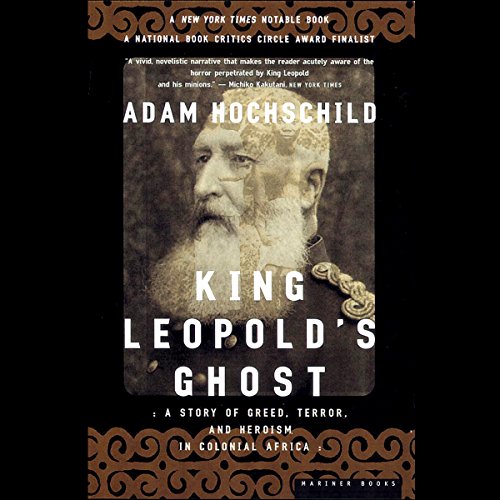
King Leopold's Ghost
Summary
In the late 1890s, Edmund Dene Morel, a young British shipping company agent, noticed something strange about the cargoes of his company's ships as they arrived from and departed for the Congo, Leopold II's vast new African colony. Incoming ships were crammed with valuable ivory and rubber. Outbound ships carried little more than soldiers and firearms. Correctly concluding that only slave labor on a vast scale could account for these cargoes, Morel resigned from his company and almost singlehandedly made Leopold's slave-labor regime the premier human rights story in the world. Thousands of people packed hundreds of meetings throughout the United States and Europe to learn about Congo atrocities. Two courageous black Americans - George Washington Williams and William Sheppard - risked much to bring evidence to the outside world. Roger Casement, later hanged by Britain as a traitor, conducted an eye-opening investigation of the Congo River stations. Sailing into the middle of the story was a young steamboat officer named Joseph Conrad. And looming over all was Leopold II, King of the Belgians, sole owner of the only private colony in the world.
©1998 Adam Hochschild (P)2010 Random House

Iron Kingdom
Summary
In the aftermath of World War II, Prussia - a centuries-old state pivotal to Europe's development - ceased to exist. In their eagerness to erase all traces of the Third Reich from the earth, the Allies believed that Prussia, the very embodiment of German militarism, had to be abolished. But as Christopher Clark reveals in this pioneering history, Prussia's legacy is far more complex. What we find is a kingdom that existed nearly half a millennium ago as a patchwork of territorial fragments, with neither significant resources nor a coherent culture. With its capital in Berlin, Prussia grew from being a small, poor, disregarded medieval state into one of the most vigorous and powerful nations in Europe. Iron Kingdom traces Prussia's involvement in the continent's foundational religious and political conflagrations: from the devastations of the Thirty Years' War through centuries of political machinations to the dissolution of the Holy Roman Empire, from the enlightenment of Frederick the Great to the destructive conquests of Napoleon, and from the "iron and blood" policies of Bismarck to the creation of the German Empire in 1871 and all that implied for the tumultuous 20th century.
©2006 Christopher Clark (P)2017 Tantor

Pirate Hunters
Summary
A thrilling new adventure of danger and deep-sea diving, historic mystery and suspense, by the author of the New York Times best seller Shadow Divers. Finding and identifying a pirate ship is the hardest thing to do under the sea. But two men - John Chatterton and John Mattera - are willing to risk everything to find the Golden Fleece, the ship of the infamous pirate Joseph Bannister. While he was at large during the Golden Age of Piracy in the 17th century, Bannister's exploits would have been more notorious than Blackbeard's, more daring than Kidd's, but his story and his ship have been lost to time. If Chatterton and Mattera succeed, they will make history - it will be just the second time ever that a pirate ship has been discovered and positively identified. Soon, however, they realize that cutting-edge technology and a willingness to lose everything aren't enough to track down Bannister's ship. They must travel the globe in search of historic documents and accounts of the great pirate's exploits, face down dangerous rivals, and battle the tides of nations and governments and experts. But it's only when they learn to think and act like pirates - like Bannister - that they become able to go where no pirate hunters have gone before. Fast paced and filled with suspense, fascinating characters, history, and adventure, Pirate Hunters is an unpauseable story that goes deep to discover truths and souls long believed lost.
©2015 Robert Kurson (P)2015 Random House Audio

Red Famine
Summary
From the author of the Pulitzer Prize-winning Gulag and the National Book Award finalist Iron Curtain, a revelatory history of one of Stalin's greatest crimes - the consequences of which still resonate today. In 1929 Stalin launched his policy of agricultural collectivization - in effect a second Russian Revolution - which forced millions of peasants off their land and onto collective farms. The result was a catastrophic famine, the most lethal in European history. At least five million people died between 1931 and 1933 in the USSR. But instead of sending relief, the Soviet state made use of the catastrophe to rid itself of a political problem. In Red Famine, Anne Applebaum argues that more than three million of those dead were Ukrainians who perished not because they were accidental victims of a bad policy but because the state deliberately set out to kill them. Applebaum proves what has long been suspected: After a series of rebellions unsettled the province, Stalin set out to destroy the Ukrainian peasantry. The state sealed the republic's borders and seized all available food. Starvation set in rapidly, and people ate anything: grass, tree bark, dogs, corpses. In some cases they killed one another for food. Devastating and definitive, Red Famine captures the horror of ordinary people struggling to survive extraordinary evil. Today, Russia, the successor to the Soviet Union, has placed Ukrainian independence in its sights once more. Applebaum's compulsive narrative recalls one of the worst crimes of the 20th century and shows how it may foreshadow a new threat to the political order in the 21st.
©2017 Anne Applebaum (P)2017 Random House Audio

Bronze Age Mindset
Summary
The Atlantic named this author as possibly Steve Bannon's contact in the White House (Rosie Gray, The Atlantic, Feb 10, 2017: "'Think you should speak directly to my WH cutout/cell leader,' Yarvin said in an email. 'I've never met him and don't know his identity, we just DM on Twitter. He's said to be ‘very close’ to Bannon.... Goal is to intimidate Congress with pure masculine show of youth, energy. Trump is said to know, will coordinate with powerful EOs...."); and a recent Vox article (Tara Isabella Burton, Vox, June 1, 2018) claimed he is the "text" to Jordan Peterson's "subtext" and a "distilled" form of Peterson. Distilled means purer: yes, so why not listen and understand the purer version? T. I. Burton also adds in this article that this author, Bronze Age Pervert, is a kind of priest-king to thousands on Twitter and outside and is possibly leading a spiritual reawakening. Some say that this work, found in a safe-box in the port area of Kowloon, was dictated because Bronze Age Pervert refuses to learn what he calls "the low and plebeian art of writing". It isn't known how this work was transcribed. The contents are pure dynamite. He explains that you live in ant farm. That you are observed by the lords of lies, ritually probed. Ancient man had something you have lost: confidence in his instincts and strength, knowledge in his blood. BAP shows how the Bronze Age mind-set can set you free from this iron prison and help you embark on the path of power. He talks about life, biology, hormones. He gives many examples from history, both ancient and modern. He shows the secrets of the detrimental robots, how they hide and fabricate. He helps you escape gynocracy and ascend to fresh mountain air. Praise be to the Pervert. Praise be to his teaching of peace. Be careful.
©2018 Bronze Age Pervert (P)2018 Bronze Age Pervert

Human Prehistory and the First Civilizations
Summary
Where do we come from? How did our ancestors settle this planet? How did the great historic civilizations of the world develop? How does a past so shadowy that it has to be painstakingly reconstructed from fragmentary, largely unwritten records nonetheless make us who and what we are? These 36 lectures bring you the answers that the latest scientific and archaeological research and theorizing suggest about human origins, how populations developed, and the ways in which civilizations spread throughout the globe. It's a narrative of the story of human origins and the many ties that still bind us deeply to the world before writing. And it's a world tour of prehistory with profound links to who we are and how we live today. Woven through this narrative is a set of pervasive themes: emerging human biological and cultural diversity (as well as our remarkable similarities across surprising expanses of time and space); the impact of human adaptations to climatic and environmental change; and the importance of seeing prehistory not merely as a chronicle of archaeological sites and artifacts, but of people behaving with the extraordinary intellectual, spiritual, and emotional dynamism that distinguish the human. Among the corners of our mysterious past you'll explore: human prehistory from Australopithecus africanus through Homo habilis and Homo erectus; the beginnings of agriculture and animal domestication; theories behind the appearance of urban civilization and overall attributes of preindustrial civilizations; the maritime trading revolutions in Africa, India, and Southeast Asia; and much more. PLEASE NOTE: When you purchase this title, the accompanying reference material will be available in your Library section along with the audio.
©2003 The Teaching Company, LLC (P)2003 The Great Courses
SPQR
Summary
A sweeping, revisionist history of the Roman Empire from one of our foremost classicists. Ancient Rome was an imposing city even by modern standards, a sprawling imperial metropolis of more than a million inhabitants, a "mixture of luxury and filth, liberty and exploitation, civic pride and murderous civil war" that served as the seat of power for an empire that spanned from Spain to Syria. Yet how did all this emerge from what was once an insignificant village in central Italy? In SPQR, world-renowned classicist Mary Beard narrates the unprecedented rise of a civilization that even 2,000 years later still shapes many of our most fundamental assumptions about power, citizenship, responsibility, political violence, empire, luxury, and beauty. From the foundational myth of Romulus and Remus to 212 CE, nearly a thousand years later, when the emperor Caracalla gave Roman citizenship to every free inhabitant of the empire, SPQR (the abbreviation of "The Senate and People of Rome") not just examines how we think of ancient Rome but challenges the comfortable historical perspectives that have existed for centuries by exploring how the Romans thought of themselves: how they challenged the idea of imperial rule, how they responded to terrorism and revolution, and how they invented a new idea of citizenship and nation. Opening the audiobook in 63 BCE with the famous clash between the populist aristocrat Catiline and Cicero, the renowned politician and orator, Beard animates this "terrorist conspiracy", which was aimed at the very heart of the republic, demonstrating how this singular event would presage the struggle between democracy and autocracy that would come to define much of Rome's subsequent history. Illustrating how a classical democracy yielded to a self-confident and self-critical empire, SPQR reintroduces us, though in a wholly different way, to famous and familiar characters.
©2015 Mary Beard (P)2015 Recorded Books

The American Civil War
Summary
Between 1861 and 1865, the clash of the greatest armies the Western hemisphere had ever seen turned small towns, little-known streams, and obscure meadows in the American countryside into names we will always remember. In those great battles, those streams ran red with blood - and the United States was truly born. If you've ever wanted to understand the Civil War, this series of 48 startlingly evocative lectures by a leading Civil War historian can serve as both an ideal single course or a solid starting point for further exploration - a richly detailed examination of how this great conflict affected every person in America. For you'll gain not only a deep knowledge of what happened, but new insights into why. You'll learn how both sides' armies were recruited, equipped, and trained, and about the hard lot of those they took prisoner. You'll hear how soldiers on each of those sides dealt with the rigors of camp life, campaigns, and the terror of combat. And you'll understand how slaves and their falling masters responded to the advancing war, as well as the desperate price paid by the families so many left behind. Though this series of lectures goes far beyond a simple examination of battles and generals, it also offers detailed analyses of the strategic and tactical dimensions of the Civil War's most important campaigns. At the same time, it never forgets that the conflict involved far more than pins on a map - and indeed claimed a greater cost in human lives than all other American wars combined. PLEASE NOTE: When you purchase this title, the accompanying reference material will be available in your My Library section along with the audio.
©2000 The Teaching Company, LLC (P)2000 The Great Courses
The Rise and Fall of the British Empire
Summary
What were the forces that thrust the British Empire to its extraordinary position of greatness and then just as powerfully drove it into decline? And why is nearly every nation on earth, in one way or another, the consequence of the British Empire? In these 36 lectures, Professor Allitt leads you through four centuries of British power, innovation, influence, and, ultimately, diminishment - four profound centuries that literally remade the world and bequeathed the complex global legacy that continues to shape your everyday life. This is a remarkable lecture series; one that will give you fresh insights into world history in a wide range of areas - political, economic, technological, social, and more. And it will also give you a comprehensive overview you won't find offered anywhere else - a context into which you can integrate new knowledge about this country, as well as understand the background of current events in so many other countries that were once part of Britain's empire, from Ireland to China, and in Africa and the Caribbean. Indeed, it seems fair to say that one cannot truly understand the most important aspects of world history without a firm grasp of the history of the British Empire. In giving you that grasp, these lectures draw on a vast range of critical events, riveting personalities, revealing anecdotes, and eloquent quotations. Compelling, comprehensive, and astonishing in the force of its narrative power, each lecture will give you a refreshing new understanding of what made the British Empire both great in its achievements and vulnerable to its eventual downfall. PLEASE NOTE: When you purchase this title, the accompanying reference material will be available in your Library section along with the audio.
©2009 The Teaching Company, LLC (P)2009 The Great Courses

The Last Lion: Winston Spencer Churchill, Volume I: Visions of Glory 1874-1932
Summary
Winston Churchill is perhaps the most important political figure of the 20th century. His great oratory and leadership during the Second World War were only part of his huge breadth of experience and achievement. Studying his life is a fascinating way to imbibe the history of his era and gain insight into key events that have shaped our time.
In political office at the end of WWI, Churchill foresaw the folly of Versailles and feared what a crippled Germany would do to the balance of power. In his years in the political wilderness, from 1931 to 1939, he alone of all British public men, continually raised his voice against Hitler and his appeasers. For over 50 years, he was constantly involved in, and usually at the center of, the most important events of his age. It was, however, his obduracy on matters of principle, his fortitude in the face of opposition, and his perseverance in standing alone that defined him.
©1983 William Manchester (P)1990 Blackstone Audio Inc.

The Pentagon's Brain
Summary
The definitive history of DARPA, the Defense Advanced Research Project Agency, from the author of the New York Times best seller Area 51. No one has ever written the history of the Defense Department's most secret, most powerful, and most controversial military science R&D agency. In the first-ever history of the organization, New York Times best-selling author Annie Jacobsen draws on inside sources, exclusive interviews, private documents, and declassified memos to paint a picture of DARPA, or "the Pentagon's brain", from its Cold War inception in 1958 to the present. This is the book on DARPA - a compelling narrative about this clandestine intersection of science and the American military and the often frightening results.
©2015 Annie Jacobsen (P)2015 Hachette Audio
A Brief History of the World
Summary
The construction of the great pyramids of Egypt, the development of democracy in ancient Greece, the glories of ancient Rome - these stories are familiar to students of history. But what about the rest of the world? How do the histories of China and Japan, or Russia, India, and the remote territories of Sub-Saharan Africa and South America fit in with commonly known accounts of Western traditions? Learn the rest of the story with these 36 riveting lectures that survey the expanse of human development and civilization across the globe. From the invention of agriculture in the Neolithic era to the urbanized, technologically sophisticated world of the 21st century, you'll apprehend "the big picture" of world history. You'll examine and compare the peoples, cultures, and nations of Europe, Asia, Africa, and the Americas to understand how, throughout history, peoples all over the world have connected and interacted, traded goods and technology, and conquered and learned from each other. As you travel around the world and through time, Professor Stearns provides surprising insights that will overturn many of your assumptions about history. For instance, you'll see how the invention of agriculture brought with it a number of drawbacks, such as a new inequality between men and women and greater exposure to epidemic diseases. Fascinating episodes like these will give you a deep appreciation for the human experience as it was lived throughout the centuries. PLEASE NOTE: When you purchase this title, the accompanying reference material will be available in your Library section along with the audio.
©2007 The Teaching Company, LLC (P)2007 The Great Courses