Jeff Hoyt has narrated 20 audiobooks on Listento.it by 25 authors, with an average listener rating of 3.9★ across 75 ratings. The most-rated is Collaborating with the Enemy.

The Laws of Lifetime Growth
Summary
Growth is a fundamental human need. It is at the root of everything that gives us a feeling of accomplishment, satisfaction, meaning, and progress. Yet many people find their growth stalled at some point. In The Laws of Lifetime Growth, Dan Sullivan and Catherine Nomura offer 10 simple laws that everyone can use to keep a fresh, innovative perspective on their lives and the world around them. These laws are the distillation of Sullivan's years of coaching successful people, paying attention to what motivates them and what unlocks their greatest abilities. Each chapter is devoted to exploring one of the 10 laws in detail, including stories of people from all walks of life who exemplify the law in action, common pitfalls that people often run into when trying to apply the law, and practical strategies for getting past those obstacles. This second edition includes new examples, a self-assessment to measure your progress, and access to an interactive online tool. Once you start to integrate these laws into your life, you'll never outgrow them, they'll never become obsolete, and they will continue to lead you to greater happiness and fulfillment.
©2016 Dan Sullivan and Catherine Nomura (P)2016 Dan Sullivan and Catherine Nomura

Collaborating with the Enemy
Summary
We're trying to get something done that really matters to us. To do this we need to work with others. But these others include people we don't agree with or like or trust, so working with them seems impossible - like collaborating with the enemy. What can we do? International consultant Adam Kahane, whose work has been praised by Nobel Peace Prize winners Nelson Mandela and Juan Manuel Santos, has faced this challenge many times in working both on big issues, like economic restructuring, climate change, and civil war, and on ordinary issues within organizations and families. He has come to understand that everything we think we know about collaboration - that it requires a harmonious team that agrees on where it's going and how it's going to get there - is wrong. On the contrary, the only way to get things done with diverse others is to abandon harmony, agreement, and control and to learn to work with discord, experimentation, and genuine cocreation. Kahane proposes a new approach to collaboration - stretch collaboration - that is built on this insight. He offers examples of how he's helped people apply it in all kinds of tough situations throughout the world. This approach requires stepping forward with openness and commitment, as in the words of poet Antonio Machado, "Walker, there is no path. The path is made by walking." As our societies have become more polarized and globalized and our organizations have become less hierarchical, more of us need to collaborate across more heterogeneous groups than ever before. This means that increasingly often we face situations where conventional collaboration does not work. Kahane's book offers a proven and practical approach to getting things done in such complex and conflictual contexts. It could not be more timely.
©2017 Adam Kahane (P)2017 Adam Kahane

PEMF-The Fifth Element of Health
Summary
You probably know that food, water, sunlight, and oxygen are required for life, but there is a fifth element of health that is equally vital and often overlooked: The Earth's magnetic field and its corresponding PEMFs (pulsed electromagnetic fields). The two main components of Earth's PEMFs, the Schumann and Geomagnetic frequencies, are so essential that NASA and the Russian space program equip their spacecrafts with devices that replicate these frequencies. These frequencies are absolutely necessary for the human body's circadian rhythms, energy production, and even keeping the body free from pain. But there is a big problem on planet earth right now, rather, a twofold problem, as to why we are no longer getting these life-nurturing energies of the earth. In this book we'll explore the current problem and how the new science of PEMF therapy (a branch of energy medicine), based on modern quantum field theory, is the solution to this problem, with the many benefits.
©2013 Bryant Andrew Meyers (P)2014 Bryant Andrew Meyers

Get to the Point!
Summary
In Joel's Schwartzberg's 10-plus years as a strategic communications trainer, the biggest obstacle he's come across - one that connects directly to nervousness, stammering, rambling, and epic fail - is that most speakers and writers don't have a point. They typically have just a title, a theme, a topic, an idea, an assertion, a catchphrase, or even something much less. A point is something more. It's a contention you can propose, argue, defend, illustrate, and prove. A point offers a position of potential value. "Global warming is real" is not a point. "Scientific evidence shows that global warming is a real, human-generated problem that will have a devastating environmental and financial impact" is a point. When we have a point, our influence snaps into place. We communicate belief, conviction, and urgency. This book shows you how to identify your point, leverage it, stick to it, and sell it and how to train others to identify and successfully make their own points.
©2017 Joel Schwartzberg (P)2017 Joel Schwartzberg

Servant Leadership in Action
Summary
We've seen the negative impact of self-serving leaders in every sector of our society. Not infrequently, they end up bringing down their entire organization. But there is another way. Servant leaders lead by serving their people, not by exalting themselves. In this collection, edited by legendary business author and lifelong servant leader Ken Blanchard and his longtime editor Renee Broadwell, leading businesspeople, best-selling authors, and spiritual leaders offer tools for implementing this proven - but for some, still radical - leadership model. The book is organized into six parts. Part one, Fundamentals of Servant Leadership, describes basic aspects of servant leadership. Part two, Elements of Servant Leadership, highlights some of the different points of view of servant leaders. Part three, Lessons in Servant Leadership, focuses on what people have learned on a personal level from observing servant leadership in action. Part four, Exemplars of Servant Leadership, features people who have been identified as classic servant leaders. Part five, Putting Servant Leadership to Work, offers firsthand accounts of people who have made servant leadership come alive in their organizations. Part six, Servant Leadership Turnarounds, illustrates how servant leadership can dramatically impact both results and human satisfaction in organizations. This is the most comprehensive and wide-ranging guide ever published for what is, in every sense, a better way to lead.
©2018 Polvera Publishing (P)2018 Polvera Publishing

The Future of Packaging
Summary
Only 35 percent of the 240 million metric tons of waste generated in the US alone gets recycled, according to the Environmental Protection Agency. This extraordinary collection shows how manufacturers can move from a one-way take-make-waste economy that is burying the world in waste to a circular, make-use recycle economy. Steered by Tom Szaky, recycling pioneer, eco-capitalist, and founder and CEO of TerraCycle, each chapter is coauthored by an expert in his or her field. From the distinct perspectives of government leaders, consumer-packaged-goods companies, waste-management firms, and more, the audiobook explores current issues of production and consumption, practical steps for improving packaging and reducing waste today, and big ideas and concepts that can be carried forward. Intended to help every business from a small start-up to a large established consumer product company, this audiobook serves as a source of knowledge and inspiration. The message from these pioneers is not to scale back, but to innovate upward. They offer nothing less than a guide to designing ourselves out of waste and into abundance.
©2018 Tom Szaky (P)2018 Tom Szaky

Conflict Without Casualties
Summary
Most organizations are terrified of conflict, seeing it as a sign of trouble. But clinical psychologist and transformative communication expert Dr. Nate Regier says conflict is really just a kind of energy that can be used for good or ill. With the concepts and tools he shares in this book, you can turn conflict into a partner for positive change. Handled incorrectly, conflict becomes drama - people struggle against themselves or each other to feel justified about their negative behavior. It's immensely costly to companies, teams, and relationships at all levels. Regier illustrates the interpersonal dynamics that perpetuate drama through a concept called the Drama Triangle and offers an alternative: compassionate accountability. Compassionate accountability is the engine that turns conflict into a creative force. It's a process of holding people accountable while preserving their dignity. It balances caring, concern, empathy, and transparency with boundaries, goals, aspirations, and standards. Regier shows how the destructive dynamics of the Drama Triangle can be transformed using its constructive counterpart: the Compassion Cycle. Provocative and illuminating, this book helps us replace the unrealistic, sometimes punishing, even crushing demands we exact on both our colleagues and our loved ones with openness, resourcefulness, and persistence.
©2017 Nate Regier, PhD (P)2017 Nate Regier, PhD

Prisoners of Our Thoughts
Summary
World-renowned psychiatrist Viktor Frankl's Man's Search for Meaning was named by the Library of Congress as one of the 10 most influential books of the 20th century. Dr. Frankl's story of finding a reason to live in the most horrible circumstance imaginable - Nazi concentration camps - continues to inspire millions. Drawing on the entire body of Frankl's work, Alex Pattakos and Elaine Dundon elaborate seven core principles and demonstrate how they can be applied to everyday life and work in the 21st century. These principles include the ultimate freedom to choose our attitude no matter the situation - the idea most closely associated with Frankl - but his ageless wisdom goes well beyond this. The third edition is revised and updated throughout and includes four new chapters: looking at meaning in a holistic, integrated way; envisioning what a meaning-centered world would look like; and exploring Frankl's legacy in the 21st century. Prisoners of Our Thoughts opens up new opportunities for finding personal meaning through living an authentic life.
©2017 Alex Pattakos, PhD, and Elaine Dundon (P)2017 Alex Pattakos, PhD, and Elaine Dundon

Seeing People Through
Summary
NASA, Pixar Animation Studios, and BMW all use the Process Communication Model as a way of training leaders to connect effortlessly with anyone. This book simplifies the complex model to make it easy for anyone to use. Today, more than ever, leaders need a new style of leadership. They are realizing that true transformation happens through meaningful relationships, and discovering that the key to sustainable connections that create possibility and potential is through communication. In Seeing People Through, we take a deep dive into The Process Communication Model® (PCM), a behavioral communication model that teaches people how to assess, connect, motivate, and resolve conflict by understanding the personality types that make up a person’s whole self, which is the key to leveraging personality diversity. PCM is more than a lens for understanding how people see things differently; it’s a deep journey into self-awareness and self-transformation. In this book, new emerging leaders, senior leaders, and seasoned consultants alike will develop a fresh and relevant framework on leadership that is consistent with emerging trends, and they will learn how individual and collective concerns can be reconciled in leadership. NASA, Pixar Animation Studios, and BMW are just some of the companies who have all used PCM as a way to build better relationships through authenticity, trust, agility, and positive influence — and now you can, too!
©2020 Next Element Consulting, LLC (P)2020 Next Element Consulting, LLC

Synchronicity
Summary
We’ve all had those perfect moments when events that could never be predicted, let alone controlled, remarkably seem to guide us along our path. Carl Jung called this phenomena “synchronicity” - “a collaboration between persons and events that seems to enlist the cooperation of fate.” In this book, Joseph Jaworski argues that the right state of mind will make you the kind of person who can enlist the cooperation of fate and take advantage of synchronicity, creating the conditions for “predictable miracles.” If you are tired of being the victim of circumstances, this book will teach you to be the kind of person who creates your own circumstances. Jaworski shares the story of his own escape from an inauthentic life and his journey into a world filled with possibility. He maps out the inner path of leadership for those who feel the call to achieve their full potential, using his own life story to teach listeners a greater truth. He examines the fundamental shifts of mind that free us to seek out the power of synchronicity. After listening to this book, you will discover your own power to help those realities unfold. You will learn to “listen” to realities that want to emerge in this world and acquire the courage to help them be born.
©2011 Joseph Jaworski (P)2019 Joseph Jaworski

The Serving Leader
Summary
It's people who make organizations great, so how can leaders best help their people achieve that greatness? As Ken Jennings and John Stahl-Wert show in this new edition of their best seller, you can't just demand greatness - you have to inspire it. The most effective leaders don't just stand in front of their people, they stand behind them too. As one of the characters in the book notes, "You qualify to be first by putting other people first." This concept sounds paradoxical, but it leads to extraordinary outcomes - and The Serving Leader shows precisely how and why. While Jennings and Stahl-Wert use a compelling fictional story to outline the basics of serving leadership, all the characters in it are based on real people; the organizations depicted are based on real organizations, and the results they achieve are what really happened. This edition features a new foreword by Ken Blanchard, a new introduction, and a new chapter checking back in with Mike, the main character, to see what he has learned in the 12 years since he embraced serving leadership. On one level this is the most practical guide available to implementing serving leadership; on a deeper level, it is a book about the personal journey of growth that real leadership requires. Great organizations are great because they're filled with people who freely choose to do their very best. It's a maddeningly simple concept, yet it's stunningly hard to execute. Jennings and Stahl-Wert show leaders how to earn that kind of commitment.
©2003, 2004, 2016 Ken Jennings, John Stahl-Wert, and the Blanchard Family Partnership (P)2016 Ken Jennings, John Stahl-Wert, and the Blanchard Family Partnership

Co-Active Leadership
Summary
Top down, one-dimensional leadership models are hopelessly outmoded in today's rapidly-changing world. And they waste the leadership ability that is present throughout an organization, not just at the top. In this visionary audiobook, Karen and Henry Kimsey-House provide a model that harnesses the possibility of many rather than relying on the power of one. They begin with a new definition of leadership itself: "Leaders are those who are responsible for their world." Which, of course, we all are, or should be - so everyone is a leader. Co-Active Leadership is a deeply collaborative approach, but the first of its five dimensions focuses on the individual: leading from within. We must be fully present and live lives of integrity, openheartedness, and self-awareness if we are to make the kind of conscious, creative choices Co-Active Leadership demands. Each of the remaining four dimensions work together holistically. Depending on the situation, you may lead from the front, offering guidance and inspiration; from behind, supporting and encouraging others; from beside, partnering with and supporting other members of your team; or from the field, drawing on insights and wisdom available beyond the rational mind. Co-Active Leadership is the only model to celebrate and honor these different expressions of leadership. It invites all of us to share our expertise and allows collaborative solutions to emerge that would never have been possible otherwise.
©2015 Karen and Henry Kimsey-House (P)2015 Karen and Henry Kimsey-House

You Matter.
Summary
Transform the way you live your life with a message of unexpected hope, radical joy, and deep connection. You matter. Not because of what you earn or how you look or what you’ve achieved, but because you are inherently valuable. Author Matthew Emerzian takes this seemingly simple premise and shows listeners how truly understanding their own worth will change every aspect of their lives. You Matter is a call to empathy and a joyous celebration of the value of each and every person. The audiobook is structured into three sections, each of which expands the concept in ever widening ripples. In the first section, “I Matter”, listeners come to terms with their own worth, in “You Matter” that awareness expands to acknowledge and celebrate the value of the people around us, and finally in “We Matter” Emerzian explores the power of a thriving community with those around us. Each chapter features exercises, journal prompts, and conversation starters to help listeners dive deeper. Author Matt Emerzian is the founder of Every Monday Matters, a not-for-profit dedicated to spreading the message of self-worth and compassion to people throughout the world. Every week 1.2 million people - from elementary school children to employees at national corporations - engage with ideas and concepts from Every Monday Matters. You Matter is a manifesto of self-esteem and call to action for people to find their meaning and live fully - and change the world while doing so. A Macmillan Audio production from St. Martin's Essentials PLEASE NOTE: When you purchase this title, the accompanying PDF will be available in your Audible Library along with the audio.
©2020 Matthew Emerzian (P)2020 Macmillan Audio

A Leadership Kick in the Ass
Summary
It's a sad fact. You have to be bad at leading others before you can learn to be good at it. Sooner or later, every leader runs into a wall of incompetence, weakness, or hubris that Treasurer calls "the leadership kick in the ass". Do you derail or learn from scraping your knees? Treasurer finds that the most difficult problem leaders face is finding the right midpoint between overconfidence and indecisiveness or weakness. Just about all leaders land on the wrong side of this tough balance at some point - and that's when they get their asses kicked. Although most leaders say it can be a very valuable experience, Steve Jobs, who definitely favored one side, famously said, "Getting fired was the best thing that ever happened to me." This book is a survival guide, coach, and morale booster to help the listener master the art of confident humility. If you succeed, the next place you get kicked might be upstairs.
©2017 Bill Treasurer (P)2017 Bill Treasurer

The Directors: Take Four
Summary
In this fourth installment of The Directors, the companion to the Silver Plaque-winning Starz/Encore documentary series, eight of today's most acclaimed filmmakers reveal intimate details about their most influential work and their unique approaches to their art.
©2003 Big Show Entertainment, Inc. (P)2012 Audible, Inc.

Co-Active Leadership, Second Edition
Summary
As leaders, how we are is as important as what we do. This new edition of a leadership classic shows how to master the inner and outer work needed to build relationships that unleash the transformational creative potential in everyone. Top-down, one-dimensional leadership models are hopelessly outmoded in today’s rapidly changing world. And they waste the leadership ability present throughout an organization, not just at the top. In the second edition of this visionary book, Karen and Henry Kimsey-House provide a model that harnesses the possibility of many rather than relying on the power of one. Co-active leadership is a deeply collaborative approach, but the last of its five dimensions focuses on the individual: leading from within. We must be fully present and live with integrity, openheartedness, and self-awareness if we are to make the kind of conscious, creative choices co-active leadership demands. The second edition is updated with two additional chapters, one offering new ways to utilize the Co-Active Leadership Model and another that goes deeply into the Co-Active philosophy that drives the authors’ approach. Each of the five dimension chapters is expanded to incorporate feedback, new language, case studies, and practical suggestions for practice and development.
©2021 Karen and Henry Kimsey-House (P)2021 Karen and Henry Kimsey-House

The Vanishing American Corporation
Summary
It may be hard to believe in an era of Walmart, Citizens United, and the Koch brothers, but corporations are on the decline. The number of American companies listed on the stock market dropped by half between 1996 and 2012. In recent years we've seen some of the most storied corporations go bankrupt (General Motors, Chrysler, Eastman Kodak) or disappear entirely (Bethlehem Steel, Lehman Brothers, Borders). Gerald Davis argues this is a root cause of the income inequality and social instability we face today. Corporations were once an integral part of building the middle class. He points out that in their heyday, they offered millions of people lifetime employment, stable career paths, health insurance, and retirement pensions. They were like small, private welfare states. The businesses that are replacing them will not fill the same role. For one thing, they employ far fewer people - the combined global workforces of Facebook, Yelp, Zynga, LinkedIn, Zillow, Tableau, Zulily, and Box are smaller than the number of people who lost their jobs when Circuit City was liquidated in 2009. And in the "sharing economy", companies have no obligation to most of the people who work for them - at the end of 2014 Uber had over 160,000 "driver-partners" in the United States but recognized only about 2,000 people as actual employees. Davis tracks the rise of the large American corporation and the economic, social, and technological developments that have led to its decline. The future could see either increasing economic polarization, as careers turn into jobs and jobs turn into tasks, or a more democratic economy built from the grass roots. It's up to us.
©2016 Gerald F. Davis (P)2016 Gerald F. Davis
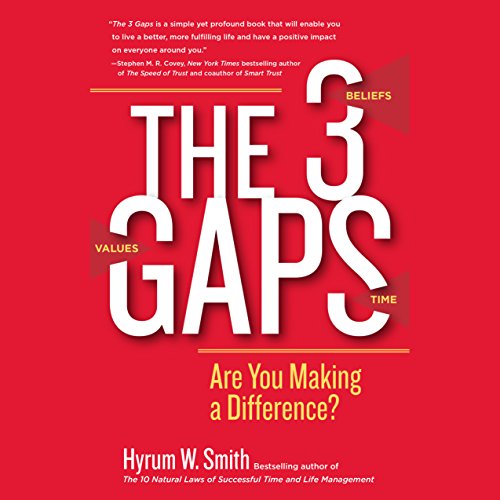
The 3 Gaps: Are You Making a Difference?
Summary
We all eventually ask ourselves the question, "Am I making a difference?" We want our lives to have meaning. We want to contribute through our work, our family relationships, and our interactions with others in our community. But just as an airline flight attendant will tell you to put your own oxygen mask on before assisting others, getting your own life together is the first step to making a positive impact on the world around you. In this new book, FranklinCovey cofounder Hyrum Smith shows that achieving a meaningful, fulfilling, and impactful life is a straightforward process. He identifies three root causes of stress, dissatisfaction, and pain, which drain the energy we need to make a difference: the gaps between where we are and where we want to be. The first is the Beliefs Gap: the gap between what we believe to be true and what is actually true. The second is the Values Gap: the gap between what we value most in life and what we actually spend our life doing. The third is the Time Gap: the gap between what we plan to do each day and what we actually get done. Using inspiring true stories of people who have overcome difficult challenges, the author offers a practical blueprint that we all can use to close each of these three gaps in our personal and work lives. He shows how this will result in the inner peace so necessary in dealing with the chaos in the world today. Smith provides the concepts and the tools to move from the life you currently have to the life you really want.
©2015 Hyrum W. Smith (P)2015 Hyrum W. Smith

You Are What You Believe
Summary
We all have times in our lives when the results of our behavior don't seem to be meeting our needs. These shortfalls may result in depression, anger, frustration, and relationship struggles, among a host of possible symptoms. It often seems difficult to see a clear path out of the problems. In this new book, Hyrum Smith does two things that are invaluable to people who wish to make their lives less painful. First, he reveals, through a clear and simple model, how we get to the place where our behaviors cause these kinds of problems. Then, with a simplicity that is impressive in itself, he describes the steps we must take to identify and rectify the beliefs leading to our painful behavior. Through the use of the "Reality Model" and the concept of the "Belief Window," illustrated through humorous anecdotes and a powerful experience at a high school, Hyrum not only lays out the intellectual framework of this model, he draws you in emotionally as well. When you are done, you will agree with him that the solution to our problems is simple. It's not easy, but it is simple. The result is a powerful process for transforming your habits, relationships, and personal and career success.
©2016 Hyrum W. Smith (P)2016 Hyrum W. Smith

Synchronicity
Summary
From Aristotle's Physics to quantum teleportation, learn about the scientific pursuit of instantaneous connections in this insightful examination of our world. For millennia, scientists have puzzled over a simple question: Does the universe have a speed limit? If not, some effects could happen at the same instant as the actions that caused them - and some effects, ludicrously, might even happen before their causes. By 100 years ago, it seemed clear that the speed of light was the fastest possible speed. Causality was safe. And then quantum mechanics happened, introducing spooky connections that seemed to circumvent the law of cause and effect. Inspired by the new physics, psychologist Carl Jung and physicist Wolfgang Pauli explored a concept called synchronicity, a weird phenomenon they thought could link events without causes. Synchronicity tells that sprawling tale of insight and creativity, and asks where these ideas - some plain crazy, and others crazy powerful - are taking the human story next. PLEASE NOTE: When you purchase this title, the accompanying PDF will be available in your Audible Library along with the audio.
©2020 Paul Halpern (P)2020 Basic Books