The Great Courses has 635 audiobooks on Listento.it, narrated by 479 narrators, with an average listener rating of 4.5★ across 19,831 ratings. The most-rated is A Column of Fire.

Neuroscience of Everyday Life
Summary
Your nervous system is you. All the thoughts, perceptions, moods, passions, and dreams that make you an active, sentient being are the work of this amazing network of cells. For many centuries, people knew this was true. But no one was sure how it happened. Now, thanks to the exciting new field of neuroscience, we can chart the workings of the brain and the rest of the nervous system in remarkable detail to explain how neurons, synapses, neurotransmitters, and other biological processes produce all the experiences of everyday life, in every stage of life. From the spectacular growth of the brain in infancy to the act of learning a skill, falling in love, getting a joke, revising an opinion, or even forgetting a name, something very intriguing is going on behind the scenes. PLEASE NOTE: When you purchase this title, the accompanying PDF will be available in your Audible Library along with the audio.
©2010 The Great Courses (P)2010 The Teaching Company, LLC

Ignite the Fire
Summary
Now in a revised, expanded, and upgraded edition, Ignite the Fire is the highly practical approach to personal training already relied on by thousands of trainers worldwide. Repeatedly called one of the "best books for personal trainers", it provides a clear road map teaching you how to become a personal trainer, to getting a personal trainer certification, to building your career from the bottom up so you can build a clientele, your reputation, and income. Have you ever wanted to know the best, high-integrity techniques to get more clients, run a fitness business, or have a solid system for selling personal training? You're not alone. For years Jon's been asked these questions so he read, watched, researched, and interviewed the best in the world to compile Ignite the Fire. This powerful book for certified personal trainers will show you how to: Find your dream job in the fitness industry Find, market to, and sell your ideal client while seamlessly dealing with objections Build amazing workouts for beginners Deal with difficult client types Develop multiple income streams while maintaining your reputation Ignite the Fire provides a clear road map to building your career from the bottom up so you can build a clientele, your reputation, and income.
©2015 Jonathan Goodman (P)2015 Jonathan Goodman

The Art of Storytelling: From Parents to Professionals
Summary
An absolute treat for the heart and mind, these 24 lectures demonstrate how to master the art of storytelling, offering insight into the process of crafting and delivering a tale to enhancing the stories you tell everyday - to your children at bedtime, in your conversational anecdotes, and in your presentations at work. Teachers, lawyers, clergy, coaches, parents, and anyone who wants to understand the power of stories to capture hearts and minds will benefit from these lessons. You'll discover practical methods for building dynamic tension and capturing - then maintaining - your audience's attention. You'll acquire tips and techniques for finding, selecting, and preparing stories, whether they're based on your own experiences, time-honored folk tales, or beloved family yarns. You'll also learn to choose expressive language, craft compelling characters, refine your narrator's point of view, shape your story's plot, structure, and emotional arc, use body language to connect with your audience, and more. Part how-to workshop, part intellectual study of the history of narrative, these lectures feature exercises that literally get you moving to develop your stories and make them more enjoyable. Professor Harvey's interactive activities and "side coaching" sessions are designed to make you comfortable enough with your story to tell it naturally and make impromptu changes as needed. You'll even learn what to do if the unexpected occurs while telling a story to a roomful of kids or giving a presentation, and about the practical considerations of using props, PowerPoint, and microphones in various scenarios. PLEASE NOTE: When you purchase this title, the accompanying reference material will be available in your Library section along with the audio.
©2012 The Teaching Company, LLC (P)2012 The Great Courses

Great Utopian and Dystopian Works of Literature
Summary
Can literature change our real world society? At its foundation, utopian and dystopian fiction asks a few seemingly simple questions aimed at doing just that. Who are we as a society? Who do we want to be? Who are we afraid we might become? When these questions are framed in the speculative versions of Heaven and Hell on earth, you won't find easy answers, but you will find tremendously insightful and often entertaining perspectives. Utopian and dystopian writing sits at the crossroads of literature and other important academic disciplines such as philosophy, history, psychology, politics, and sociology. It serves as a useful tool to discuss our present condition and future prospects - to imagine a better tomorrow and warn of dangerous possibilities. To examine the future of mankind through detailed and fascinating stories that highlight and exploit our anxieties in adventurous, thought-provoking, and engaging ways. From Thomas More's foundational text Utopia published in 1516 to the 21st-century phenomenon of The Hunger Games, dive into stories that seek to find the best - and the worst - in humanity, with the hope of better understanding ourselves and the world. Great Utopian and Dystopian Works of Literature delivers 24 illuminating lectures, led by Pamela Bedore, Associate Professor of English at the University of Connecticut, which plunge you into the history and development of utopian ideas and their dystopian counterparts. You'll encounter some of the most powerful and influential texts in this genre as you travel centuries into the past and thousands of years into the future, through worlds that are beautiful, laughable, terrifying, and always thought-provoking. PLEASE NOTE: When you purchase this title, the accompanying reference material will be available in your Library section along with the audio.
©2017 The Teaching Company, LLC (P)2017 The Great Courses

The Art of Critical Decision Making
Summary
Learn to approach the critical decisions in your life with a more seasoned, educated eye with this fascinating 24-lecture series that explores how individuals, groups, and organizations make effective decisions. The heart of this accessible series is a thorough examination of decision making at three key levels. First, you'll look at decisions made at the individual level, where, among the many things you'll learn is that intuition is more than just a gut instinct and, in fact, represents a powerful pattern recognition capability. Then, you'll explore decisions made at the group level, where you'll try to answer the question of whether groups are "smarter" and more capable of making critical decisions than individuals. And finally, you'll pull back to analyze organizational decision making, in which Professor Roberto demonstrates how some organizations have encouraged and reliably performed vigilant decision making in the face of risky scenarios. Whether you're the head of a Fortune 500 company, a government agency, or an everyday household, you constantly make decisions important to you and those immediately around you. These lectures offer you a toolbox of practical knowledge and skills that you can apply to various decisions - whether large or small - in your everyday life and work. Professor Roberto's lively lectures are packed with useful anecdotes, tools, and advice designed to improve your own ability to make informed decisions. As you explore the intriguing process of making a good decision, you'll strengthen your grip on individual theories of decision making and the situations that illustrate them. PLEASE NOTE: When you purchase this title, the accompanying reference material will be available in your Library section along with the audio.
©2009 The Teaching Company, LLC (P)2009 The Great Courses

Thinking about Capitalism
Summary
In these 36 engaging lectures, Professor Muller takes you deep inside the perspectives on this most important and pervasive force. You'll gain fresh insights that will strengthen your understanding of capitalism's rich history, its fascinating proponents and opponents, and its startling impact on our world. These lectures take you beyond economic analysis to look at how some of the greatest intellects have thought about capitalism and its moral, political, and cultural ramifications. Covering capitalism from its 17th-century beginnings to today's era of globalization, Professor Muller explores some wide-ranging questions. What effect does capitalism have on personal development? What about the seemingly unending variety of consumer goods made possible by capitalism? Do the facts support our tendency to think about capitalism as the economic system practiced in "free" countries? Or can capitalism exist in a wide variety of political systems? These are just a few of the many provocative and absorbing questions and issues you'll untangle here. By placing capitalism in its full societal context, these lectures will enhance your ability to consider, discuss, and answer these and other critical questions - whatever your point of view. Genial and disarming, Professor Muller connects the dots from idea to idea, thinker to thinker, and helps you finally grasp the history and the concepts of this vital economic system, as well as its importance on the global economic stage and in your own life. PLEASE NOTE: When you purchase this title, the accompanying reference material will be available in your Library section along with the audio.
©2008 The Teaching Company, LLC (P)2008 The Great Courses

Lifelong Health: Achieving Optimum Well-Being at Any Age
Summary
We all want to discover the secret to a long and healthy life. But how do you incorporate the secrets of personal wellness into the unique demands of your own schedule? What information would a knowledgeable and compassionate family physician offer someone looking for a reference guide to healthy living? These 36 comprehensive lectures offer you practical and expert advice that allows you to make your own personalized choices about healthy living, as well as ways to apply that knowledge to your lifestyle. With this course, you'll nourish your body, strengthen your mind, and forever change the way you think about and live your life. Professor Goodman teaches you about the six fundamentals of personal well-being: aging, nutrition and whole foods, movement, mental health, specific health issues, and general health choices. These fundamentals offer a well-rounded and engaging survey of the concepts, issues, and lessons of lifelong health. Professor Goodman's advice is rooted in scientific information and proven results - without bogging you down in complex terminology or theories. More importantly, it is flavored with commonsense tips, helpful advice, and inspirational stories that make lifelong health both appealing and achievable. Crafted with the concerns of everyone in mind, whether you're in adolescence or advancing age, this wonderful resource is the perfect way to take those first steps on the road to becoming a better, healthier you. PLEASE NOTE: When you purchase this title, the accompanying reference material will be available in your Library section along with the audio.
©2010 The Teaching Company, LLC (P)2010 The Great Courses
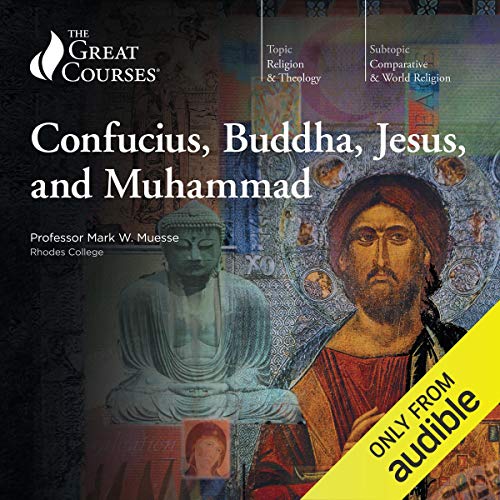
Confucius, Buddha, Jesus, and Muhammad
Summary
No understanding of human life, individual or collective, could be complete without factoring in the role and contribution of these history-shaping teachers. Now, this 36-lecture series takes you deep into the life stories and legacies of these four iconic figures, revealing the core teachings, and thoughts of each, and shedding light on the historical processes that underlie their phenomenal, enduring impact. Speaking from multilevel personal experience with these teachings, Professor Muesse leads you in an inquiry with a dynamic double thrust. First, you'll get the chance to reflect in depth on the most essential values of spirituality and the art of living, seen from four archetypal perspectives. Second, you'll delve into the historical contexts and individual lives of the four sages, and how the religious and philosophical traditions we associate with them came into being. The lectures serve as a unique window on the origins of these traditions, through their focus on the teachings, actions, and historical roles of the sages who inspired them. In uncovering the original wisdom and practices of each sage, you'll grapple with key questions. How did each man understand the nature of the universe? How did each envision the human self? What did they each see as the path to true self-realization? In words reflecting profound and compassionate insight, these lectures bring the teachings vividly alive as they speak to their essential purpose and as they shed light on the choices we all face, moment by moment, in living deliberately and savoring life to the fullest. PLEASE NOTE: When you purchase this title, the accompanying reference material will be available in your Library section along with the audio.
©2010 The Teaching Company, LLC (P)2010 The Great Courses

The History of the United States, 2nd Edition
Summary
This comprehensive series of 84 lectures features three award-winning historians sharing their insights into this nation's past - from the European settlement and the Revolutionary War through the Civil War, 19th-century industrialization, two world wars, and the present day. While American history spans not much more than two centuries, it is filled with a wealth of leaders, wars, movements, inventions, and ideas - each of which contributed in its own unique way to America's transformation from 13 disparate colonies on the east coast of North America into a global superpower. These lectures give you the opportunity to grasp the different aspects of our past that combine to make us distinctly American, and to gain the knowledge so essential to recognizing not only what makes this country such a noteworthy part of world history, but the varying degrees to which it has lived up to its ideals. The lectures chart the five predominant themes that run throughout the chronicle of U.S. history: The American passion for freedom-including religious, political, and economic freedom. The pursuit of education, which has been the quintessential way for Americans to invent (and reinvent) themselves. The unquestioned faith in the value of popular government. The willingness of Americans to experiment with and adapt to new environments and situations. The belief that the United States is a "city on the hill," a country the likes of which the world has never seen before. Placing familiar historical events in the context of these overarching themes will help you see American history less as a series of separate events and more as a mosaic in which everything is interconnected. PLEASE NOTE: When you purchase this title, the accompanying reference material will be available in your My Library section along with the audio.
©2003 The Teaching Company, LLC (P)2003 The Great Courses

The Industrial Revolution
Summary
From electric lights to automobiles to the appliances that make our lives easier at work and at home, we owe so much of our world to the Industrial Revolution. In this course, The Great Courses partners with the Smithsonian - one of the world's most storied and exceptional educational institutions - to examine the extraordinary events of this period and uncover the far-reaching impact of this incredible revolution. Over the course of 36 thought-provoking lectures, longtime Great Courses favorite Professor Allitt introduces you to the inventors, businessmen, and workers responsible for transforming virtually every aspect of our lives and fueling one of the greatest periods of innovation in human history. The technological achievements of this era are nothing short of astonishing. Thanks to inventions such as the steam engine and processes such as large-scale iron smelting, industrial entrepreneurs were able to mechanize labor, which allowed for a host of new efficiencies such as division of labor, mass production, and global distribution. You'll discover the science behind some of the most astounding inventions in modern history, including the spinning jenny, the incandescent light bulb, and the computer processor. You'll learn how these inventions came about and consider what effects these technologies had on every aspect of human life. Get an inside look at the history of industrial innovation and explore the lives of engineers, inventors, architects, and designers responsible for changing the world - as well as ordinary workers who lost their livelihoods to new technologies and suffered from unsafe working conditions. The story of the Industrial Revolution is complex, and these lectures will leave you with a new appreciation for the amazing human achievements all around us. PLEASE NOTE: When you purchase this title, the accompanying reference material will be available in your Library section along with the audio.
©2014 The Teaching Company, LLC (P)2014 The Great Courses

Ancient Empires before Alexander
Summary
Complete your knowledge of the ancient world with this comprehensive look at the dozen empires that flourished in the 2,000 years before the conquests of Alexander the Great. Over the course of 36 insightful lectures, you'll follow the Egyptians, the Mycenaean Greeks, the Persians, the Carthaginians, and others as they rise to glory, create administrative and military structures, clash with one another, and eventually collapse. Professor Dise immerses you in the political, administrative, and military details of these thrilling civilizations, analyzing three basic questions: How did this particular empire emerge? How was it governed and defended? How and why did it ultimately fall? These questions raise a host of profound issues on the growth, development, and failures of vast imperial systems. Grounded in a chronological approach, you'll find no better guide through the palatial halls, administrative offices, and war-torn battlefields of these empires than Professor Dise. Each lecture is packed with a range of rich sources on which our current understanding of the ancient Near East rests, including cuneiform tablets, colorful narratives, and archaeological remains. As you comb through these intriguing records, you quickly become more informed about how the past is recorded and passed down to subsequent generations. Spanning thousands of years of human history and encompassing regions both familiar and forgotten, this course is a remarkable tour through the farthest reaches of the ancient world - in all its marvelous diversity.
©2009 The Teaching Company, LLC (P)2009 The Great Courses
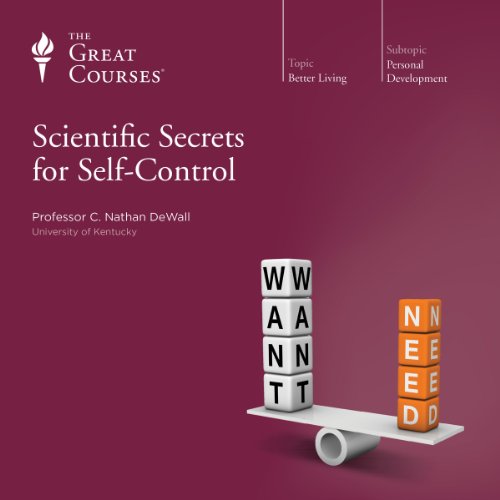
Scientific Secrets for Self-Control
Summary
Join an expert in self-control research for six engaging and inspirational lessons that shatter the myths about willpower and replace them with verifiable science that can make the seemingly unattainable finally possible. Packed with eye-opening studies, experiments, and exercises to strengthen your self-control when dealing with money, fitness, personal relationships, and more, this course will have you wondering why you ever doubted yourself. Whether you're looking for new ways to resist temptation, make a strong first impression, or better control your emotions, this is your guide to understanding—and mastering—what is a frequently misunderstood subject. In clear language, your award-winning professor introduces you to the general theories behind self-control: what it is, how it works, and how you can take steps to improve it. Among the topics you'll investigate: How researchers discovered that delayed gratification can lead to better individual well-being in everything from higher self-worth to less sensitivity to rejection One of the most influential theories about how self-control works - the limited resource model, which argues that self-control relies on limited energy that becomes depleted after use How scientists discovered the link between the prefrontal cortex and aggression, and how people at risk for violent anger show abnormalities in that region of the brain. Alongside groundbreaking scientific findings and research, you'll get personal exercises, activities, and thought experiments you can use to practice strengthening your self-control skills to meet whatever specific goals you want to achieve. Disclaimer: Please note that this recording may include references to supplemental texts or print references that are not essential to the program and not supplied with your purchase.
©2013 The Teaching Company, LLC (P)2013 The Great Courses

Crashes and Crises: Lessons from a History of Financial Disasters
Summary
Professor Connel Fullenkamp of Duke University guides listeners through four centuries of economic disasters - from tulip mania in the 1600s to the Great Recession of 2007-2009. Each of his 24 lectures covers a notable incident of financial misfortune or folly that is worthy of a Hollywood thriller. You hear how Charles Ponzi conducted the moneymaking scam that bears his name; how mining companies in the Old West sprang up like Internet start-ups, with a similar imbalance of winners and losers; how hyperinflation destroyed Germany’s economy at the beginning of 1920s and how its resulting stock market crash nearly sank America’s stock market. You also hear how the Great Depression deepened through a wave of bank panics; how, in more recent times, the US savings and loan industry went belly-up; how Orange County in California went bankrupt, how Japan’s hard-charging economy came to a screeching halt; how currency crises swept the globe; how subprime mortgages nearly sparked a second Great Depression; and much more. You also learn how technology has transformed stock trading, how cryptocurrencies work, and why we live in an era of financial instability. As well as entertaining you with riveting stories, Professor Fullenkamp inoculates you against the gullibility, overconfidence, and herd mentality that have trapped even Wall Street professionals in misguided investments that lost billions. You won’t have any trouble staying awake through these stimulating lectures. And, armed with the knowledge of how to stay out of harm’s way, you may even sleep better at night. PLEASE NOTE: When you purchase this title, the accompanying PDF will be available in your Audible Library along with the audio.
©2018 The Teaching Company, LLC (P)2018 The Great Courses

Foundations of Western Civilization II: A History of the Modern Western World
Summary
Beginning with the Renaissance, the culture of the West exploded. Over the next 600 years, rapid innovations in philosophy, technology, economics, military affairs, and politics allowed what had once been a cultural backwater left by the collapse of the Roman Empire to dominate the world. This comprehensive series of 48 lectures by an award-winning teacher and captivating lecturer will show you how - and why - this extraordinary transformation took place. As you listen to the series, you'll begin to grasp not only the history of Western civilization, but the meaning of civilization itself, as this grand narrative of the past five centuries creates a coherent context for the period's events and trends, and offers an analysis of what these five centuries have bequeathed to us. Lecture by lecture, you'll explores the ideas, events, and characters that modeled Western political, social, religious, intellectual, cultural, scientific, technological, and economic history between the 16th and 20th centuries. You'll learn how Western civilization was shaped by the low as well as the mighty, the practical as well as the artistic. You'll gain a larger understanding of the political, social, and cultural events that shaped Europe. And you'll explore the ramifications of these epoch-making events on the rest of the world, including the United States. PLEASE NOTE: When you purchase this title, the accompanying reference material will be available in your My Library section along with the audio.
©2006 The Teaching Company, LLC (P)2006 The Great Courses

iRest: Integrative Restoration Yoga Nidra for Deep Relaxation
Summary
The form of research-based meditation known as Integrative Restoration (or iRest®) has helped special operations troops improve their resiliency, executives manage stress, cancer patients cope with pain, and trauma survivors experience safety and healing. Now, bring the practice right into your life and home in these 24 classes. Alternating between the theoretical and experiential, between the philosophical and the scientific, these classes guide you through each of the 10 vital steps of the iRest Yoga Nidra practice. You’ll also enjoy specialized sessions that examine how iRest Yoga Nidra can help you with improving your sleep habits, relieve short-term and chronic pain, manage stressors in work and life, and heal from traumatic injuries or experiences. Also, enjoy a variety of short- and long-form iRest Yoga Nidra practice sessions you can dive into either in the context of other classes or on their own. With the care, consideration, and guidance you’d expect from a master meditation teacher, Ms. Birkholm helps you with proper positioning, sensing your body, discovering uncaused joy, cultivating your inner resource, and more. The result is an integrated learning experience that invites you to participate in guided meditation techniques that have been adopted by large corporations and the US Department of Defense. Crafted with joy, peace, and wisdom, these classes are an empowered (and empowering) tool with the potential to reshape the way you react to the world. PLEASE NOTE: When you purchase this title, the accompanying PDF will be available in your Audible Library along with the audio.
©2018 The Great Courses (P)2018 The Teaching Company, LLC
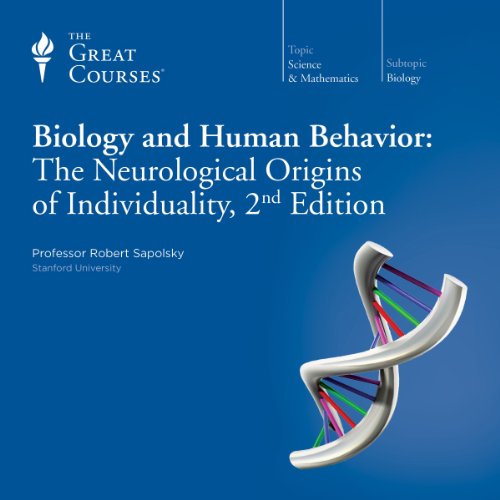
Biology and Human Behavior: The Neurological Origins of Individuality, 2nd Edition
Summary
When are we responsible for our own actions, and when are we in the grip of biological forces beyond our control? What determines who we fall in love with? The intensity of our spiritual lives? The degree of our aggressive impulses? These questions fall into the scientific province of behavioral biology, the field that explores interactions between the brain, mind, body, and environment that have a surprising influence on how we behave. In short, how our brains make us the individuals we are. In this series of 24 fascinating lectures by a prominent neurobiologist, zoologist, and MacArthur Foundation "genius" grant recipient, you'll investigate how the human brain is sculpted by evolution, constrained or freed by genes, shaped by early experience, modulated by hormones, and otherwise influenced to produce a wide range of behaviors, some of them abnormal. And you'll learn how little can be explained by thinking about any of these factors alone, because some combination of influences is almost always at work. Professor Sapolsky includes a provocative exploration of the implications of our emerging understanding of the origins of individual differences, considering such questions as: How much do these insights threaten our own sense of self and individuality? Where do we draw the line between the essence of the person and the biological abnormalities? What counts as being ill? Who is biologically impaired, and who is just different? As more and more subtle abnormalities of neurobiology are understood, how much should we worry about the temptation to label people as "abnormal"? And what happens when we each have a few of these labels? PLEASE NOTE: When you purchase this title, the accompanying reference material will be available in your Library section along with the audio.
©2005 The Teaching Company, LLC (P)2005 The Great Courses

Between the Rivers: The History of Ancient Mesopotamia
Summary
All cultures lie in the shadow of ancient Mesopotamia-the land between the Tigris and Euphrates Rivers that is now mostly encompassed by the borders of modern Iraq. In this fascinating series of 36 lectures, an award-winning teacher leads you on a vivid journey through Mesopotamian history-from Neolithic times to the age of Alexander the Great-and into the lives of mighty emperors, struggling farmers, ambitious merchants, and palace servants to reveal why this ancient culture occupies such a foundational position in our history. The lectures look back to the time when the first cities arose in Mesopotamia and kings created complex bureaucracies to rule their expanding territories, thus fostering the invention of writing and other technologies. You peer into the lives and fortunes of Mesopotamia's people and learn about the birth of the urban lifestyle. Professor Castor creates a detailed image not only of larger Mesopotamian society but of life on the level of the individual Mesopotamian as well. Among the many fascinating insights into daily Mesopotamian life you examine are how they ate, worked, learned, worshiped, married, and reared children; used scientific ideas to help them order and understand the natural world; engaged with their powerful neighbors in Egypt, Syria, and Anatolia (modern-day Turkey); waged war and experienced peace; and endured the collapse of their cities. PLEASE NOTE: When you purchase this title, the accompanying reference material will be available in your Library section along with the audio.
©2006 The Teaching Company, LLC (P)2006 The Great Courses

The Era of the Crusades
Summary
What were the forces that led to one of history's most protracted and legendary periods of conflict? How did they affect the three great civilizations that participated in them? And, ultimately, why did they end and what did they accomplish? In these 36 lectures, you'll look at the "big picture" of the Crusades as an ongoing period of conflict involving Western Christendom (we would now call it Western Europe), the Byzantine Empire, and the Muslim world. From this perspective, you'll study the complex but absorbing causes of the Crusades, which include the many political, cultural, and economic changes in Western Europe after the fall of the Roman Empire. You'll examine the Crusades in terms of the specific military campaigns-the eight "canonical" Crusades that took place from 1095-1291-proclaimed to retake Jerusalem and the Holy Land from Muslim hands and return them to Christendom. You'll consider the immediate circumstances-the leaders, purposes, key battles, and degrees of success or failure-surrounding these often-monumental expeditions. You'll also explore a wide variety of misperceptions and long-debated questions about the Crusades: Did the popes preach the Crusades as a way to increase their personal power and authority? Why did the members of the Fourth Crusade decide to sack Constantinople, turning the Crusades from Christian against "infidel" to Christian against Christian? Taken together, these historically rich lectures are an opportunity to appreciate fully how Western Civilization changed in many profound ways during the Crusading era. PLEASE NOTE: When you purchase this title, the accompanying reference material will be available in your Library section along with the audio.
©2003 The Teaching Company, LLC (P)2003 The Great Courses

Bach and the High Baroque
Summary
Though unappreciated in his own time, Johann Sebastian Bach has ascended to Olympian heights, the verdict of contemporary audiences long since overruled by succeeding generations of music lovers. But what makes his music great? In this series of 32 lectures, a working composer and musicologist brings his exceptional teaching skills to the task of helping you hear the extraordinary sweep of Bach's music. You'll understand the compositional language that enabled him to compose such extravagant, unbridled music while still maintaining precise control of every aspect - beat, melody, melodic repetition, interaction, and harmony. Whether devoted admirer or casual listener, you'll gain a new appreciation of the composer and a heightened skill at listening to his work. You begin by learning the musical traditions and composers that inspired Bach, and how he absorbed those influences to become the transcendent composer of the High Baroque, more representative of the period and its aesthetic of emotional extravagance and technical control than any other. And you'll learn how both his German Lutheran heritage and family background - at least 42 relatives professionally involved with music - helped shape him as an artist. Above all, though, you experience an abundance of music, with Professor Greenberg highlighting his discussions by playing major excerpts from several of Bach's most important works - including the Brandenburg Concerto no. 2, the Goldberg Variations, and the Toccata and Fugue in D Minor - and also showing you how to compare Bach with other composers both before and after his time. PLEASE NOTE: When you purchase this title, the accompanying reference material will be available in your Library section along with the audio.
©1995 The Teaching Company, LLC (P)1995 The Great Courses

The Art of War
Summary
Sun Tzu's The Art of War is a landmark achievement in the evolution of strategic thought. So universal and timeless are its tactics for pursuing a competitive advantage that some of the most notable people in government, sports, and the entertainment world have all quoted from its nearly 2500-year-old pages. These six expertly crafted lectures explore this classic's wisdom for staying nimble in an ever-changing environment and for maximizing reward while minimizing risk remains eternally fresh. As war and business become more mental and less physical, human intellect plays an ever greater role in competition-making Sun Tzu's strategies highly relevant to the information age. Through a precise explanation of the original text and case studies, Professor Wilson examines how the seminal work's model of leadership has been applied-and misapplied-throughout the realms of war, politics, business, and beyond. You'll study the text's historical framework and then delve into the critical calculations that must be made prior to war-what Sun Tzu refers to as knowing the enemy, knowing ourselves. By studying real-world examples, you'll come away understanding the qualities effective commanders must possess and the work's practical implications for outmaneuvering competitors in daily life. By taking this course, you will appreciate Sun Tzu's content on a far deeper level. Disclaimer: The views expressed in this course are those of the professor and do not necessarily reflect the position or policy of the U.S. Navy, the U.S. Department of Defense, or the U.S. government. Disclaimer: Please note that this recording may include references to supplemental texts or print references that are not essential to the program and not supplied with your purchase.
©2012 The Teaching Company, LLC (P)2012 The Great Courses